Fecal Flotation
You can do basic fecal exams at home, specifically looking for coccidia, round-, hook-, whipworms. Use your veterinarian and a lab for giardia to confirm diagnoses until you are comfortable doing your own fecal floats. Labs like Idexx now offer antigen testing, which are great for giardia and can be used to confirm round, hook and whipworms in
tough cases.
What You Will Need
Something to collect the feces, fecal flotation medium or solution, a microscope, microscope slides and cover slips. I’ve never centrifuged for my fecals although folks have mentioned it.
I use Fecalyzers and buy them by the dozens. They are inexpensive and make doing fecals easier.
You can make fecal solution at home but at least in the US, it’s very inexpensive. Fecal solution causes the eggs to float to the top, hence the term fecal flotation.
Hopefully you have microscope slides and cover slips for your vaginal cytology.
You need a microscope with 40x and 100x and, possibly, 400x but at that point you are buying a pretty expensive scope. 40x and 100x should be enough. Once you are good, you can use 1000x, too, but you can also leave that to your vets. Read the reviews as you pick your scope. Good optics and functionality will make your life much easier
Finally, you need visuals to help you identify the eggs. I’d recommend a book and websites. Book graphics are clearer but there aren’t many cheap ones. I use a vet version but this vet tech book looks great. If you get it, let us know what you think. You need a picture guide to compare what you are seeing on the slide to what each parasites’ eggs look like so you can properly treat. Most importantly, you need to distinguish coccidia from hook/whip/roundworms so you treat with the correct dewormer. If you want to check for coccidia, you’ll need another flotation solution called Sheather’s Sugar solution.
You can do basic fecal exams at home, specifically looking for coccidia, round-, hook-, whipworms. Use your veterinarian and a lab for giardia to confirm diagnoses until you are comfortable doing your own fecal floats. Labs like Idexx now offer antigen testing, which are great for giardia and can be used to confirm round, hook and whipworms in tough cases.
Now, What Do You Do?
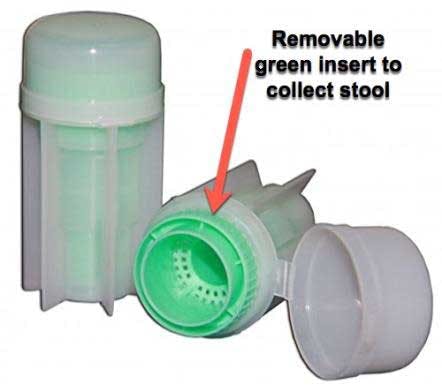
- Collect feces with the Fecalyzer. Fresh is best! Diarrhea is fine. Flip the Fecalyzer cap back and remove the green insert. Press the round, narrow end of the green insert into the stool. Collect from a few stools if you want. Try to fill the narrow tube at the end.
- Put the green insert back into the white case and push it down until you can close the lid again.
- Remove the lid again and fill the Fecalyzer 1/2 to 2/3rds of the way with flotation solution. My Fecalyzers have a line on them telling me how far to fill it.
- Rotate the green insert several times, which causes the eggs to float to the surface.
- Push the green insert down to lock it into position.
- Fill the Fecalyzer the rest of the way until a dome of liquid forms (that’s called the meniscus).
- Place a microscope cover slip on the miniscus and leave it for 20 minutes. 8. After the wait, place the cover slip on a microscope slide, wet-side down. 9. Look at the slide under the microscope.
Resources
Supplies
- Fecalyzers — collect stool samples
- fecal flotation medium or solution — floats the parasite for viewing
- microscope
- microscope slides and cover slips
- Sheather’s Sugar solution — specific flotation solution for Coccidia
- Diagnostic Parasitology for Veterinary Technicians — great book for parasite pictures
Websites
- The Pet Informed website has some great info here: Pet Informed Veterinary Advice Online — Fecal Flotation
- This website is also great: Pet Informed Fecal Float (Fecal Flotation) Parasite Pictures Gallery
Videos
Here are some videos for those who like to watch and learn:
- Using the Fecalyzer: https://www.youtube.com/watch?v=3Gxk7jFSeWM
- Prepping the fecal flotation: https://www.youtube.com/watch?v=qd1Ny88zgM8
- Examining a fecal with the microscope: https://www.youtube.com/watch?v=go_BbP4_Fz8
Books
This book is a good resource: Diagnostic Parasitology for Veterinary Technicians


