Good Dog’s Policy on Merles
We established our Merle Policy to provide a framework for working towards population-wide improvements, which are a critical part of our mission.
Good Dog is on a mission to educate the public, support dog breeders, and promote canine health so we can give our dogs the world they deserve.
Good Dog is on a mission to educate the public, support dog breeders, and promote canine health so we can give our dogs the world they deserve.
Good Dog is on a mission to educate the public, support dog breeders, and promote canine health so we can give our dogs the world they deserve.
We established our Merle Policy to provide a framework for working towards population-wide health improvements in dogs, which are a critical part of our mission.
What is a merle dog?
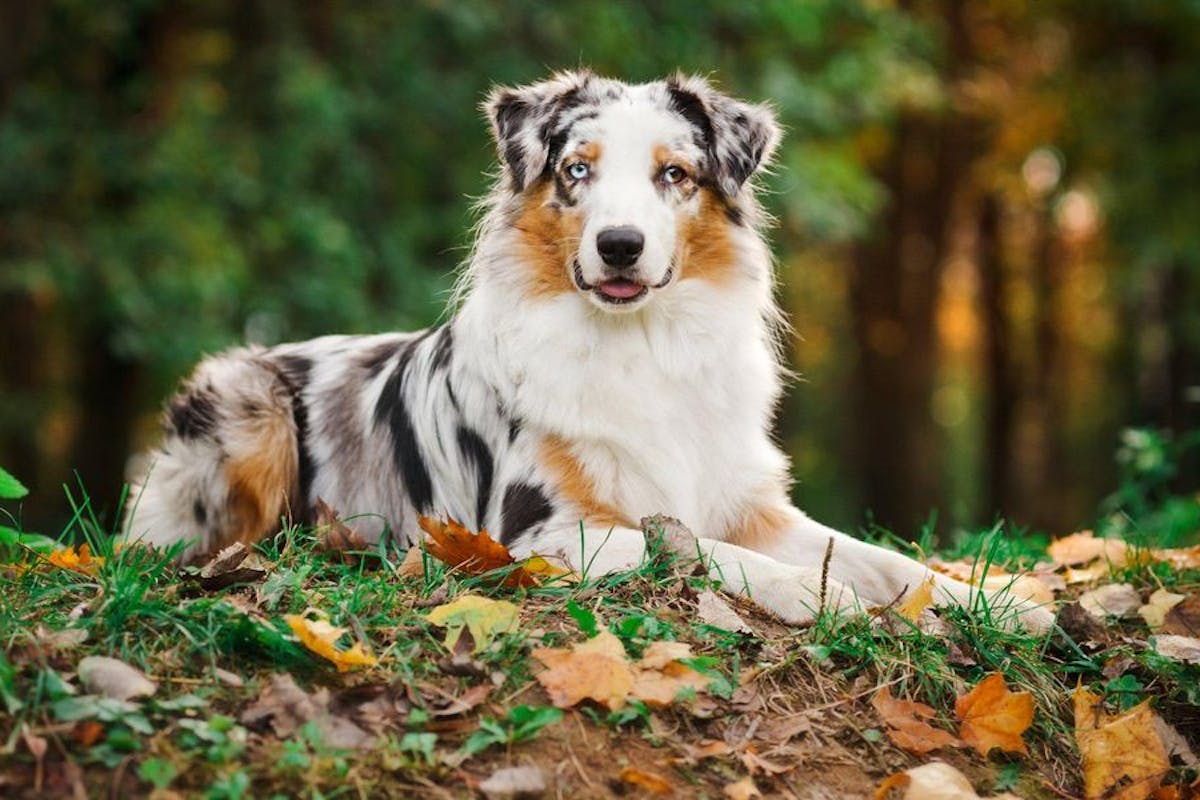
Merle refers to a pattern found in a dog’s coat, caused by a variant on the M locus of the PMEL gene. This unique pattern is typically made up of mottled, patchwork markings in either a solid or piebald coat that has black or brown as a base color. Merle coats come in a range of colors, and variations in patterns and patching. Merle dogs often have blue eyes or heterochromia (two differently-colored eyes) and differing skin pigments.
The merle allele on the PMEL gene does not always result in the merle pattern. Cryptic (also known as hidden or phantom) merles are dogs with the merle gene, but who have little or no merle patterning.
What is Good Dog’s policy on merles?
Good Dog accepts merles if the breed is one in which the merle gene is known to occur, the pattern is a characteristic of the breed, or it is considered part of the breed standard. Good Dog does not accept merles if the breed is one in which the merle gene is not known to occur, the pattern is not a characteristic of the breed, or it is not considered part of the breed standard. [Jump to our list of breeds in which merle is part of the standard.]
This policy applies to all dogs listed on Good Dog - whether they are breeding dogs, puppies, or adult dogs - regardless of whether or not you bred them yourself.
In the absence of a breed standard, such as with some new breeds and crossbreeds, Good Dog will work with a breeder individually to learn more about testing history. Our team may ask you about the following:
DNA Testing to Avoid Breeding Double-Merles.
All merle breeding dogs and all dogs bred to merle breeding dogs should be DNA tested to determine if a dog carries the merle allele for the PMEL gene, to ensure that two merles are not bred together.
Avoid Breeding Hidden Merles.
Merles should not be purposefully crossed with colors or patterns that will produce hidden merle puppies, which include sable, cream, ee/recessive red, or brindle.
Breeders should also test for the size (length) of the merle allele, which influences the expression of the merle pattern (whether a merle is phantom or not). Currently, this test is only available at a small number of laboratories (Paw Print Genetics, UC Davis).
Avoid Breeding Merles with Piebald or White Dogs.
To reduce the likelihood of producing dogs with vision and hearing problems, merles should not be bred into lines that carry piebald (white dogs with spots) or extreme white spotting patterns (dogs that are mostly white with minimal spotting). Merles should only be bred to dogs that have up to 33% (1/3) white coats, such as a typical Irish marking pattern (typically a white collar, legs and tail tip).
Recommended Additional Health Testing of Breeding Dogs & Puppies
We recommend CERF and BAER testing for all merle breeding dogs and puppies produced from a merle parent dog. Breeding dogs should be tested before being bred and puppies should receive annual testing.
Why is Good Dog taking this approach?
The merle gene is associated with an increased risk for some serious health conditions, including, among others, deafness and blindness.
We established our community standards to offer a framework for working towards population-wide health improvements, which are a critical part of our mission. We note that our community standards, including our policy with respect to merles, are subject to continual revisions as new research and evidence becomes available.
Feedback
Our community is founded on a commitment to listen, learn, and as with so many issues in the dog world, sometimes people have very different opinions and it can take time for us to determine what makes sense for our community. If you have any questions for us, please feel free to contact us anytime at help@gooddog.com.
Breeds with merle in the breed standard, currently accepted on Good Dog:
- Alapaha Blue-Blood Bulldog
- Australian Shepherd
- Beauceron
- Bergamasco Sheepdog
- Border Collie
- Cardigan Welsh Corgi
- Catahoula Leopard Dog
- Chihuahua
- Cockapoo
- Collie (Rough and Smooth)
- Dachshund (Dapple)
- Goldendoodle
- Great Dane (Merle and Harlequin)
- Hungarian Mudi
- Miniature American Shepherd
- Miniature Australian Shepherd
- Norwegian Dunker
- Old English Sheepdog
- Pomeranian
- Pyrenean Shepherd
- Shetland Sheepdog
Note: this list may be incomplete.
Reference & further reading
Ballif B, C, Ramirez C, J, Carl C, R, Sundin K, Krug M, Zahand A, Shaffer L, G, Flores-Smith H. The PMEL Gene and Merle in the Domestic Dog: A Continuum of Insertion Lengths Leads to a Spectrum of Coat Color Variations in Australian Shepherds and Related Breeds. Cytogenet Genome Res 2018;156:22-34. https://www.karger.com/Article/Pdf/491408
Clark LA, JM Wahl, CA Rees, KE Murphy. Retrotransposon insertion in SILV is responsible for merle patterning of the domestic dog. Proceedings of the National Academy of Sciences Jan 2006, 103 (5) 1376-1381. https://www.ncbi.nlm.nih.gov/pmc/articles/PMC1360527/pdf/pnas-0506940103.pdf
Langevin M, H Synkova, T Jancuskova, S Pekova. Merle phenotypes in dogs - SILV SINE insertions from Mc to Mh. PLoS One. 2018;13(9):e0198536. Published 2018 Sep 20. https://www.ncbi.nlm.nih.gov/pmc/articles/PMC6147463/pdf/pone.0198536.pdf
Murphy, S and Clark, LA. The genetics of merle coat patterns in dogs. 2018. https://blogs.biomedcentral.com/on-biology/2018/08/03/the-genetics-of-merle-coat-patterns-in-dogs/
Murphy SC, Evans JM, Tsai KL, Clark, LA. Length variations within the Merle retrotransposon of canine PMEL: Correlating genotype with phenotype. Mobile DNA. 2018, 9:26. https://mobilednajournal.biomedcentral.com/track/pdf/10.1186/s13100-018-0131-6
Pelles Z, A Gáspárdy, L Zöldág, X Lénárt, N Ninausz, L Varga, P Zenke. Merle allele variations in the Mudi dog breed and their effects on phenotypes. Acta Veterinaria Hungarica. 2019, 67:2, 159-173 https://akademiai.com/doi/pdf/10.1556/004.2019.018
Strain, G. Hereditary Deafness in Dogs and Cats: Causes, Prevalence, and Current Research. https://www.vin.com/apputil/content/defaultadv1.aspx?pId=11165&id=3848661
UC Davis Veterinary Genetics Laboratory https://www.vgl.ucdavis.edu/services/dog/Merle.php
Last modified: November 26th, 2024
Join our Good Breeder community
Are you a responsible breeder? We'd love to recognize you. Connect directly with informed buyers, get access to free benefits, and more.