Guide to Trademarks
Learn about the types of trademarks available and how to register your trademark.
Good Dog is on a mission to educate the public, support dog breeders, and promote canine health so we can give our dogs the world they deserve.
Good Dog is on a mission to educate the public, support dog breeders, and promote canine health so we can give our dogs the world they deserve.
Good Dog is on a mission to educate the public, support dog breeders, and promote canine health so we can give our dogs the world they deserve.
Disclaimer: This article is provided for general information purposes only, and shall not be construed as trademark/legal advice. We would recommend connecting with a trademark attorney in your state if you are able. Good Dog expressly disclaims all liability in respect of actions taken or not taken based on any or all of the contents in this article.

A trademark is how customers recognize and distinguish you from your competitors. It can be almost anything that identifies the source of your goods or services, like words, symbols, and designs. As a breeder, you might be considering trademarking the name of your breeding program. This name is a key component of your brand, and, though not necessary, you may decide you would like to protect it with a registered trademark.
Do I have to register my trademark?
No, you do not need to register your trademark in order to use it, but by registering you gain wider protections. Options to register your trademark include state, federal and international protection:
- State trademark registration - creates rights in that state only, but you can register in more than one state
- Federal trademark registration - creates rights throughout the entire United States and its territories
- International trademark protection - allows protection in a non-US country, just as if that office had registered it
If you decide to register your trademark at the federal level through the United States Patent and Trademark Office (USPTO), you should make sure your mark can be registered by searching for others who may have already registered a similar mark. The more unique the trademark, the easier it will be for you to register it. Investigating whether your mark is available for use and qualifies for registration can help ensure your trademark will be a protected part of your breeding business for years to come.
Should you decide not to register your trademark, you may rely on common law rights. Common law rights protection is based solely on using your trademark in commerce within a particular geographic area, meaning that you might only be able to enforce your trademark rights for the specific area where your trademark is used.
What is the advantage of registering a trademark?
Registering your trademark at the state or federal level prevents other people from using your business name in the same industry. If someone infringes on your trademark, it is much easier to defend and show proof of ownership if it is registered. A registered trademark may use the Ⓡ symbol.
Unregistered trademarks may use the “™” symbol. People or businesses that use unregistered trademarks could potentially be forced to change their trademark and also could face liability for infringement if someone else has the same or very similar trademark. Trademark infringement is when someone is using a trademark without authorization and the use of the mark causes confusion, deception, or mistake about the source of the goods and/or services. Trademark owners who find their mark has been infringed upon may choose to file a civil action (i.e., lawsuit) in either state court or federal court for trademark infringement, depending on the circumstances. If you find yourself on either side of a trademark infringement, you might consider retaining a trademark attorney in your area for assistance.
What is the process to register a trademark?
The U.S. Patent and Trademark Office (USPTO) divides marks into 45 different "classes" of products or services to allow different types of businesses to register their trademarks into categories most related to their business. You can search the USPTO’s classification list to find out how the USPTO classifies a breeding program.
The length of time required to register a trademark varies from trademark to trademark and is determined by a number of factors, but the typical length of time is 12 to 18 months. It is worth noting that not all trademarks are approved and they can be rejected for a variety of reasons, such as sound, appearance or meaning of the trademark.
Although you can complete the trademark registration process on your own, contacting a trademark attorney in your area to assist you with the process has several benefits, including:
- Offering important legal advice about your trademark.
- Running a clearance search on your trademark before you file an application to see if your trademark is available to be registered.
- Application preparation.
- Corresponding with USPTO regarding legal information.
- Maintaining and enforcing your trademark rights.
- Representation at the USPTO’s Trademark Trial and Appeal Board, should you need it.
- Protection from fraudulent solicitations.
The steps to register a trademark are generally as follows:
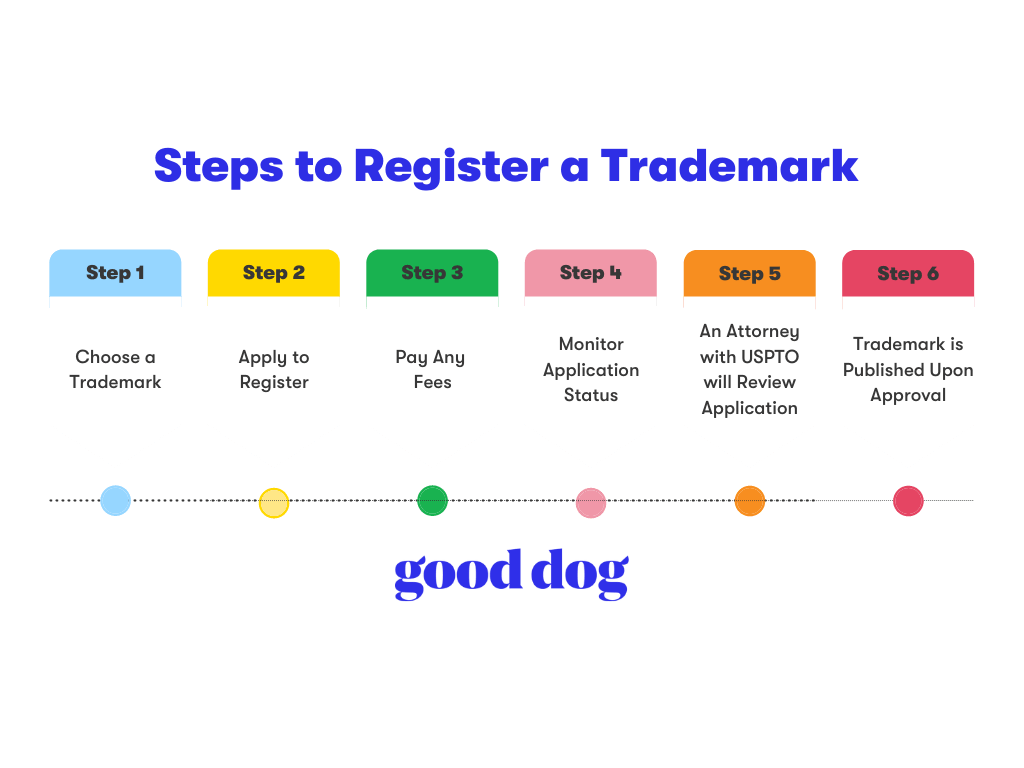
Click photo above to enlarge.
- Determine what you want to trademark.
- Apply to register your trademark. You can apply online to register your trademark directly on the USPTO's website.
- Pay any associated fees with your application.
- Monitor your application status. It is helpful to keep an eye on your status throughout the entire process.
- The USPTO then assigns your application a serial number and a trademark examining attorney who will review your application and decide if there are any issues with your application. If there are any issues the attorney will let you know through an “office action” which then will require you to respond.
- If your trademark is approved by the examining attorney it will typically then be published. There is then a 30-day period during which any member of the public who thinks they’ll be harmed by the registration of your trademark may oppose it. Following the 30-day publication period, you should receive notification of registration status in three-four months.
Fees involved in registering a trademark
The Trademark Electronic Application System (TEAS) has one initial application form with two filing options:
- The TEAS Plus - more requirements upfront when you submit your initial application. As a result, you pay a lower fee per class of goods/services.
- The TEAS Standard - fewer requirements upfront. However, you must eventually meet all the application requirements and pay a higher fee per class of goods/services.
Key differences when selecting your filing option:
Filing fees:
- TEAS Plus: Pay $250 per class of goods/services.
- TEAS Standard: Pay $350 per class of goods/services.
When you pay fees:
- TEAS Plus: Pay all application filing fees with your initial application.
- TEAS Standard: Pay one application filing fee with your initial application and the rest later in the process.
Disclaimer: This article is provided for general information purposes only, and shall not be construed as trademark/legal advice. We would recommend connecting with a trademark attorney in your state if you are able. Good Dog expressly disclaims all liability in respect of actions taken or not taken based on any or all of the contents in this article.
Join our Good Breeder community
Are you a responsible breeder? We'd love to recognize you. Connect directly with informed buyers, get access to free benefits, and more.