Traveling With Your Pup
Learn how to safely and happily drive with you pup!

By
Good Dog is on a mission to educate the public and make it simple for people to get dogs from good sources and for reputable breeders, shelters and rescues to put their dogs in good homes.
Good Dog is on a mission to educate the public and make it simple for people to get dogs from good sources and for reputable breeders, shelters and rescues to put their dogs in good homes.
This summer I have logged over 7,300 miles in the van with my dogs (and another 7,000 miles without the dogs) so travel is on my mind. Many people have emailed me about how easily my dogs travel so I thought I would share some of the things I do to make sure trips with my buddies are safe and fun. Whether you want to go near or far, these suggestions should help you. I will post Part 2 later this week.
Good Dog is on a mission to educate the public and make it simple for people to get dogs from good sources and for reputable breeders, shelters and rescues to put their dogs in good homes.
Top Tips For Traveling With Your Dog
I teach my dogs to love the car
I start taking my puppies on car trips before they are 8 weeks old with short trips to fun places (NOT just the vet office for shots), usually with or to visit dog friends. We work up to longer and longer trips, till my dogs ride calmly for upwards of eight hours at a time.
If you travel a lot, teach your dog to love the car by starting with slow, short trips on straight roads, perhaps just up and down your driveway or neighborhood street.
I find the biggest mistakes people make when teaching their dog to enjoy the car are:
- Only taking their puppy or young dog in the car when going to the vet.
- Driving too far or too fast in the first few trips.
- Confining the puppy in the back of the car, away from people, too soon.
My dogs always travel with restraint
After their very first trip home, my dogs always travel in crates or with doggie seat belts, for their safety and mine. I start my pups out in small crates on the front passenger seat where I can comfort, praise and reward them during the trip. Only once they are calm during these early trips, do I move them further from me and confine them with seat belts or a larger crate in the back of the car. No matter their age, my dogs have water to drink, bones to chew on, and toys to play with if they get bored while traveling.
I keep emergency information and rabies certificates in the van
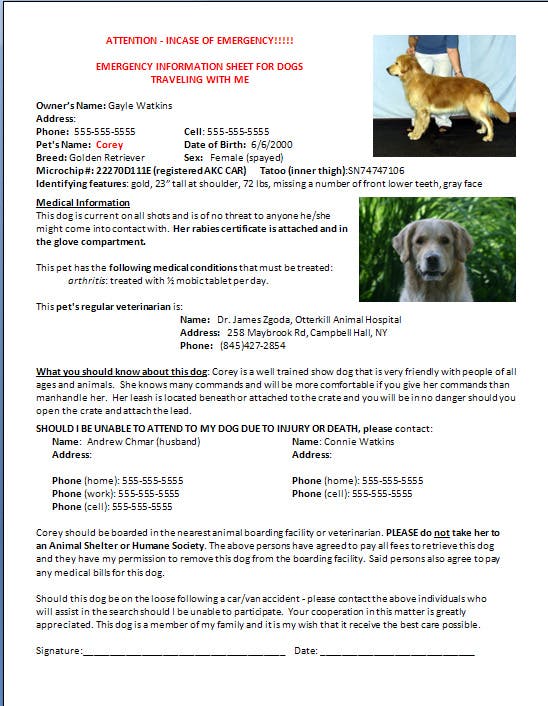
Although I do not like thinking about car accidents, they happen. I keep emergency information for my dogs on their crates and in the glove compartment just in case I am injured in an accident. The emergency information includes a description and photos of each dog, medical information, and contacts, including my vet, with phone numbers. I also carry copies of their rabies certificates stapled to the emergency information sheet.
My dogs wear ID
Although my dogs rarely wear collars at home, they always wear them while we are on the road. Each dog’s collar is embroidered or printed with a contact phone number, their microchip number, and the word “Reward.” (I use Reward to encourage whoever finds my dogs to return rather than keep them.) I get embroidered collars from:
- AKC Companion Animal Recovery–reflective collars printed with your dog’s microchip number, the CAR toll-free number and your dog’s name or “Reward”
- Orvis–nylon and leather collars and harnesses that can be personalized
- Cabela’s–nylon and leather collars that can be personalized
We find places to exercise nearly every day
Although I am tired at the end of a long day’s drive, my dogs are usually not. Most highway rest areas have pet potty spots for quick visits but few offer places for dogs to relax or run (though I found some great rest areas on I-80 in Nebraska). So how can you find places to exercise your dogs? Here are three options:
- I often ask when I check into my hotel to see if the front desk clerk knows of local parks or trails. Many know the area well and can be quite helpful.
- Most GPSs have a “Park” feature that not only enables you to find parks but gets you there, too! State and national forests are often good best for open space and trails the dogs can enjoy.
- Google “dog park” and the town you are near. Many dog parks post their rules, photos and reviews on line, which makes it easy to determine if they are worth a stop.