Your Litter A to Z, Module 6 - The Third Trimester
Day 43 Until Stage 1 Labor Begins
These courses are for educational and informational purposes only and are not a substitute for professional veterinary advice, diagnosis, or treatment. Always consult your veterinarian before making decisions about your dog's health, including administering supplements, changing their diet, or implementing training techniques that could affect their wellbeing.
A2Z Quick Links
- A2Z Calendar and Reminders
- Deworming Info
- Ca:Ph Ratio Calculator
- Safe Drugs, Pregnancy & Lactation
- Post-Natal Calcium Calculator
- A2Z Master Supplies List
Module 6 Documents
What’s In This Module
- Third Trimester Basics
- Verifying Puppy Counts
- Care, Nutrition
- Fitness
- Deworming
- Other Care
- Vaccine Nomographs
- When is She Due?
- Predicting Whelping Dates With Body Temperature
- The Whelping Rules
- The Whelping Room & Boxes
- Whelping Equipment and Supplies
- Additional Third Trimester Resources
- Troubleshooting the Third Trimester
Third Trimester Basics
- Read the Third Trimester required reading and watch the video below.
- If you haven’t yet, update your A to Z Calendar dates to get reminders based on your breeding details
Verifying Puppy Counts
It is very helpful to have an idea of litter size during the third trimester so you can manage your bitch’s feeding amounts, plan homes, and prepare yourself and your vets. Whether litter size is average, above average, or below average depends upon the breed and size of your bitch. Very small and very large litters both have increased risks so talk to other breeders in your breed or use this chart to determine where your litter falls on the spectrum.
There are several ways to estimate how many pups you are having. We say “estimate” because for all but the smallest litters, we are only able to estimate how many pups there are. Your options are:
Fetal or Obstetric Doppler – you can use this tool at home to find puppy heartbeats to get an idea of how many pups there are and how healthy they are all the way up to their birth. You can also use a Doppler to confirm that there are no more pups coming.
If you breed regularly, the best Dopplers to purchase are Huntleighs. However, they are a financial investment so also look for used models on Amazon or E-bay. Look for a quality Doppler with a 2- or 3-mHz probe, a digital readout that gives the actual heart rate, a speaker, and a jack for a headset, in case your bitch doesn’t like the sounds from the Doppler. Very cheap Dopplers, those under US$200 new, are usually not worth buying. They are slow to identify heart rates so must be kept over a pup longer than is safe.
For more on using Dopplers, watch the video below and read Checking Pups with a Doppler
Click here to listen to a Fetal Puppy Heartbeat (download)
Ultrasound – if you have a home ultrasound machine or if your vet has one, you can estimate the number of pups using this tool, although it is most accurate between 28-35 days post ovulation. Ultrasound has been used to evaluate human pregnancies for four decades and is considered quite safe for dogs or people, including mothers, embryos, and fetuses, when used correctly and only a few times. You can now purchase at-home ultrasounds but we have no seen enough evidence or guidance regarding their use to recommend them.
X-ray – although we don’t recommend routine fetal radiographs, xrays can enable you to see your pups’ skeletons after 45 days of age. The clearest xrays are usually done after 52 days post ovulation.
Weight Gain — breeders have long used their bitches’ weight gain in the last week of pregnancy to estimate the number of pups she is carrying. This is the least accurate method but if you don’t want to do the others, you can try it.
- Begin by weighing her and subtracting out her pre-pregnancy weight. This gives you how much weight she has gained.
- Divide that gain by 2 because pups and placentas each contribute approximately equal weight to a bitch’s weight gains during pregnancy. So we now have how much of that gain is due to puppies.
- Divide this number again by the average birthweight of pups of your breed or breeding program.
For example, my bitch has gained 30 pounds while pregnant. I divide that by 2 and she is carrying 15 pounds of puppies. The average birthweight of a golden retriever puppy is 16 ounces so we estimate that she is carrying 15 puppies! Wow!
Care For Your Bitch and Her Pups During the Third Trimester
Third Trimester Nutrition
Keep your bitch on an AAFCO All-life Stages or Growth/Reproduction (sometimes called Puppy) diet that also meets the criteria in Nutrition for the 3rd Trimester. If she is not eating well, getting too thin or plump, see the Troubleshooting guide.
- 29% or higher protein – by dry matter
- 18% or higher fat – by dry matter
- Carbohydrates – If you feed kibble, your bitch will get enough carbohydrates but if you feed raw or cooked diet, be sure she is getting 20% of her calories from carbs
- 1:1 to 1.3:1 Calcium-Phosphorus ratio – use this calculator to determine the food’s Ca:Ph ratio, if the manufacturer doesn’t provide it.
Continue to include the following additional nutrients in her diet throughout this trimester.
- Folic acid or Folate – a human product is fine. If folic acid is bothering your girl, you can stop it now since she has already received the benefits for reducing cleft palates and midline defects. However, folic acid can also aid in puppy immune system development and lactation so continue to give 800 mcg per day.
- Vitamins & minerals – we use AVN Canine Probalance, or a B-50 vitamin
- Wild fish oil – we use and recommend Grizzly, Carlson’s DHA Super Gems and Nordic Naturals since all have been checked for mercury and other toxins. Give enough so your dog gets 15 mg of DHA, a component of fish oil, for every pound bodyweight. Use this calculator to determine how much of these products you need to feed.
- Probiotic – we rotate between Fortiflora, Geneflora, and Proviable.
- Antioxidants – we use frozen wild berries, such as blueberries and blackberries.
Do not feed her:
- joint supplements
- red raspberry leaves
- calcium supplements or calcium-rich foods like yogurt or cottage cheese
- flax seeds
- cod liver oil
Gradually increase the amount you are feeding over this trimester if she has a medium or large-sized litter per this chart.
- Small litter – feed her 10% more per pup of her maintenance amount
- Average litter – increase her food to 200% of maintenance or twice as much as you normally feed her
- Large litter – increase her food to 250% of maintenance or 2 ½ times as much as you normally feed her
- If you didn’t ultrasound her and get a puppy count, increase her food to 150% of her maintenance amount
Third Trimester Nutrition Video
Third Trimester Fitness and Exercise
Now is the time to limit your bitch’s exercise and activities. Many bitches will have no interest in sport or hard exercise but if you have a very active girl, you will need to tell her “no” when she asks to go crazy. In particular, do NO training or competitions, the limited exercises in the video below, and relaxed Good For the Soul exercises at her own pace, as long as that pace isn’t a gallop! Be careful exercising her with other dogs so they don’t encourage her to push harder than she should and to ensure they don’t run into her.
- Go through Fit to Be Tied, Lesson 7
- Do the Fit to Be Tied exercises for this trimester in the video below
- Do relaxed Good For the Soul activities this trimester
- Review the Exercise Throughout the Breeding Cycle Chart
Pregnancy Deworming
Continue deworming your bitch each day of this trimester. If you didn’t start deworming with fenbendazole on Day 40, you can do so at any time this trimester, it just may not be quite as effective. For details on deworming, go here. For the deworming medicating calculator, go here.
Other Care
Proper care of your bitch during this trimester includes:
Using only pregnancy-safe heartworm, flea and tick products, if heartworm, fleas, and/or ticks are endemic in your area, meaning they are regularly found there, treat her on schedule. However, if you can safely skip treatments during this trimester, do so.
Avoiding any risk of communicable diseases by limiting where you take her, as well as other household dogs.
Avoiding all but essential medications. Your bitch should not be on any medications during this period unless prescribed by your veterinarian and verified as safe for pregnant dogs. If a situation arises where she must be on a medication, double check that the medication is safe for pregnant bitches. If a medication has not been specifically tested on pregnant bitches, we recommend you do not give it to her without a thorough discussion with your vet.
An enrichment program that consists of things your bitch enjoys—cuddling, games, play, walks and other mentally stimulating activities. Grooming and cuddling are more than nice for your bitch, they are good for her puppies so brush and cuddle as much as the two of you want. Rub her belly, massage her muscles and tell her how fabulous she is.
Keep her stress low by avoiding all activities and events that are stressful to her, except for essential veterinary care. Since stress is in the eyes of the bitch, let her tell you what she should and shouldn’t do during this trimester.
Vaccine Nomographs
Now is the time to send in your bitch’s blood for a vaccine nomograph, if you haven’t already. Nomographs are simple, inexpensive ($50) tests that can help you give your puppies’ parvo and distemper vaccinations at the ideal time. Not only do they keep your puppies safer but they might save you and your owners money on unneeded vaccines. To get a vaccine nomograph for your litter, submit your bitch’s blood or serum to the CAVIDs lab at University of Wisconsin Vet School. Neither you nor your vet need an account at the lab or special equipment.
The one limition is that you must draw the blood more than 2 weeks prior to whelping or later than 2 weeks after whelpings. So that means you should draw before Day 49 post ovulation or after your pups turn 2 weeks old.
More about nomographs:
- Canine Nomographs eBook – with stepy-by-step instructions
- CAVIDs submission form and instructions
When is She Due
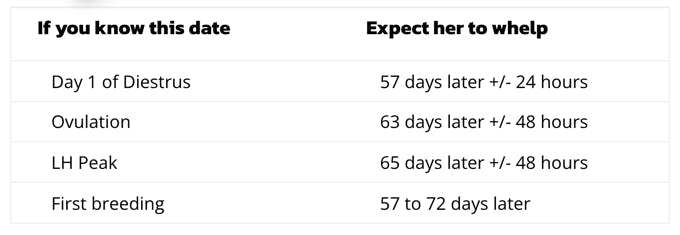
Dogs have “whelping windows” rather than singular “due dates.” Regardless of how well we time a breeding, the closest we can predict whelping is 48 hours. This is why we use the term “whelping window” rather than due date. If you didn’t use hormone testing or vaginal smears, your bitch’s whelping window can be as long as 7 to 8 days. If you did time your bitch’s breeding closely with LH, progesterone, and vaginal cytology, you can narrow that window to 48 hours. For this reason alone, it is worth doing hormone testing and/or vaginal smears.
This table shows whelping windows based on breeding events, such as ovulation, LH, etc. Even if you did an artificial insemination with your vet, determine the range of dates your bitch is due. Why is this so important? Because canine placentas have a limited lifespan, after which the pups die. If you know the last date your pups should be born, you can be sure to do a c-section early on that day to give your pups the best chance of survival.
Litter Size Often Effects When Pups Are Born
Litter size also influences when the pups will be born. It will be helpful for you to know your breed’s average litter size. Speak to other breeders, in particular the breeder of your bitch. Otherwise, check out this chart for litter sizes based on bodyweight of the bitch.
- Larger-than-average litters often coming earlier in the whelping window than smaller-than-average litters.
- For every four puppies above the average litter size, whelping will occur a day earlier. So 9 pups is an average litter for a golden retriever. We would expect a golden bitch with 13 or more, to whelp 55 to 56 days post diestrus rather than 56 to 58 days.
- Similarly, for every 4 pups below average, say a golden litter of 5 or fewer, we’d expect her to whelp a day later.
- Singletons often come at the end of the whelping window, if labor ever starts at all.
Breed Can Effect When Pups Are Born A few breeds are known to vary even more than other breeders. In particular, Cavalier King Charles Spaniels typically whelp up to three days early and still have healthy puppies.
Predicting Whelping Using Body Temperature
We highly recommend that you start taking and recording your bitch’s temperature four times a day starting 4 days before her whelping window opens. Around 80% of bitches experience a marked drop in body temperature as their progesterone levels drop in preparation for whelping. This is particularly true if she has two or more puppies, one if she is a toy breed. This temp drop, as it is known, is one of the markers we can use to ensure our pups are born on time.
If your girl is one of the 80%, her temperature is likely to fluctuate in the week prior to whelping before going lower and lower until it drops below 99.0F and stays there for 6 to 8 hours. Some bitch’s temperatures will go as low as 97F. To identify the temp drop, you must have two consecutive readings below 99F. Once you have that, the time of the first low temp starts your whelping clock. It doesn’t matter when her temperature returns to normal, you simply want to catch the drop.
This temperature drop indicates that your girl is preparing for whelping and you should see the first puppy within 24 to 36 hours, rarely 48 hours. If her pups haven’t been born at the 48-hour mark, it’s time for a vet visit and possibly a c-section. As we said earlier, canine placentas have a limited lifespan. If the pups aren’t born before the placenta begins to deteriorate, they will die in utero and often very quickly. Record her readings on the Temperature Chart, which you can download from Module 6: The Third Trimester.
However, if your bitch is 63 days post ovulation and hasn’t had a temp drop, use the other Whelping Rules to determine when you will head to the vet.
You need a good thermometer for this–it is worth trying to find mercury thermometers, though they are rare because of the risk of mercury poisoning should the instrument break, or investing in one or more good rectal digital thermometers, which typically cost US$10 or more.
- Practice taking your bitch’s temperature several times earlier in the trimester so both of you are comfortable and you know how to use the thermometer.
- When taking your dog’s temp, do so rectally and use lots of K-Y or similar lubricant on the thermometer.
- Ensure you insert them about halfway up the thermometer to get an accurate reading.
- If the reading seems off, take your girl out to go to the bathroom since feces can lower the temperature recorded.
- Give your bitch lots of treats for putting up with you. Have a second person around to help, if needed. If your dog is clicker trained, click her for being calm while you do this.
- Plot her temperature on the Temperature Chart. Print out the chart and keep it near where you will take her temp each day. Mark an X to show her temp each time so you can follow her progression.
Whelping Rules
As you approach the end of the third trimester, prepare for your litter’s birth by going through Module 7. One of the most important things to decide is when you will take your bitch to the vet if the whelping doesn’t proceed normally. The problem is that it is often very difficult to tell what is normal and what isn’t. This is true for experienced breeders and bitches, as well as those just starting out because often our bitches don’t show any signs of problems.
We have five rigid whelping rules that we stick to NO MATTER WHAT to keep our bitches safe during whelpings. By sticking with them precisely, we ensure that exhaustion, ambiguity, sleep deprivation, second thoughts, or anything else that might hinder our judgment, do not cause us to unintentionally put our bitches at risk.
We highly encourage you to learn these whelping rules and print them out to put in your whelping room!
Note that for each rule, we are not “on our way for a c-section.” Instead, we are on our way for a checkup by a veterinary professional. Which vet do you use for these exams? Any vet that you trust AND has an ultrasound machine that can get actual puppy heartrates. Specifically, we want the bitch examined and an ultrasound done to confirm the heart rates we have been monitoring on the pups with our handheld Doppler. If any pups’ heart rate is below 180 beats per minute (bpm), we will immediately do a c-section. X-rays are usually less helpful at that stage but if your vet feels it is essential to understand what is happening to the bitch and her pups, do one.
Whelping Rule #1: At the Vet on Day 65 Post-Ovulation. Our first whelping rule only applies if you know your bitch’s ovulation date. Without a confirmed ovulation date based on progesterone, LH testing or diestrus smear, skip to Whelping Rule #2. However, if you know when she ovulated, you want her to be seen by a vet if you have not seen pups by Day 65 from ovulation, Day 67 from the LH peak, or Day 57 from the first day of diestrus.
Placentas can only sustain the pups for about 65 days, after which they begin to deteriorate. Unfortunately, this can happen with no outward signs so use your calendar and get her in to the vet.
Whelping Rule #2: At the Vet Within 36 hours of the Temp Drop; Pups Within 48. Our second whelping rule is that we must see the bitch’s first visible contractions within 36 hours of the first of two consecutive temperatures under 99° F (37.2° C). So if her temp was 98.8° F (37.1° C) at noon on Friday and 98.3° F (36.8° C) at 6 PM the same day, we must see visible contractions by midnight on Saturday since the start of the temperature drop was at noon. If we do not see any visible contractions by that point, we are on our way to the vet, either our regular vet, repro clinic, or emergency clinic.
Tied to this rule is that we want the puppies born within 48 hours of the temperature drop. Placentas deteriorate quickly at the end of the whelping window, resulting in fetal death and stillborn puppies.
Whelping Rule #3: A Pup within 2 Hours of First Visible Contraction. Our third whelping rule is that we must see a puppy within two hours of the FIRST visible contraction that our bitch has, regardless of how mild the contraction appears.
This rule applies to every puppy so the clock restarts at the first visible contraction after each pup is born.
Write down the time of the FIRST visible contraction your bitch has. Now figure out how far your vet is from you in travel time to the vet and count backwards to determine when you need to leave the house to be at the vet’s at the two-hour mark. Start whelping assistance actions 20-30 minutes before leaving for the vet to see if you can reposition pups that might be stuck. See below for more on these actions.
Again, we are going to the vet for a checkup of the bitch, the puppy in the birth canal and the rest of the litter. We use our vet’s assistance in ensuring the pup that is in the birth canal is born quickly, whether that is using injected calcium, oxytocin or a c-section.
If your vet gives your bitch an oxytocin shot, DO NOT GO HOME!!! Stay nearby, even in the parking lot, in case the pups aren’t born quickly. Oxytocin can be helpful in triggering uterine contractions but those contractions are disorganized
and can cause early detachment of all of the pups’ placentas. If your bitch is given an oxytocin shot while whelping, you must follow all of the Whelping Rules religiously to ensure the safety of all of the pups, especially those higher up in the
uterus.
Whelping Rule #4: A Pup within 45 minutes of Sustained Contractions. Once a bitch starts into sustained visible contractions, those that come every few minutes, we want to see a puppy within 45 minutes. Productive labor will typically produce a puppy within 30 minutes of onset, but we will wait as long as 45 minutes. Bitches can exhaust themselves or their uterus with unproductive labor putting themselves and their pups in danger.
After 45 minutes of ongoing visible labor, we take action. That said, sometimes bitches will have several contractions quickly before taking a break and going back to sleep. This is not sustained visible labor so falls until Rule #3 not Rule #4.
Whelping Rule #5: Every Breeding and Whelping is the “First.” Bitches do not necessarily follow patterns on seasons, breedings or whelpings. Look at every one of them with fresh eyes rather than what your bitch or her mother or sister did previously. Don’t assume your bitch will do what she did last litter.
How Rigid About These Rules Are We? Many breeders ask us if we really stick to these rules. We do, absolutely! To the letter! We believe these rules have kept our bitches safe during a wide array of whelpings over 40 years. Sadly, we have had fellow breeders violate these rules and lose puppies, entire litters, and even their bitches.
One of the remarkable things about bitches is how stoic they can be when things are going wrong. Puppies can be stuck and even her uterus ruptured, but she may show no outward signs. In fact, some bitches appear to sleep during this. The whelping rules keep us focused on both our bitch and the clock to ensure we have good outcomes.
The Whelping Room and Box
The whelping box and the room it is in will have much to do with your pups’ survival and your bitch’s enjoyment of her pups. You have five things to focus on when setting up your whelping room. Watch the video below and read Preparing the Nursery to learn about setting up a whelping room that enables your dam and pups to thrive.
1. Temperature. Whelping boxes are often far too hot for our dams and pups so you must be able to safely change the temperature in your whelping room. Puppies cannot tolerate drafts so you need to protect them from fans and air conditioner vents.
2. Security. Your bitch must feel secure if she is to mother well. Some bitches are fine with their litter in the middle the house but most are more secure in their own room, away from other dogs and activity.
3. Safety. Neonate puppies are unable to keep themselves safe so we must examine every aspect of the whelping box to ensure they cannot get hurt.
4. Cleanliness. Since our puppies’ immune systems are undeveloped, we must be diligent about proper cleaning and disinfecting. But some of the products on the market can contribute to puppy illnesses, such as fading puppy syndrome.
5. Traction. The bedding we provide our puppies has a significant impact on their short- and long-term health, including their risk of hip dysplasia. Wonder Fleece is by far our favorite bedding after testing many types.
Whelping Boxes
You can spend a lot or a little on your whelping box. Here are some suggestions:
- Jonart Whelping boxes are some of the best (but most expensive) on the market. We love them but know they are an investment. They are sturdy enough for you to lean on or even sit on the sides. Jonart will also tailor products to your needs so reach out to them. They are easy to clean but can be challenging to store.
- Durawhelp Whelping boxes are very popular. They are not sturdy enough for you to lean on or even sit on the sides. They are easy to clean and store.
- Plastic wading pools have been used for decades. They are low enough for you to reach over the sides and are easy to clean. You may need to add a pig rail although the sides have enough give that many breeders don’t use a rail. They are awkward to store so many breeders buy them each year.
- Raised garden beds have been increasingly popular. They are inexpensive, available, relatively sturdy, and easy to clean. You may need to add a pig rail.
- Small-dog breeders often use the bottom of a plastic crate or even a plastic storage box as their whelping boxes.
- If you are handy, you can build your own whelping box with our Whelping Box Plans
Whelping Equipment and Supplies
Gather and organize the whelping supplies on the whelping list, as well as supplies for the first few days of your pups’ lives.. If you have whelped before, it’s time to get your gear out to clean and check over.
We often talk to people who are reluctant to invest in the entire supply/gear list but in many cases, these items can mean the difference between a pup’s survival. When you think about it, they are relatively inexpensive when compared to the value of a puppy. So these items may be a financial investment but compared to the price and life of one puppy, they are worth it.
- Whelping Equipment & Supplies list
- Pack to To Go to Vet During Whelping or for a C-section
- Prepare to Mark Your Pups at Birth
- Prepare to Supplement Your Puppies
- Make and Freeze – Liver Water | Mother’s Pudding | Myra Savant Harris’s Puppy Formula | Meals for you and your family
Additional Resources for the Third Trimester
Supplies and Equipment
- Klasi Kreations Warming Boxes (Avidog students get 20% off!)
- Wonder Fleece
- Rescue/Accel Disinfectant, Revival Animal Health
- Accel Disinfectant MSDS
- Pure Green 24 Disinfectant
- Pure Green 24 Disinfectant MSDS
- Hydrogen Peroxide Cleaner Disinfectant Wipes, Amazon
- Clorox Bleach MSDS
- Consumers Report Thermometer Buying Guide
- About the American Society for Testing and Materials (ASTM)
- CVS Flexible Tip Digital Thermometer
- Digital Thermometer
- Nomograph video with Dr Laurie Larson
- Canine nomograph evaluation improves puppy immunization
- AKC CHF Podcast: Pregnancy Diagnosis
- Take a tour of Our Puppy Room and Tools
- Pregnancy and the Bitch, Q&A with Dr Robert Hutchinson (“Hutch”) by Good Dog. Timestamp: 40:18 to 41:38
- Learn about 3rd-trimester embryonic puppies in the Canine Embryonic Atlas. Search on Days 42 to 63.
- Images of Embryonic Puppies in the Canine Embryonic Atlas. Search on Days 1 to 21 – discover what is happening to your embryonic pups during the first trimester
Troubleshooting the Third Trimester
Her breasts or vulva are swollen
In addition to her growing belly, your bitch’s vulva and mammary glands will swell toward the end of this trimester. Her vulva will soften and grow to about the size it was during breeding. However, it should not be immense. An enormous vulva, a hard abdomen, and/or swelling of the legs may be a sign of a serious health condition called maternal hydrops, so off to the vet if you see this.
You may see milk dripping from your bitch’s mammary glands by the eighth week. However, “bagging up” isn’t essential to normal milk production so do not worry if your bitch doesn’t look like a dairy cow. Avoid expressing milk from her glands since this can trigger whelping. If she has an over-abundance of milk, check her breasts daily, watching for hardness, redness, heat, or an orange peel appearance to the skin. Though rare, bitches can get mastitis before they whelp so be on the lookout. If you see any of these signs, read our Mastitis report, take her temperature, and begin hot compresses immediately.
My bitch is peeing a lot or even incontinent
Your bitch may need to urinate more frequently than normal because the pups are pressing on her bladder. This is particularly the case with large litters. Some bitches pee so much that they appear to have a UTI, and might urinate in the house or even leak. Try to manage your bitch as best you can. If it continues, take in a urine sample to your vet to confirm that she doesn’t have an infection.
She's hot all the time.
Bitches in the 3rd trimester are often very hot since the pups increase their body temperature. During cool weather conditions, this is fine but when it is hot out, they can be miserable. Do your best to keep your girl cool. Let her sit in a baby pool with clean, cool water, lie near an air conditioner or fan, lie against frozen water or soda bottles, or simply hang out in the coolest room in your house.
My bitch has a vaginal discharge.
Towards the end of this trimester, many bitches will have a small amount of clear discharge from their vulva. It is often sticky so you may find it on her tail or rear legs. This is perfectly normal.
Less often, a bitch may have a green or black discharge. Unless your bitch is in labor, this indicates a problem with one or more of the puppies. Although many bitches with dark discharges have whelped normal litters, I recommend a vet visit and ultrasound in these cases to confirm the viability of the puppies. There is little you can do if things have gone wrong with one or more pups but it helps to be prepared during the whelping
My bitch is vomiting
1. Take her temperature to ensure it isn’t elevated. If it’s 103F or higher, get her in to see your vet because she may have an infection.
2. Stop feeding her normal food immediately! Bitches can imprint on a food that causes them to feel sick so offer her anything else so you have a chance to return to her normal food once she is feeling better. Try the alternative foods in the next section, My Bitch Will Not Eat.
3. Split her daily food into many small meals each day.
4. If she is only sick in the morning, feed her more in the evening or throughout the day.
5. Do not worry if she misses a few meals but if it goes on for 3 days, time for a vet visit.
If your bitch vomits continuously or does not eat at all for more than three days, take her to your vet for evaluation and treatment.
My bitch will not eat.
Anorexia can be a sign of both pregnancy and the serious uterine infection known as pyometra. If she goes off her normal food and shows no other signs of pyometra, try these options. If she eats nothing for 3 days or is very finicky for a week, have your vet check her out to confirm she is fine.
- If your bitch has morning sickness, do not encourage her to eat her normal food if she is not interested. Change to another food immediately!!
- Warm the food you are feeding to bring out its aroma.
- Mix the food with liver water or stock.
- Remove supplements from her meals and feed another time or wait to reintroduce them in a week.
- Give her some saltine crackers in the AM or when she appears nauseous and feed at other times of the day
- Try the following food alternatives: Canned or fresh green tripe; Rotissairie chicken; Canned dog or cat food; FreshPet dog food; Another type of dog food–canned, raw, cooked, dehydrated, kibble, etc.; Human baby food (meat or poultry); Chicken or hamburger and rice; Chicken hearts, livers, or gizzards (raw or cooked); Eggs (raw, cooked, scrambled, boiled); Bacon, ham, liverwurst; Dog treats; Rice (cooked, white is better than brown); Oatmeal (cooked regular or Irish but not instant); Bread; Whatever you are eating!
My bitch has diarrhea.
a. Fast her for 24 hours to rest her gut.
b. Give her one Fortiflora Canine probiotic packet, made by Purina Veterinary Diets, per day for seven days. Fortiflora is very effective on diarrhea, even for dogs on other probiotics.
c. Ensure she keeps drinking by offering her diluted chicken or beef stock or even soup.
d. Give her slippery elm or slippery elm syrup. To make this syrup mix 1 rounded teaspoon of slippery elm powder in 1 cup cold water, bring to boil while stirring, turn down the heat, stir and simmer for 2 to 3 minutes. Remove from heat, add 1 tablespoon of honey (preferably all natural) and let it cool. Store in a glass container in the refrigerator.
Dosage: For dogs under 25lbs, give 1 to 2 tbsp; 25-50lbs, 2 to 4 tbsp; 50lbs and over ¼ cup to ½ cup. Dose 4 times a day.
e. After fasting, introduce a low-fat, easily digested food such as boiled chicken or beef with white rice. Do not use brown rice.
f. Gradually increase the quantity of food and begin adding in her regular food.
Miscarriages and abortions
Although uncommon, miscarriages and spontaneous abortions do occur in dogs. More likely fetuses are resorbed, mummified, or stillborn but infections, toxins and luteal insufficiency can cause fetuses to be passed too soon.
- Pathogens like brucellosis, canine herpes virus (CHV) and parvovirus can cause abortions in dogs.
- Toxins that cause abortion in dogs include those used to end unwanted pregnancies, like cabergoline
- Luteal insufficiency occurs when the corpus lutea, which formed on the ovaries during estrus and maintain the pregnency, regress too early, causing a drop in progesterone. This drop triggers spontaneous labor. If the bitch isn’t in her whelping window yet, her progesterone levels can be supplemented to enable her to maintain the pregnancy so if you see abdominal contractions or a colored vaginal discharge, get her to the vet immediately.
Often puppies are aborted without any obvious signs from the bitch but you also might notice abdominal contractions or green, black or bloody vaginal discharge. If you find an aborted fetus or your bitch passes one in your presence, we highly recommend you take your bitch and the fetus to the vet. If your trip to the vet will be delayed by hours, refrigerate rather than freeze the fetus and any other tissues.
Your vet can examine your bitch to see if the unborn pups are still alive, as well as draw blood for brucellosis, herpes and other testing. The fetus should be submitted for analysis. As difficult as this testing may be, the information it provides may enable you to save the remaining puppies and breed your bitch successfully in the future.
Resorptions (up to Day 38) and Abortions (after Day 38), Good Dog’s Q&A with Dr Robert Hutchinson (“Hutch”), Timestamp: 45:40 to 51:09
Does She Seem Too Big?
Bitches with swelling of the legs or an overly tight abdomen, may have Maternal Hydrops (now known ss Excess Fetal Membrane/excess Amniotic Fluid Syndrome). This is a very serious condition that requires immediate treatment by your vet.
Her hair is falling out.
During this trimester, the hair on your bitch’s abdomen will begin to thin. Some lose a little hair while others lose a lot. If she is a long- or medium-coated breed, you will be shaving her abdomen anyway so do not worry when you see the hair falling out.
She has gained too much or too little weight.
Your bitch will gain most of her pregnancy weight during this trimester due to the puppies’ growth and weight of placentas. Pups and placentas each contribute approximately equal weight to her weight gains during pregnancy so you may be able to determine how many pups your bitch has by calculating how much weight she has gained. Then divide that gain by 2 and again by the average birthweight of pups of your breed or breeding program.
Typically, a bitch with an average-sized litter will gain about 30% of her original body weight, but it all depends upon the number of pups and her original bodyweight. Lower gains are not better in dogs. Puppy birthweight is the strongest predictor of pup survival, so your goal is that your puppies are born at your breed’s average, not too big, not too small.
Figure 1 shows below-average birth weights based on expected adult size so you want your pups to be larger than this. Ask experienced breeders of your breed or ask us about your breed’s birthweights.

Puppies of larger dogs constitute a much smaller component of her total body weight than the same number of pups in a smaller breed. So, you may see larger percentage weight gains in small breed bitches. Use your scale and monitor your bitch’s fat covering over her ribs to manage her weight. No longer can you just look at her to evaluate weight because the weight of her abdomen may make her spine and hip bones stick out more than normal.
My bitch needs medical treatment—medication, surgery, a vaccination, etc.
First-trimester embryos are very sensitive to chemicals, stress, etc. Pregnant bitches are as well and can easily resorb the litter under great stress. If your bitch needs medical treatment during the first trimester:
a. First determine if the treatment can wait at least until you know for sure if she is pregnant. If it can safely wait and it will not cause more complications later, then do so. If it cannot, focus on treating your bitch with as little damage to the pups as you can.
b. For medications, check out Safe Medications for Pregnant Bitches.
c. Although we do not recommend vaccines during pregnancy, many dogs and puppies have survived vaccination with killed or modified-live vaccines. Give them if your bitch is unprotected and has been exposed but do all you can to avoid them. The only exception is the canine herpes virus vaccine, available in Europe, which is intended to be given during pregnancy.
d. If your bitch must have surgery while pregnant, speak to your vet about the possible complications to the puppies.
My bitch was exposed to kennel cough while pregnant.
Treat her cough with Slippery Elm syrup. If you can, avoid any other treatment. If the Slippery Elm isn’t working, ask your vet if it’s safe to give her Robitussin DM (active ingredient: guaifenesin), the over-the-counter cough medicine often used to treat kennel cough. Robitussin is safe for women to take during pregnancy so we expect that it is also safe for dogs.However if your bitch is exposed to either herpes, canine influenza, or another more serious respiratory virus, the situation may be much more serious. Consult with your veterinarian immediately to determine the best treatment for your bitch and her puppies.
Your Litter A to Z Table of Contents
Section 1: Pre-Breeding
Section 2: Pregnancy & Whelping
- Module 3: The First Trimester (From ovulation to Day 21)
- Module 4: The Second Trimester (Day 22-42)
- Module 5: Placing Your Puppies
- Module 6: The Third Trimester (Day 43-whelping)
- Module 7: Labor & Whelping
Section 3: Litter Management: Month 1
- Module 8: The First 48 Hours (Birth to 48 hours)
- Module 9: Your Litter’s First Week (Birth to Day 7)
- Module 10: Your Litter’s Second Week (Day 8-14)
- Module 11: Your Litter’s Third Week (Day 15-21)
- Module 12: Your Litter’s Fourth Week (Day 22-28)
Section 4: Litter Management: Month 2
- Module 13: Your Litter’s Fifth Week (Day 29-35)
- Module 14: Your Litter’s Sixth Week (Day 36-42)
- Module 15: Your Litter’s Seventh Week (Day 43-49)
- Module 16: Sending Puppies Home
- Module 17: Your Litter’s Eighth Week (Day 50-56)
- Module 18: After the Eighth Week (Day 57 and beyond)


