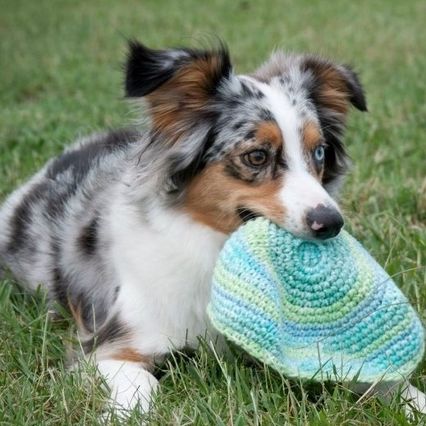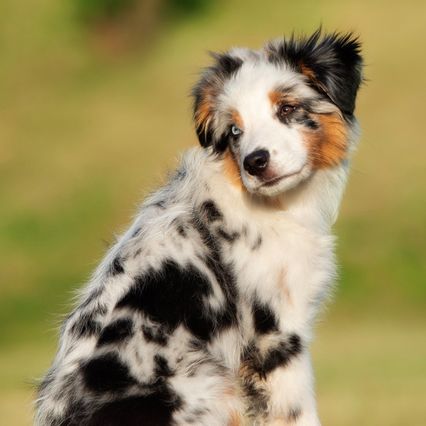
blue merle Australian Shepherd
Get to know

Australian Shepherds

Written by
Caroline Coile, Ph.D.,
 author of 34 dog books.
Written by
Caroline Coile, Ph.D.,
 author of 34 dog books, including the top-selling Barron's Encyclopedia of Dog Breeds.
| | | | |

Best friend, essential farm dog, search & rescue hero—the Australian Shepherd is many dogs to many people. One thing they all agree on: Aussies are awesome!

Bred for brains and bravery—at least when it comes to herding uncooperative cattle and sheep—Australian Shepherds bring their strong work ethic to everything they do. They’re smart, quick, biddable, energetic, and tough, a combination that makes them invaluable as working ranch dogs and unsurpassed as active home companions.
Browse available puppies

Connect with reputable breeders to find the dog of your dreams
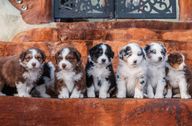
At a glance

Very High Energy

Energy level

5/5

Low Maintenance

Grooming

3/5

Medium/Large

Size

active, biddable, intelligent

Temperament

12-16 years

Lifespan

Highly Trainable

Training

5/5

Vocal

Barking

4/5

At a glance

  • Energy level

    Very High Energy

  • Grooming

    Low Maintenance

  • Size

    Medium/Large

  • Temperament

    active, biddable, intelligent

  • Lifespan

    12-16 years

  • Training

    Highly Trainable

  • Barking

    Vocal

Why people love the breed

People love Aussies because they’re more like equals than pets. They’re agreeable but not above disobeying if they think they have a better idea. The thing is, they’re usually right.
Living with an Aussie is like living with a partner who goes out of their way to find out what you want and then get it done—but who isn’t shy about suggesting a better way. Or insisting on it. Aussies are extremely smart, bred to both follow commands but to think for themselves when herding livestock. They learn quickly, want to please, and want to be active. The result is a dog who may end up watching you expectantly when it’s time for you to wake up in the morning, or get off the sofa, or just get up and get going in their opinion. This breed is great for people who like to do things with their dog, whether hiking, jogging, playing, or just working in the yard. They’re also great for people who like to compete in dog sports such as herding, obedience or Frisbee. And if you like company in the bathroom, or wherever else you may wander, they’ve got you covered. There’s also the fact that Aussies look like overgrown teddy bears. Everything looks round and soft and cuddly, although inside that fur is the body of a hard athlete. They come in several colors, all striking in their individual ways.

Appearance

The Australian Shepherd may look like an overgrown teddy bear, but inside that rounded exterior is the body of an athlete. Not overdone in any way, the Aussie’s looks appeal to just about everyone.
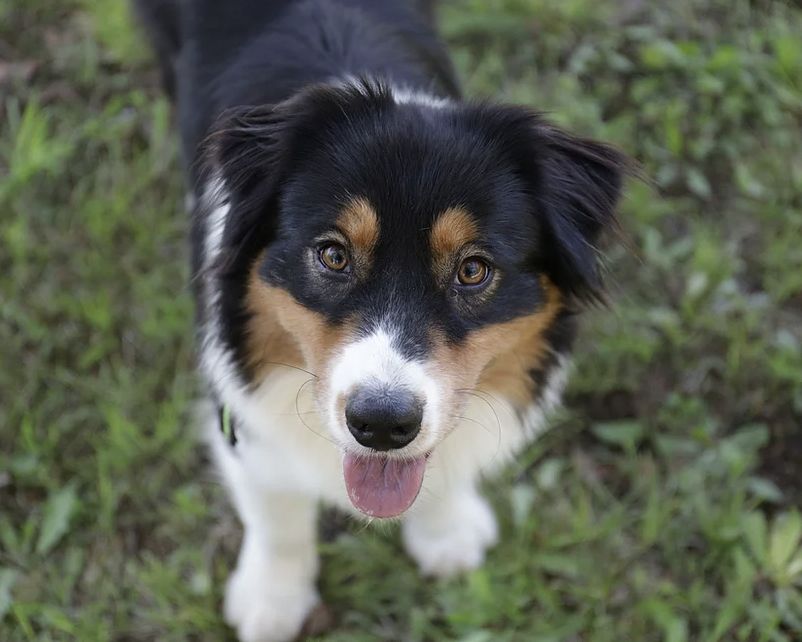
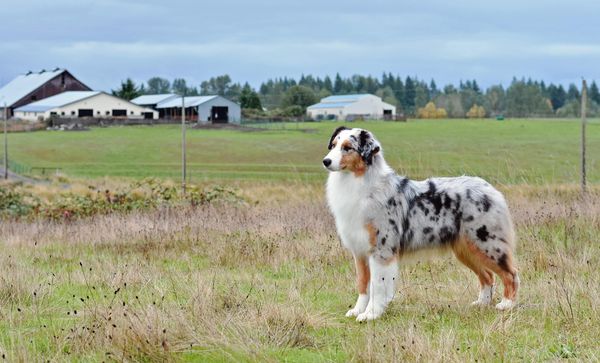
The Aussie is a medium-sized dog with neither heavy nor light bone for its size. It’s muscular and compactly built, powerful enough to work all day but light enough to be agile and quick. It’s slightly longer than tall, with a rounded appearance, moderate in every way. The head is fairly broad, with small triangular hanging ears and a keen eager expression. A few are born with natural bob tails, but most have long tails that are traditionally docked close to the body (4 inches or less in countries where docking is allowed). If left natural, the tail is usually long, straight, and plumed. If docked, it is performed around three days of birth, so you may not have the option of getting an undocked tail. The coat is of medium length, short on the face and fronts of legs but with feathering. It’s water resistant, with a fairly thick undercoat and an outer coat of medium texture, either straight or wavy. Colors can be red, black, red merle, or blue merle; all with or without white markings and/or copper points.

Grooming

Grooming is fairly easy, at least most of the year. The double coat normally requires brushing once or twice a week; once a day during shedding season.
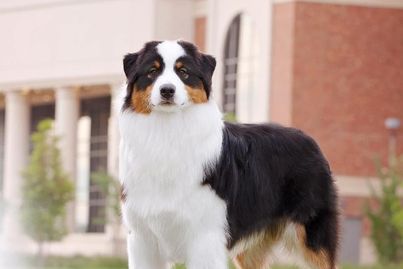
The coat doesn’t tend to tangle or mat unless it’s ignored for long periods, especially during shedding season. Dirt usually falls out of the outer coat. Nonetheless, they should be bathed about once a month. Aussies have a lot of undercoat, and they tend to shed a lot. Use a pin brush and a comb to reach the undercoat all the way to the skin and remove as much as possible when shedding. A slicker brush may also help. Bathing in warm water will help loosen the hairs from their follicles and hasten the shedding process. Trim the nails as needed (less often in working or extremely active dogs), check the ears (don't clean them unless they’re dirty) weekly and brush the teeth daily.
Australian Shepherd Dog
Img:

Diamond H Aussies

Breed temperament and characteristics

Australian Shepherds are known for their great temperament: smart, biddable, eager to please, active, protective and courageous, they make ideal companions and workers for active people.
Like most dogs bred to herd, Australian Shepherds are pre-programmed to be in tune with directions from their people, but also have the ability to override them and think for themselves when circumstances call for it. This makes them not only ideal at doing what they were bred to do, but as everyday companions. They learn quickly and enjoy showing off what they can do, and they generally will do just as you tell them. But not always; if they think your directions are wrong they won’t hesitate to substitute their own “better” way of doing things. They get along well with people of all ages, as long as somebody in the family provides them with ample physical exercise. Once they’ve done their day’s running, they are fine to relax with the rest of the family. They are good with other family dogs, but some may challenge strange dogs. They are generally safe with cats if raised with them. They are not particularly gregarious toward strange people but will accept them once they become regular visitors. Aussies are among the more protective herding dogs, and they’re tough as well. Not only will they warn you of danger, but they will step between you and it, bravely facing down any perceived treat. Aussies tend to be extremely energetic and they crave activity. This is especially true of Aussies from working lines. Even though this sounds like a great thing, these dogs can require too much activity for the average family. If you want to work your dog herding or in various high-energy competitive sports and activities, a working line may be your best choice. But if you prefer a slightly toned-down version, a companion or show line might be better for you. Dogs from either line can make amazing service dogs.

Exercise

Living with an Australian Shepherd is like having your personal fitness coach who never listens to your excuses. Be ready to get up and get going. Fortunately, Aussies have a large menu of acceptable activities.
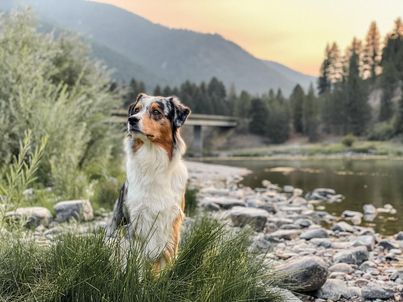
If you like to jog, hike, or play, the Aussie is the dog for you. They can jog for miles. They make great hiking partners, strong enough to carry their own backpack, nimble over rough terrain, and generally hardy in all kinds of weather. They play and work in all weather. They love to swim in warm weather, and play in the snow when it’s cold. They can even be trained to pull a person on skis or in a sled over snow. Frisbee catching is a favorite game. Most like to retrieve balls. Never play with a laser pointer with an Aussie, as it can trigger an obsessive light-chasing behavior. Aussies also need mental exercises, so training and mental challenges should be an essential part of your exercise regime. Ignore their mental exercise needs at your own peril, because a bored Aussie can quickly become destructive and neurotic. Aussies excel in several organized sports, especially herding, Frisbee, and obedience, but also agility, rally, flyball, tracking, nosework, and dock diving. The only thing they’re not good at is just sitting around, Aussies are very energetic and if you don't exercise them enough they may exercise themselves by digging holes in your yard—or in your couch. Commit to at least two hours of exercise a day for your younger Australian Shepherd, and keep it up at least for the first three or four years of their life. Then you can tone it down some, but not all.
Blue merle aussie with mountain sunset
Img:

Audacity Australian Shepherds

Training

Prepare to be impressed: The biggest challenge to training an Australian Shepherd is keeping up with them. They learn quickly and want to please—but they do have that stubborn streak because they are sure they know best.
Australian Shepherds were bred to follow directions. Herding dogs had to pay attention to the person directing them or they might chase the stock in the wrong direction. But they were also bred to think for themselves. Herding dogs who continued to head in one direction when an outlier took off in another needed to think fast and on their own to fix matters. Thus, Aussies had to also be self-reliant. This creates a breed that is both biddable but with a bit of independence. Most of the time, your Aussie will look to you for direction, and eagerly do as you say. But occasionally don’t be surprised if they blow you off and do as they think. That’s especially true if you try forcing them to do it your way. They were bred to be tough and tenacious and they can dig their feet in and be as willful and stubborn as any stock they ever tried to herd. When this happens it’s best to take a deep breath, start over and come at the problem from a different direction, and with a lot of treats. They really do want to please you and love showing off how smart they are. Never underestimate an Aussie’s ability to learn. Remember that while Aussies were bred to herd, they wormed their way into American families in large part through their trick dog performances at rodeos.

Diet and nutrition

Aussies are high-energy high-activity dogs, so they may need more calories than other dogs their size.
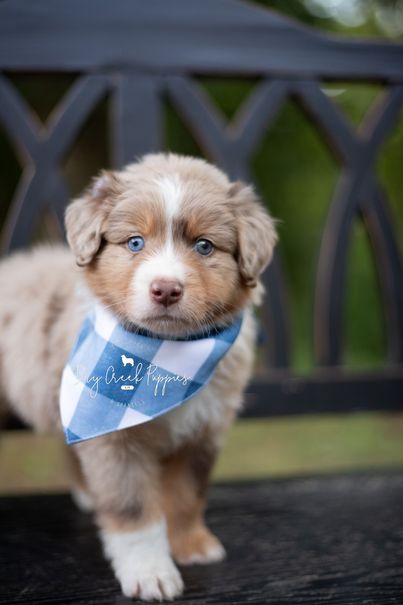
Australian Shepherds thrive on high quality commercial dog foods. As puppies, they should eat puppy food three to four times a day until around 4 months of age, then two times a day until around 9 months of age, transitioning to an adult diet at this time. For puppies, feed them using their body condition as your guide, but if they start to be chubby as older puppies you may have to slightly restrict their amounts. Active Aussies may need to eat a commercial diet formulated for active dogs. These diets are high in both protein and fat. Be careful that you don’t overfeed your Aussie as your dog ages and slows down. They’ll need fewer calories then. In addition, neutered or spayed dogs tend to need fewer calories. Factor in all the treats you may be doling out during training. They can add up the calories faster than you might think. Although the Aussie looks rounded, that should be due to its coat, not body. You should be able to feel the waist and see some indication of a narrowing through the loin from above. You should also be able to feel the ribs with minimal probing. Discuss any special diet concerns with your veterinarian. Your Aussie’s optimal diet will change with age. Some health problems require special diets that may only be available through prescription.
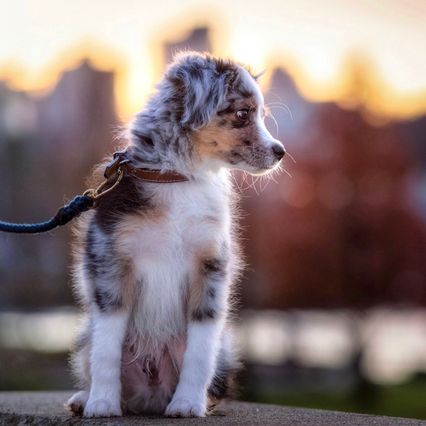
Australian Shepherd Dog puppy wearing a blue bandana
Img:

Dry Creek Puppies LLC

Health issues

Australian Shepherds are a healthy and hardy breed.

Lifespan: 12 to 16 years.

For such a popular breed, Australian Shepherds have a surprisingly short list of health concerns. They have some drug sensitivities and some minor joint concerns. Double-merles can have vision and hearing problems.

Multidrug Resistance 1

Like many Collie-related breeds, Aussies can inherit a genetic variant in their ABCB1 gene that makes them sensitive to certain drugs. This mutation can allow certain drugs and toxins to build up or even cross into the brain, causing severe and sometimes fatal reactions. A DNA test is available, and all Aussies should be tested to know if they need to avoid high doses of these drugs. It’s better to know early rather than wait until your dog may need one in a hurry.

Hip dysplasia

This is the most common hereditary disorder of the joints, especially in larger and heavier dogs. It occurs when the head of the femur doesn’t fit snugly into the socket of the pelvis, eventually causing arthritis and lameness. No genetic test is available to date, therefore, the recommended screening test is x-rays.

Collie Eye Anomaly

This is one of the few eye problems that affect Aussies. It is a hereditary condition impacting the development of the eye that can lead to blindness and retinal detachment.

Elbow dysplasia

This is a condition in which the elbow joint is formed incorrectly, causing arthritis and lameness. No genetic test is available to date, therefore, the recommended screening test is x-rays.

Double merle

The merle gene creates mottled patches of color in a solid or piebald coat, blue or odd-colored eyes, and affects skin pigment. If a dog has just one copy of the dominant M allele, along with one copy of the recessive m allele, it will be merle. But if a dog has two copies of the dominant M allele, it is a double-merle, and will likely have large areas of white fur, and very often blue eyes. Unfortunately they are also often deaf or blind. Breeding two dogs with merle together should always be avoided due to the potential health concerns.

Learn more about health issues that may impact Australian Shepherds

History

When is an Aussie not an Aussie? When it’s an Australian Shepherd, created in the United States.
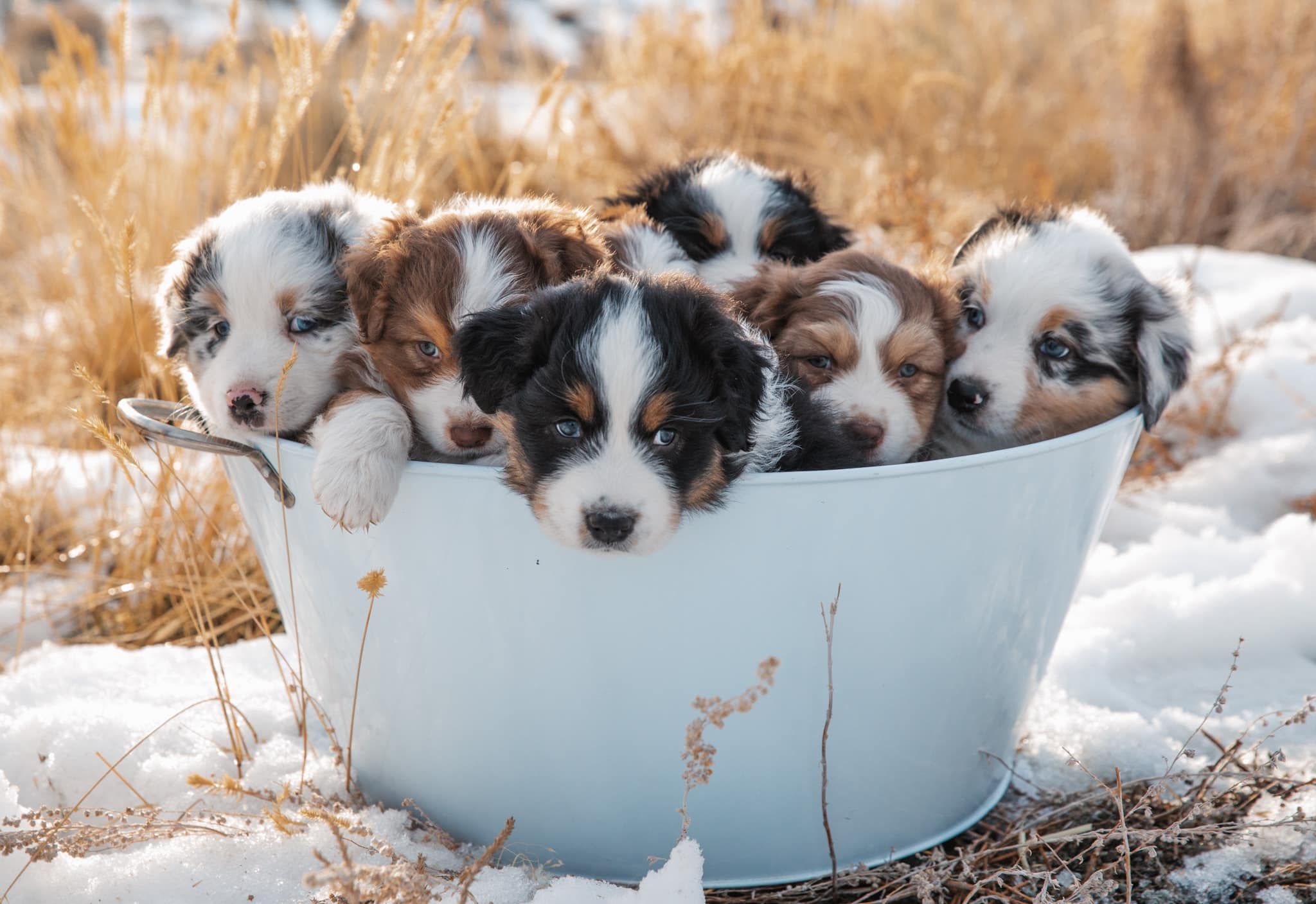
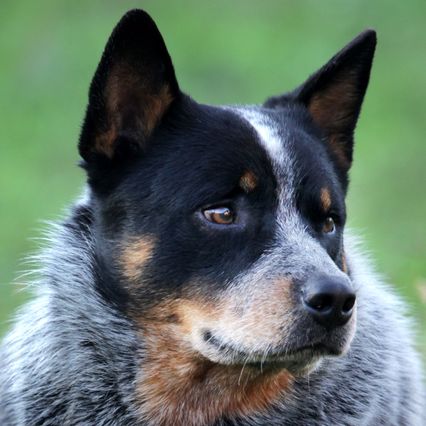
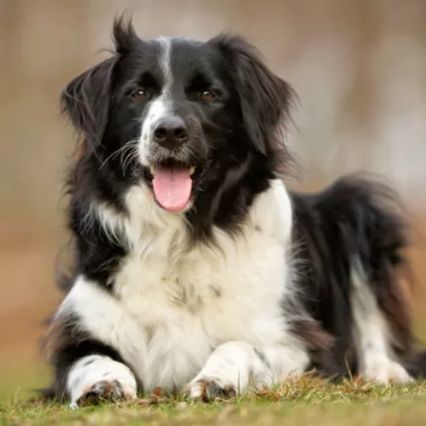
The breed’s origins began in Europe. From there, shepherds from the Basque region of Spain emigrated to Australia bringing with them their talented shepherd dogs. Australian cattle and terrain were much more fierce than what these dogs were used to, so they were interbred with tougher Australian stock dogs. When some of these Basque shepherds then emigrated to the western United States from Australia, American ranchers found these “Australian” dogs were ideal for the tough stock and terrain of the American west. Here they underwent even more crosses and selection, and became a different breed from their relatives in Australia. Today the Australian Shepherd is considered to be made in America. In the 1950s American rodeo-goers were treated to the show of Jay Sisler’s trick-trained Australian Shepherds. Many people left the rodeo with an Aussie puppy. The Australian Shepherd became a family dog. In 1957 the Australian Shepherd Club of America (ASCA) formed. Although not an American Kennel Club (AKC) recognized club, ASCA remains the largest Aussie club in America. The AKC recognized the Australian Shepherd in 1993, with a separate parent breed club. Today the two organizations co-exist peacefully. The Aussie is a member of the AKC Herding group. Genetically, its closest relative is the Collie. The Australian Shepherd is still used as a working ranch dog in many parts of the country, but its greatest fame is as a family companion. It is also used as a service dog, drug detection dog, and search & rescue dog. Owners include Mel Gibson, Steve Jobs, Demi Moore, Bruce Willis, Tim Robbins, Sally Field, and Susan Sarandon. An Aussie named Hyper Hank became so famous for his Frisbee skills that he performed at the Super Bowl and visited the White House in the 1970s.
About the author

Canine specialist, Caroline Coile, Ph.D., is the author of 34 dog books, including the top-selling Barron's Encyclopedia of Dog Breeds. She’s written thousands of magazine and web articles about dogs. She specializes in canine science, health, breeds and competitions. Caroline has won 20 national dog-writing awards, and was a 2015 Inductee into the Dog Writers Association of America Hall of Fame.

Breed Scorecard

Characteristics and temperament
  • Affectionate with family

    4

  • Watchdog level

    5

  • Playfulness

    5

  • Adaptability

    3

  • Social needs

    4

  • Temperament

    active, biddable, intelligent, alert, suspicious, tough, protective

  • Intelligence

    5

  • Good with other dogs

    3

  • Good with cats or other pets

    4

  • Friendly with strangers

    2

  • Good as a service dog

    5

  • Good for apartments

    1

  • Barking level

    4

Appearance
  • Height

    18-23"

  • Size

    Medium/Large

  • Colors

    Black & white, Red & white, Black, Red merle, Blue merle, Red, Dilute blue (non-standard), Sable (non-standard), Yellow (non-standard), Dilute red (non-standard), White (non-standard), Black tri-color, Red tri-color

  • Coat texture

    Slightly coarse

  • Coat length

    Medium

Training
  • Trainability

    5

Exercise
  • Exercise needs

    5

  • Exercise time

    2 hours daily

  • Mental exercise needs

    5

  • Favorite activities

    Herding, hiking, frisbee, agility, obedience, flyball

Grooming
  • Grooming needs

    3

  • Brushing frequency

    Weekly

  • Needs professional grooming?

    No

  • Drooling level

    1

Health issues
  • Multidrug Resistance 1

  • Hip dysplasia

  • Collie Eye Anomaly

  • Elbow dysplasia

  • Double merle

Other
  • Bred for

    Herding

  • Country of origin

    United States

  • Popularity level

    5

FAQs

  • On Good Dog, you can search for Australian Shepherd puppies or dogs in rescues and shelters. Adopting an Australian Shepherd from a shelter or rescue is generally less expensive than buying a puppy from a breeder with ethical practices. Across the United States, there are dedicated rescues that specialize in specific breeds and may even help transport an Australian Shepherd dog to you from another part of the country. Although it can be more cost-effective, adopting the exact breed you're looking for is typically more difficult than working with a responsible breeder. Learn more about adopting a dog from a shelter or rescue.

  • Prices may vary based on the breeder and individual puppy for sale. On Good Dog, Australian Shepherd puppies are around $1,650. We recommend speaking directly with your breeder to get a better idea of their price range.

  • They bark more than average, but tend to only bark when excited. It’s just that they tend to get excited.

  • They are very energetic and need a lot of physical and mental activities to keep them occupied. Otherwise they can redirect their energy to mischievous projects.

  • The Aussie is one of the best family dogs there is, as long as it’s an active family with lots of time and energy to share. If the Aussie is set aside, everyone will be unhappy as the dog can become destructive and unruly.
Caroline Coile, Ph.D.

Caroline Coile specializes in canine science, health, breeds and competitions. Caroline has won 20 national dog-writing awards, and was a 2015 Inductee into the Dog Writers Association of America Hall of Fame. She’s written thousands of magazine and web articles about dogs in addition to 34 dog books.

Content on Good Dog is generated, fact-checked, and evaluated by qualified writers and veterinarians.

Caroline Coile, Ph.D.

Caroline Coile specializes in canine science, health, breeds and competitions. Caroline has won 20 national dog-writing awards, and was a 2015 Inductee into the Dog Writers Association of America Hall of Fame. She’s written thousands of magazine and web articles about dogs in addition to 34 dog books.

Content on Good Dog is generated, fact-checked, and evaluated by qualified writers and veterinarians.