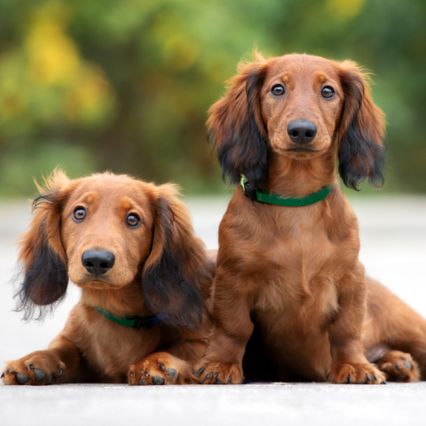
Boston Terrier poses with a plaid bandana
Get to know

Boston Terriers

Written by
Caroline Coile, Ph.D.,
 author of 34 dog books.
Written by
Caroline Coile, Ph.D.,
 author of 34 dog books, including the top-selling Barron's Encyclopedia of Dog Breeds.
| | | | |

Most people just call them “Bostons” for short.

If you don’t think you like small dogs, the Boston Terrier could change your mind. They have a big dog sense of fun and adventure, all in a compact, dapper-looking body. They’re like a little dog in a tuxedo who’s ready to roll in the mud in a fun brawl.
Browse available puppies

Connect with reputable breeders to find the dog of your dreams

At a glance

Moderate Energy

Energy level

3/5

Very Low Maintenance

Grooming

2/5

Small

Size

Playful, courageous, alert

Temperament

11-13 years

Lifespan

Quick to Learn

Training

4/5

High Vocality

Barking

5/5

At a glance

  • Energy level

    Moderate Energy

  • Grooming

    Very Low Maintenance

  • Size

    Small

  • Temperament

    Playful, courageous, alert

  • Lifespan

    11-13 years

  • Training

    Quick to Learn

  • Barking

    High Vocality

Why people love the breed

Brimming with vim and vigor, Bostons take command wherever they are—but they do it with a fun-loving sense of humor. Bostons make you smile.
Bostons are lively, fun-loving dogs that truly personify the “big dog in a little body” description. They are not large but they are in charge and they tend to strut into a situation and take over the room. Their dapper good looks attract attention wherever they go. They have good manners and get along well with everyone, making ideal gentle playmates for children and equally ideal entertaining companions for the elderly. They’re active and adventurous enough to be partners in almost any adventure or endeavor. This is a breed that truly deserves its popularity, and should be considered by anyone wanting a small dog for an active family.

Appearance

The Boston Terrier is known for its distinctive markings, clean-cut outline, alert expression, and rounded or squarish head.
The Boston has a compact, square-proportioned body with a wide chest, short back and muscular torso. It has medium bone, and should combine sturdiness and strength with liveliness and style. The short tail is not docked, but is naturally very short. The backskull is square or rounded, and wrinkle-free. There is an abrupt brow leading to a squarish muzzle that is shorter than wide. The eyes are large and round. The ears are small and erect, and may be natural or cropped. They have a short fine coat, which is close-fitting. The standard colors include black, brindle, or seal with white markings.

Grooming

Bostons are a great choice if you hate to brush. But like all dogs, they still need some upkeep.
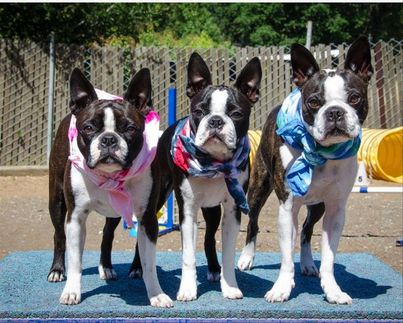
Boston's short hair will never tangle, and you can get away with never brushing it. However, your Boston will appreciate the feeling that a good brushing with a natural bristle brush will give him, and brushing (especially with a rubber bristle brush or grooming mitt) will remove dead and loose hairs that would otherwise be left on your furniture. Some dogs with wrinkles on their face require those wrinkles to be cleaned regularly, but most Bostons don’t have wrinkles deep enough to require this. Their prominent eyes are prone to abrasions so should be checked regularly for discharge or irritation. Keep the nails trimmed as needed, and brush the teeth daily.
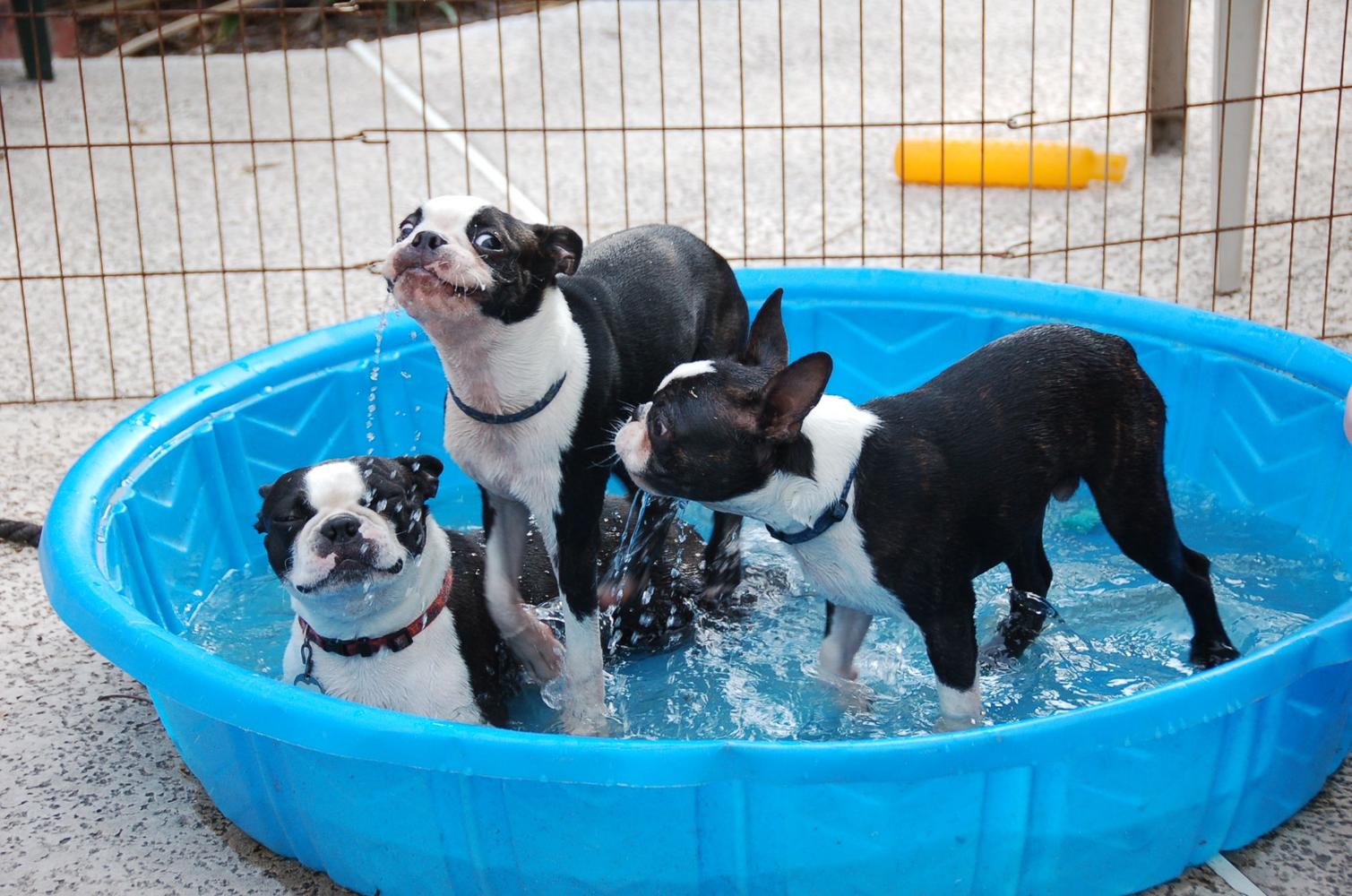
3 Boston Terriers pose with bandanas
Img:

HiFly'n Bostons

Breed temperament and characteristics

The saucy Boston looks serious but has the heart of a clown.
The Boston Terrier is a one-dog entertainment center. It’s always ready to play just about any game proposed. It tends to be fearless and up to any challenge, enjoying a multitude of outdoor activities more closely associated with big dogs. The breed is extremely alert and eager to sound the alarm at any hint of an intruder. Sometimes the barking may border on overkill however, so if you hate barking you may need to work on with your Boston from an early age. But they do make great watch dogs, although ineffective protection dogs. Given sufficient exercise, Bostons are content to take it easy indoors and are very well-mannered house dogs. They enjoy cuddling close and make excellent companions as long as they get to run off their extra energy each day. Bostons normally get along well with other pets, and usually, with other dogs. They are fairly demonstrative to their family but can be standoffish toward strangers. They are gentle and safe with children, and make ideal children’s companions. They are eager to please but do have a stubborn streak.

Exercise

While active, they are small, so their exercise needs could possibly be met in a smaller space.
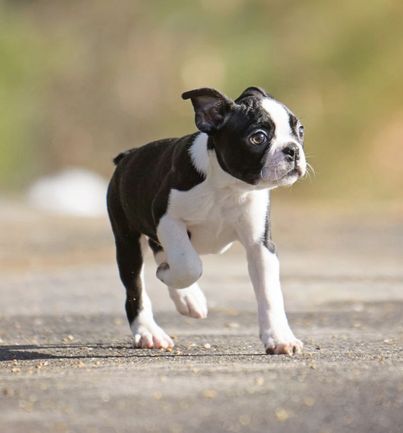
Bostons are very active dogs that need to run and play daily lest they become a nuisance indoors. Fortunately, their smaller size enables them to burn off energy in a smaller yard or if absolutely necessary, indoors. Even so, they need the added mental stimulation of a walk around the neighborhood or trip to the dog park or even a hike in the woods. Most Bostons should only go to a dog park that has separate areas for small dogs. Because of their short muzzles, Bostons can overheat more easily so extra care must always be taken to minimize exercising in warm weather. This is not a breed for jogging. Bostons enjoy organized physical activities such as agility and lure-coursing. Some have even excelled at dock-diving, although swimming is not generally a favored activity.
Boston Terrier puppy running
Img:

Tysadie's Boxers and Bostons

Training

Bostons are quick to learn and eager to please and show off.
Bostons respond well to training, although expect to have a few instances of stubbornness. In these cases they will come around if you try to convince them what you want is their idea rather than trying to force them to succumb to your idea. They are very good at getting their way when they set their mind to it. Once you've convinced them that your idea is fun, they excel at learning tricks and activities, and have competed at the very highest levels of obedience, agility, and trick dog competitions. They are enthusiastic workers that give every performance their all.

Diet and nutrition

Boston Terriers generally require no special diets, and are good eaters. Just watch out for weight gain.
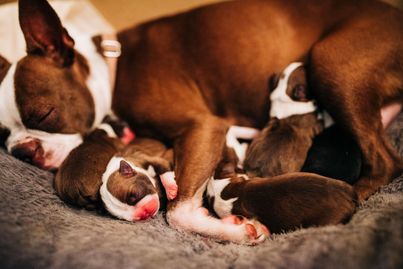
A Boston should be trim and muscular, with an indication from the side and top of a smaller waist. Ask your veterinarian's opinion if you worry your Boston may be overweight. Other than that, Bostons don’t require any special diets, although most dogs will benefit from high-quality dog food. Feed them as directed by your veterinarian, but do not overfeed them. Feed them three meals a day until they are about 4 months old, then twice daily. Adult diets can be offered around nine months of age. Discuss any special diet concerns with your veterinarian. Your Boston’s optimal diet may change with age. Some health problems require special diets that may only be available through prescription. Fortunately, Boston Terriers are not prone to problems requiring special diets (except that some have food sensitivities).
Boston Terrier mom cuddles her young puppies
Img:

Olive & Co. Boston Terriers

Health issues

Bostons are generally healthy dogs with only a very few health concerns.

Lifespan: 11 to 13 years.

Cataracts

An opacity in the lens, occur at an increased frequency in Bostons. Breeding dogs should have annual eye examinations as onset of symptoms will vary depending on disease and individual. DNA testing is available for the early onset form.

Patellar luxation

In which the kneecap slips out of the groove in which it should be nested, causes lameness and arthritic changes. It occurs mostly in small breed dogs. Screening involves an examination and grading of the degree of luxation present registered with OFA.

Deafness

The inability to hear with either one or both ears being affected.

Learn more about health issues that may impact Boston Terriers

History

The Boston Terrier is the most popular “Made in America” breed ever.
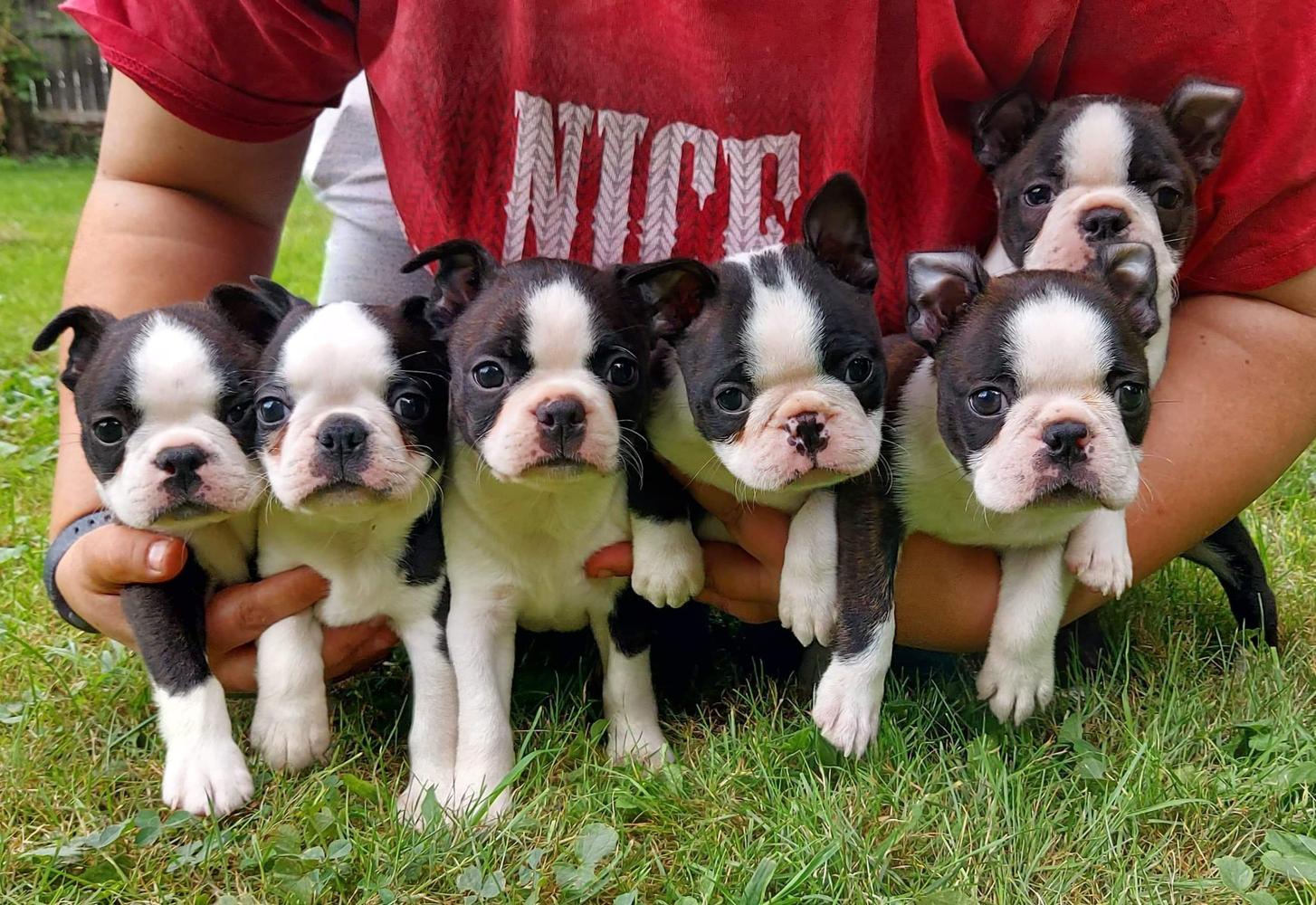
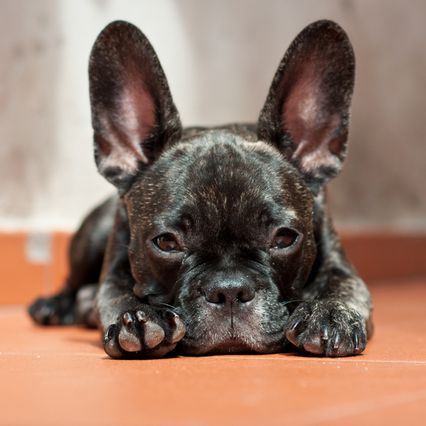
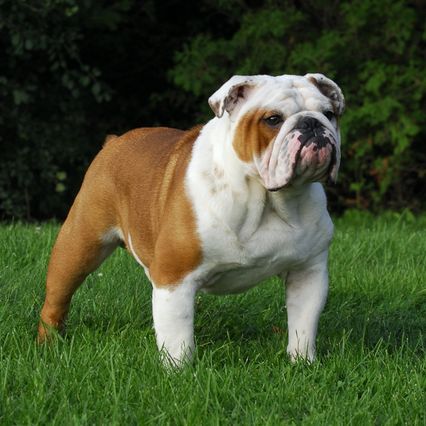
The Boston’s history began when coachmen of wealthy Bostonians bred their employers’ English Terrier to an English Bulldog in 1865, resulting in a dog named Hooper’s Judge, who would become the father of the breed. Hooper’s Judge weighed about 30 pounds, but he and his offspring were bred to smaller dogs, mostly French Bulldogs, and by 1889 the smaller dogs were a hit in Boston. Initial names suggested for the breed were American Bull Terrier and Roundhead, but both were rejected. The American Kennel Club (AKC) recognized the Boston Terrier in 1893, an unheard of short time from creation to recognition. The Boston Terrier is in the AKC Non-Sporting Group. Throughout much of the world, it is in the Companion and Toy Group. The Boston Terrier was the most popular breed in America for two years, once during the 1910s and once during the 1930s. It was the number 2 most popular breed of the decade from 1900 to 1910, and stayed in the top three for five decades. The Boston's nickname is "The American Gentleman." The breed is also often erroneously called the Boston Bulldog. The Boston Terrier is the state dog of Massachusetts. Owners have included Warren G. Harding, Vincent Price, Louis Armstrong, Joan Rivers, Yves St. Laurent, LeAnn Rimes, Robin Willians, Norman Reedus, and Helen Keller.
About the author

Canine specialist, Caroline Coile, Ph.D., is the author of 34 dog books, including the top-selling Barron's Encyclopedia of Dog Breeds. She’s written thousands of magazine and web articles about dogs. She specializes in canine science, health, breeds and competitions. Caroline has won 20 national dog-writing awards, and was a 2015 Inductee into the Dog Writers Association of America Hall of Fame.

Breed Scorecard

Characteristics and temperament
  • Affectionate with family

    3

  • Watchdog level

    5

  • Playfulness

    4

  • Adaptability

    4

  • Social needs

    4

  • Temperament

    Playful, courageous, alert

  • Intelligence

    3

  • Good with other dogs

    3

  • Good with cats or other pets

    4

  • Friendly with strangers

    3

  • Good as a service dog

    2

  • Good for apartments

    4

  • Barking level

    5

Appearance
  • Height

    10-17"

  • Size

    Small

  • Colors

    Lilac (non-standard), Red (non-standard), Blue (non-standard), Black and white, Black brindle and white, Brindle and white, Seal and white, Seal brindle and white

  • Coat texture

    Fine, smooth

  • Coat length

    Short, close-fitting, no furnishings

Training
  • Trainability

    4

Exercise
  • Exercise needs

    3

  • Exercise time

    1 to 2 hours daily

  • Mental exercise needs

    4

  • Favorite activities

    Agility, barn hunt, earthdog, tug games, dog sports

Grooming
  • Grooming needs

    2

  • Brushing frequency

    Monthly

  • Needs professional grooming?

    No

  • Drooling level

    1

Health issues
  • Cataracts

  • Patellar luxation

  • Deafness

Other
  • Bred for

    Ratting

  • Country of origin

    United States

  • Popularity level

    5

FAQs

  • On Good Dog, you can search for Boston Terrier puppies or dogs in rescues and shelters. Adopting a Boston Terrier from a shelter or rescue is generally less expensive than buying a puppy from a breeder with ethical practices. Across the United States, there are dedicated rescues that specialize in specific breeds and may even help transport a Boston Terrier dog to you from another part of the country. Although it can be more cost-effective, adopting the exact breed you're looking for is typically more difficult than working with a responsible breeder. Learn more about adopting a dog from a shelter or rescue.

  • Prices for Boston Terrier puppies for sale vary by breeder and individual puppy. On Good Dog today, Boston Terrier puppies are typically around $1,750. Because all breeding programs are different, you may find dogs for sale outside that price range.

  • The Boston was initially created from a cross of an English Terrier to an English Bulldog, but was subsequently crossed with other small dogs, mostly French Bulldogs.

  • Not one bit. They require virtually no grooming, their exercise needs may be met in a smaller space, and they’re not constantly in your face—although you certainly can’t ignore them. Always work with a reputable breeder who performs any necessary health testing on their dogs.

  • Bostons are usually great house dogs as long as they get sufficient exercise. They are one of the easiest small breeds as they are clean, have little doggy odor, and they’re easy to housetrain. They can bark a lot, which could be disruptive to neighbors if you live in an apartment.
Caroline Coile, Ph.D.

Caroline Coile specializes in canine science, health, breeds and competitions. Caroline has won 20 national dog-writing awards, and was a 2015 Inductee into the Dog Writers Association of America Hall of Fame. She’s written thousands of magazine and web articles about dogs in addition to 34 dog books.

Content on Good Dog is generated, fact-checked, and evaluated by qualified writers and veterinarians.

Caroline Coile, Ph.D.

Caroline Coile specializes in canine science, health, breeds and competitions. Caroline has won 20 national dog-writing awards, and was a 2015 Inductee into the Dog Writers Association of America Hall of Fame. She’s written thousands of magazine and web articles about dogs in addition to 34 dog books.

Content on Good Dog is generated, fact-checked, and evaluated by qualified writers and veterinarians.