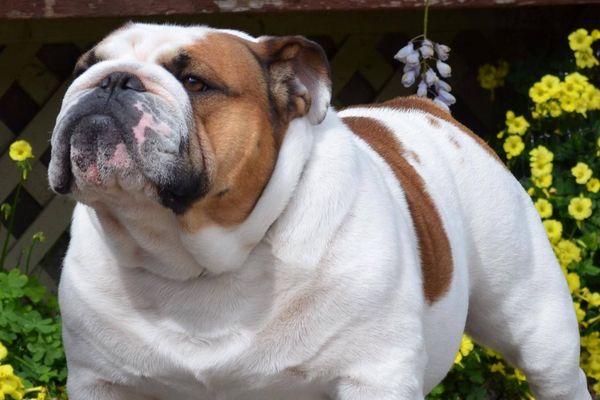
Bulldog standing with flowers in background
Get to know

Bulldogs

Written by
Caroline Coile, Ph.D.,
 author of 34 dog books.
Written by
Caroline Coile, Ph.D.,
 author of 34 dog books, including the top-selling Barron's Encyclopedia of Dog Breeds.
| | | | |

With the most distinctive mug in dogdom, the Bulldog (also called the English Bulldog) may have a fierce expression, but it’s a lover, not a fighter.

They are the ultimate in repurposed dogs, going from bull baiter to family jester—and loving every minute.
Browse available puppies

Connect with reputable breeders to find the dog of your dreams

At a glance

Very Low Energy

Energy level

1/5

Low Maintenance

Grooming

3/5

Medium

Size

Comical, friendly, affectionate

Temperament

8-10 years

Lifespan

Moderate Trainability

Training

2/5

Quiet

Barking

1/5

At a glance

  • Energy level

    Very Low Energy

  • Grooming

    Low Maintenance

  • Size

    Medium

  • Temperament

    Comical, friendly, affectionate

  • Lifespan

    8-10 years

  • Training

    Moderate Trainability

  • Barking

    Quiet

Why people love the breed

Bulldogs are born comedians. People love that Bulldogs make them laugh, always seeming to come up with something new as though they planned it.
Don’t even try to stay sad if you’re around a Bulldog. Before you know it, they’ll be skateboarding past, trying a forward roll (unsuccessfully), chasing their tail (unsuccessfully), or trying to swim in the bathtub (really unsuccessfully). Bulldogs snort, snore, burp and pass gas, all to their owner’s apparent delight. Because Bulldogs appeal most of all to people with a good sense of humor. They’re not easy to care for, or easy to live with, or easy to train. But for the people who love them, no other breed even comes close.

Appearance

With a face only a mother could love, Bulldogs nonetheless find their sour mugs attract a lot of attention. And their body is just as unusual.
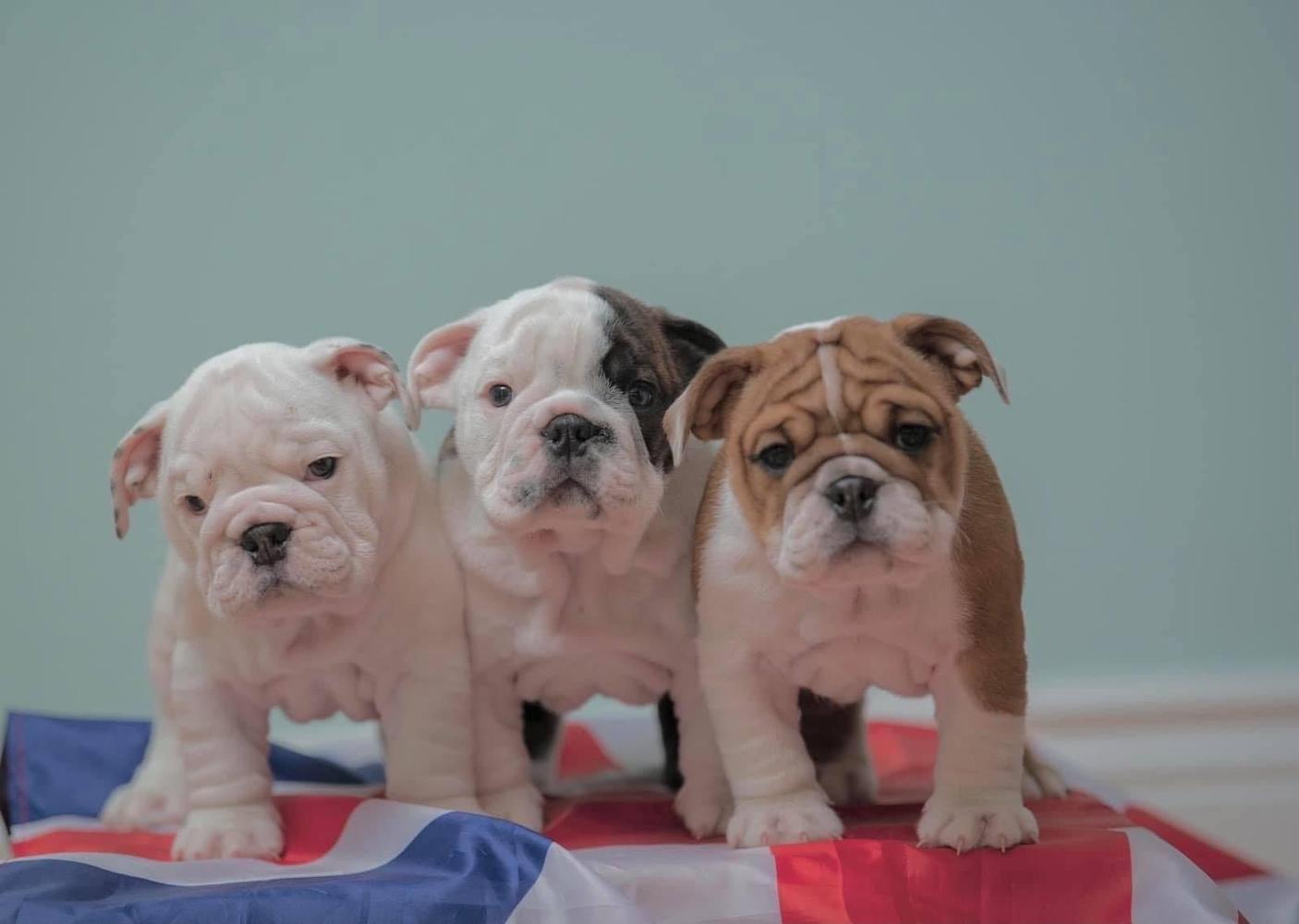
The Bulldog has a very heavy, wide, and low-slung torso, with especially wide-set front legs. This gave them a low center of gravity when trying to hold on to a bull. The rear is narrower than the front. The hind legs are longer than the front legs. The back is rounded, the tail either straight or screwed and set low. The Bulldog is one of the few breeds to have a naturally short tail. This type of tail is also seen in French Bulldogs and Boston Terriers and is caused by a recessive gene. The gait is loose-jointed, rolling, and shuffling. The Bulldog's head exemplifies a brachycephalic head; that is, a head with a short muzzle, wide flat face and undershot jaw (meaning the bottom teeth protrude in front of the top teeth). This was considered the best head for gripping power, allowing the dog to both breathe and hold tight. Along with the short muzzle comes deep folds of skin. The coat is fine and glossy, and comes in red, white, fawn, fallow or any combination the foregoing.

Grooming

Grooming the fur is easy. Grooming the wrinkles may be more challenging.
The coat needs only occasional brushing and bathing. If the dog has drool you may want to bathe at least the drooled on parts more often. Many people have their Bulldogs wear a drool bib to prevent it soiling the fur. Bulldogs with deep wrinkles need extra attention. The wrinkles can remain moist within them, creating a perfect place for bacteria to grow. Left unchecked, it can cause skin infections. So you must clean and dry the wrinkles daily. This includes the tail wrinkle if the dog has one. As with all breeds, the nails should be trimmed as needed and the teeth brushed daily. Check the ears for debris weekly.
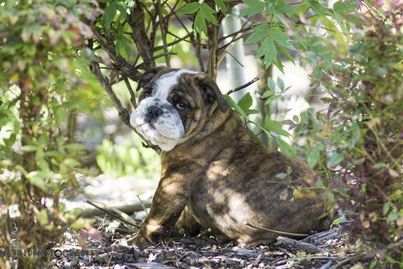
Brindle Bulldog puppy sitting in the bushes
Img:

Michaeline Jablonski

Breed temperament and characteristics

Despite their grouchy expression, Bulldogs are one of the most cheerful breeds around. They always seem to be thinking up some new way to entertain you—and succeeding.
Bulldogs are easygoing and low energy. They are friendly to almost everyone, though some can be aggressive toward other dogs. They enjoy being the class clown or whatever it takes to be the center of attention. They are adept at winning over new fans from people who thought (wrongly) they didn’t like Bulldogs. Although they have bursts of activity, they’re generally sedentary and don’t mind napping away the day. They don’t bark much, and make terrible watch dogs or protection dogs. They get along well with children, but children must be cautioned not to make them become overheated. Because they enjoy lounging around, they can also be good dogs for the elderly. Bulldogs are independent but willing to please–if they feel like it. If they don’t, their stubborness is the stuff of legend.

Exercise

Bulldogs don’t need much exercise, but that doesn’t mean you can just lock them up and ignore them. The key is in finding opportunities to tire them out without overheating them.
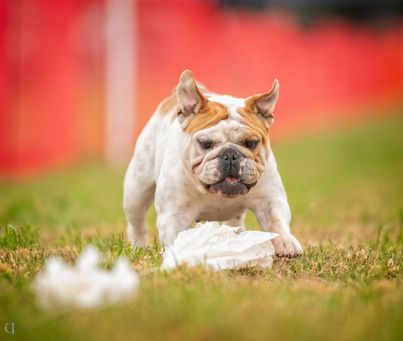
They should never be encouraged to exercise in hot weather. Early morning is the best time for outside excursions. Because of their conformation they don’t cool easily; and when they exercise they might experience respiratory difficulty. Overheating and blocked airways are two major but preventable causes of death in Bulldogs. Even if breathing problems and overheating were not an issue, Bulldogs simply aren’t designed to be runners. They lumber and shuffle along, more like Sumo wrestlers than sprinters. They also aren’t designed to be swimmers, in fact, Bulldogs generally can't swim. The best Bulldog activities are those with mild physical exercise but lots of mental exercise. They love learning tricks, they’re capable of nosework, and for some reason seem to be especially talented at riding skateboards.
Bulldog lure coursing
Img:

Winehaus Bulldogs

Training

Bulldogs love to show off, and while they’re not hop-to-it obedience types, as long as they think everyone watching is suitably impressed, they’ll generally try to do as you ask.
Bulldogs also love learning, and their active minds seem to search for an outlet on days when it’s too hot to do much outside. They will eagerly work for treats but just as eagerly enjoy performing just for the audience. Bulldogs can actually learn very complex tasks. Just don’t be surprised when they do something totally original instead of what you told them. Some have reached the highest levels of competitive obedience. Only a few compete in agility, but those that do have been outstanding. Bulldogs should be well socialized as puppies, meeting a variety of people, dogs and other animals.

Diet and nutrition

Most Bulldogs will thrive on a high-quality commercial diet, or on a home-prepared diet (only following consultation with a veterinary nutritionist). Just don’t let them become overweight
Bulldogs love to eat, so be ready to calorie count if needed. They are not picky eaters. Not only do they have a tendency toward obesity (especially if spayed or neutered) but obesity can worsen their tendency toward overheating, breathing difficulties, and joint problems. Yes, Bulldogs tend to be gassy. You can discuss switching food with your veterinarian but you may just have to live with it. Bulldogs puppies should eat several times a day, until they are eating twice a day at about 4 months of age. If your Bulldog has a health problem that can be managed with diet, your veterinarian may prescribe a food to address it.
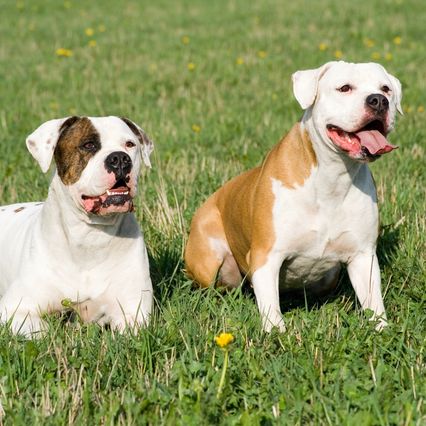
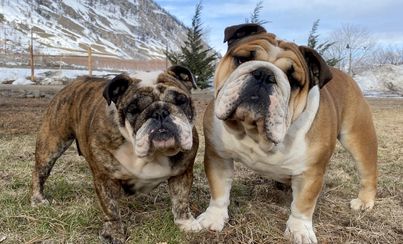
2 Bulldogs stand with a mountain backdrop
Img:

Fields’ Folly

Health issues

Bulldogs have become the poster child dog of health issues, and it is true that they have more than most breeds.

Lifespan: 8 to 10 years.

Brachycephalic obstructive airway syndrome (BOAS)

Occurs in short-faced breeds, including Bulldogs. Some Bulldogs have one or more of the components of BOAS, which can cause breathing difficulties. These components are stenotic nares (pinched nostrils), elongated soft palate, and other anatomic defects associated with the respiratory tract. Dogs that have difficulty breathing, that require surgical therapy, or that have a hypoplastic trachea should not be considered for breeding.

Cesarean section

Most Bulldogs are born by Cesarean section. Many breeders arrange for a planned C-section, which is oftentimes safer than waiting for problems to develop.

Inability to tolerate hot weather

Bulldogs cannot tolerate hot weather. They must have air conditioning in any warm climate, and should not exercise in the heat. Even summer road trips entail preparation in case the car's air conditioning fails. Battery fans, cool mats, cool coats and bandanas can help keep them cool on warm outings. When it comes to Bulldogs, heat kills.

Orthopedic issues

Multiple orthopedic issues such as hip dysplasia (when the head of the femur doesn’t fit in the pelvic socket, causing arthritis and lameness), elbow dysplasia (in which the elbow joint develops inappropriately, causing arthritis and lameness), and patellar luxation (in which the kneecap slips out of the groove in which it should be nested).

Ocular issues

Several ocular problems such as dry eye, distichiasis, entropion and ectropion, and cherry eye.

Other health issues

Other conditions seen at a higher rate include skin issues, pulmonic stenosis, bladder stones, spina bifida, and hiatal hernias.

Learn more about health issues that may impact Bulldogs

History

The Bulldog was once known for its ferocity, but is now better known as a companion, especially popular with celebrities. It’s one of America’s most popular breeds.
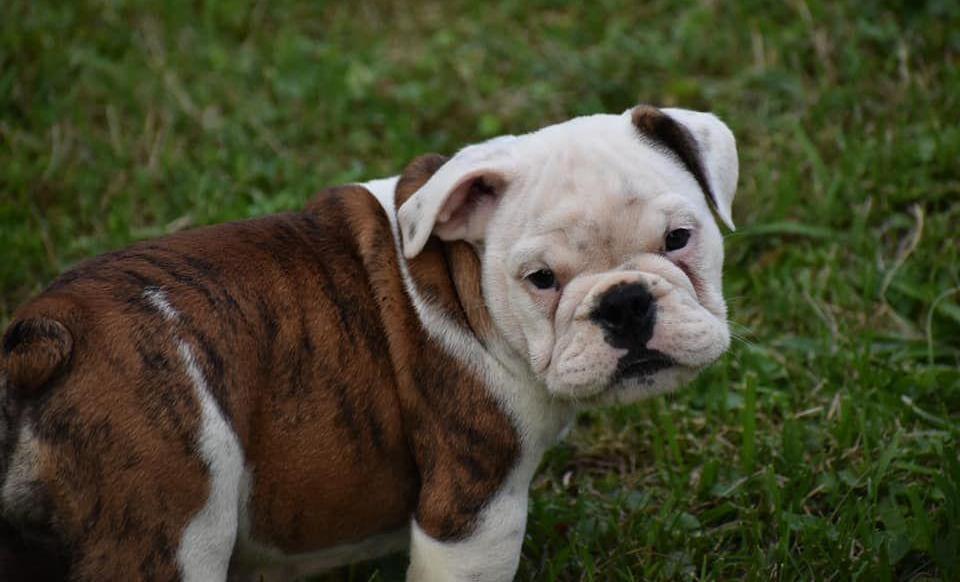
The Bulldog’s ancestors aren't known, but they probably descended from ancient Roman molossian war dogs and British Mastiffs. Interbreeding these strains produced a large, fearless dog suited for fighting a range of imposing animals in the arena at a time when there was no television or video games for entertainment. Bear baiting was particularly popular, although almost any large animal was victimized in the name of spectacle. By the 16th century smaller Mastiffs became popular as butcher's dogs. Their job was to control cattle in the stock yard and more importantly, to bait bulls---essentially tormenting them to death because it was thought to render the bull's meat more tender.Fortunately bull baiting was banned in 1835. The Bulldog was then repurposed as a purely companion dog, bred for personality and appearance, The American Kennel Club (AKC) recognized the Bulldog in 1886, making it one of the earliest AKC breeds. The Bulldog was placed in the Non-Sporting group and has remained there since. Celebrity owners include Brad Pitt, Adam Sandler, Pink, Miley Cyrus, Gloria Estafan, Ice-T, and Presidents Calvin Coolidge and Warren Harding.
About the author

Canine specialist, Caroline Coile, Ph.D., is the author of 34 dog books, including the top-selling Barron's Encyclopedia of Dog Breeds. She’s written thousands of magazine and web articles about dogs. She specializes in canine science, health, breeds and competitions. Caroline has won 20 national dog-writing awards, and was a 2015 Inductee into the Dog Writers Association of America Hall of Fame.

Breed Scorecard

Characteristics and temperament
  • Affectionate with family

    5

  • Watchdog level

    1

  • Playfulness

    4

  • Adaptability

    3

  • Social needs

    4

  • Temperament

    Comical, friendly, affectionate

  • Intelligence

    4

  • Good with other dogs

    2

  • Good with cats or other pets

    4

  • Friendly with strangers

    4

  • Good as a service dog

    1

  • Good for apartments

    5

  • Barking level

    1

Appearance
  • Height

    14-15"

  • Size

    Medium

  • Colors

    Blue tri-color (non-standard), Black tri-color (non-standard), Chocolate tri-color (non-standard), Lilac tri-color (non-standard), Fallow, Red, Fawn, White, Brindle, Fawn and brindle, Fawn and white, Fawn brindle and white, Red brindle and white, Red and white, Red brindle

  • Coat texture

    Fine

  • Coat length

    Close, short

Training
  • Trainability

    2

Exercise
  • Exercise needs

    1

  • Exercise time

    About a half hour daily

  • Mental exercise needs

    3

  • Favorite activities

    Tricks

Grooming
  • Grooming needs

    3

  • Brushing frequency

    Monthly

  • Needs professional grooming?

    No

  • Drooling level

    4

Health issues
  • Brachycephalic obstructive airway syndrome (BOAS)

  • Cesarean section

  • Inability to tolerate hot weather

  • Orthopedic issues

  • Ocular issues

  • Other health issues

Other
  • Bred for

    Bull baiting

  • Country of origin

    England

  • Popularity level

    5

FAQs

  • On Good Dog, you can search for Bulldog puppies or dogs in rescues and shelters. Adopting a Bulldog from a shelter or rescue is generally less expensive than buying a puppy from a breeder with ethical practices. Across the United States, there are dedicated rescues that specialize in specific breeds and may even help transport a Bulldog dog to you from another part of the country. Although it can be more cost-effective, adopting the exact breed you're looking for is typically more difficult than working with a responsible breeder. Learn more about adopting a dog from a shelter or rescue.

  • Yes. Bulldogs are gregarious and usually want to be everybody’s new best friend. They can be a great choice as a family pet.

  • Bulldogs are not at all aggressive, A few can itch for a fight with a strange dog, but generally they are lovers, not fighters, And they tend to be very safe with children.

  • DNA.

  • Prices for Bulldog puppies for sale vary by breeder and individual puppy. On Good Dog today, Bulldog puppies are typically around $4,250. Because all breeding programs are different, you may find dogs for sale outside that price range.
Caroline Coile, Ph.D.

Caroline Coile specializes in canine science, health, breeds and competitions. Caroline has won 20 national dog-writing awards, and was a 2015 Inductee into the Dog Writers Association of America Hall of Fame. She’s written thousands of magazine and web articles about dogs in addition to 34 dog books.

Content on Good Dog is generated, fact-checked, and evaluated by qualified writers and veterinarians.

Caroline Coile, Ph.D.

Caroline Coile specializes in canine science, health, breeds and competitions. Caroline has won 20 national dog-writing awards, and was a 2015 Inductee into the Dog Writers Association of America Hall of Fame. She’s written thousands of magazine and web articles about dogs in addition to 34 dog books.

Content on Good Dog is generated, fact-checked, and evaluated by qualified writers and veterinarians.