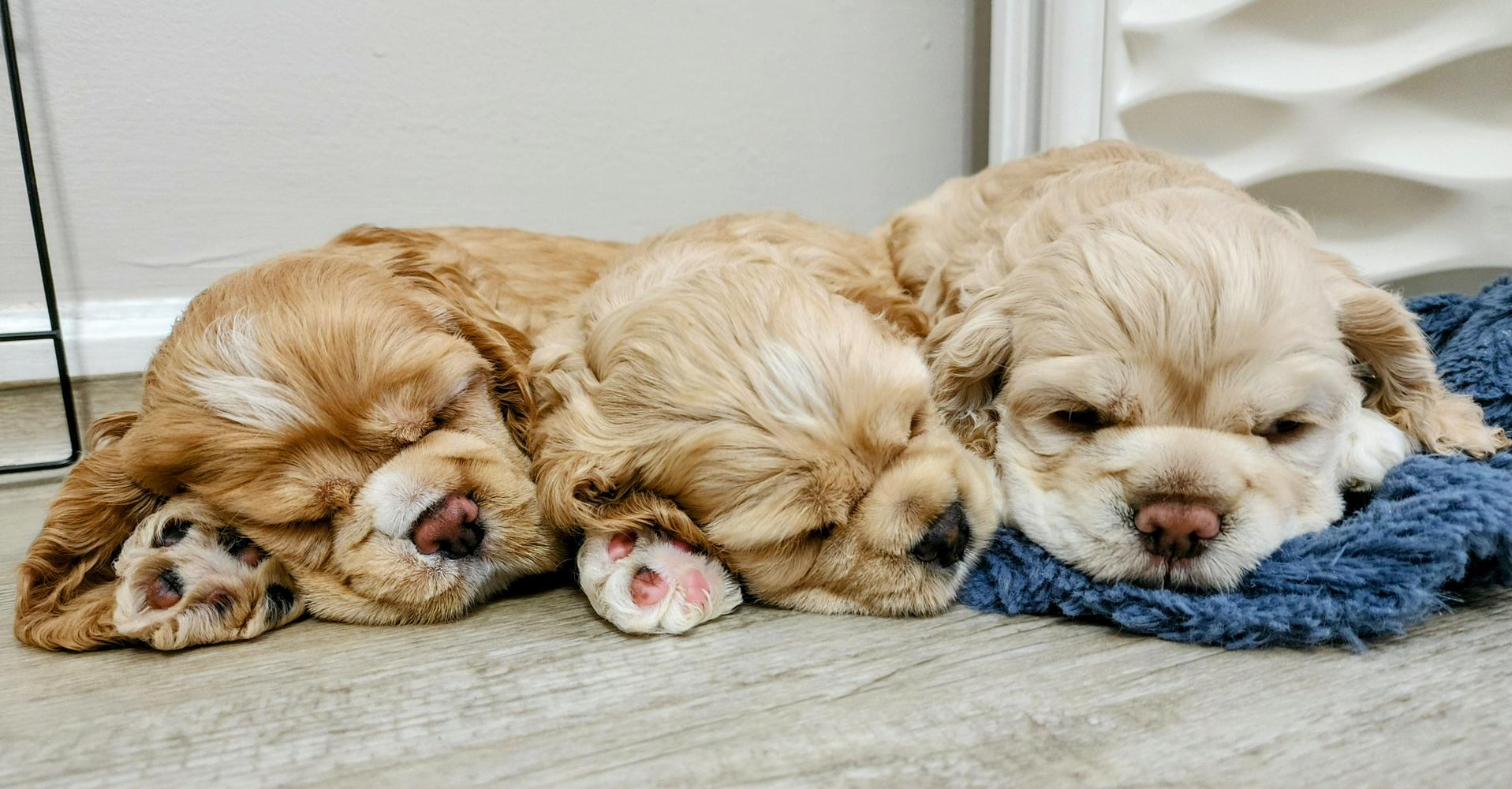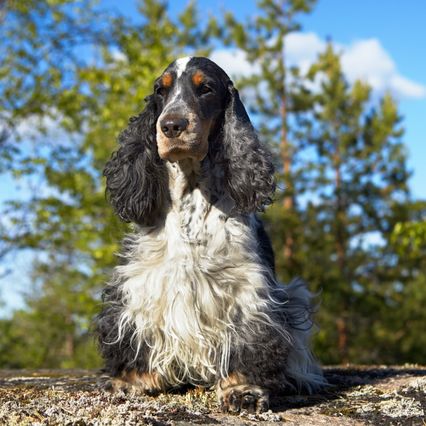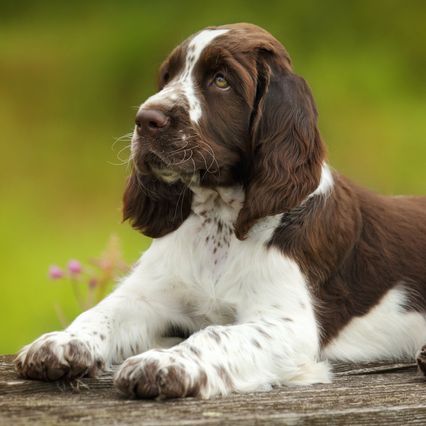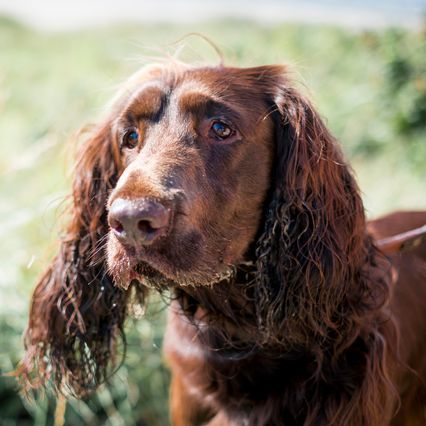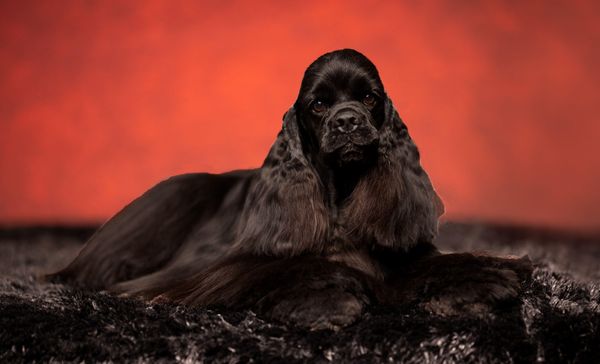
A beautifully groomed Black Cocker Spaniel lays with a red backdrop.
Get to know

Cocker Spaniels

Written by
Caroline Coile, Ph.D.,
 author of 34 dog books.
Written by
Caroline Coile, Ph.D.,
 author of 34 dog books, including the top-selling Barron's Encyclopedia of Dog Breeds.
| | | | |

While there’s also an English Cocker Spaniel, in North America ‘Cocker” means (American) Cocker Spaniel.

The Cocker had a job change from hunting companion to family companion, becoming the most popular breed in America for many years. Their merry attitude and sweet personality still makes them a family favorite.
Browse available puppies

Connect with reputable breeders to find the dog of your dreams

At a glance

Moderate Energy

Energy level

3/5

Regular Maintenance

Grooming

4/5

Medium

Size

Happy, exuberant, social

Temperament

10-14 years

Lifespan

Quick to Learn

Training

4/5

Medium Vocality

Barking

3/5

At a glance

  • Energy level

    Moderate Energy

  • Grooming

    Regular Maintenance

  • Size

    Medium

  • Temperament

    Happy, exuberant, social

  • Lifespan

    10-14 years

  • Training

    Quick to Learn

  • Barking

    Medium Vocality

Why people love the breed

Cockers have everything going for them: personality, looks, size—and lots and lots of love.
Cockers are perpetually happy, eager to please, affectionate, adventurous, playful, and gentle, all in a conveniently sized package and wrapped in a luxurious fur coat of many colors. Cockers get along with everyone in the family, and make new friends easily. And then there’s that puppy face: have you ever noticed how many stuffed toy dogs have faces obviously modeled after Cockers? That’s because the Cocker has one of the sweetest faces in the dog world. And they’re as sweet as they look.

Appearance

The Cocker combines a sweet face with a luxurious coat and a medium-sized compact body.
The Cocker is a square-proportioned dog with long hair that can reach the ground when well-cared for. The face is one of the Cocker’s defining features, along with kind eyes, and long feathered ears. The tail is traditionally docked where docking is legal. The Cocker is divided into three varieties according to color: Black; ASCOB (which stands for Any Solid Color Other than Black, and includes cream, red, brown, and brown with tan points); and Particolor.

Grooming

If you want a coat like those sported by Cockers in the show ring, it’s going to take some work. But most Cockers can be maintained fairly easily in a shorter clip done by a groomer.

The long coats you see on show Cockers take a lot of work. The feathering below the ear is wrapped or held back by a snood to keep the hair out of the dog’s mouth or food. The coat is meticulously clipped and scissored to achieve the perfect look. It’s a skill that professional Cocker handlers have perfected, and even a pet groomer won't master. Pet groomers do their own version of Cocker trimming. They use the clippers more liberally, leaving just enough hair on the ears and legs and chest to maintain that Cocker look without too much work at home. This is what most owners elect for their Cocker, visiting the groomer every 6 weeks or so. In between grooming appointments, you still need to do your part by using a pin brush and comb every day to keep the silky coat tangle and mat free. Washing the hair will decrease its tendency to tangle, as oily, dirty coats tangle more. Cockers aren’t big shedders, but you still need to comb out dead hair regularly. Check your Cocker’s lush ears at least weekly. Cockers have a tendency to develop ear infections because of their long, drooping ears and excessive hair growth and wax production within the ear canals. Cockers also have a propensity to develop dry eye and other eye problems resulting in discharge. If this occurs, discuss with your veterinarian. Brush the teeth daily.
Cocker Spaniel puppy sits in a basket.

Breed temperament and characteristics

The breed is known as the “merry” Cocker, and it’s not a case of false advertising.
The Cocker is an eternal optimist, happy-go-lucky and full of love and merriment. Whether it’s an outing in the car, a walk around the block, a game in the house, or a snuggle on the sofa, Cockers tend to approach every activity as though they just won the lottery. They’re known for their wagging tail that as often as not continues on to a full body wag. They are not known for being understated. Cockers can be great family dogs. They are playful and gentle enough to be a child’s playmate, adventurous enough to be a hiking buddy for adults, and sweet enough to be a calm companion for the elderly. They can make outstanding therapy dogs, but their size and tendency to become overly excited holds them back from being great service dogs. The Cocker’s ancestors were bred as determined hunters. Today’s Cockers are bred as family companions, and are considered to have had their hunting abilities dulled. Nonetheless, some Cocker lines are still used for hunting small upland birds and for field events and perform these jobs well. Even a city Cocker will come to full alert upon spotting a bird in the brush.

Exercise

Like most gun-dog breeds, Cockers tend to be high energy and need a fair amount of exercise.

Because of their size, Cockers may be able to meet their exercise requirements in a smaller space, but still need either a yard to play in or at least an hour-long walk daily. Most do well with a daily walk around the neighborhood plus some vigorous games in the yard or house. They enjoy hiking and some but not all enjoy swimming. They do well in dog parks but are at the borderline between small dogs and large dogs in most parks that divide areas by size. Fetch is one of their favorite games. Cockers have very good noses and many enjoy the sports of tracking, nosework and even barn hunt. Many enjoy dog sports such as agility, which exercises their mind as much as their body.
5 Cocker Spaniels pose on a mountainside
Img:

Gail Workman's Cocker Spaniels

Training

Cockers are eager to please and extremely biddable. They make training fun.
Cockers are excited just to have the chance to learn something new. Sometimes their high excitement can interfere with training so you may have to try extra hard to keep a calm mellow tone and approach when you train. You may even have to use less yummy treats. But every Cocker is different so you may have to experiment before you find the best level of excitement. Once you’ve got your Cocker’s attention, the breed is very easily trained. They enjoy pleasing you (and of course, getting treats) and they learn quickly. Cockers have competed at the highest levels of competitive obedience. They do very well in the sport of Agility which requires a great deal of obedience. They learn tricks quickly.

Diet and nutrition

Cockers tend to be hearty eaters and may pack on extra pounds.
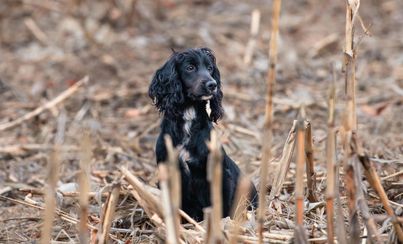
Generally high-quality commercial food will give your Cocker ideal health. If you choose to devise your own diet, be aware that it is impossible to prepare one yourself that is appropriate (you must consult with a veterinary nutritionist). Cockers approach eating as they do everything else—with enthusiasm. That means you have to keep an eye on their weight. You should be able to feel the ribs without much poking, and see an hourglass figure when viewed from above. Talk to your veterinarian about reducing weight if your Cocker starts to be pudgy. In fact, your veterinarian should be a main source of your information about special diets for medical needs as well.
Img:

Berry Creek Labs & Cockers

Health issues

Although like most popular breeds, Cockers have what seems like a laundry list of disorders, few of them are severe, and few overwhelmingly common.

Lifespan: 10 to 14 years.

Hip dysplasia

This is a complex condition that involves both genetic and environmental factors and arises when the head of the femur doesn’t fit in the pelvic socket, causing arthritis and lameness. No genetic test is available to date, therefore, the recommended screening test is x-rays.

Other health issues

Hypothyroidism, chronic ear infections, juvenile cataracts, distichiasis, and glaucoma.

Learn more about health issues that may impact Cocker Spaniels

History

American Cockers are an American breed, and are an American media sweetheart.

Spaniels were developed by dog breeders in Europe in the 1300s to flush birds into nets or to waiting falcons. Later they added not just flushing, but finding birds to their list of talents. They became specialized, with the Cocker used to hunt woodcock. After coming to America, they became popular as show dogs, but the winning Cockers tended to be smaller, longer-legged, rounder headed and with a heavier coat than their ancestors. In 1946, the American Kennel Club (AKC) split the breed into the original, now called the English Cocker Spaniel, and the new show dog, simply the Cocker Spaniel. Note that in the rest of the world, the original is the Cocker Spaniel and the other the American Cocker Spaniel. The Cocker is in the AKC Sporting group. The Cocker was the most popular breed in America from 1936 to 1952, and from 1983 to 1990. It is still one of the more popular dog breeds today. Cocker celebrities include Spot (of Dick and Jane “See Spot Run” fame), Lady ("Lady and the Tramp"), and the Coppertone Cocker. Lady and Spot are amongst the most popular dog names. Owners include Richard Nixon, Robert Kennedy, George Bush, Bill Clinton, Rutherford B. Hayes, Lauren Bacall, Ernest Hemingway, Katharine Hepburn, Sugar Ray Leonard, Tom Selleck, Frank Sinatra, Steven Spielberg, Elizabeth Taylor, Tom Selleck and Oprah Winfrey.
About the author

Canine specialist, Caroline Coile, Ph.D., is the author of 34 dog books, including the top-selling Barron's Encyclopedia of Dog Breeds. She’s written thousands of magazine and web articles about dogs. She specializes in canine science, health, breeds and competitions. Caroline has won 20 national dog-writing awards, and was a 2015 Inductee into the Dog Writers Association of America Hall of Fame.

Breed Scorecard

Characteristics and temperament
  • Affectionate with family

    5

  • Watchdog level

    2

  • Playfulness

    4

  • Adaptability

    4

  • Social needs

    5

  • Temperament

    Happy, exuberant, social, easy to please, gentle

  • Intelligence

    4

  • Good with other dogs

    5

  • Good with cats or other pets

    5

  • Friendly with strangers

    4

  • Good as a service dog

    3

  • Good for apartments

    3

  • Barking level

    3

Appearance
  • Height

    13-15"

  • Size

    Medium

  • Colors

    Blue roan, Cream (non-standard), Red roan, Brown, Buff, Red, Black and tan, Black and white, Black white and tan, Brown and white, Brown white and tan, Red and white, Brown roan, Brown roan and tan, Golden (non-standard), Sable (non-standard), Sable and white (non-standard), Black, Blue roan and tan, Silver, Brown and tan, Buff and white

  • Coat texture

    Silky

  • Coat length

    long, feathered, flat

Training
  • Trainability

    4

Exercise
  • Exercise needs

    3

  • Exercise time

    1 hour daily

  • Mental exercise needs

    4

  • Favorite activities

    Hunting, retrieving, nose work, tricks, obedience,

Grooming
  • Grooming needs

    4

  • Brushing frequency

    Daily

  • Needs professional grooming?

    Yes

  • Drooling level

    2

Health issues
  • Hip dysplasia

  • Other health issues

Other
  • Bred for

    Upland bird flushing and retrieving

  • Country of origin

    United States (previously England)

  • Popularity level

    5

FAQs

  • On Good Dog, you can search for Cocker Spaniel puppies or dogs in rescues and shelters. Adopting a Cocker Spaniel from a shelter or rescue is generally less expensive than buying a puppy from a breeder with ethical practices. Across the United States, there are dedicated rescues that specialize in specific breeds and may even help transport a Cocker Spaniel dog to you from another part of the country. Although it can be more cost-effective, adopting the exact breed you're looking for is typically more difficult than working with a responsible breeder. Learn more about adopting a dog from a shelter or rescue.

  • Prices may vary based on the breeder and individual puppy for sale.. On Good Dog, Cocker Spaniel puppies are around $1,750. We recommend speaking directly with your breeder to get a better idea of their price range.

  • Yes. They tend to have good manners with proper training and are not particularly destructive, although any dog can be. They tend to get along with everyone.

  • Most dogs don’t enjoy being left alone, and because Cockers are particularly social, they may enjoy it even less. They might be alright while you're at work, but if you plan to always be gone, it may not work out. In addition, if you can exercise your dog before leaving, that will help the dog rest while you're gone.

  • Cocker Spaniels were the most popular breed in America for many years simply because they are such good family dogs. They are merry, gentle, adventurous and just the right size for their dog owners. They get along with everyone.

Caroline Coile, Ph.D.

Caroline Coile specializes in canine science, health, breeds and competitions. Caroline has won 20 national dog-writing awards, and was a 2015 Inductee into the Dog Writers Association of America Hall of Fame. She’s written thousands of magazine and web articles about dogs in addition to 34 dog books.

Content on Good Dog is generated, fact-checked, and evaluated by qualified writers and veterinarians.

Caroline Coile, Ph.D.

Caroline Coile specializes in canine science, health, breeds and competitions. Caroline has won 20 national dog-writing awards, and was a 2015 Inductee into the Dog Writers Association of America Hall of Fame. She’s written thousands of magazine and web articles about dogs in addition to 34 dog books.

Content on Good Dog is generated, fact-checked, and evaluated by qualified writers and veterinarians.