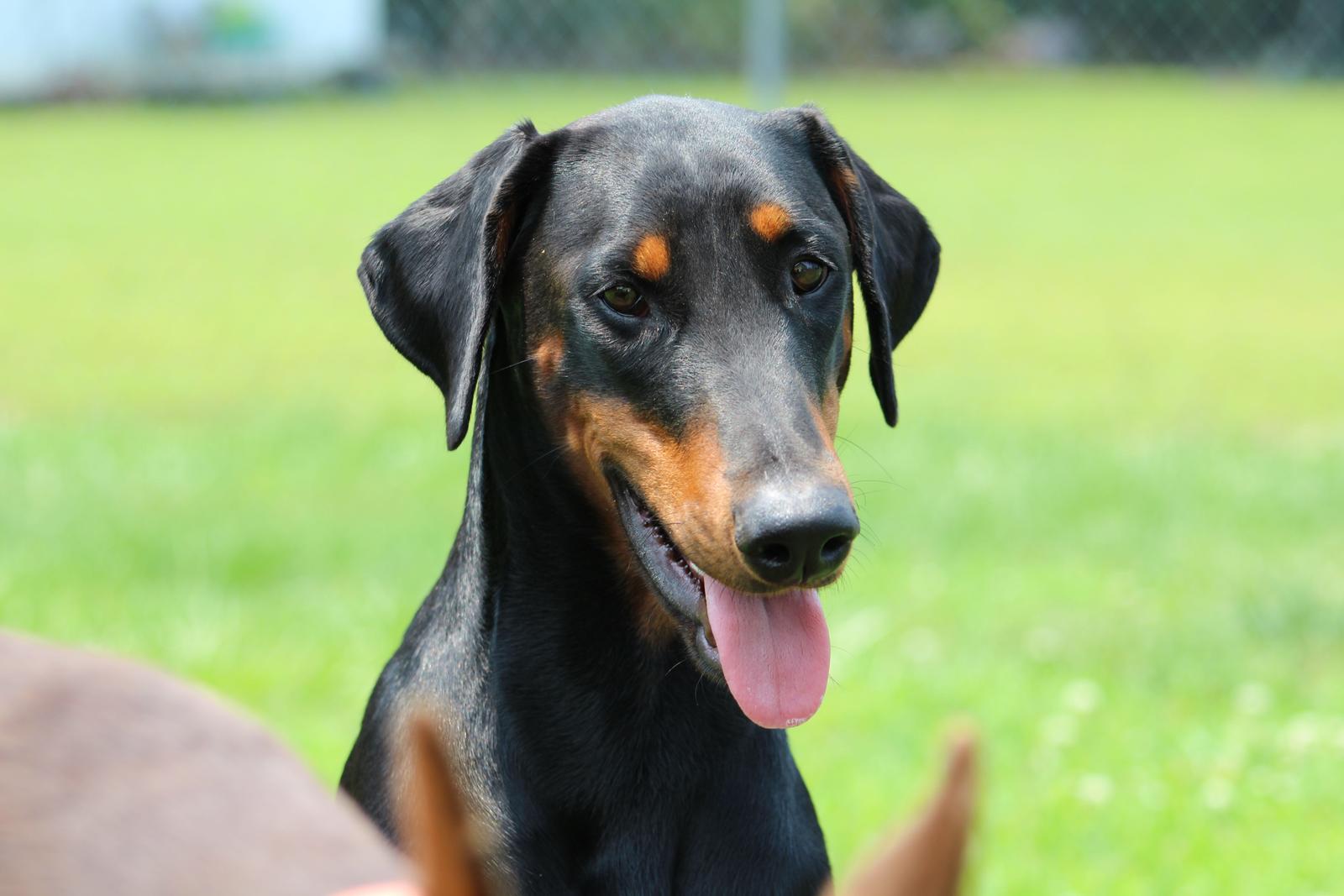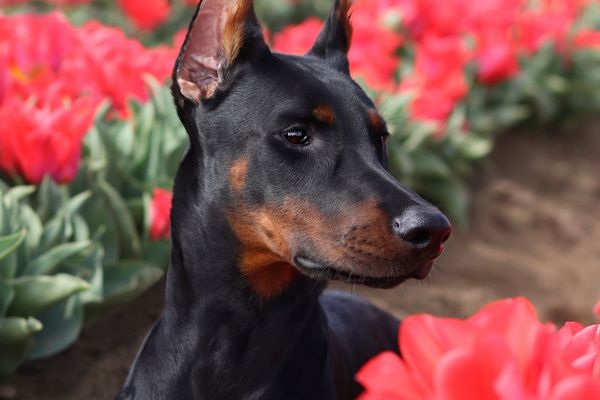
A black and rust Doberman sits with a background of red tulips
Get to know

Doberman Pinschers

Written by
Caroline Coile, Ph.D.,
 author of 34 dog books.
Written by
Caroline Coile, Ph.D.,
 author of 34 dog books, including the top-selling Barron's Encyclopedia of Dog Breeds.
| | | | |

Who needs a security system when you have a Doberman in the house?

A Doberman Pinscher is like having a security camera, burglar alarm, and one-dog SWAT team all connected to a central computer whose aim is to seamlessly guard your home and self.
Browse available puppies

Connect with reputable breeders to find the dog of your dreams

At a glance

High Energy

Energy level

4/5

Minimal Maintenance

Grooming

1/5

Large to Extra Large

Size

Alert, suspicious, biddable

Temperament

10-12 years

Lifespan

Highly Trainable

Training

5/5

Vocal

Barking

4/5

At a glance

  • Energy level

    High Energy

  • Grooming

    Minimal Maintenance

  • Size

    Large to Extra Large

  • Temperament

    Alert, suspicious, biddable

  • Lifespan

    10-12 years

  • Training

    Highly Trainable

  • Barking

    Vocal

Why people love the breed

Dobes are protective without being obtrusive, strong without being massive, and smart without being hyperactive. Plus they look good.
Dobermans are tough when the situation calls for it, but they’re very good at discriminating against a serious threat from one they can just keep an eye on. And they will indeed keep an eye on everyone and everything. If a real threat is perceived, they’re ready to take action. It’s their combination of brains, brawn and bravery that has made them so popular with police, military and families for decades. Dobermans are highly intelligent, learn quickly and are willing to please. They are alert and active but not annoyingly so. They make well-mannered house dogs. The Doberman physique is a picture of sleek athleticism. The Doberman is strong but graceful, with an alert attitude and piercing gaze that can intimidate the bravest of burglars. A Doberman always turns heads wherever it goes. Owning a Doberman is like having your own guard dog and sentry service that can patrol your yard and share your home, and look like a high-fashion model doing it.

Appearance

The Doberman is the picture of a dog on high-alert, always at the ready, their entire being giving the impression of tamped down energy looking for a legitimate reason to go get’em.
The Doberman is square-proportioned but compactly built. They are sleek, with flowing lines, but also athletic and muscular. The stomach is tucked up, but not as much as a Greyhound’s. The topline is flat. The feet are well-knuckled. The head is a blunt wedge. Overall, the Doberman combines elegance and power. Its carriage tends to be proud and alert, with an intelligent look. The breed naturally stops four-square, and its gait is tireless. In countries in which it’s legal, the tail is customarily docked, and the ears cropped. Uncropped ears hang down. Standard colors include black, red, blue, and fawn, while standard markings include rust.

Grooming

Doberman grooming is as easy as it gets, requiring no special tools, techniques, or time.
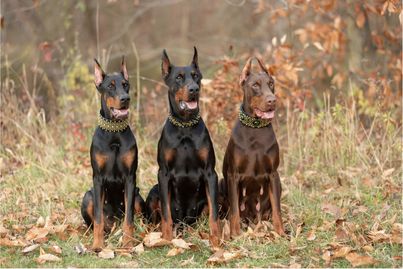
The Doberman’s hard, short coat not only conforms to the body, accentuating the athletic build, but also repels dirt. Even mud tends to just dry up and fall off. The breed has minimal doggy odor. However, an occasional brushing with a bristle or rubber brush will remove loose hairs, And an occasional shampoo gives your Doberman a silkier feel to the coat and cleaner smell all over. Check the ears for excessive debris weekly. The Doberman’s foot conformation tends to have very steep toes, which makes it all the more important to keep toenails trimmed short. Brush the teeth daily to prevent tartar build-up.
3 Dobermans sit and pose for the camera, 2 are black and rust and 1 is red and rust
Img:

Imperium Dobermann Kennel

Breed temperament and characteristics

Alert, courageous and intelligent—the Doberman is like an elite special forces soldier. Which is one of their many jobs they’ve actually held.
The Doberman Pinscher was a breed specifically created with a job in mind: to serve as a personal protection dog for a door-to-door tax collector in the late 1800s. This was not a popular job, nor a safe one, and Louis Dobermann needed a dog that he could trust with his life. The dog had to be alert, protective, biddable and intelligent—traits that survive today in the breed. They have been used extensively as police, military, private sentry and family protection dogs since then. They can be fierce when the circumstances warrant, but are generally gentle and safe around trusted ones, including family members of all ages. That said, most Dobermans do not easily trust strangers, and won't hesitate to make sure even your welcome company doesn't feel at home––at least not until they’ve visited several times. Dobermans make well-mannered house dogs, and are devoted family members. They do bark, but not without reason. They can be reactive toward other dogs, but tend to get along with housemates. They do well with other household pets, especially if they are raised together. Even though they tend to be alert, and love outdoor adventures and action, they are also capable of relaxing, and they relish lazy time on the couch with family. This is a great family dog that is able to fulfill many roles: guardian, playmate, fellow adventurer and even cuddler.

Exercise

Dobermans are large, active, and athletic, so they need a lot of exercise, But they’re not hyperactive, and if you miss a day, they won’t necessarily turn into a demolition dog. Just don’t make it a habit.
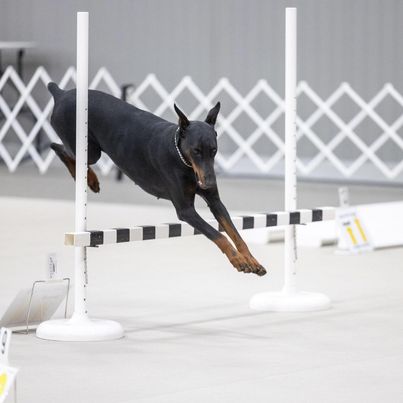
Dobermans Pinschers need one to two hours of exercise each day. Some of this can be hard running and jumping, but most can be trotting or playing games. They make excellent running or hiking companions. They enjoy a variety of games, including fetch, Frisbee, and tug. Many enjoy swimming. Mental exercise is equally important, and should be a part of their exercise every day. Otherwise they may flex their brain power by thinking up ways to destroy your home. Consider dog sports and activities such as agility, dock diving, and Schutzhund that combine physical and mental exertion.
Black and rust Doberman jumping in a competition
Img:

Gordon Farms Dobermans

Training

Dobermans have the ability to make you feel like they're smarter than you are. And sometimes, they just may be.
It’s as though all Dobermans are born with a hereditary knowledge of who to trust and what to do in an emergency. They can look right through a person as though reading their intentions. And they can do this to you if you try to train them using force techniques. It’s important to know what you’re doing when training any dog; it's imperative with a Doberman. If they think you’re a bully or using harsh techniques, they'll rebel and refuse to work. If they think you're uncertain and don't have a clue about training, they’ll agree, and again, refuse to cooperate. But if you use appropriate positive rewards, consistently coupled with firm and consistent rules, they will respect you—because they want to, not because they've been forced to. Dobes have succeeded at the very highest levels of competitive obedience and rally. They’ve excelled as military, police, service, and search & rescue dogs—all jobs where people’s lives depended on these dogs. They are capable of uncanny feats of intelligence. You just have to show them how, and convince them you both want to do them. Dobermans love to show off their ability at obedience, rally, agility, tracking, dock diving and protection sports.

Diet and nutrition

Adult Dobermans usually require no special diet, but as puppies should eat a food formulated for large breeds.
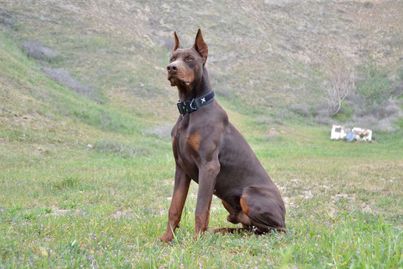
Dobermans thrive on high quality food. The Doberman is a svelte athletic breed. You should be able to feel the ribs and hips without much prodding, and the musculature should be evident. Your Dobe should have a slightly hourglass shape viewed from the top, with a well tucked up abdomen from the side, and no dimple over the tail. A very young Doberman puppy should eat puppy food three times a day until ~4 months of age, then puppy food two a day until ~age 9 months, then adult food two times a day thereafter. For puppies, feed them as directed by your veterinarian, but if they become chubby as older puppies you may have to slightly restrict their amounts. Talk to your veterinarian about special diets that may help some health problems, especially for Dobermans with cardiomyopathy.
Red Doberman sits majestically in front of a mountain
Img:

Obsidian Kennels

Health issues

Dobermans can be healthy and vigorous, but they might have two problems that occur more commonly in the breed: a heart disease and a blood clotting condition.

Lifespan: 10 to 12 years.

Dilated cardiomyopathy

In which the heart muscle becomes thinner and weaker, leading to a larger heart as the walls expand due to the pressure from the blood inside the heart, is one of the biggest health concerns in the breed. Echocardiograms performed by a veterinary cardiologist or radiologist can detect this condition and should be performed on any Doberman destined to be a parent.

Von Willebrand Disease (vWD)

Is an inherited bleeding disorder caused by a lack of and/or deficiency in von Willebrand factor protein, which is needed to help platelets stick together to form clots. This disease occurs more commonly in Dobes.

Hip dysplasia

Common in large breed dogs, this complex condition involves both genetic and environmental factors and arises when the head of the femur doesn’t fit in the pelvic socket, causing arthritis and lameness. No genetic test is available to date, therefore, the recommended screening test is x-rays.

Other health issues

Wobbler syndrome, flank sucking behavior, color dilution alopecia, gastric dilatation-volvulus, and narcolepsy

Learn more about health issues that may impact Doberman Pinschers

History

Dobermans owe their existence largely to the dream of one man, who sought to develop an intelligent guardian.
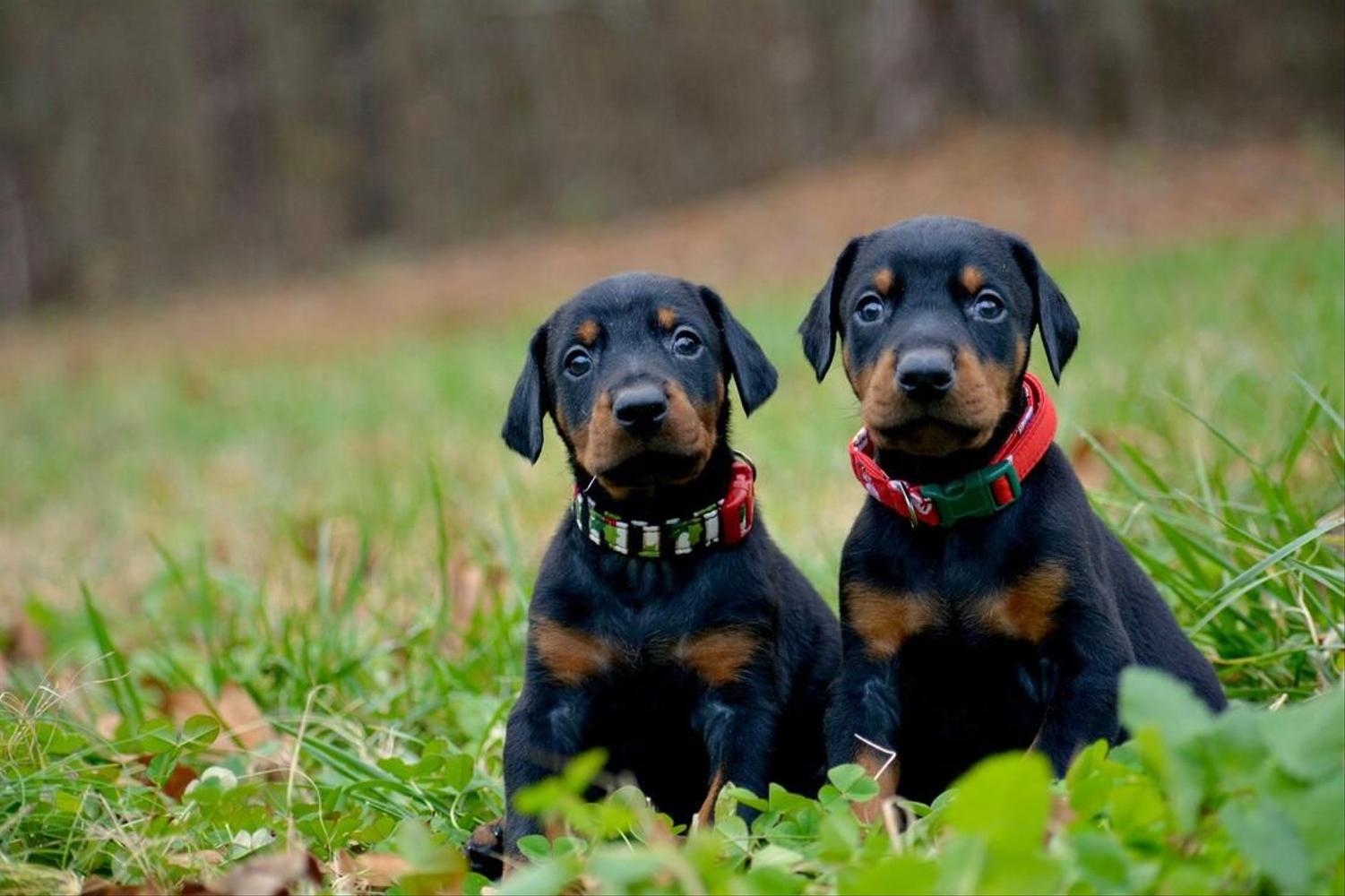
Doberman Pinschers were developed by the efforts of one man, Herr Louis Dobermann, a door-to-door tax collector who needed someone to watch his back. So in the late 1800s he crossed breeds including the Rottweiler, Beauceron, German Pinscher, and later the Black & Tan Manchester Terrier, Greyhound, and Weimaraner. The breed bearing his name was soon adopted as a police, guard, and war dog. During World War II, the United States Marine Corps adopted the Doberman as its official war dog. Later, they became a popular family pet, eventually rising to become the second most popular AKC breed in 1977. In the late 1970s the breed received much bad press as it was portrayed as a demonic attack dog. It’s true that during this time of irresponsible ownership Doberman bites were not uncommon. In most of the world the breed name is simply “Doberman.” The Doberman is still a popular military dog, but has been replaced in many cases by the Belgian Malinois. A Doberman that was supposed to be guarding a priceless stuffed toy exhibition once infamously ripped up a $75,000 Teddy bear. Owners include Rudolph Valentino, Bela Lugosi, John F. Kennedy, Raquel Welch, William Shatner, Priscilla Presley, Nicolas Cage, Hunter Thompson, and Mariah Carey.
About the author

Canine specialist, Caroline Coile, Ph.D., is the author of 34 dog books, including the top-selling Barron's Encyclopedia of Dog Breeds. She’s written thousands of magazine and web articles about dogs. She specializes in canine science, health, breeds and competitions. Caroline has won 20 national dog-writing awards, and was a 2015 Inductee into the Dog Writers Association of America Hall of Fame.

Breed Scorecard

Characteristics and temperament
  • Affectionate with family

    3

  • Watchdog level

    5

  • Playfulness

    3

  • Adaptability

    4

  • Social needs

    3

  • Temperament

    Alert, suspicious, biddable, protective

  • Intelligence

    5

  • Good with other dogs

    2

  • Good with cats or other pets

    3

  • Friendly with strangers

    1

  • Good as a service dog

    4

  • Good for apartments

    1

  • Barking level

    4

Appearance
  • Height

    24-28"

  • Size

    Large to Extra Large

  • Colors

    Black and rust, Blue and rust, Fawn (isabella) and rust, Red and rust

  • Coat texture

    Hard, smooth

  • Coat length

    Short, close

Training
  • Trainability

    5

Exercise
  • Exercise needs

    4

  • Exercise time

    1 to 2 hours daily

  • Mental exercise needs

    5

  • Favorite activities

    Schutzhund, obedience, agility, tracking, hiking

Grooming
  • Grooming needs

    1

  • Brushing frequency

    Monthly

  • Needs professional grooming?

    No

  • Drooling level

    1

Health issues
  • Dilated cardiomyopathy

  • Von Willebrand Disease (vWD)

  • Hip dysplasia

  • Other health issues

Other
  • Bred for

    Guarding

  • Country of origin

    Germany

  • Popularity level

    5

FAQs

  • On Good Dog, you can search for Doberman Pinscher puppies or dogs in rescues and shelters. Adopting a Doberman Pinscher from a shelter or rescue is generally less expensive than buying a puppy from a breeder with ethical practices. Across the United States, there are dedicated rescues that specialize in specific breeds and may even help transport a Doberman Pinscher dog to you from another part of the country. Although it can be more cost-effective, adopting the exact breed you're looking for is typically more difficult than working with a responsible breeder. Learn more about adopting a dog from a shelter or rescue.

  • Prices may vary based on the breeder and individual puppy for sale.. On Good Dog, Doberman Pinscher puppies are around $3,250. We recommend speaking directly with your breeder to get a better idea of their price range.

  • They can be if not socialized and trained extensively. This was more of a problem when the breed was extremely popular, but far less so now.

  • They are smart and learn quickly, but do not suffer fools as trainers. Train them firmly, kindly, and consistently with proper training and they will learn quickly.

  • Yes! They are loyal, protective, intelligent, biddable, fun-loving and can be good with children. They enjoy outdoor adventures but can also relax indoors.
Caroline Coile, Ph.D.

Caroline Coile specializes in canine science, health, breeds and competitions. Caroline has won 20 national dog-writing awards, and was a 2015 Inductee into the Dog Writers Association of America Hall of Fame. She’s written thousands of magazine and web articles about dogs in addition to 34 dog books.

Content on Good Dog is generated, fact-checked, and evaluated by qualified writers and veterinarians.

Caroline Coile, Ph.D.

Caroline Coile specializes in canine science, health, breeds and competitions. Caroline has won 20 national dog-writing awards, and was a 2015 Inductee into the Dog Writers Association of America Hall of Fame. She’s written thousands of magazine and web articles about dogs in addition to 34 dog books.

Content on Good Dog is generated, fact-checked, and evaluated by qualified writers and veterinarians.