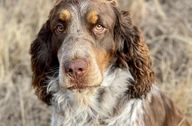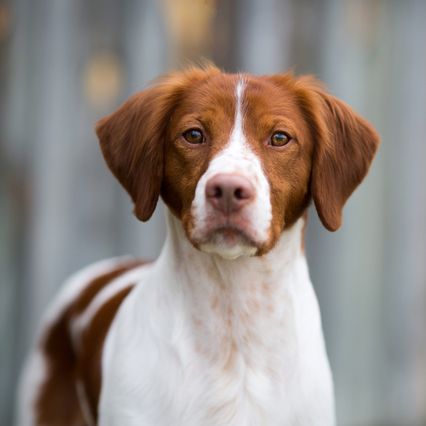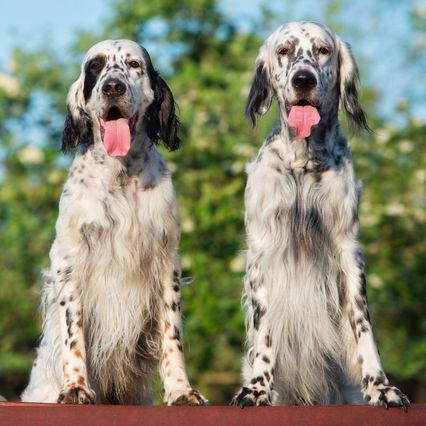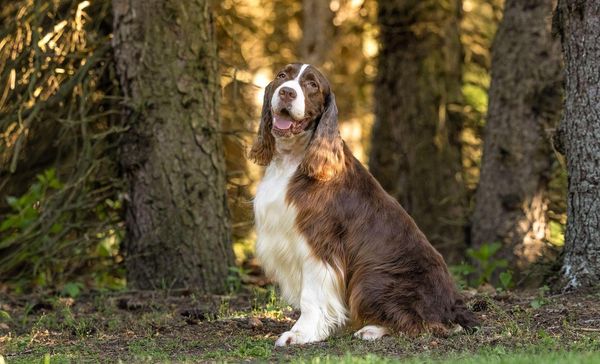
Liver and white English Springer Spaniel sitting with a forest in the background
Get to know

English Springer Spaniels

Written by
Caroline Coile, Ph.D.,
 author of 34 dog books.
Written by
Caroline Coile, Ph.D.,
 author of 34 dog books, including the top-selling Barron's Encyclopedia of Dog Breeds.
| | | | |

True, there’s also a Welsh Springer Spaniel, but when you just say “Springer” everyone knows you mean the English Springer.

The English Springer is one of the most regal of the spaniels. The Springer appeals to those with both a sense of tradition and adventure.

At a glance

High Energy

Energy level

4/5

Regular Maintenance

Grooming

4/5

Medium

Size

Energetic, playful, adventurous

Temperament

12-14 years

Lifespan

Highly Trainable

Training

5/5

Medium Vocality

Barking

3/5

At a glance

  • Energy level

    High Energy

  • Grooming

    Regular Maintenance

  • Size

    Medium

  • Temperament

    Energetic, playful, adventurous

  • Lifespan

    12-14 years

  • Training

    Highly Trainable

  • Barking

    Medium Vocality

Why people love the breed

People love English Springer Spaniels because Springers combine a dog that can spend the day hunting in the field with one that can spend the night sleeping on the bed–and never quit wagging their tail in either case.
Springers are always cheerful, eager to go on a grand adventure, whether it’s into the wilds or off to the store. They are eager to please and fairly easy to train. They are gregarious and usually get along well with everyone. They’re larger than a Cocker but smaller than the setters. They possess a classic look that shouts nobility, yet they have no problem making your home their castle. Most of all, Springers never quit wagging their tail. They have an enthusiasm that’s hard to resist, and seem to be eternal optimists.

Appearance

The Springer should be a combination of strength, agility and endurance, with the look of a dapper gun dog that can hunt tirelessly under difficult conditions.
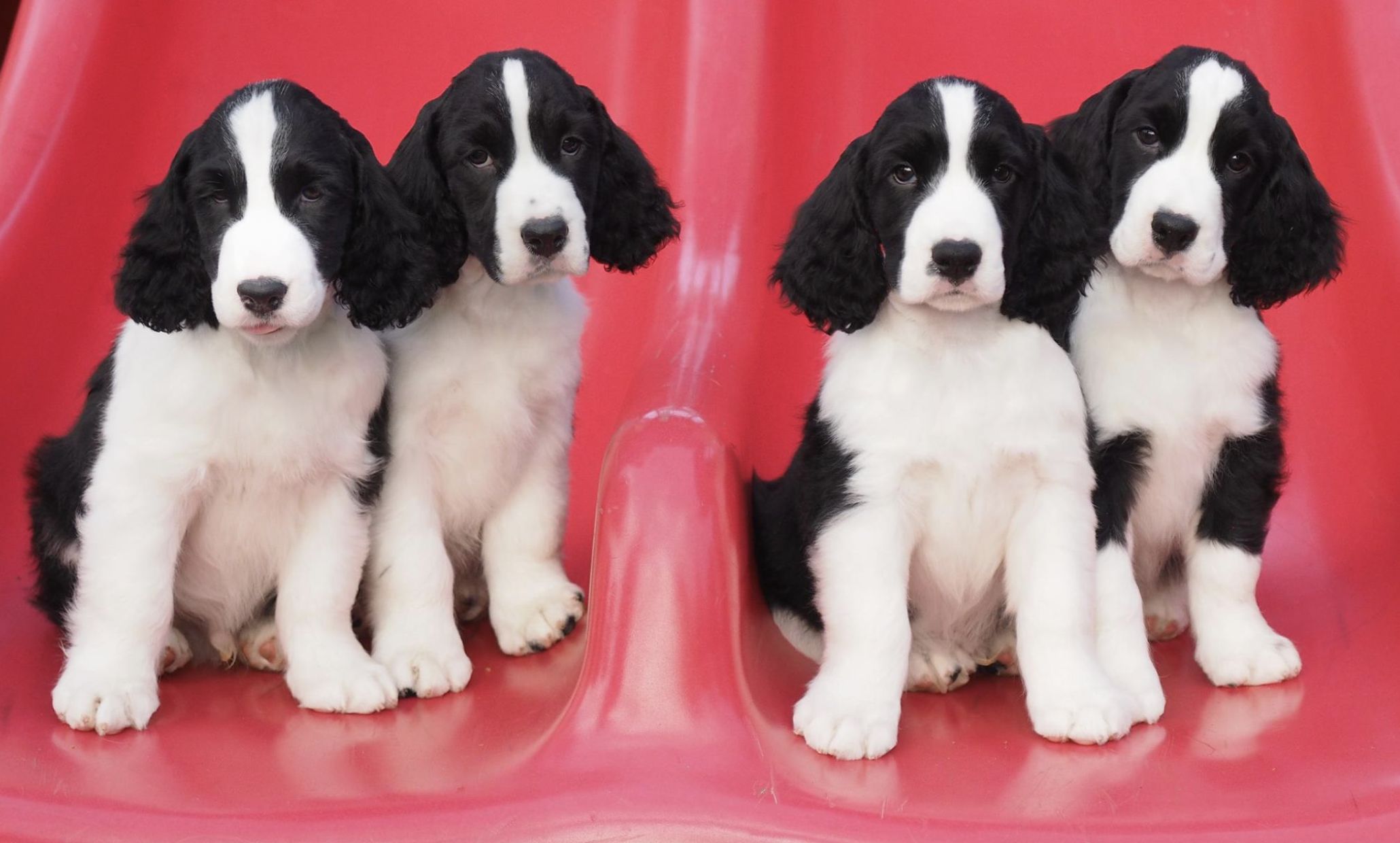
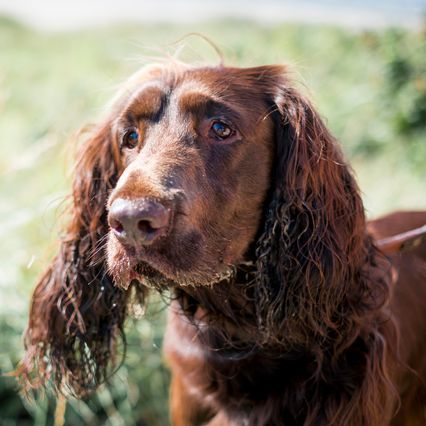
Springers are probably the most striking spaniel breed. Their athletic build, with a compact body, proud carriage, and medium-length feathered coat, commands attention. They are slightly longer than tall, with a straight topline sloping slightly toward the rear. The head has long hanging ears, and deep set oval eyes, creating an alert, kind, trusting expression. The coat is fine and straight to slightly wavy, feathered and without facial furnishings. The hair is silky, and most often liver saddled or black saddled with white trim, but also roan or tri-colored, or white with markings. There are two types of English Springer Spaniels. Show-bred, aka Bench bred Springers tend to be slightly larger, and field-bred slightly smaller, but this is quite variable. Field-bred Springers have more variable color patterning compared to show Springers, which are almost always black or liver saddled with white markings.

Grooming

Springers have a fairly long coat that can get out of hand if you don’t care for it regularly. Some people opt for professional grooming but you don’t necessarily need that as long as you keep up with it.
The perfect coats you see on show Springers take some work. They are combed daily, and the feathering below the ear is wrapped or held back by a snood to keep the hair out of the dog’s mouth or food. The coat is meticulously clipped and scissored to achieve that stunning silhouette. It’s a skill that professional show handlers have perfected, and even a pet groomer won't master. But you don’t need that degree of perfection. If you want a semblance of that show look, pet groomers can do a great job. More often Springer owners let their dog’s hair grow however it wants, so it tends to have more on the neck and back compared to the show or even pet clip. Keep in mind that Springers from show lines tend to have more coat and will need more care. Regardless, you need to do your part by using a pin brush and comb every few days to keep the coat tangle and mat free. Washing the hair will decrease its tendency to tangle, as oily dirty coats tangle more. Springers aren’t big shedders, but you still need to comb out dead hair regularly. Check your Springer’s ears at least weekly. The somewhat heavy hanging ears provide a warm damp haven in which infections can thrive, and Springers are at increased risk for chronic ear infections. Even pulling the ears back so the canal gets air can help keep them healthy. Brush the teeth daily. Check the nails and clip them as needed.
Adult liver and white Springer standing in the grass
Img:

Crossroad Springers

Breed temperament and characteristics

Springers are ever-cheerful and full of enthusiasm and energy.
Springers can be cheerful to the point of being giddy, with their tail wagging so fast their entire body is wagging with it. Sometimes you have to get them to calm down before they can concentrate on what they should be doing. Whatever you want to do, Springers want to do it too. That’s especially true if it’s something outside. They love adventure, but they also love to play games and to cuddle. They are good with everyone in the family, even other dogs and pets. They are gentle with children and the elderly.

Exercise

Springers are active dogs bred to spend hours in the field hunting. Plan on getting some exercise.
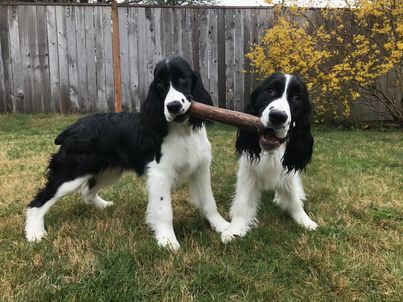
Springers love to be doing something, preferably outside and with their people. Hunting and hiking are some of their favorite activities. They also enjoy fetching and swimming. If you want a dog to get you off the couch, a Springer will do their part as they are not for someone with a sedentary lifestyle. Plan on spending one to two hours a day doing some physical activity with your Springer. They may not be able to get out into the field every day, but a long walk around the neighborhood, or some active games in the yard, or agility training, should be enough to settle them down when they come inside. They do fairly well at dog parks, as they tend to get along with other dogs.
2 black and white Springers hold onto the end of a stick
Img:

Tandem English Springer Spaniels

Training

Springers can be easy to train once you get their attention.
The Springer’s role in the field as a hunter’s companion meant it had to follow directions, often from a distance. Today’s Springers retain the ability to look for directions from their human companion. Some can be high-energy and overly excited at times, but once you calm them down and get them to focus they are incredibly bright and eager to please. They especially enjoy learning activities such as agility and field directions that integrate physical and mental challenges. Springers have reached the highest levels of obedience and agility competitions. They perform with exuberance, tail wagging throughout. Their most difficult training exercises are the “stays.” They work eagerly for treats, a chance to fetch, or praise.

Diet and nutrition

Springers are hardy eaters and need no special diet.

A good quality commercial food will keep most Springers healthy throughout their life. Some people prefer to make their own food, but must follow recommendations from a veterinary nutritionist. Springers eat with gusto, and have a tendency to gain weight. You should be able to feel the ribs without much poking, and see an hourglass figure when viewed from above. There should not be a dimple in front of the tail, nor a roll around the withers. Talk to your veterinarian about reducing weight if your Springer starts to become pudgy. In fact, your veterinarian should be a main source of your information about special diets for relevant medical needs as well. Puppies should eat puppy food multiple times a day until they are about four months old, then twice a day thereafter.
2 Springers with a pink and blue bandana on
Img:

45 N Springers

Health issues

The typical Springer is healthy of mind and body. However, they do have several potentially serious health problems. While uncommon, they should be considered when choosing a puppy.

Lifespan: 12 to 14 years.

Hip Dysplasia

Common in large breed dogs, this complex condition involves both genetic and environmental factors and arises when the head of the femur doesn’t fit in the pelvic socket, causing arthritis and lameness. No genetic test is available to date, therefore, the recommended screening test is x-rays.

Elbow Dysplasia

Found more often in larger breeds, this is a condition in which the elbow joint develops inappropriately, causing arthritis and lameness. No genetic test is available to date, therefore, the recommended screening test is x-rays.

Progressive Retinal Atrophy (PRA)

This disorder occurs due to a group of diseases that cause the receptors of the eye’s retina to gradually deteriorate, causing blindness. Various DNA tests are available, depending on breed. Ophthalmic exams performed by ophthalmologists are recommended as well.

Other health issues

Also reported are phosphofructokinase deficiency, glaucoma, fucosidosis, ear infections, seborrhea, bronchiectasis, immune mediated hemolytic anemia, and idiopathic epilepsy.

Learn more about health issues that may impact English Springer Spaniels

History

From the field to the White House, Springers seem to know how to move up in the world.
Spaniels were developed in Europe by the 1300s to flush game birds into nets, and later to find and point birds as well. They split into different lineages that specialized in certain birds and became separate breeds. Those specializing in large birds were called Springers (the smaller ones were Cockers). Springers were larger and ranged farther afield, flushing or “springing” the birds. The American Kennel Club (AKC) recognised the breed in 1810, placing it in the Sporting group. They quickly became extremely successful show dogs. Springers have won Best in Show at the Westminster Kennel Club dog show six times, more than any other Sporting breed. Their keen sense of smell has also been used to detect contraband, explosives, and even bees. A Springer named Buster was awarded Britain’s prestigious Dickin Medal for locating explosives in Iraq. Celebrity owners include Kate Middleton, Prince Harry, Princess Grace, both Presidents George Bush, Oprah Winfrey, Jimmy Buffett. Tilda Swinton, and Anderson Cooper.
About the author

Canine specialist, Caroline Coile, Ph.D., is the author of 34 dog books, including the top-selling Barron's Encyclopedia of Dog Breeds. She’s written thousands of magazine and web articles about dogs. She specializes in canine science, health, breeds and competitions. Caroline has won 20 national dog-writing awards, and was a 2015 Inductee into the Dog Writers Association of America Hall of Fame.

Breed Scorecard

Characteristics and temperament
  • Affectionate with family

    5

  • Watchdog level

    4

  • Playfulness

    4

  • Adaptability

    4

  • Social needs

    4

  • Temperament

    Energetic, playful, adventurous, attentive

  • Intelligence

    4

  • Good with other dogs

    3

  • Good with cats or other pets

    4

  • Friendly with strangers

    4

  • Good as a service dog

    2

  • Good for apartments

    1

  • Barking level

    3

Appearance
  • Height

    18-21"

  • Size

    Medium

  • Colors

    Liver white and roan, Tri-Roan, Red and white (non-standard), White and black, White and liver, Lemon and white (non-standard), Orange and white (non-standard), Black and white, Black white and tan, Liver and white, Liver white and tan

  • Coat texture

    Silky

  • Coat length

    Medium, flat or wavy, feathered

Training
  • Trainability

    5

Exercise
  • Exercise needs

    4

  • Exercise time

    1 and a half to 2 hours daily

  • Mental exercise needs

    4

  • Favorite activities

    Hunting, retrieving, nose work, obedience

Grooming
  • Grooming needs

    4

  • Brushing frequency

    Daily

  • Needs professional grooming?

    No

  • Drooling level

    2

Health issues
  • Hip Dysplasia

  • Elbow Dysplasia

  • Progressive Retinal Atrophy (PRA)

  • Other health issues

Other
  • Bred for

    Upland bird flushing and retrieving

  • Country of origin

    England

  • Popularity level

    4

FAQs

  • On Good Dog, you can search for English Springer Spaniel puppies or dogs in rescues and shelters. Adopting an English Springer Spaniel from a shelter or rescue is generally less expensive than buying a puppy from a breeder with ethical practices. Across the United States, there are dedicated rescues that specialize in specific breeds and may even help transport an English Springer Spaniel dog to you from another part of the country. Although it can be more cost-effective, adopting the exact breed you're looking for is typically more difficult than working with a responsible breeder. Learn more about adopting a dog from a shelter or rescue.

  • Prices for English Springer Spaniel puppies for sale vary by breeder and individual puppy. On Good Dog today, English Springer Spaniel puppies are typically around $1,550. Because all breeding programs are different, you may find dogs for sale outside that price range.

  • Some do, some don’t. They are not amongst the top cuddlers, but they still have an affectionate disposition and enjoy lying by your side, touching.

  • No, they shed less than other dogs.

  • Yes, they are great dogs for active families. However, care must be taken to avoid Springers from lines associated with aggression.
Caroline Coile, Ph.D.

Caroline Coile specializes in canine science, health, breeds and competitions. Caroline has won 20 national dog-writing awards, and was a 2015 Inductee into the Dog Writers Association of America Hall of Fame. She’s written thousands of magazine and web articles about dogs in addition to 34 dog books.

Content on Good Dog is generated, fact-checked, and evaluated by qualified writers and veterinarians.

Caroline Coile, Ph.D.

Caroline Coile specializes in canine science, health, breeds and competitions. Caroline has won 20 national dog-writing awards, and was a 2015 Inductee into the Dog Writers Association of America Hall of Fame. She’s written thousands of magazine and web articles about dogs in addition to 34 dog books.

Content on Good Dog is generated, fact-checked, and evaluated by qualified writers and veterinarians.