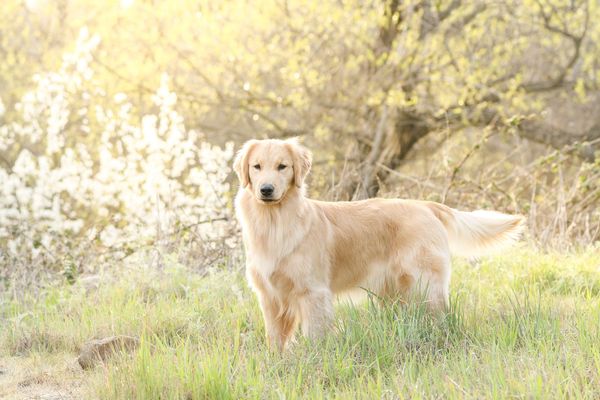
Golden Retriever stands in a field of grass
Get to know

Golden Retrievers

Written by
Caroline Coile, Ph.D.,
 author of 34 dog books.
Written by
Caroline Coile, Ph.D.,
 author of 34 dog books, including the top-selling Barron's Encyclopedia of Dog Breeds.
| | | | |

This lovable retriever with a coat of gold has a heart to match.

Known for their sunny disposition, trainability and love of tennis balls, the Golden Retriever is the golden child of the dog world, a perennial favorite with families, service dog trainers, hikers, obedience competitors and hunters. Always cheerful, the Golden is the perfect therapy dog–even when you don’t need therapy!
Browse available puppies

Connect with reputable breeders to find the dog of your dreams

At a glance

High Energy

Energy level

4/5

Low Maintenance

Grooming

3/5

Large

Size

Cheerful, kind, friendly

Temperament

10-12 years

Lifespan

Highly Trainable

Training

5/5

Medium Vocality

Barking

3/5

At a glance

  • Energy level

    High Energy

  • Grooming

    Low Maintenance

  • Size

    Large

  • Temperament

    Cheerful, kind, friendly

  • Lifespan

    10-12 years

  • Training

    Highly Trainable

  • Barking

    Medium Vocality

Why people love the breed

People love Goldens because Goldens love them back even more.
The Golden Retriever breed is one of the most popular dog breeds in the world—and deserves to be! It’s not just because it’s the most glamorous of the retrievers, or because its coat color is a shiny shade of spun gold. It’s because adding a Golden to your family is like adding a best friend who’s always happy, loving, eager to please, helpful—and maybe a little bit goofy! Besides being ideal fun-loving family dogs, Goldens are top-ranked in the fields of competitive obedience, agility and retrieving field trials. They’re also skilled service and guide dogs, therapy dogs, emotional support dogs, detection dogs and search & rescue dogs. Golden Retriever people seem to be as charitable as their dogs, possibly contributing more money to canine health research than any other breed. One of their special projects is the Golden Retriever Lifetime Study, one of the largest prospective canine health studies in the US.

Appearance

Goldens are the most glamorous of the Retrievers.
Goldens are fairly large and strong, weighing from 55 to 75 pounds. Historically, Their broad head and square muzzle gave them the jaw strength needed to carry heavy birds. Their dense water-repellent coat protected them from becoming chilled. These days their coat is more appreciated for its aesthetics than function. Per the breed standard, the undercoat is very dense and soft, while the outer coat is somewhat harsh, and generally straight to slightly wavy. The color comes in various shades of gold, from pale cream to dark rust. Perhaps the Golden’s most noteworthy features are the expression: friendly and almost smiling; and their tail, which is always wagging!

Grooming

Despite a fairly long coat, grooming is pretty easy.
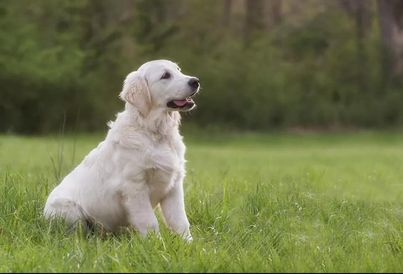
Grooming is fairly easy. You’ll need to brush the coat at least every week, more often if your dog gets into brambles that can tangle in the longer feathering. That feathering can mat, so be sure to brush or comb right down to the skin. This is especially true during shedding season (twice a year), when you may want to provide daily brushing. Trim the toenails as needed and brush those teeth every day to keep them healthy!
light colored golden retriever puppy sitting in a field looking off to the right
Img:

Spun Gold Golden Retrievers

Breed temperament and characteristics

They really do have a heart of gold…
Goldens are among the friendliest of breeds and tend to get along well with others. They love their family and welcome guests–especially if they come bearing balls or other toys to throw. For this reason, Goldens do fail miserably at one job: Protection dog. They may bark at an intruder, but it’s probably more in welcome, and in hopes the burglar will throw a tennis ball once inside. Goldens enjoy almost any activity they can share with a family member, whether it’s retrieving, playing tug, catching a Frisbee, hiking, swimming or just cuddling. They particularly like activities that combine mental and physical challenges. They seem to have a special ability to key in on people’s feelings, and make ideal therapy and emotional support dogs.

Exercise

Goldens need an hour or two of exercise–mental and physical—every day.
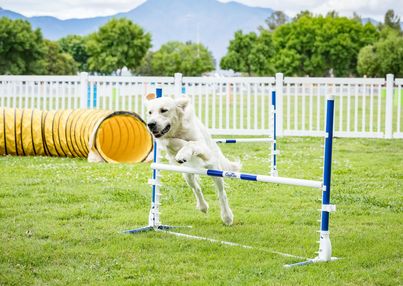
Goldens were selectively bred to swim or run after downed birds over and over during a day’s hunting. Those that tired out and quit were either not used for breeding or worse, could have drowned. That’s why today’s Goldens just don’t quit. That doesn’t mean you should take advantage of that attitude. Instead, it’s up to you to make sure they don’t push themselves beyond the limit. They tend to be high energy and their favorite activities are swimming and retrieving. But they will enjoy just about anything that involves a challenge and plenty of exercise. They are great hiking companions as well as backyard playmates. Obedience and agility training provides mental activity they also need.
light colored golden retriever jumping on an agility course
Img:

Golden Borealis

Training

Smart, active and eager-to-please; it’s why the Golden is one of the most trainable of all breeds.
Goldens love to learn! Some of the top-ranked dogs of any breed in the competitive dog sports of obedience and agility have been Golden Retrievers. Like all retrievers, Goldens had to locate downed birds that were often hidden in brush or rough water. They did this by following directions given by the hunter. If they didn’t, they either couldn't find the bird or they could end up just swimming out to sea. This is why retrievers in general are some of the most trainable and attentive breeds. But they’re no pushovers. Young Golden pups can be extremely boisterous and hard to settle down. And they’re as strong-willed as they are strong-bodied! One good aspect of the breed for trainers is that Goldens aren’t easily discouraged when they make mistakes, and this dedication probably stems from this bit of youthful stubbornness! You must be firm in your rules and with time, they’ll find out it’s more fun to be part of the team.

Diet and nutrition

Goldens have hearty appetites and may be prone to overeating.

As a large breed prone to hip dysplasia, puppies should be fed a large-breed puppy food, which regulates their growth rate as they reach full size at a later age. Very young puppies will require feeding three to four times a day until around 4 months of age, then two times a day until around 9 months of age, transitioning to an adult diet at this time. Remember the Golden is an athletic breed. You should still be able to feel the ribs and hips without much pushing. Your Golden should have an hourglass shape when viewed from the top Talk to your veterinarian about reducing weight if your Golden starts to be pudgy. In fact, your veterinarian should be a main source of your information about special diets for special medical needs as well.
Dark red golden retriever laying in the snow
Img:

Redwood Goldens

Health issues

Like all popular breeds, Goldens seem like they have a lot of health concerns—but they're really pretty healthy.

Lifespan: 10 to 12 years.

Goldens are generally healthy, but like any very popular breed, their health issues are magnified simply because of the sheer number of dogs that veterinarians see and report.

Elbow dysplasia

Found more often in larger breeds, this is a condition in which the elbow joint develops inappropriately, causing arthritis and lameness. No genetic test is available to date, therefore, the recommended screening test is x-rays.

Progressive retinal atrophy (PRA)

This disorder occurs due to a group of diseases that cause the receptors of the eye’s retina to gradually deteriorate, causing blindness. Various DNA tests are available, depending on breed. Ophthalmic exams performed by ophthalmologists are recommended as well.

Hip dysplasia

Common in large breed dogs, this complex condition involves both genetic and environmental factors and arises when the head of the femur doesn’t fit in the pelvic socket, causing arthritis and lameness. No genetic test is available to date, therefore, the recommended screening test is x-rays.

Neuronal ceroid lipofuscinosis 5 (NCL5)

NCL5 is a lysosomal storage disease. The symptoms begin between 18-24 months of age and include vision loss, loss of coordination, and behavior changes including decreased response to commands, increased fear, hallucinations, and aggression.

Hypothyroidism

A condition in which the thyroid gland produces reduced levels of hormones, often due to the immune system attacking the gland.

Lymphoma

Lymphoma, a cancer that originates in the lymphocyte cells of the immune system.

Hemangiosarcoma (HSA)

HSA is a cancer of the blood vessel lining that is almost invariably fatal, most often from uncontrolled internal bleeding from the spleen or heart.

Skin problems

Skin allergies, which can include itchiness, inflammation, hot spots, and even chronic ear problems, can occur in response to fleas, food and environmental allergens.

Learn more about health issues that may impact Golden Retrievers

History

Goldens were created by Lord Tweedmouth in Scotland in the mid 1800s.

Hunters created retrievers when the advent of guns made it common for shot birds to fall out of the hunter’s reach. In the mid 1800s in the Scottish Highlands, Lord Dudley Marjoribanks Tweedmouth set out to make a retriever that was strong enough to carry geese through cold water and heavily vegetated shorelines. He crossed a yellow Wavy-Coated Retriever (a descendent of the Newfoundland and Labrador Retriever) with a Tweed Water Spaniel (a liver-colored retriever with a curly coat). In 1927 the American Kennel Club (AKC) recognized the Golden Retriever. It’s been one of the most popular breeds in the United States for more than 25 years, ranking 3rd in 2022. President Ford's Golden, Liberty, had a litter of puppies while living at the White House. Ronald Reagan and Indira Gandhi also owned Goldens. Celebrity Golden dog owners include Ben Affleck, Pamela Anderson, Jennifer Aniston, George Clooney, Cheryl Crowe, Billy Ray Cyrus, Neil Diamond, Cameron Diaz,Enrique Iglesias, Nick Jonas, Ashton Kutcher, Adam Levine, Blake Lively, James Marsden, Ricky Martin, Paul Newman, Jack Nicklaus, Conan O'Brien, Joe Pesci, Ryan Reynolds, Jerry Seinfeld, Shakira, Mike “The Situation” Sorrentino, Emma Stone, Betty White, Oprah Winfrey and Renee Zellwanger. Famous Goldens include the Bush's baked bean spokesdog, and Air Bud, who gained fame for his ability to play basketball.
About the author

Canine specialist, Caroline Coile, Ph.D., is the author of 34 dog books, including the top-selling Barron's Encyclopedia of Dog Breeds. She’s written thousands of magazine and web articles about dogs. She specializes in canine science, health, breeds and competitions. Caroline has won 20 national dog-writing awards, and was a 2015 Inductee into the Dog Writers Association of America Hall of Fame.

Breed Scorecard

Characteristics and temperament
  • Affectionate with family

    5

  • Watchdog level

    3

  • Playfulness

    5

  • Adaptability

    5

  • Social needs

    5

  • Temperament

    Cheerful, kind, friendly, eager to please, easily trained, active, loves to retrieve, outdoorsy, but also enjoys quiet time and snuggling.

  • Intelligence

    5

  • Good with other dogs

    5

  • Good with cats or other pets

    5

  • Friendly with strangers

    5

  • Good as a service dog

    5

  • Good for apartments

    2

  • Barking level

    3

Appearance
  • Height

    21-24"

  • Size

    Large

  • Colors

    Dark golden, Golden, Light golden

  • Coat texture

    Somewhat coarse outer coat, soft undercoat

  • Coat length

    Long

Training
  • Trainability

    5

Exercise
  • Exercise needs

    4

  • Exercise time

    2 hours daily

  • Mental exercise needs

    4

  • Favorite activities

    Retrieving, obedience, agility, dock diving, nosework, tracking, swimming, hiking

Grooming
  • Grooming needs

    3

  • Brushing frequency

    Weekly

  • Needs professional grooming?

    No

  • Drooling level

    1

Health issues
  • Elbow dysplasia

  • Progressive retinal atrophy (PRA)

  • Hip dysplasia

  • Neuronal ceroid lipofuscinosis 5 (NCL5)

  • Hypothyroidism

  • Lymphoma

  • Hemangiosarcoma (HSA)

  • Skin problems

Other
  • Bred for

    Retrieving

  • Country of origin

    Scotland

  • Popularity level

    5

FAQs

  • On Good Dog, you can search for Golden Retriever puppies or dogs in rescues and shelters. Adopting a Golden Retriever from a shelter or rescue is generally less expensive than buying a puppy from a breeder with ethical practices. Across the United States, there are dedicated rescues that specialize in specific breeds and may even help transport a Golden Retriever dog to you from another part of the country. Although it can be more cost-effective, adopting the exact breed you're looking for is typically more difficult than working with a responsible breeder. Learn more about adopting a dog from a shelter or rescue.

  • The typical price for Golden Retriever puppies for sale may vary based on the breeder and individual puppy. On average, the price of Golden Retriever puppies from a breeder is $2,700.

  • Yes! They are great with children, the elderly, other pets, active people, bed-bound people, competitive people and laid-back people! They just want to be part of the family and your best friend

  • No. They can bark when they’re excited, but they don’t just sit around and make noise for no reason. If your Golden is barking, you should investigate!

  • They do need a lot of exercise as they tend to be high-energy, like any dog their size. But their biggest disadvantage is that they seem to be more susceptible to some forms of cancer, especially hemangiosarcoma, than other breeds.

Caroline Coile, Ph.D.

Caroline Coile specializes in canine science, health, breeds and competitions. Caroline has won 20 national dog-writing awards, and was a 2015 Inductee into the Dog Writers Association of America Hall of Fame. She’s written thousands of magazine and web articles about dogs in addition to 34 dog books.

Content on Good Dog is generated, fact-checked, and evaluated by qualified writers and veterinarians.

Caroline Coile, Ph.D.

Caroline Coile specializes in canine science, health, breeds and competitions. Caroline has won 20 national dog-writing awards, and was a 2015 Inductee into the Dog Writers Association of America Hall of Fame. She’s written thousands of magazine and web articles about dogs in addition to 34 dog books.

Content on Good Dog is generated, fact-checked, and evaluated by qualified writers and veterinarians.