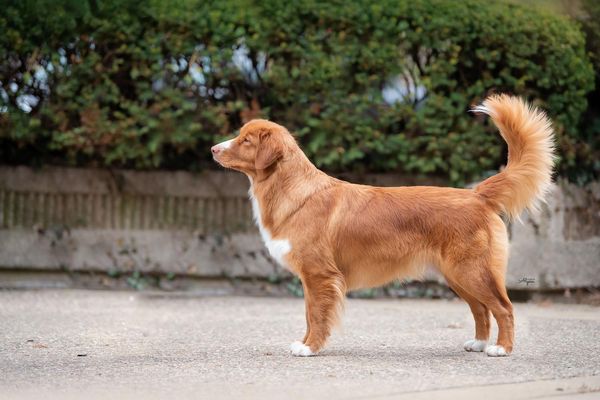
Toller standing in a stacked position outside
Get to know

Nova Scotia Duck Tolling Retrievers

Written by
Caroline Coile, Ph.D.,
 author of 34 dog books.
Written by
Caroline Coile, Ph.D.,
 author of 34 dog books, including the top-selling Barron's Encyclopedia of Dog Breeds.
| | | | |

Their zest for life is perfect for high energy people.

Tollers (as they're called for short) are the smallest of the retriever breeds, and their method of duck hunting is entirely different from the others. This hidden gem is not well-known - but it should be.

At a glance

Very High Energy

Energy level

5/5

Low Maintenance

Grooming

3/5

Medium

Size

Playful, energetic

Temperament

12-14 years

Lifespan

Quick to Learn

Training

4/5

Vocal

Barking

4/5

At a glance

  • Energy level

    Very High Energy

  • Grooming

    Low Maintenance

  • Size

    Medium

  • Temperament

    Playful, energetic

  • Lifespan

    12-14 years

  • Training

    Quick to Learn

  • Barking

    Vocal

Why people love the breed

People love their Tollers because of their energetic playfulness and the fact that they are always up for an adventure.
Tollers were bred to toll. Tolling is an old word meaning to entice or lure (tolling bells entice or draw worshippers to them, for example). The Toller actually entices or lures ducks to come in closer to shore, where they are cavorting in the shallows. Foxes naturally perform this behavior, and Tollers do as well. Tollers are encouraged to chase sticks and balls, and to run from cover to cover, which causes the ducks to be curious and they approach to see. The hunter then shoots them and the Toller retrieves them. Tollers are the canine version of a duck decoy. A Toller’s job depends on them being always ready to play. Another part of their job requires them to be attentive to the hunters' cues so they can find and retrieve a downed duck in the water. A retriever that swims on, oblivious to signals to return, will either never find the duck, or worse, swim out to sea. So Tollers must also be very biddable. As the smallest retriever, the Toller is a much handier size than their cousins. And some people like the “Toller scream,” a harrowing, high-pitched banshee scream they sometimes make.

Appearance

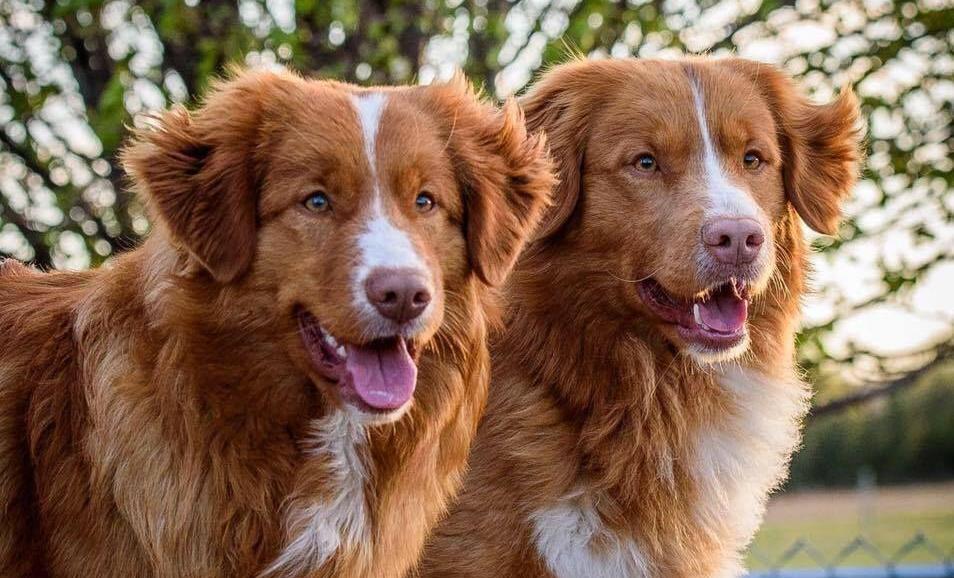
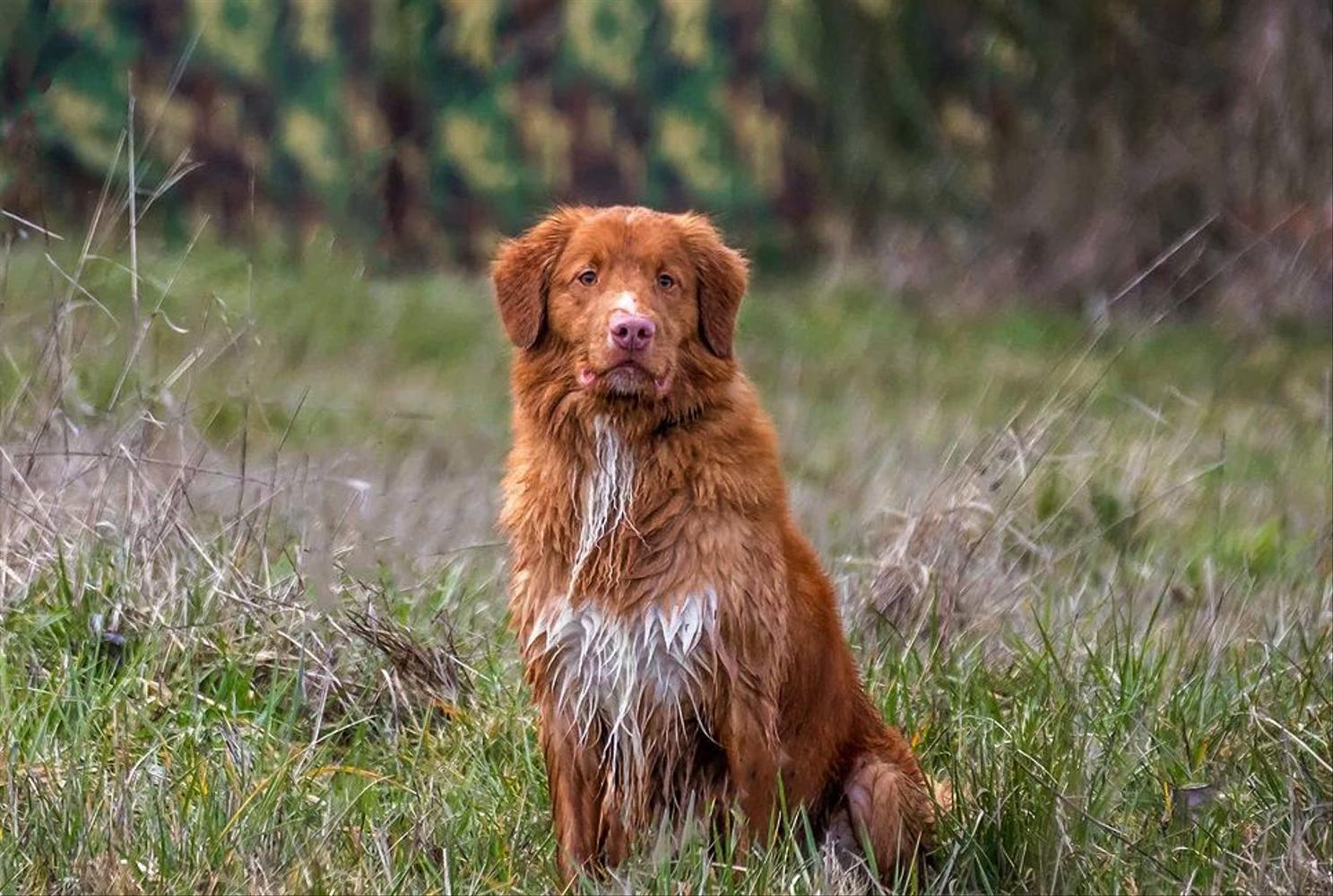
Tollers are built for both running and swimming, the smallest and most agile of the retrievers. They are especially noted for their vivid red coat.
Tollers have a powerful build, yet are much smaller boned compared to other retrievers. Tolling requires them to leap and play tirelessly while maintaining enough reserve to run, swim and retrieve. The backline is level and straight, flowing into the tail that reaches at least to the hock. The head is lightly wedge-shaped, not nearly as broad as other retrievers but still with sufficient strength to carry a duck. The eyes are almond-shaped, and the ears set on high, triangular in shape, but with rounded tips. The eyes tend to be hazel, and the nose light colored. The coat is double, with a thick undercoat for warmth and a medium-length water-repelling outer coat. The color is any shade of red, usually with white markings on either the tail tip, feet, chest and/or blaze. The white markings make the dog’s movement more noticeable to the ducks.

Grooming

Grooming is fairly easy, consisting of weekly brushing and occasional bathing.
Use a long-toothed metal comb or a pin brush to reach down to the skin when grooming. Generally the coat does not tend to mat but during shedding season the undercoat can mat somewhat. At this time a slicker brush may be more effective in pulling out loose hairs, brushing the coat in layers to reach as much undercoat as possible. But even in shedding season grooming is not a challenge. The coat is not so profuse that it needs much brushing. Trim the toenails as needed, brush the teeth daily, and check the ears for debris weekly.
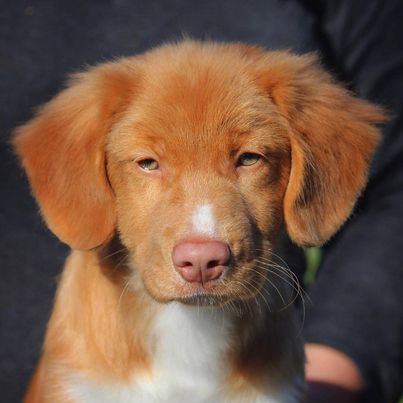
Toller puppy
Img:

Kagee Border Collies

Breed temperament and characteristics

The Toller is a dog bred to be playful, the Peter Pan of the dog world—except the Toller is more likely to listen to you.
If you wish for a dog that will play and retrieve tirelessly, the Toller is your dream dog. They were bred to play, and they are true to their heritage. If you can think of a game, chances are your Toller will think it’s the best game ever—especially if it’s retrieving. Tollers weren’t only bred to play, though. They had to follow the hunter’s directions from afar in order to find ducks that may have fallen out of sight, or be obscured by high waves. Those that didn’t would be poor hunting companions, as they would either miss many retrieves or worse, keep on swimming out to sea in search of a downed duck they never found. It’s essential for all retrievers, but especially water retrievers, to be biddable. For this reason, Tollers tend to be willing to do as asked. This is not a Golden Retriever in miniature, but a much more energetic breed. Tollers are extremely active dogs, with a high energy level—again, necessary for cavorting along the shorelines for long periods. They are friendly dogs, getting along well with every member of the family, even other dogs and pets. They are friendly enough toward strangers, but don’t jump all over them. They do have a high-pitched bark or whine called the “Toller scream” that can be annoying to some people but entertaining to others.

Exercise

Tollers are extremely energetic and active dogs, and need a lot of exercise.
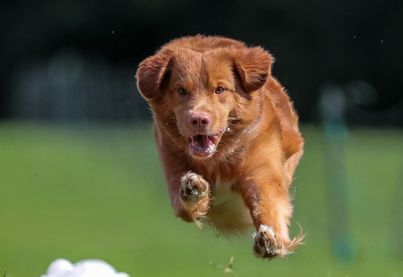
Bred to play and retrieve for long periods of time, it sometimes seems Tollers are inexhaustible. They need a lot of activity, ideally a mixture of long runs and backyard games. A leisurely stroll around the block will not be sufficient to satisfy most Tollers. But they will make great jogging partners and hiking companions. Mental exercise is equally important. Most Tollers find just jogging to be boring, though, so you should mix it up with lots of games. Retrieving and swimming are two favorites, but they also like Frisbee catching, agility, coursing, tugging and just running amok, as well as mind games like trick training or nose work. Hunting, especially if they can both toll and retrieve, is their very favorite activity. Tollers have a breed-specific performance test called the Basic Retrieving and Tolling (BRT) test, in which the dog is based on its ability to toll and retrieve. Three levels of accomplishment are awarded: the Working Certificate (WC), Working Certificate Intermediate (WCI), and Working Certificate Excellent (WCX). Tollers love working for all of them. This is not a dog that can be locked up for long periods. Once sufficiently exercised, it makes a calm house dog capable of snuggling and relaxing.
Toller lure coursing
Img:

Jemstone’s Tollers

Training

Like most retrievers, Tollers are attentive and willing to please, making for a dog that is a pleasure to train.
Tollers are quick to learn. They are generally quite biddable, especially when lots of treats or games are used as rewards. Throwing a ball is as effective a reward as is handing them a treat, so alternate back and forth, using the fetch as a reward for more active exercises, such as the come when called; and the treat for calmer ones, such as the stay in place. Their main problem in training is that they are easily distracted and easily bored, so you have to keep it fast-paced and interesting. They can compete at the very highest levels of obedience and agility, earning advanced titles easily. They especially love any training exercise that combines high activity with obedience. As with all dogs, early socialization is a necessity so they are at their best around strange people, dogs, and situations. They tend to be easy to house train.

Diet and nutrition

Tollers might need high-calorie food because of their activity level. They do well on many “performance” commercial dog foods—or you can make your own (only following consulting with a veterinary nutritionist).
Young Tollers are more likely to be underweight than overweight because of their high activity. But with age they tend to gain weight, especially if neutered or spayed. Proper weight is when the body has an hourglass figure viewed from both the top and side, with a noticeable tuck-up. No ribs or vertebrae should show, but you should be able to feel the ribs without digging for them. If the dog begins to be overweight, discuss with your veterinarian. Puppies should eat high-quality food formulated for puppies. Neither puppies nor adults have any breed-specific precautions. Like any dog, an individual might develop specific health problems that can be managed with special diets. Your veterinarian can advise you.
Toller hunting
Img:

Fireball Tollers

Health issues

Tollers are extremely healthy, with very low levels of orthopedic disease compared to most other breeds. They do have some eye conditions, however.

Lifespan: 12 to 14 years.

Hip Dysplasia

Is a complex condition involves both genetic and environmental factors and arises when the head of the femur doesn’t fit in the pelvic socket, causing arthritis and lameness. No genetic test is available to date, therefore, the recommended screening test is x-rays.

Progressive Retinal Atrophy (PRA)

Is a disorder that occurs due to a group of diseases that cause the receptors of the eye’s retina to gradually deteriorate, causing blindness. Various DNA tests are available, depending on breed. Ophthalmic exams performed by ophthalmologists are recommended as well.

Collie Eye Anomaly

Is a hereditary condition impacting the development of the eye that can lead to blindness and retinal detachment.

Learn more about health issues that may impact Nova Scotia Duck Tolling Retrievers

History

The Toller may be Nova Scotia’s best export. But nobody really knows what its ingredients are.
Canadian hunters noticed foxes frolicking along the shoreline, enticing ducks to approach so they could catch them. The hunters taught their dogs to do the same by repeatedly throwing sticks in the water for them to retrieve. They also favored red, fox-colored dogs. In the 1800s a strain of dogs was purposefully bred for its tolling ability. They were called the Little River Duck Dog or Yarmouth Toller after the river and county in Nova Scotia where they were developed. The dogs that went into the Tollers development are unknown, and DNA evidence gives no clue. The Toller is the provincial dog of Nova Scotia. It became popular with hunters down the east coast, especially along the Chesapeake Bay. Despite its popularity with hunters, so few registered their dogs that the breed was in danger of extinction in the 1970s. Through tireless efforts it regained its numbers. The AKC recognized the Nova Scotia Duck Tolling Retriever in 2003. It is a member of the Sporting group.
About the author

Canine specialist, Caroline Coile, Ph.D., is the author of 34 dog books, including the top-selling Barron's Encyclopedia of Dog Breeds. She’s written thousands of magazine and web articles about dogs. She specializes in canine science, health, breeds and competitions. Caroline has won 20 national dog-writing awards, and was a 2015 Inductee into the Dog Writers Association of America Hall of Fame.

Breed Scorecard

Characteristics and temperament
  • Affectionate with family

    5

  • Watchdog level

    2

  • Playfulness

    5

  • Adaptability

    4

  • Social needs

    4

  • Temperament

    Playful, energetic

  • Intelligence

    4

  • Good with other dogs

    5

  • Good with cats or other pets

    5

  • Friendly with strangers

    3

  • Good as a service dog

    4

  • Good for apartments

    1

  • Barking level

    4

Appearance
  • Height

    17-21"

  • Size

    Medium

  • Colors

    Red, Buff (non-standard), Red gold

  • Coat texture

    Fairly soft

  • Coat length

    Medium, feathered

Training
  • Trainability

    4

Exercise
  • Exercise needs

    5

  • Exercise time

    One to two hours daily

  • Mental exercise needs

    4

  • Favorite activities

    Playing, fetch, retrieving, swimming

Grooming
  • Grooming needs

    3

  • Brushing frequency

    Weekly

  • Needs professional grooming?

    No

  • Drooling level

    1

Health issues
  • Hip Dysplasia

  • Progressive Retinal Atrophy (PRA)

  • Collie Eye Anomaly

Other
  • Bred for

    Tolling (attracting) and retrieving ducks

  • Country of origin

    Canada

  • Popularity level

    3

FAQs

  • On Good Dog, you can search for Nova Scotia Duck Tolling Retriever puppies or dogs in rescues and shelters. Adopting a Nova Scotia Duck Tolling Retriever from a shelter or rescue is generally less expensive than buying a puppy from a breeder with ethical practices. Across the United States, there are dedicated rescues that specialize in specific breeds and may even help transport a Nova Scotia Duck Tolling Retriever dog to you from another part of the country. Although it can be more cost-effective, adopting the exact breed you're looking for is typically more difficult than working with a responsible breeder. Learn more about adopting a dog from a shelter or rescue.

  • Yes. However they are very active so you must also give them lots of outdoor time with lots of exercise.

  • For shorter periods of time, only if it receives enough exercise to tire it out. Longer periods of time would not be a good idea.

  • They can be fantastic family dogs, doing well with people of all ages. They do require a lot of exercise, however.
Caroline Coile, Ph.D.

Caroline Coile specializes in canine science, health, breeds and competitions. Caroline has won 20 national dog-writing awards, and was a 2015 Inductee into the Dog Writers Association of America Hall of Fame. She’s written thousands of magazine and web articles about dogs in addition to 34 dog books.

Content on Good Dog is generated, fact-checked, and evaluated by qualified writers and veterinarians.

Caroline Coile, Ph.D.

Caroline Coile specializes in canine science, health, breeds and competitions. Caroline has won 20 national dog-writing awards, and was a 2015 Inductee into the Dog Writers Association of America Hall of Fame. She’s written thousands of magazine and web articles about dogs in addition to 34 dog books.

Content on Good Dog is generated, fact-checked, and evaluated by qualified writers and veterinarians.