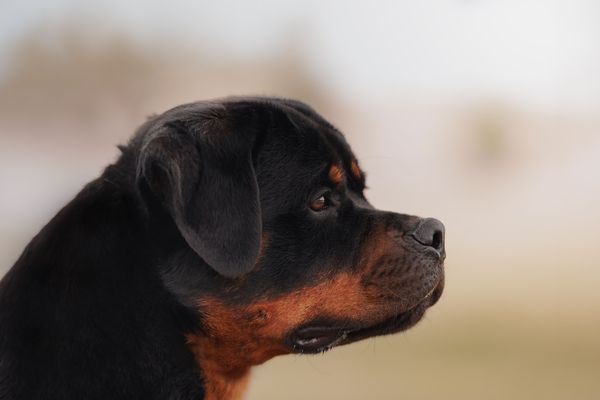
Adult rottweiler side profile
Get to know

Rottweilers

Written by
Caroline Coile, Ph.D.,
 author of 34 dog books.
Written by
Caroline Coile, Ph.D.,
 author of 34 dog books, including the top-selling Barron's Encyclopedia of Dog Breeds.
| | | | |

Tough when they need to be, gentle when they should be, they easily transition from guardian to companion.

The Rottweiler hails from working class roots, and although the breed eventually found favor with the rich and famous, most Rotties still have a blue collar outlook, demanding few luxuries while giving their all.
Browse available puppies

Connect with reputable breeders to find the dog of your dreams

At a glance

Moderate Energy

Energy level

3/5

Minimal Maintenance

Grooming

1/5

Extra Large

Size

Protective, alert, confident

Temperament

9-10 years

Lifespan

Quick to Learn

Training

4/5

Medium Vocality

Barking

3/5

At a glance

  • Energy level

    Moderate Energy

  • Grooming

    Minimal Maintenance

  • Size

    Extra Large

  • Temperament

    Protective, alert, confident

  • Lifespan

    9-10 years

  • Training

    Quick to Learn

  • Barking

    Medium Vocality

Why people love the breed

People love Rottweilers because they’re like having your personal Secret Service agent watching your back. And front. But they’re also like having bodyguards that double as best friends.
Rottweilers were developed to perform a variety of tasks that required determination and courage. From a drover expected to drive uncooperative cattle for long distances, to subduing unruly livestock, to a cart hauler, and finally guard dog, these jobs required a strong, imposing dog that would follow directions but also think for themself Today’s Rottweilers aim to please, but they are strong-willed. They are one-family, or even one-person dogs, suspicious of strangers and slow to make new friends. But when they do accept somebody into their inner circle, they will protect them with their life.

Appearance

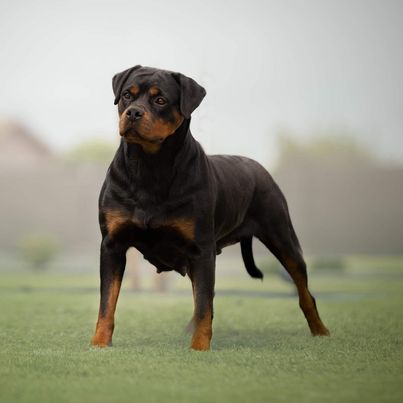
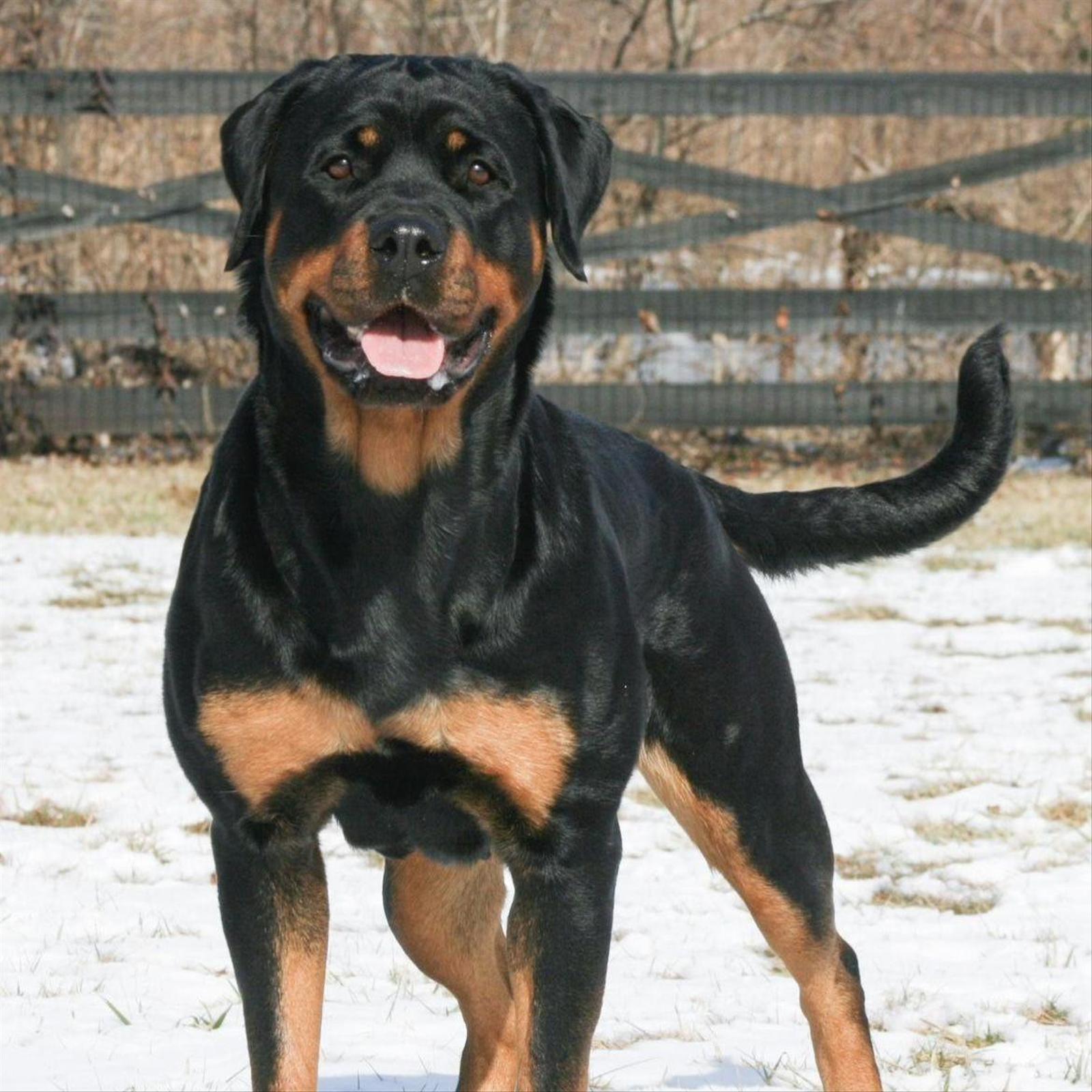
Rottweilers are imposing. Their strong physique, wide muzzle, and black & tan coloration gives them a handsome, no-nonsense look few people are willing to challenge.
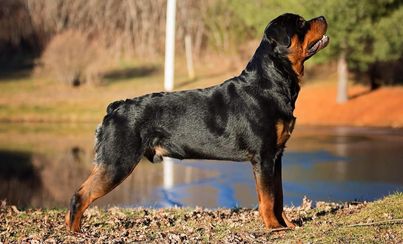
The Rottweiler is a muscular, substantial dog, slightly longer than tall, and broad from side to side. Despite being fairly heavy boned, it is agile and surprisingly light on its feet. The neck is thick and powerful. The head and muzzle are broad, the expression intense and self-confident. The jaws are wide and strong. The ears are medium-sized, triangular, and hanging and are never cropped. The tail is traditionally docked to one or two vertebrae in countries where that is allowed. If undocked, it is thick, of medium length, and often carried in a sickle shape. The coat is always black & tan. It is straight, close-lying, harsh, and dense. At a trot, the Rottweiler's movement is powerful and purposeful, never plodding nor dainty. The appearance is that of a dog on a mission, even if that mission is just heading to the food bowl.

Grooming

The Rottweiler is a lazy person’s dream dog when it comes to grooming. The coat tends to repel dirt, and does not usually tangle. It requires occasional bathing and brushing. Just don’t forget the teeth and nails.
Coat care is simple: Brush occasionally with a bristle brush to remove dried dirt, dust and shedding hair. This can be as little as monthly most of the time. During times of shedding, a brush with thick rubber points can help remove dead hair, and you may need to brush as often as daily. Bathing will give your Rottie a nice fragrance and softer coat, and if you use warm water, will hasten shedding hairs to loosen. Cut the nails as needed, more often in inactive and older dogs. Teeth should be brushed daily. Check the ears for signs of infection weekly, but don’t clean them unless there is debris present.
Adult rottweiler standing in a stacked position outside
Img:

Lonecreek Rottweilers

Breed temperament and characteristics

Rottweilers are determined, brave, and protective. They can also be gentle, silly, and loving. It’s this ability to blend into whatever family dynamic is needed that makes them such good companions.
The Rottweiler is most known for being a protective guardian of property and person. The breed comes by this reputation honestly, having once been used to not only drive cattle to market, but to guard the money the cattle brought on the trip back home. In the late 1900s, they again came to the public’s attention as a popular property guard dog. They are extremely protective of their home and family, and can be overly suspicious toward strange dogs and even people. Rottie owners must properly train and socialize their dogs to ensure their Rottie doesn’t mistake a guest as an intruder. They are strong dogs that could inflict a lot of damage if their protective nature were redirected toward an inappropriate target. Some Rottweiler lines may be more aggressive than is optimal for family living. Some experts discourage Rotties for homes with young toddlers or elderly people, not only because any act of aggression could be incredibly harmful, but also simply because even good-natured Rotties have a tendency to body-bump, a behavior they once used in their cattle droving days. Because of their size, they can easily knock down kids. Rotties have determined personalities that some describe as stubborn. They will dig their feet in if they feel they are manhandled. At the same time, they can walk all over pet parents who are too timid and easy-going. They respond best to firm, fair, calm guidance and family life. In private, Rotties can actually be big babies, lolling on their back and soaking up tummy rubs. But for most Rotties, their sense of decorum only allows this side to be seen by family and friends.

Exercise

Although athletic dogs, Rottweilers don’t require excessive amounts of exercise. An hour or two a day should suffice. Without that, though, no furniture is safe…
Rottweilers are strong, athletic dogs. While not excessively energetic, they still need an hour or two of active time each day. A long walk or a moderate jog will suffice, especially if mixed with games. Tug is usually a favorite game, and many Rotties also enjoy fetch. Most like to swim, or at least splash. Pulling a cart is also an enjoyable activity that will burn off energy. Many organized activities appeal to Rottweilers and also expend both physical and mental energy. These include weight pulling, carting, tracking, ring sport, obedience training, and agility. Because they are often not good with strange dogs, they are not good dog park candidates.
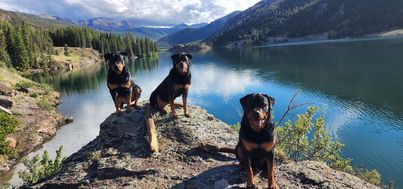
3 adult rottweilers sit on rocks posing for the camera with a beautiful Colorado mountain backdrop
Img:

Pine River Rottweilers

Training

Rottweilers love to please and they learn quickly. Too many people think because Rotties are tough they need tough training methods. That’s not true.
Many Rottweilers have achieved the highest levels in organized obedience and agility competitions. They are highly intelligent and seem to grasp what is wanted easily. Although perceived as tough dogs, they don’t require tough training methods. Rottweilers are incredibly smart dogs, but do need someone who is committed to training them. Always use positive reinforcement, which involves rewarding the behaviors you’d like to see more of in your dog. They need to learn to accept visitors, and should be socialized thoroughly as youngsters. Any Rottweiler that is overly aggressive should be seen by a professional trainer or behavior expert.

Diet and nutrition

As large dogs, Rottweilers do eat a lot. They do best eating commercial diets made for large dogs.
Rottweilers thrive on diets specifically formulated for large dogs. Such diets are especially critical for Rottweiler puppies. Many studies have shown that growing too fast increases the chance of many developmental joint diseases to which Rotties are already susceptible, including hip and elbow dysplasia. They are balanced in fat, calcium, phosphorus and vitamin D. Free-feeding is not recommended for large breed puppies, as they tend to overeat, increasing their growth rate and the chance of developmental joint disease. Instead feed several small meals over the course of a day, starting with three to four meals as a little puppy, then two meals at about four months of age, transitioning to an adult diet around 9 months of age. Note that dry large breed food has larger kibble size, which gives the dog the chance to crunch and chew more, and is less of a choking hazard from inhalation of kibble. You should always monitor your Rottie’s weight. You should be able to feel the ribs with gentle probing, and there should be a slight indication of a waist, with no dimple over the tail or roll of fat over the withers. Obesity makes joint disease worse, so always keep your Rottie trim. Remember that neutered and spayed dogs require fewer calories than intact dogs. Factor in all the treats you may be doling out during training. They can add calories faster than you might think. Always consult with your veterinarian if your dog has a particular health problem. Many specialized diets are available that are scientifically formulated for a variety of conditions.
Adult female rottweiler standing majestically in a grassy field
Img:

TRK - Tirmizi Rottweiler Kennel

Health issues

Rottweilers can be affected by several serious health conditions, namely elbow and hip dysplasia, bone cancer, and a congenital heart problem.

Lifespan: 9 to 10 years.

Hip Dysplasia

Common in large breed dogs, this complex condition involves both genetic and environmental factors and arises when the head of the femur doesn’t fit in the pelvic socket, causing arthritis and lameness. No genetic test is available to date, therefore, the recommended screening test is x-rays.

Elbow Dysplasia

Found more often in larger breeds, this is a condition in which the elbow joint develops inappropriately, causing arthritis and lameness. No genetic test is available to date, therefore, the recommended screening test is x-rays.

Osteosarcoma

A malignant bone cancer, is reported in Rottweilers more than other breeds. It most commonly affects the long bones (front and hind legs).

Subaortic stenosis

This is a narrowing of the area underneath the aortic valve which causes an obstruction of the blood flow through the heart, and a disease that occurs at a higher frequency in Rottweilers than in other breeds.

Osteochondritis Dissecans (OCD)

This is an abnormality of cartilage development causing an inflammatory condition when the disease's cartilage separates from the underlying bone, can occur in large breed puppies, especially if not eating an appropriately formulated large breed puppy food.

Gastric Dilatation-Volvulus (GDV)

Rottweilers, like most deep-chested breeds, are at increased risk for GDV, a life threatening emergency in which the stomach twists within the abdomen. Dogs with first-degree relatives that have had GDV are at an increased risk for developing the condition.

Learn more about health issues that may impact Rottweilers

History

Rottweilers come from the Mastiff family, with working class roots that trace to the war dogs of ancient Rome. Their journey to win the hearts of people today began with the Roman journey to conquer Europe in around 50 BC.
When the ancient Romans trekked across Europe, they needed tough mastiff-like dogs to control the livestock they brought along for food. They left puppies and impregnated dogs wherever they journeyed, and various descendants grew to make local “breeds.” In the town of Rottweil, named for its red tile roofs, they became all-around cattle dogs, controlling cattle in the butcher’s yard, pulling the butchers’ meat-laden carts around town, driving cattle from town to town, and guarding the money on the trip home. In the mid-1800s railroads took over the job of moving cattle, and Rottweilers gradually became unemployed. By the early 1900s, only a single Rottweiler remained in Rottweil. The breed was rescued by fanciers who found it a new job as a police dog and show dog. The breed came to America in the 1930s, and American Kennel Club (AKC) recognized it in 1935. In the 1970s and 80s their popularity grew until in the mid 1990s, the Rottweiler was the 2nd most popular AKC breed. It then fell in popularity, but has now risen back to the 7th most popular breed. DNA evidence shows that the Rottweiler’s closest relatives are the Black Russian Terrier (because Rotties went into making it), Giant Schnauzer and Doberman Pinscher. Celebrity owners include Leonardo DiCaprio and Will Smith.
About the author

Canine specialist, Caroline Coile, Ph.D., is the author of 34 dog books, including the top-selling Barron's Encyclopedia of Dog Breeds. She’s written thousands of magazine and web articles about dogs. She specializes in canine science, health, breeds and competitions. Caroline has won 20 national dog-writing awards, and was a 2015 Inductee into the Dog Writers Association of America Hall of Fame.

Breed Scorecard

Characteristics and temperament
  • Affectionate with family

    2

  • Watchdog level

    5

  • Playfulness

    2

  • Adaptability

    3

  • Social needs

    3

  • Temperament

    Protective, alert, confident, guarded

  • Intelligence

    4

  • Good with other dogs

    1

  • Good with cats or other pets

    2

  • Friendly with strangers

    1

  • Good as a service dog

    4

  • Good for apartments

    1

  • Barking level

    3

Appearance
  • Height

    22-27"

  • Size

    Extra Large

  • Colors

    Black and mahogany, Black and rust, Black and tan

  • Coat texture

    Coarse, straight, dense, close-lying

  • Coat length

    Short

Training
  • Trainability

    4

Exercise
  • Exercise needs

    3

  • Exercise time

    1 to 2 hours daily

  • Mental exercise needs

    3

  • Favorite activities

    Schutzhund, Obedience, Tracking, Hiking

Grooming
  • Grooming needs

    1

  • Brushing frequency

    Monthly

  • Needs professional grooming?

    No

  • Drooling level

    3

Health issues
  • Hip Dysplasia

  • Elbow Dysplasia

  • Osteosarcoma

  • Subaortic stenosis

  • Osteochondritis Dissecans (OCD)

  • Gastric Dilatation-Volvulus (GDV)

Other
  • Bred for

    Cattle control, carting, guarding

  • Country of origin

    Germany

  • Popularity level

    4

FAQs

  • On Good Dog, you can search for Rottweiler puppies or dogs in rescues and shelters. Adopting a Rottweiler from a shelter or rescue is generally less expensive than buying a puppy from a breeder with ethical practices. Across the United States, there are dedicated rescues that specialize in specific breeds and may even help transport a Rottweiler dog to you from another part of the country. Although it can be more cost-effective, adopting the exact breed you're looking for is typically more difficult than working with a responsible breeder. Learn more about adopting a dog from a shelter or rescue.

  • Prices for Rottweiler puppies for sale vary by breeder and individual puppy. On Good Dog today, Rottweiler puppies are typically around $2,750. Because all breeding programs are different, you may find dogs for sale outside that price range.

  • They combine noble courageous protectiveness with just enough playfulness and affection to capture your heart and guard it with their lives.

  • Like any dog, they can be left alone but they don’t generally like it. All dogs are social creatures and some can find it stressful to be alone. In addition, if they don’t get enough exercise they can become destructive due to boredom.

  • They are a great family dog for active people who also want a protective dog. They are very powerful dogs and can be too strong for young children or the elderly, however. Some Rottweilers can be aggressive so care must be taken to ensure adequate and positive early socialization.
Caroline Coile, Ph.D.

Caroline Coile specializes in canine science, health, breeds and competitions. Caroline has won 20 national dog-writing awards, and was a 2015 Inductee into the Dog Writers Association of America Hall of Fame. She’s written thousands of magazine and web articles about dogs in addition to 34 dog books.

Content on Good Dog is generated, fact-checked, and evaluated by qualified writers and veterinarians.

Caroline Coile, Ph.D.

Caroline Coile specializes in canine science, health, breeds and competitions. Caroline has won 20 national dog-writing awards, and was a 2015 Inductee into the Dog Writers Association of America Hall of Fame. She’s written thousands of magazine and web articles about dogs in addition to 34 dog books.

Content on Good Dog is generated, fact-checked, and evaluated by qualified writers and veterinarians.