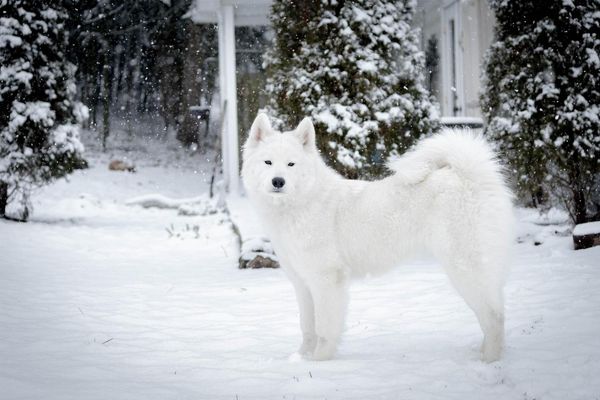
A Samoyed stands in the snow
Get to know

Samoyeds

Written by
Caroline Coile, Ph.D.,
 author of 34 dog books.
Written by
Caroline Coile, Ph.D.,
 author of 34 dog books, including the top-selling Barron's Encyclopedia of Dog Breeds.
| | | | |

It’s Sammy for short!

This ancient northern spitz breed has a perpetual smile that puts smiles on people’s faces as well. And the dazzling smile is matched only by one of the most dazzling personalities, and dazzling white coats, in the dog world.
Browse available puppies

Connect with reputable breeders to find the dog of your dreams
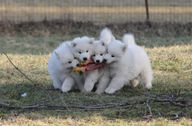
At a glance

Moderate Energy

Energy level

3/5

Regular Maintenance

Grooming

4/5

Medium to Large

Size

Gentle, independent, calm

Temperament

12-14 years

Lifespan

Average Trainability

Training

3/5

Vocal

Barking

4/5

At a glance

  • Energy level

    Moderate Energy

  • Grooming

    Regular Maintenance

  • Size

    Medium to Large

  • Temperament

    Gentle, independent, calm

  • Lifespan

    12-14 years

  • Training

    Average Trainability

  • Barking

    Vocal

Why people love the breed

The legendary Samoyed smile isn’t fake; Samoyeds really are perpetually happy dogs, and they make their families just as happy.
The Samoyed is exuberant, cheerful and always happy to join in whatever fun you suggest. True, they may quit if your game mostly consists of obedience and training, but if it involves outdoor activities—especially in cold weather—count them in. The breed is independent, but willing to please if you suggest, rather than demand, compliance. They are gentle to everyone, and make adventurous partners for active adults, patient playmates for children, and loving companions for the elderly. They tend to get along well with other dogs and pets. They are excellent watchdogs, but poor protection dogs.

Appearance

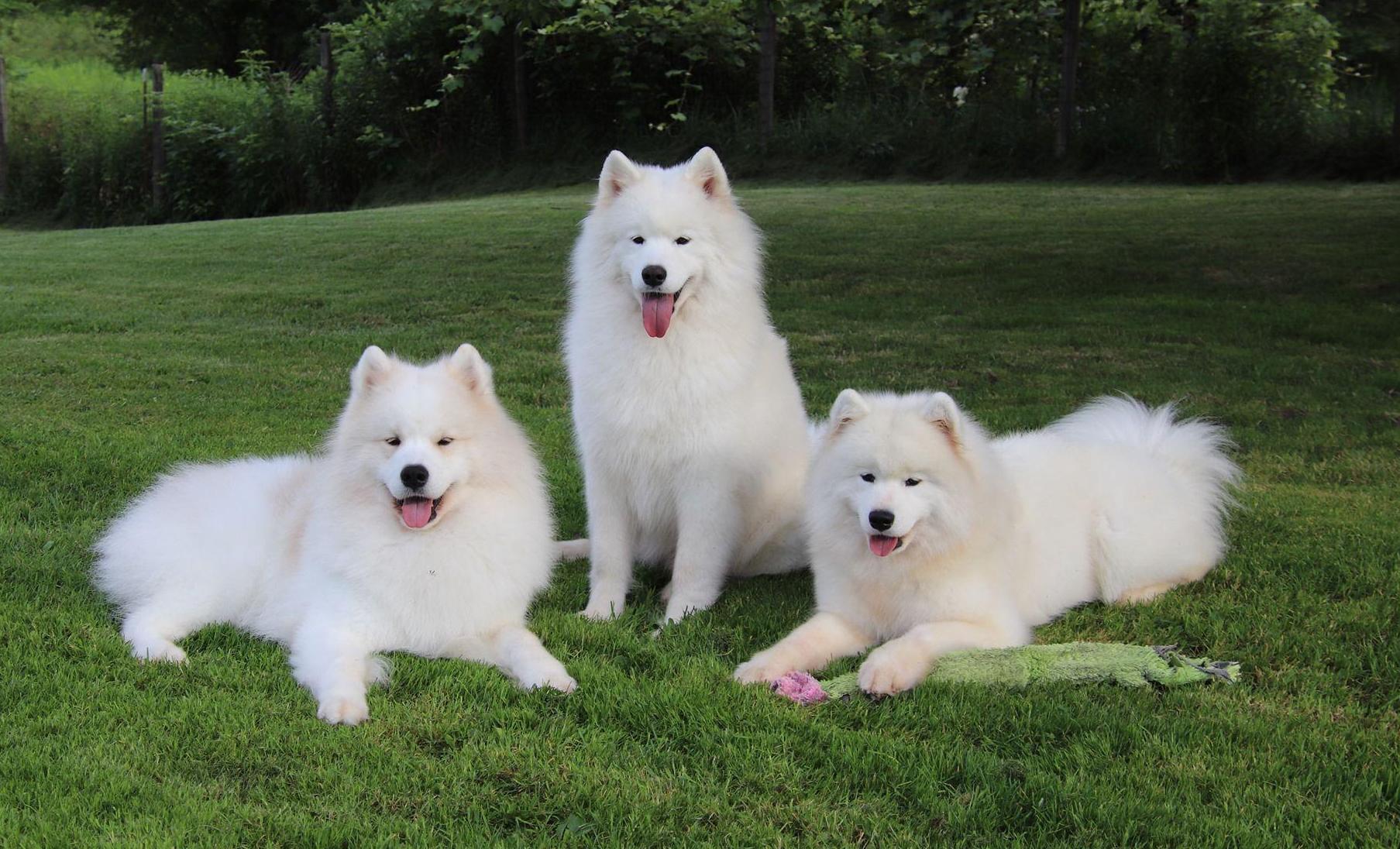
The Samoyed has a typical spitz build covered with a dazzling white coat. Their face looks like a canine snowman, with features that look as though they are made of coal set against snow white.
The Samoyed has typical spitz features: compact body, small erect ears, long bushy tail that is carried over the back and to the side, and thick double coat that stands off from the body—all features that help them conserve heat in frigid conditions. They are a medium to large breed, combining strength, agility, and some speed to enable them to do varied jobs such as reindeer herding and freight pulling over snow. They are slightly longer than tall, with a quick, agile gait. The skull is broad and wedge shaped, with the almond-shaped eyes and other facial features standing out in contrast. The black lips are slightly turned up at the corners of the mouth, giving the impression of smiling. The thick coat is double, with a soft dense undercoat and a harsh, long outer coat that stands straight out from the body. This combination offers maximal insulation and water resistance. The coat has a glistening silvery sheen in some lights. Although everyone thinks of the Samoyed coat as being only white, they can also be all biscuit colored, or white with biscuit or cream. It’s sometimes hard to tell the colors apart, as cream is almost white, and biscuit can mean anything from dark cream to the color of a freshly baked (not burned) biscuit.

Grooming

You may think you're in a blizzard, but it’s really just Samoyed shedding season…
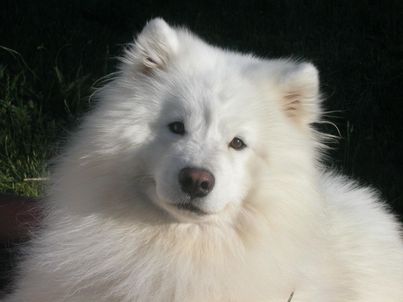
Most of the time, grooming your Samoyed is pretty straight forward. Your main challenge is to not become complacent and just groom the outer coat. That’s easy. Instead, you need to use a rake or other long-toothed comb or brush to reach down into and through the undercoat, all the way to the skin. Otherwise it can form a solid mat between the outer coat and the skin. When this happens, the mat can start to pinch the skin as the hair gets wet, shrinks, and pulls in on itself. Such cases need professional grooming to carefully shave the dog down to the skin. This is a special danger during shedding season. However, as long as you continue to groom by reaching down to the skin, and by pulling out any hair ready to be shed during regular brushing, there are no special grooming challenges except keeping up during shedding season. While you can skip several days throughout the rest of the year, you can’t skip days when your Samoyed is shedding. Be prepared to comb out bags of hair from your dog from their double-layer coats. Some people even save it and make it into yarn, and then sweaters. You will also want to bathe your Samoyed periodically. Doing so during shedding season will hasten loose hair to fall out, especially if you use warm water. Cut their nails when they get long, check their ears for debris, and brush their teeth daily.
A happy Samoyed looks into the camera
Img:

Pyles of Smiles

Breed temperament and characteristics

The Samoyed is among the friendliest of the spitz breeds. They are cheerful, amiable, and gentle, as welcoming as its smile suggests.
Although Samoyeds are willing to please, they’re still a spitz, with typical spitz stubbornness and independence. Their original jobs as a herder of reindeer, and as a guardian, required them to think for themself, and the typical Samoyed values their own opinion very highly. Samoyeds are amiable and gentle, which make them great family dogs for almost any family that has the time to devote to caring for and interacting with them. They thrive on attention, and enjoy sharing both outdoor activities and indoor rest times. As long as they get adequate mental and physical exercise, they’re calm house dogs. They can, however, dig and bark if they are just left in the yard. And they can be imaginatively destructive if ignored inside. This is a very loyal and interactive breed. Some tend to herd family pets and children, but they do so gently as a rule. They are not fighters, and most (but not all) get along with other dogs and pets. Samoyeds tend to be very vocal, and like to howl and make a variety of odd noises.

Exercise

This ancient working breed brings their tireless work ethic to life in your home.
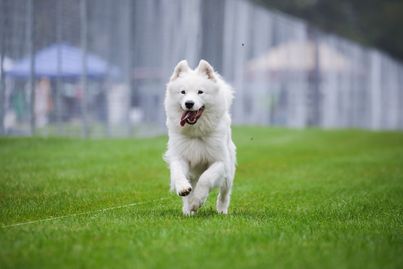
Although Samoyeds weren’t specifically bred to be long-distance sled pullers, they nonetheless can be sled dogs if asked. Their job as a herder and guardian of herds of reindeer meant that they had to be alert and active for long hours. Don’t expect to put your Samoyed in a kennel and have them act calmly when you finally let them out, they can be high-energy dogs. The Samoyed breed needs a good deal of exercise, more than a walk around the block. They make good jogging partners in cooler weather. Some owners even have sleds or carts for their Samoyeds to pull. Most Samoyeds prefer to just run rather than fetch, but some will also play fetch games. Some but not all enjoy swimming, and hiking is also a favorite activity. They like nothing better than a frigid day with snow on the ground. This is not really an ideal breed for hot or warmer climates, as their need for exercise can be difficult to mix with their tendency to get hot due to their thick double coat. Given a snow day, expect your Samoyed to want to spend the entire day outside in it. Mental exercise will sometimes tire them faster than physical exercise, so be sure to include training and puzzles into your exercise regime. These active dogs are not known as great agility dogs or obedience dogs, although some have excelled at these sports.
A Samoyed runs in the grass
Img:

Painted Hills Samoyeds

Training

Samoyeds are more willing to please, and less independent, than many spitz breeds. But don't expect a push-button obedience dog.
The Samoyed dog breed was bred to act of their own accord when herding or guarding. They naturally tend to have a mind of their own, which means forcing them to do something will only end up in a stalemate. Your job as a trainer is to convince them your idea is also their idea, and that going along with it will benefit them in terms of treats, toys, and games. They really are willing to please you, so acting suitably impressed every time they do as you wish is also a big help. Samoyeds are fast learners, and once they get into the game, can reach the top levels of competitive obedience. It’s those first steps that are the hardest. Socialization should begin at an early age so your Samoyed can learn to accept strangers and even other dogs. Fortunately, most Samoyeds enjoy meeting new people and dogs. Unfortunately, because a Samoyed puppy is one of the cutest beings on the planet, you may find yourself overwhelmed with people wanting to greet them.

Diet and nutrition

Most Samoyeds will thrive on any high quality diet formulated for adult dogs. Those working in cold weather may need additional calories from fat and protein.
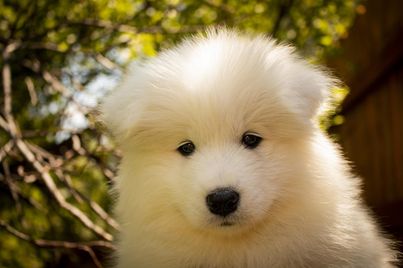
Samoyeds are large enough to qualify for large breed dog foods. These foods are balanced in calories, calcium, and phosphorus. They are especially critical for puppies because they allow them to grow at a healthy, steady rate. Many studies have shown that growing too fast increases the chance of many developmental joint diseases to which Samoyeds are already susceptible, including hip dysplasia. You should feed high-quality food in several small meals over the course of a day, starting with three-four meals as a little puppy, then two meals at about four months of age, transitioning to an adult diet at around 9 months. Obesity makes joint disease worse, so always keep your Samoyed trim. You should be able to feel the ribs with gentle probing, and there should be a definite indication of a waist, with no dimple over the tail or roll of fat over the withers. Always consult with your veterinarian if your dog has a particular health problem. Many specialized diets are available that are scientifically formulated for a variety of conditions.
A Samoyed puppy looks into the camera
Img:

Carriage Court Kennels

Health issues

There are a few health conditions that affect this breed.

Lifespan: 12 to 14 years.

Hip dysplasia

When the ball of the femur fails to fit appropriately into the socket of the pelvis. It can cause lameness and arthritis. Screening is by radiograph.

Gastric dilation-volvulus (“torsion”)

A life-threatening sudden twisting of the stomach, is a risk in large deep-chested breeds. It is an extreme emergency that can be fatal if not treated immediately

Pulmonic stenosis

The valve that carries blood from the heart to the lungs is narrowed, can be an inherited or spontaneous condition in Samoyeds. An echocardiogram performed by a cardiologist can confirm the diagnosis of pulmonic stenosis, or identify any other structural heart problems.

Diabetes mellitus

A hereditary disorder of Samoyeds. It has an unknown mode of inheritance.

Other health issues

Other health conditions that appear in Samoyeds include sebaceous adenitis, alopecia-X, uveodermatologic (VKH-Like) syndrome, primary glaucoma, cataracts, retinal dysplasia, and X-linked progressive retinal atrophy.

Learn more about health issues that may impact Samoyeds

History

This ancient breed was developed by the nomadic Samoyede people of Siberia to control and guard their reindeer, pull sledges and help hunt large game.
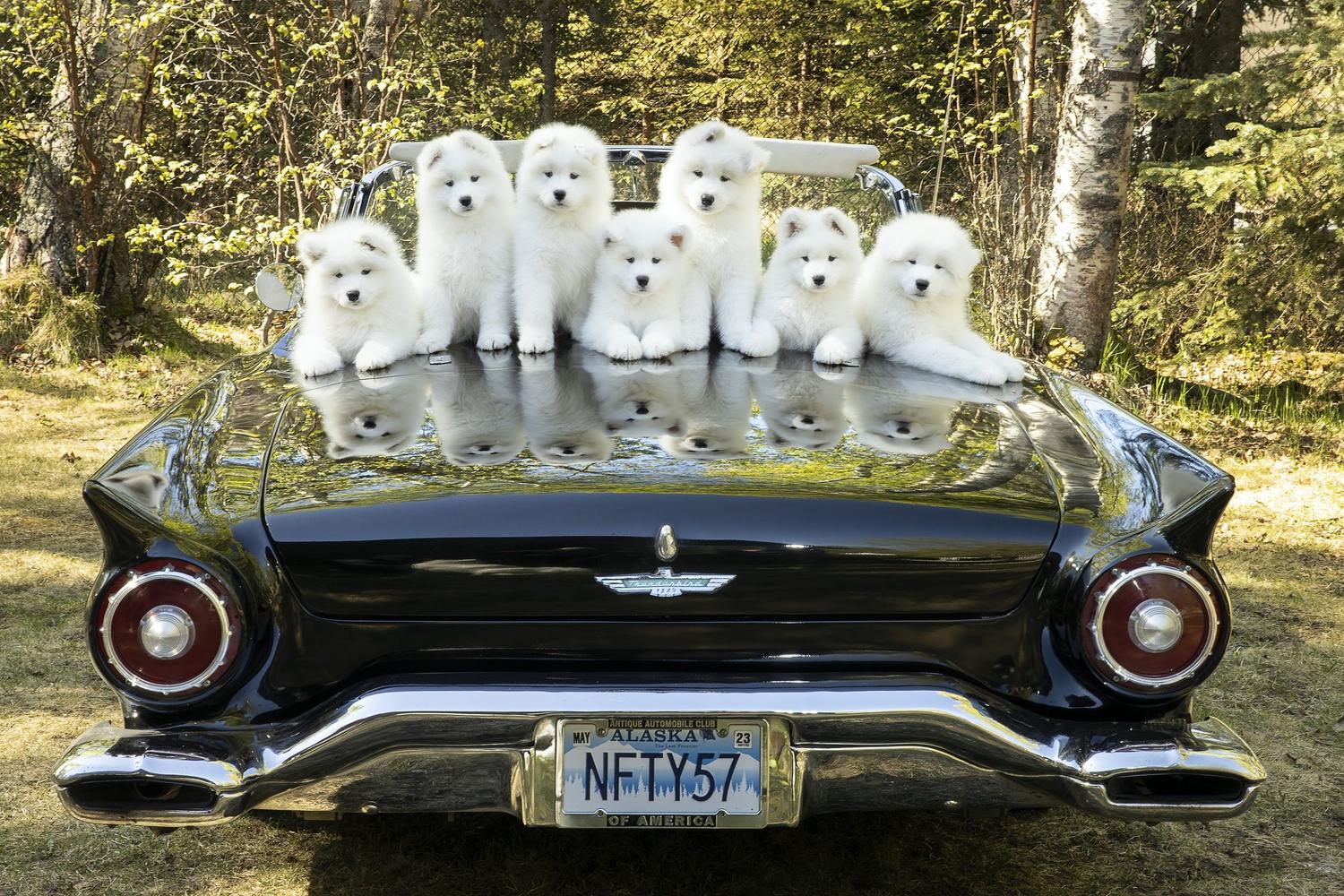
According to DNA studies, the Samoyed is among the most ancient of breeds. Their closest relatives are the Finnish Spitz and the Eurasier. They were first called bjelkiers, and lived in the tents and slept with the children to help keep them warm. They came in many colors. In 1895, Samoyeds made world news for leading the expedition to the North Pole led by Fridtjof Nansen. England’s Queen Alexandra was one of the breed's earliest proponents. Many of today's Samoyeds can be traced back to her dogs. Roald Amundsen used a dog team led by a Samoyed named Etah on the first expedition to reach the South Pole. The first recognized Samoyed came to America in 1906 as a gift from Russia's Grand Duke Nicholas. The American Kennel Club (AKC) recognized the breed in the same year. They are in the AKC Working group. Owners include Kelly Clarkson, Antonio Banderas, Shaun White, and Ariel Winter.
About the author

Canine specialist, Caroline Coile, Ph.D., is the author of 34 dog books, including the top-selling Barron's Encyclopedia of Dog Breeds. She’s written thousands of magazine and web articles about dogs. She specializes in canine science, health, breeds and competitions. Caroline has won 20 national dog-writing awards, and was a 2015 Inductee into the Dog Writers Association of America Hall of Fame.

Breed Scorecard

Characteristics and temperament
  • Affectionate with family

    4

  • Watchdog level

    4

  • Playfulness

    4

  • Adaptability

    3

  • Social needs

    4

  • Temperament

    Gentle, independent, calm

  • Intelligence

    3

  • Good with other dogs

    3

  • Good with cats or other pets

    4

  • Friendly with strangers

    4

  • Good as a service dog

    4

  • Good for apartments

    3

  • Barking level

    4

Appearance
  • Height

    19-23"

  • Size

    Medium to Large

  • Colors

    White and biscuit, White, Cream, Biscuit

  • Coat texture

    Harsh outer coat; soft undercoat

  • Coat length

    Long

Training
  • Trainability

    3

Exercise
  • Exercise needs

    3

  • Exercise time

    3

  • Mental exercise needs

    3

  • Favorite activities

    Sledding, bikejoring, skijoring, hiking, weight pulling

Grooming
  • Grooming needs

    4

  • Brushing frequency

    Daily

  • Needs professional grooming?

    No

  • Drooling level

    1

Health issues
  • Hip dysplasia

  • Gastric dilation-volvulus (“torsion”)

  • Pulmonic stenosis

  • Diabetes mellitus

  • Other health issues

Other
  • Bred for

    Draft, guardian, herding reindeer

  • Country of origin

    Russia (Siberia)

  • Popularity level

    3

FAQs

  • On Good Dog, you can search for Samoyed puppies or dogs in rescues and shelters. Adopting a Samoyed from a shelter or rescue is generally less expensive than buying a puppy from a breeder with ethical practices. Across the United States, there are dedicated rescues that specialize in specific breeds and may even help transport a Samoyed dog to you from another part of the country. Although it can be more cost-effective, adopting the exact breed you're looking for is typically more difficult than working with a responsible breeder. Learn more about adopting a dog from a shelter or rescue.

  • The average price of a responsibly-bred Samoyed puppy is $3,700. The price of a Samoyed puppy from a good breeder can be related to their show potential, health certifications, or other factors.

  • Samoyeds should be primarily indoor dogs, although they need outdoor excursions for exercise. In warm climates, it may often be too hot to keep them outside, and they are very social dogs who prefer to be with their family. While they do shed, they are generally calm inside as long as they get regular exercise outside.

  • Their biggest grooming challenge is keeping the undercoat from matting, especially during shedding season. If you hate brushing, then yes, they are high maintenance. If you like brushing, then no.
Caroline Coile, Ph.D.

Caroline Coile specializes in canine science, health, breeds and competitions. Caroline has won 20 national dog-writing awards, and was a 2015 Inductee into the Dog Writers Association of America Hall of Fame. She’s written thousands of magazine and web articles about dogs in addition to 34 dog books.

Content on Good Dog is generated, fact-checked, and evaluated by qualified writers and veterinarians.

Caroline Coile, Ph.D.

Caroline Coile specializes in canine science, health, breeds and competitions. Caroline has won 20 national dog-writing awards, and was a 2015 Inductee into the Dog Writers Association of America Hall of Fame. She’s written thousands of magazine and web articles about dogs in addition to 34 dog books.

Content on Good Dog is generated, fact-checked, and evaluated by qualified writers and veterinarians.