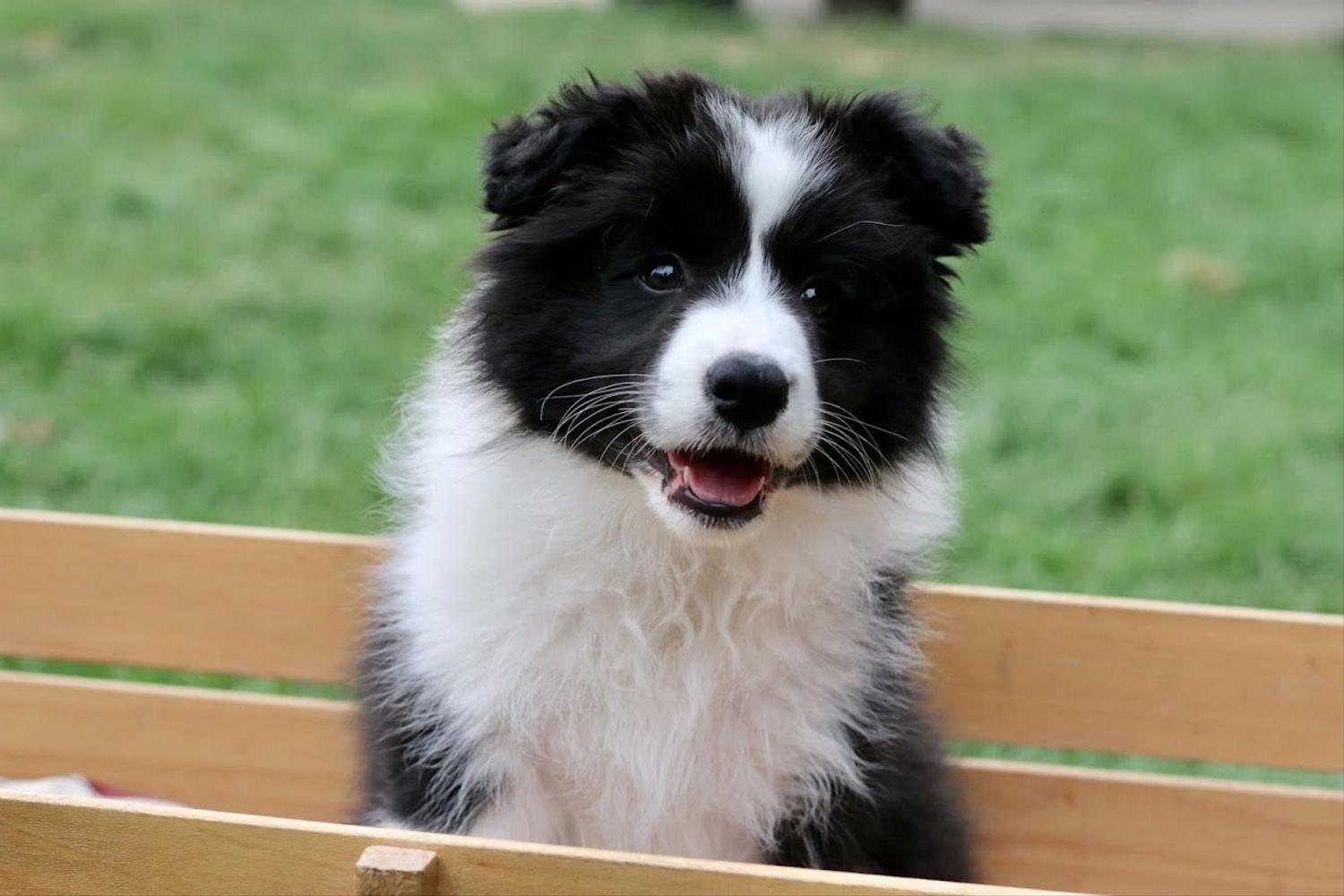
Black and white Border Collie standing nicely in a field
Get to know

Border Collies

Written by
Caroline Coile, Ph.D.,
 author of 34 dog books.
Written by
Caroline Coile, Ph.D.,
 author of 34 dog books, including the top-selling Barron's Encyclopedia of Dog Breeds.
| | | | |

The undisputed brainiacs of the dog world, Border Collies are born overachievers. They do best with owners who also think a fun day begins before dawn and is spent in a contest to show who’s smartest and fastest. The dogs usually win.

Border Collies were bred to perform precision herding of flocks of sheep, a task requiring the ability to think fast, obey directions from afar, predict a sheep’s next move, and to do so all day long. To do this they need to be smart, biddable, active, tireless, and surprisingly independent. They love to learn and perform all sorts of difficult tasks, and need challenges every day to be fulfilled. This is not a breed that will be happy just lounging around. Note, however, that show-bred lines tend to be more mellow than working-bred lines.
Browse available puppies

Connect with reputable breeders to find the dog of your dreams
At a glance

Very High Energy

Energy level

5/5

Low Maintenance

Grooming

3/5

Medium

Size

Extremely active, smart, biddable

Temperament

12-15 years

Lifespan

Highly Trainable

Training

5/5

High Vocality

Barking

5/5

At a glance

  • Energy level

    Very High Energy

  • Grooming

    Low Maintenance

  • Size

    Medium

  • Temperament

    Extremely active, smart, biddable

  • Lifespan

    12-15 years

  • Training

    Highly Trainable

  • Barking

    High Vocality

Why people love the breed

People love Border Collies because they are freakishly smart and they strive to excel. They live to impress you with their ability to predict your next desire, and then show you how to do it even better. Not only do they obey, but they do it at Mach speed.
Border Collies define Type A personality. Living with a Border Collie may sound like it’s easy, but it actually challenges you as well. Border Collie owners are constantly trying to think up games and activities and jobs to fulfill their dogs’ quest for mental and physical stimulation. They love to run, play, and do things together. Living with a Border Collie is like having your own personal fitness coach to get you out of bed and into the great outdoors. Life is never ever boring with a Border Collie. They love to show off. While not fawning, they are affectionate and are very eager to do your bidding. They are loyal and tend to stay around when hiking, unless the activity (such as herding) calls for them going farther away. Border Collies aren’t pets; they’re equals, true family members who just may be smarter than some other family members. Or at least, they think they are!

Appearance

The Border Collie is built to have agility, strength, speed, and stamina. They're small to medium-sized dogs with the body of a marathon runner rather than a body-builder. Everything about their build is in moderation, but their movement is without parallel.
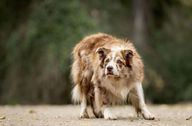
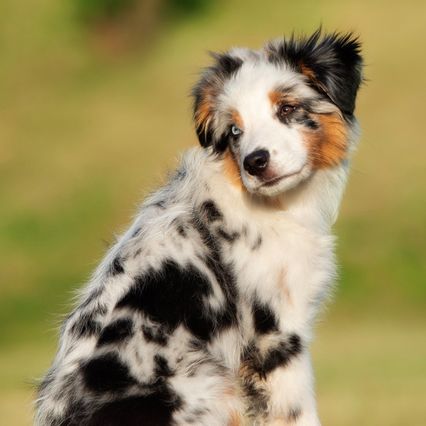
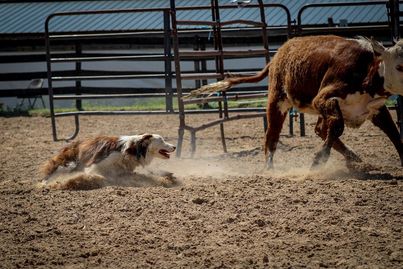
The Border Collie body is slightly longer than tall, with a level topline. The long plumed tail is carried low. The head is fairly wide, with oval eyes. The ears can be erect or semi-erect. Border Collies from show lines tend to be slightly heavier bodied with fuller coats, whereas those from working lines tend to be rangier with a much more sparse coat. The coat can be either smooth or rough, but the rough coat is more common, especially in show lines. The rough coat is feathered, and can vary between medium to long in length, with show lines tending to have more coat. The color is most often black with white trim, but it can also be any solid color (except for white), or bi-color, or tri-color; or exhibiting merle or sable patterns. The movement is what sets the Border Collie apart from other breeds. Their trot is flowing, ground-covering, and tireless, with the head held at about the same height as the topline. When working, they have an uncanny ability to trot while crouched, like a cheetah stalking its prey. They can accelerate, decelerate and turn in an instant.

Grooming

Although many do have a fairly long, thick coat, it nonetheless is easy to care for.
Dirt tends to fall out of the harsh coat, but the longer coats should still be brushed once or twice a week. The short coat only needs brushing once a week. It’s a thick coat, so a pin brush works best for either coat type. Both coats can shed a lot during shedding times, and will need more frequent brushing then. Bathing will make the coat more enjoyable to feel, and help loosen hairs that are about to be shed. Because they can have a heavy undercoat, be sure to brush or comb down to the skin to avoid mats forming. Of course, if burrs get caught in the tail and you don’t remove them, the tail can mat. Small mats might also form under the ears or in a thick ruff or britches. Most Border Collies are so active they wear their toenails down, but be sure to check them weekly and trim them if needed. Brush the teeth daily. Check the ears weekly for build-up but don’t clean them unless there is debris, at which point you can also seek your veterinarian's guidance.
Img:

Graham Livestock

Breed temperament and characteristics

Intense, alert, active, biddable, high-energy, independent, impatient, job-oriented—all of these describe the typical Border Collie.
Border Collies are often described as canine Einsteins, but that doesn’t give the whole picture. They’re more like canine Einsteins on an adrenaline rush that won’t let up. Even when apparently resting around the house, they’re on their feet at your slightest movement, ready to go do something. Some Border Collies may be too intense to be ideal service dogs, although they are amazing at any job that requires them to be active. While affectionate, they aren’t fawning, and they sometimes just seem too busy to kiss or cuddle at length. They get along well with most other dogs and pets. They often try to herd other animals or young children, especially if the animals or children are running around, which can be irritating to the one getting herded. They are gentle with toddlers and the elderly, but would generally rather be doing something more active. Like most herding breeds, they can be wary toward strangers. Border Collies herd by intimidating the sheep with stalking behavior, which involves intensely staring, crouching and creeping toward the sheep. They will often use this same behavior when they’re interested in something. The staring, especially, can be unnerving if it’s directed at you—which it often is if they want you to do something. Given enough activity, they do calm down and can be model citizens in the home. Give them an assigned spot and they will run to it on command. They are easy to housebreak and not wantonly destructive. Again, the show-bred lines tend to be a bit more low-key. Herding breeds seem to be more prone to certain behavioral problems such as noise phobias or even compulsive behaviors such as chasing lights or their own tail. Though initially cute, these behaviors should not be encouraged.

Exercise

A Border Collie without enough exercise is not a dog you want to live with. It's not fair to them or to you. So don’t get a Border Collie unless you’re committed to hours of shared activities every day.
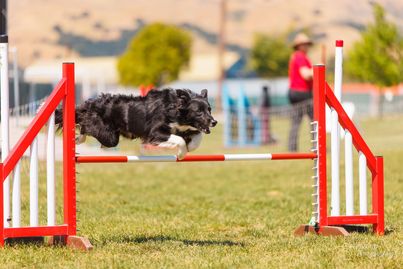
Border Collies from working lines need several hours of mental and physical activity every day. Border Collies are not the sort of dog you can just turn loose in the yard and expect them to run around by themselves, though. They are more likely to run in circles and bark than to get any meaningful exercise. They enjoy directed activities that challenge them mentally and physically. They love to play games of Frisbee and fetch, to the point you have to put a stop to them because they probably won’t. Herding is probably their favorite activity on earth, but most people don’t have access to a flock of sheep or even ducks, which are sometimes used as well. Border Collies excel in the sport of dog agility. In fact, the sport was designed with them in mind. Even with limited room you can set up an agility course in the yard and exercise your Border Collie’s body and mind with it. Competitive agility involves complicated courses over jumps, through tunnels, weaves and over other obstacles. Flyball is another high octane sport that many Border Collies enjoy. Border Collies also enjoy just getting out in nature and hiking with you. They can even jog long distances. Remember again, that a show-bred Border Collie will generally require less exercise than a working-bred Border Collie.
Black and white Border Collie going over an agility jump during a competition
Img:

Cathedral Border Collies

Training

Border Collies seem to come pre-programmed to learn. They enjoy the training process and may not leave you alone until the next session. However, you must stay one step ahead in order to keep them from second-guessing your desires.
Border Collies are known as one of the most intelligent dog breeds and have set records for performing various feats on intelligence. Working with a Border Collie is very fulfilling, but sometimes daunting as they often learn things you didn’t intend to teach them. They are impatient learners; if you don’t give a cue as fast as they expect it, they will often substitute their own guesses for what you want them to do. This is especially evident in the sport of agility, when many Border Collies actually fail because they didn’t think their handler was fast enough in directing them to the next obstacle, so they just guessed which one it might be rather than wait an extra second. So while they learn fast, you must be careful to plan your lessons with them. Border Collies are so trainable because they were bred to follow directions. When herding, they need to pay attention to the person directing them from a distance so they know where to direct the stock, or even which sheep need to be cut from the others. But they also need to think for themselves. Sheep move too fast to wait for the shepherd to give explicit directions. Give the Border Collie a general job, and leave the details to the dog as to how to accomplish it. Thus, most Border Collies don’t like to be micromanaged. Border Collies are both biddable but with a bit of independence. Working-bred Border Collies are unrivaled in the sport of competitive herding. Both working and show-bred Border Collies have achieved the very highest levels of agility and obedience competitions, often winning national competitions. In fact, certain lines specialize in just obedience and agility. Border Collies are also gifted search & rescue dogs.

Diet and nutrition

Border Collies are high energy dogs that need high-quality food to fuel their day.
Border Collies thrive on high-quality, commercial dog foods. As puppies, they should eat puppy food three to four times a day until about 4 months of age, then two times a day thereafter. For puppies, feed as directed by your veterinarian, but if they start to become chubby as older puppies you may have to slightly restrict their intake. Active Borders may need to eat a commercial diet formulated for active dogs. Be careful that you don’t overfeed your Border Collie as your dog ages and eventually slows down. They’ll need fewer calories then. Factor in all the treats you may be doling out during training. They can add calories faster than you might think. Although some Border Collies, especially show-bred Border Collies, may look rounded, that should be due to their coat, not body. You should be able to feel the waist and see some indication of a narrowing through the loin from above. You should also be able to feel the ribs with minimal probing. Discuss any special diet concerns with your veterinarian. Your Border’s optimal diet will change with age. Some health problems require special diets that may only be available through prescription. Fortunately, Border Collies as a breed are not typically prone to many problems requiring special diets.
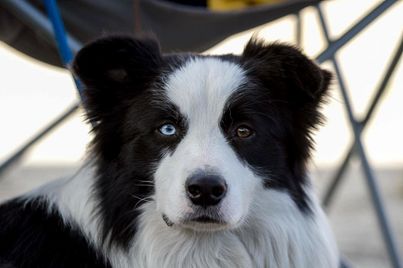
A black and white Border Collie with a blue eye and brown eye
Img:

Aleannan Border Collies

Health issues

The Border Collie is among the healthiest of breeds, probably thanks to the heavy emphasis on working ability throughout most of its existence.

Lifespan: 12 to 15 years.

Hip dysplasia

This is a complex condition that involves both genetic and environmental factors and arises when the head of the femur doesn’t fit in the pelvic socket, causing arthritis and lameness. No genetic test is available to date, therefore, the recommended screening test is x-rays.

Collie Eye Anomaly

A hereditary condition impacting the development of the eye that can lead to blindness and retinal detachment.

Epilepsy

Is reported at a higher rate in Border Collies compared to other breeds. The exact cause is unknown but a genetic basis is suspected in many breeds. No specific gene has been identified, so no genetic testing is available.

Neuronal ceroid lipofuscinosis (NCL5)

A lysosomal storage disease. The symptoms begin between 15-20 months of age and can include vision loss, loss of coordination, and behavior changes including decreased response to commands, increased fear, hallucinations, and aggression.

Double merle

The merle gene creates mottled patches of color in a solid or piebald coat, blue or odd-colored eyes, and affects skin pigment. If a dog has just one copy of the dominant M allele, along with one copy of the recessive m allele, it will be merle. But if a dog has two copies of the dominant M allele, it is a double-merle, and will likely have large areas of white fur, and very often blue eyes. Unfortunately they are also often deaf or blind. Breeding two dogs with merle together should always be avoided due to the potential health concerns.

Learn more about health issues that may impact Border Collies

History

The Border Collie was born to herd. So adamant were the breed’s fanciers that many fought AKC recognition for years, insisting it should only be evaluated on working ability rather than appearance. This eventually led to a split between working and show lines, but both lines have amazing workers in them.
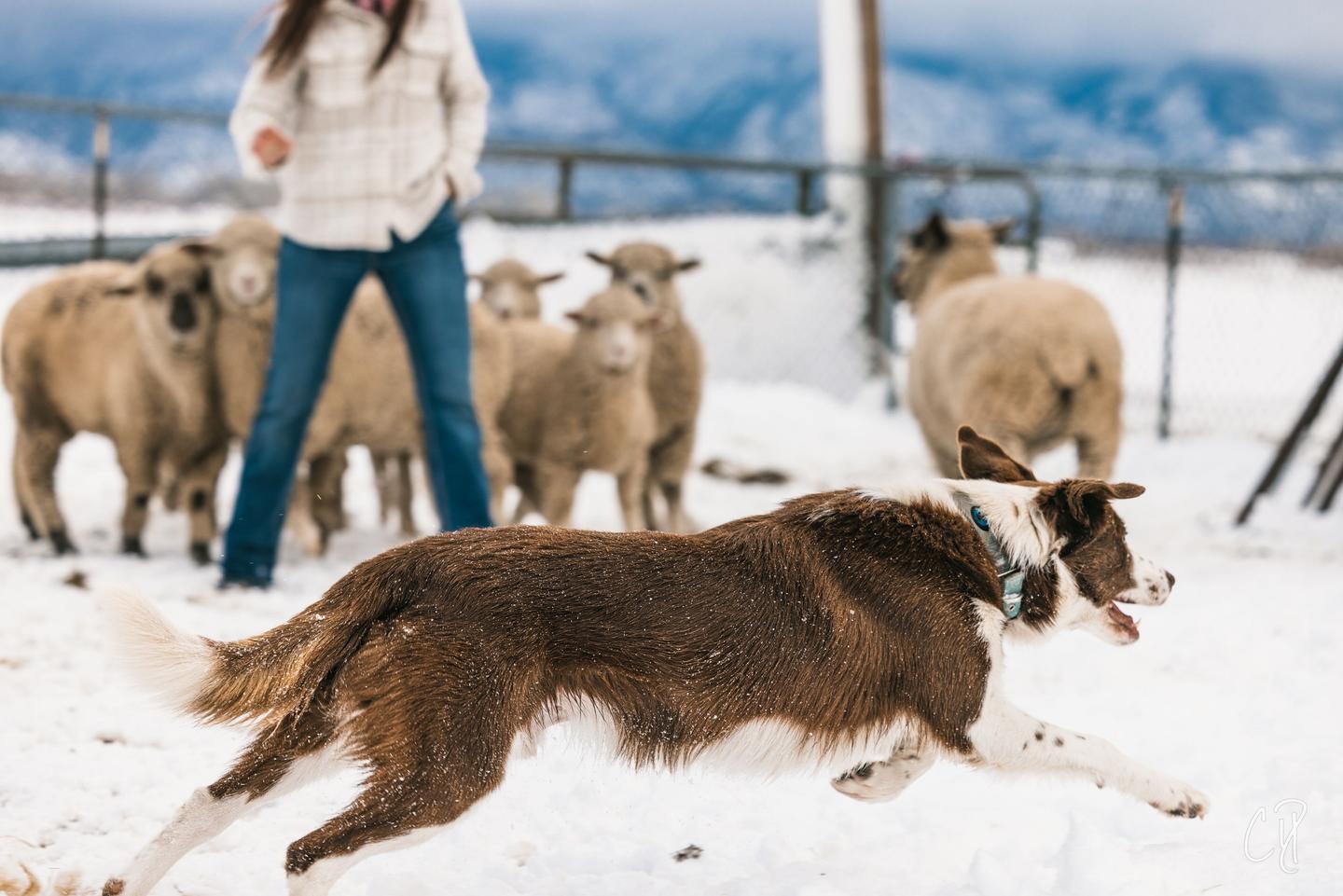
In the 1800s most sheep-herding dogs controlled flocks by nipping and barking. Shepherds boasted about their favorite dogs to the point that the first official sheepdog trial was held in 1873. At that trial, a dog named Hemp stood out. He didn’t nip or bark, but intimidated the sheep by staring and stalking (called “giving eye”). So effective was he that he sired more than 200 puppies and is considered the father of the Border Collie. The first breed standard, written in 1906, was unlike other standards that described ideal appearance. Instead, the Border Collie standard only described working ability. The name Border Collie was adopted in 1915, in reference to its origin along the border between England and Scotland. Fanciers fought AKC recognition, which they feared would lead to dogs being bred just for appearance, and would increase their popularity with people not equipped for their high energy. They were, however, competing from the AKC Miscellaneous class for decades, and showed the world they were capable of winning obedience trials at the highest levels. The AKC recognized the Border Collie in 1995. The breed split into show and working lines, with proponents of each fiercely protective. Because most Border Collies are not registered with the AKC, AKC’s rankings underestimate their popularity. DNA studies show the Border Collie’s closest relative is the Australian Kelpie. Border Collies have starred in movies such as “Babe” and its sequels, and in books such as “Nop’s Trials.” Owners have included David Lee Roth, Jon Bon Jovi, Tiger Woods, Jerry Seinfeld, Jane Fonda, and Ethan Hawke.
About the author

Canine specialist, Caroline Coile, Ph.D., is the author of 34 dog books, including the top-selling Barron's Encyclopedia of Dog Breeds. She’s written thousands of magazine and web articles about dogs. She specializes in canine science, health, breeds and competitions. Caroline has won 20 national dog-writing awards, and was a 2015 Inductee into the Dog Writers Association of America Hall of Fame.

Breed Scorecard

Characteristics and temperament
  • Affectionate with family

    3

  • Watchdog level

    4

  • Playfulness

    5

  • Adaptability

    4

  • Social needs

    4

  • Temperament

    Extremely active, smart, biddable, eager

  • Intelligence

    5

  • Good with other dogs

    3

  • Good with cats or other pets

    2

  • Friendly with strangers

    2

  • Good as a service dog

    4

  • Good for apartments

    1

  • Barking level

    5

Appearance
  • Height

    18-22"

  • Size

    Medium

  • Colors

    Tri-color, Gold merle, Slate merle, Brindle merle, Lilac merle, Black and white, Blue merle, Red merle, Black, Blue, Brindle, Gold, Lilac, Red, Sable, Sable merle, Saddleback sable, White and blue, White and blue merle, White and red, White and red merle, White ticked, Seal, Slate, White and gold, White and seal

  • Coat texture

    Slightly harsh, feathered, close-lying

  • Coat type

    Rough, Smooth

  • Coat length

    Usually medium to long, sometimes short

Training
  • Trainability

    5

Exercise
  • Exercise needs

    5

  • Exercise time

    2-3 hours daily

  • Mental exercise needs

    5

  • Favorite activities

    Herding, agility, frisbee, tricks, dog sports

Grooming
  • Grooming needs

    3

  • Brushing frequency

    Weekly

  • Needs professional grooming?

    No

  • Drooling level

    1

Health issues
  • Hip dysplasia

  • Collie Eye Anomaly

  • Epilepsy

  • Neuronal ceroid lipofuscinosis (NCL5)

  • Double merle

Other
  • Bred for

    Sheep herding

  • Country of origin

    Scotland

  • Popularity level

    4

FAQs

  • On Good Dog, you can search for Border Collie puppies or dogs in rescues and shelters. Adopting a Border Collie from a shelter or rescue is generally less expensive than buying a puppy from a breeder with ethical practices. Across the United States, there are dedicated rescues that specialize in specific breeds and may even help transport a Border Collie dog to you from another part of the country. Although it can be more cost-effective, adopting the exact breed you're looking for is typically more difficult than working with a responsible breeder. Learn more about adopting a dog from a shelter or rescue.

  • Yes, but only if the family plans to include the dog in a lot of activities. They are not a good dog if the expectation is for them to relax and fade into the background. They need people who want to share hours every day with them in various activities; otherwise, they can become frustrated and even neurotic or destructive.

  • They tend to be excitement barkers, especially when impatient for an activity to begin. Once participating, they concentrate on the task at hand and get to work, seldom barking unless they feel their handler is too slow in giving cues. They can also bark a lot if relegated to the backyard with nothing else to do. However, compared to most other herding dogs, which often bark to get sheep or cattle moving, Border Collies herd by silently staring and stalking. Thus, they are actually much more quiet than most herding breeds.

  • They can be, if they are expected to just take it easy and wait for the mood to strike you to do something. For active people who like training and interacting with their dogs a lot, they’re not at all difficult. For inactive people, or those too busy with other things to fit in several hours of dogtime a day, they can be difficult.

  • The typical price for Border Collie puppies for sale may vary based on the breeder and individual puppy. On average, the price of Border Collie puppies from a breeder is $1,750.
Caroline Coile, Ph.D.

Caroline Coile specializes in canine science, health, breeds and competitions. Caroline has won 20 national dog-writing awards, and was a 2015 Inductee into the Dog Writers Association of America Hall of Fame. She’s written thousands of magazine and web articles about dogs in addition to 34 dog books.

Content on Good Dog is generated, fact-checked, and evaluated by qualified writers and veterinarians.

Caroline Coile, Ph.D.

Caroline Coile specializes in canine science, health, breeds and competitions. Caroline has won 20 national dog-writing awards, and was a 2015 Inductee into the Dog Writers Association of America Hall of Fame. She’s written thousands of magazine and web articles about dogs in addition to 34 dog books.

Content on Good Dog is generated, fact-checked, and evaluated by qualified writers and veterinarians.