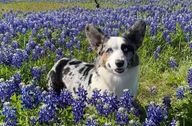
Cardigan Welsh Corgi lays in the grass
Get to know

Cardigan Welsh Corgis

Written by
Caroline Coile, Ph.D.,
 author of 34 dog books.
Written by
Caroline Coile, Ph.D.,
 author of 34 dog books, including the top-selling Barron's Encyclopedia of Dog Breeds.
| | | | |

The Cardigan Welsh Corgi is one of those underrated breeds that should be at the top of just about anyone’s list of dogs.

They’re great pets, being both fun and lovable. They are often overlooked in favor of the flashier Pembroke Welsh Corgi, but the Cardigan has a lot going for it.
Browse available puppies

Connect with reputable breeders to find the dog of your dreams
At a glance

Moderate Energy

Energy level

3/5

Very Low Maintenance

Grooming

2/5

Medium

Size

Trainable, devoted, spirited

Temperament

12-15 years

Lifespan

Quick to Learn

Training

4/5

Vocal

Barking

4/5

At a glance

  • Energy level

    Moderate Energy

  • Grooming

    Very Low Maintenance

  • Size

    Medium

  • Temperament

    Trainable, devoted, spirited

  • Lifespan

    12-15 years

  • Training

    Quick to Learn

  • Barking

    Vocal

Why people love the breed

Cardigans are the “calmer Corgi,” less inclined to bark or run amuck than their close relative, the Pembroke Welsh Corgi. They also appeal to somebody wanting something a little different and off beat.
Cardigans are big dogs with short legs. They’re not so big that they take up a lot of room, but they are plenty sturdy. Their herding heritage means they are attentive and biddable and smart, with enough independence to think for themselves at times. They make amazing companions for adults, children and elderly alike. They are fun and even comical, always showing off their long tail by wagging it. They are excellent cattle drovers and handy to have around the farm. Plus they come in lots of neat colors.

Appearance

Many call them “the Corgi with the tail,” but they are much more than that.
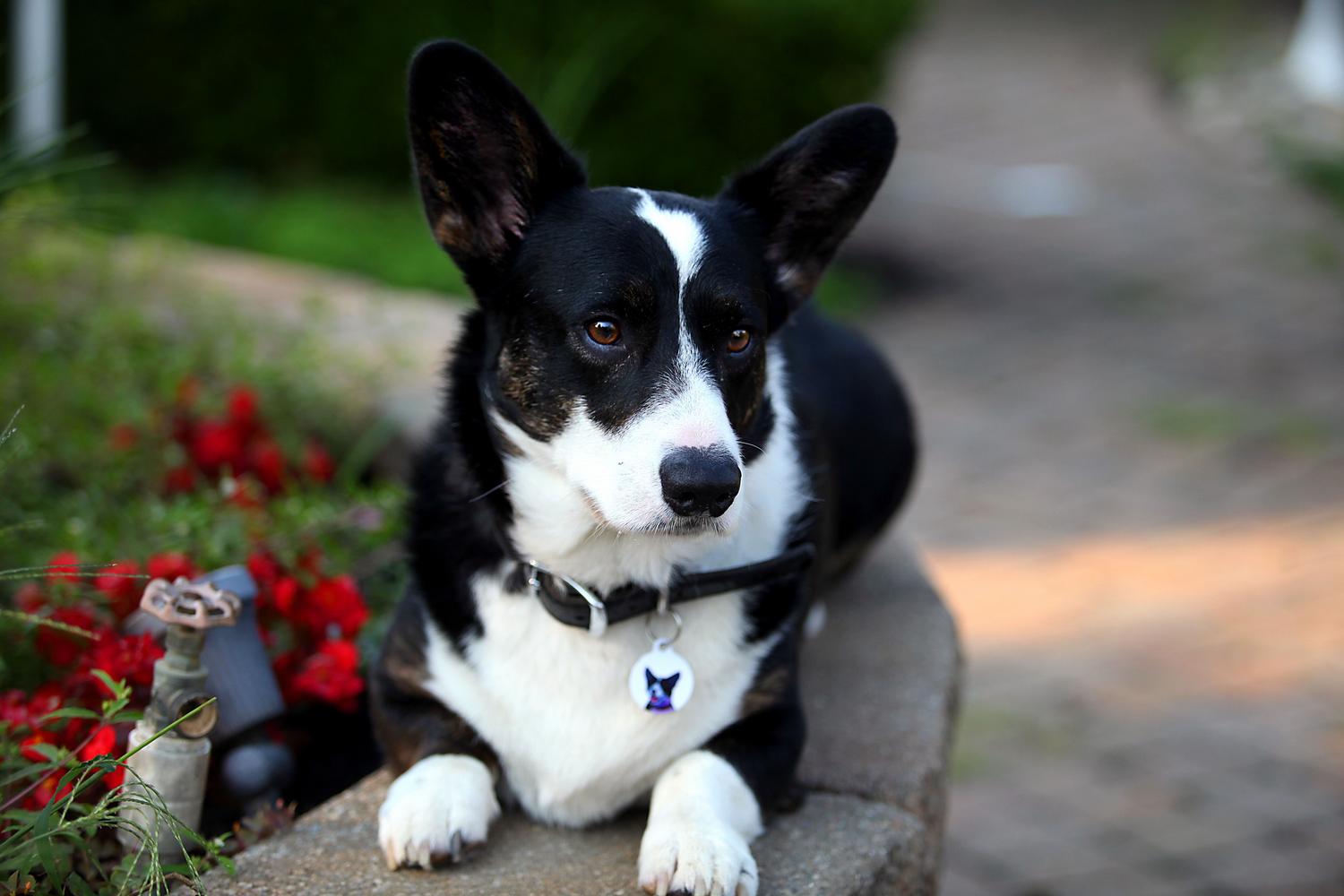
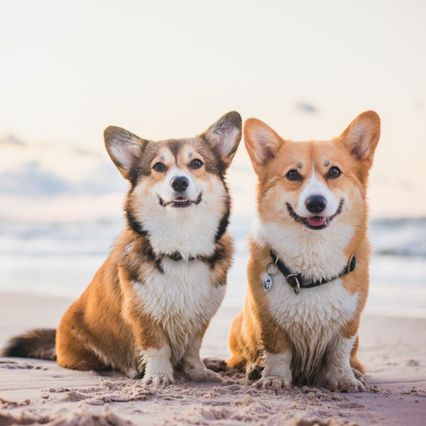
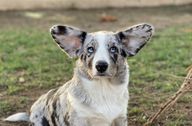
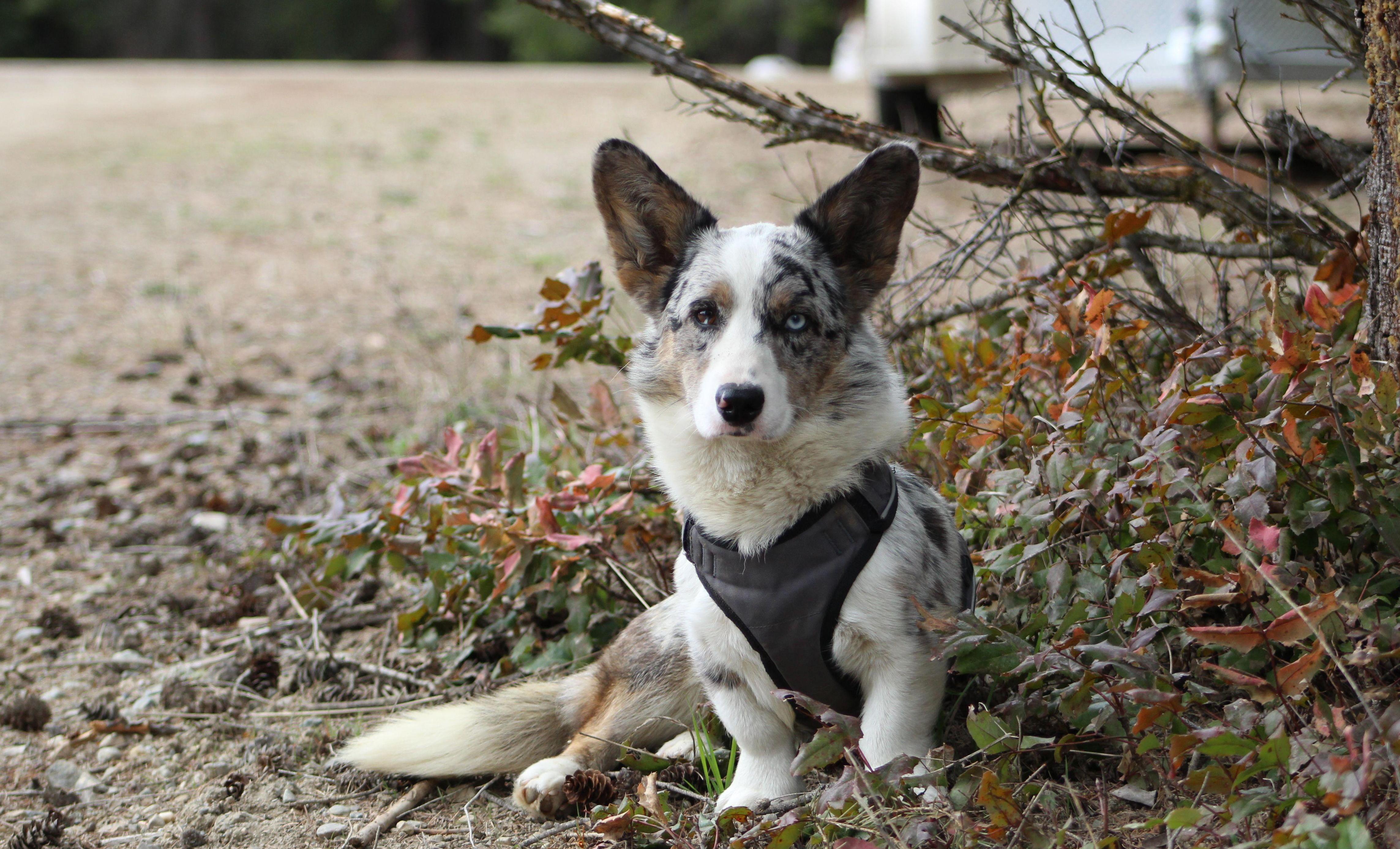
Cardigans differ from Pembroke Welsh Corgis in several ways. The most obvious is that they always have a long tail. They are larger overall. They also come in some colors and patterns that Pembrokes don't come in, most notably brindle and merle. They are heavier boned, with a larger head and much larger, more rounded ears than a Pembroke. Their front feet, which are also larger, point not straight ahead, but angled to the side, to go with their wrap-around-front. The Cardigan is long and low, a dwarf breed that has a normal size large body on shortened legs. They are about 1.8 times longer than tall. This enabled them to duck and let the cattle’s kicking hooves miss them as they drove cattle. They have a level topline. The tail is carried low, not over the back. The eyes are medium to large. The double coat consists of a soft thick undercoat and slightly hard outer coat, both of which lie flat.

Grooming

Grooming is straightforward, but they can shed a lot periodically.
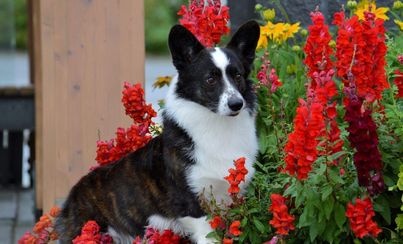
For most of the year, you need to brush the coat to pull out dead hairs every week or so. But twice yearly, when they shed, you need to do this every day. Washing in warm water can help loosen dead hair. Otherwise, just bathe as needed. Keep the nails trimmed short. Examine the ears for debris weekly, and don’t clean them unnecessarily. Brush the teeth daily.
Cardigan stands amongst beautiful red flowers
Img:

Grandiose Cardigan Welsh Corgis

Breed temperament and characteristics

The Cardigan is a happy dog that loves challenges and adventures as well as down-time.
This is a breed that always seems to be having fun, with a perpetual smile and wagging tail. They are eager to please, and look to their person for direction, but are not shy about making their own decisions as well. Cardigans can make great hiking and playtime companions. They make rollicking playmates for children and tender companions for the elderly. They were developed to spend the day in the field, driving cattle and avoiding their kicks, so they are an energetic breed. But they also enjoy relaxing and unlike many herding breeds have a definite “off” button. They are fairly outgoing toward strangers (though tend to be more suspicious than Pembrokes), get along with other pets, and may or may not get along with strange dogs. They are eager to please and highly intelligent, making them quite easy to train.

Exercise

The Cardigan was bred to run all day, nipping at and dodging the heels of unruly cattle. They couldn’t afford to get tired. That energy level persists in today’s Cardis.
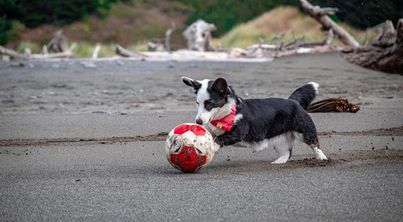
Chances are you can’t get a herd of cattle to exercise your Cardigan. Or even a flock of sheep. But you can go jogging, hiking, or just on long walks. You can play a vigorous game of fetch and chase in the yard. You can train on a home agility course. You can even take herding lessons if they’re offered in your area. Fortunately it does take a lot of energy for those short legs to cover a lot of ground so they will likely not be winning any marathons. As long as you make an effort and stay outside mixing it up for an hour or so, you're good. Besides herding, some Cardigans enjoy lure coursing sports.
Cardigan plays with a soccer ball on the beach
Img:

Glacier Cardigan Welsh Corgis

Training

Cardigans are extremely intelligent and eager to please, making them easy to train and live with.
Herding dogs must have a combination of biddability balanced with the ability to think for themselves in order to do their jobs. Cardigans are no exception, and they are generally eager to please and quick to learn. Positive techniques using rewards like food or games work best. Cardigans have competed successfully at the highest levels of obedience. They also enjoy trick training, barn hunt, tracking, and agility. Socialization is important so your Cardigan can be more comfortable around unfamiliar dogs, places, and people.

Diet and nutrition

Most Cardigans are good eaters and do well on a variety of commercial diets. Few have health problems requiring special food.
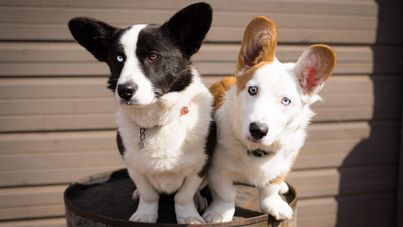
Feed a Cardigan puppy as you would any puppy. Offer them three meals a day until they are about 4 months old, then twice daily. Adult diets can be offered starting at around nine months of age. Young Cardigans may be so active it can be hard keeping weight on them. But with age, and especially if your dog is neutered or spayed, they can gain too much weight. A Cardigan should be trim and muscular, with an indication from the side and top of a smaller waist. Ask your veterinarian's opinion if you worry your dog may be over-- or underweight. Because of their propensity to injure their backs, keeping your Cardigan trim is especially important. Discuss any special diet concerns with your veterinarian. Your dog’s optimal diet may change with age. Some health problems require special diets that may only be available through prescription.
2 Cardigans stand on an old barrel
Img:

Star N Cardigan Corgis

Health issues

The Cardigan is robust and healthy, but has predispositions to a couple of potentially serious conditions.

Lifespan: 12 to 15 years.

Hip dysplasia

In which the head of the femur is not seated properly in the hip socket, causing lameness and arthritis.

Progressive retinal atrophy

This is a group of degenerative diseases in which the cells in the retina deteriorate over time, eventually leading to blindness.

Intervertebral disc disease (IVDD)

This is a degenerative disease that can affect a dog's spinal cord and cause a range of painful mobility issues. It can also be described as a ruptured, slipped, bulging or herniated disk. IVDD most frequently affects chondrodystrophic dogs—those characterized by having short legs and long backs.

Degenerative myelopathy

A disease affecting the spinal cord, resulting in slowly progressive hind limb weakness and paralysis. A DNA test is available that indicates if dogs are at greater risk.

Learn more about health issues that may impact Cardigan Welsh Corgis

History

This all-purpose farm dog has served many roles. Its best may be as a companion.
Their early ancestors may have included short-legged turnspit dogs, which turned meat over a spit. But they were also used for guarding the farm. Their great talent was as cattle drovers. They were especially adept at getting behind the herd and scattering them across a field. In this way they took up more land, which was good for tenant farmers claiming to need as much as possible. “Corgi” means “dwarf dog “ in Welsh. The original Cardigans were from Cardiganshire, South Wales. In some parts it was called the “yard-long dog” or Ci-llathed.” Only later were they crossed with spitz-like dogs to create the Pembroke Welsh Corgi. Until 1934, the Cardigan and Pembroke were considered one breed in Europe. The American Kennel Club (AKC) recognized the Cardigan in 1935 as a member of the Working group. They became part of the Herding group when it later split from the Working group.
About the author

Canine specialist, Caroline Coile, Ph.D., is the author of 34 dog books, including the top-selling Barron's Encyclopedia of Dog Breeds. She’s written thousands of magazine and web articles about dogs. She specializes in canine science, health, breeds and competitions. Caroline has won 20 national dog-writing awards, and was a 2015 Inductee into the Dog Writers Association of America Hall of Fame.

Breed Scorecard

Characteristics and temperament
  • Affectionate with family

    3

  • Watchdog level

    5

  • Playfulness

    3

  • Adaptability

    3

  • Social needs

    4

  • Temperament

    Trainable, devoted, spirited

  • Intelligence

    4

  • Good with other dogs

    3

  • Good with cats or other pets

    4

  • Friendly with strangers

    3

  • Good as a service dog

    3

  • Good for apartments

    3

  • Barking level

    4

Appearance
  • Height

    10-12"

  • Size

    Medium

  • Colors

    White merle (non-standard), Liver and white (non-standard), Sable merle and white (non-standard), Black and white, Blue merle and white, Brindle and white, Brindle merle and white (non-standard), Red merle and white (non-standard), Red and white, Gray and white (non-standard), Sable and white

  • Coat texture

    Somewhat hard

  • Coat length

    Medium, close fitting, unfurnished

Training
  • Trainability

    4

Exercise
  • Exercise needs

    3

  • Exercise time

    About an hour a day

  • Mental exercise needs

    4

  • Favorite activities

    Herding, Barn Hunt

Grooming
  • Grooming needs

    2

  • Brushing frequency

    Weekly

  • Needs professional grooming?

    No

  • Drooling level

    1

Health issues
  • Hip dysplasia

  • Progressive retinal atrophy

  • Intervertebral disc disease (IVDD)

  • Degenerative myelopathy

Other
  • Bred for

    Herding cattle

  • Country of origin

    Wales

  • Popularity level

    3

FAQs

  • On Good Dog, you can search for Cardigan Welsh Corgi puppies or dogs in rescues and shelters. Adopting a Cardigan Welsh Corgi from a shelter or rescue is generally less expensive than buying a puppy from a breeder with ethical practices. Across the United States, there are dedicated rescues that specialize in specific breeds and may even help transport a Cardigan Welsh Corgi dog to you from another part of the country. Although it can be more cost-effective, adopting the exact breed you're looking for is typically more difficult than working with a responsible breeder. Learn more about adopting a dog from a shelter or rescue.

  • Prices for Cardigan Welsh Corgi puppies for sale vary by breeder and individual puppy. On Good Dog today, Cardigan Welsh Corgi puppies are typically around $2,630. Because all breeding programs are different, you may find dogs for sale outside that price range.

  • Two of their main concerns include hip dysplasia and intervertebral disc disease.

  • They make excellent pets as they are biddable, friendly, and good with everyone. But you do have to be sure to exercise them in mind and body.

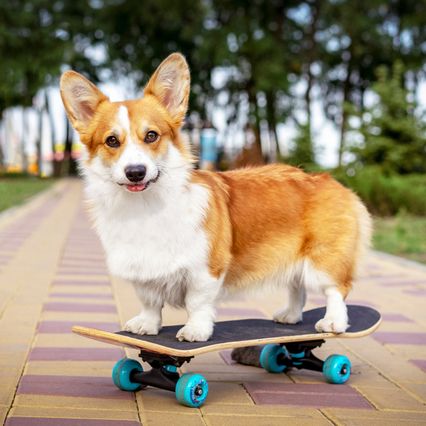
  • In appearance, the Pembroke Welsh Corgi is smaller, has a “foxier face,” smaller bone, smaller pointier ears, no tail (either docked or naturally bobbed), comes in fewer colors, and its front feet (which are smaller) face to the front, versus angled to the side. In temperament the Pembroke may be a little more excitable and barky, but also more outgoing.
Caroline Coile, Ph.D.

Caroline Coile specializes in canine science, health, breeds and competitions. Caroline has won 20 national dog-writing awards, and was a 2015 Inductee into the Dog Writers Association of America Hall of Fame. She’s written thousands of magazine and web articles about dogs in addition to 34 dog books.

Content on Good Dog is generated, fact-checked, and evaluated by qualified writers and veterinarians.

Caroline Coile, Ph.D.

Caroline Coile specializes in canine science, health, breeds and competitions. Caroline has won 20 national dog-writing awards, and was a 2015 Inductee into the Dog Writers Association of America Hall of Fame. She’s written thousands of magazine and web articles about dogs in addition to 34 dog books.

Content on Good Dog is generated, fact-checked, and evaluated by qualified writers and veterinarians.