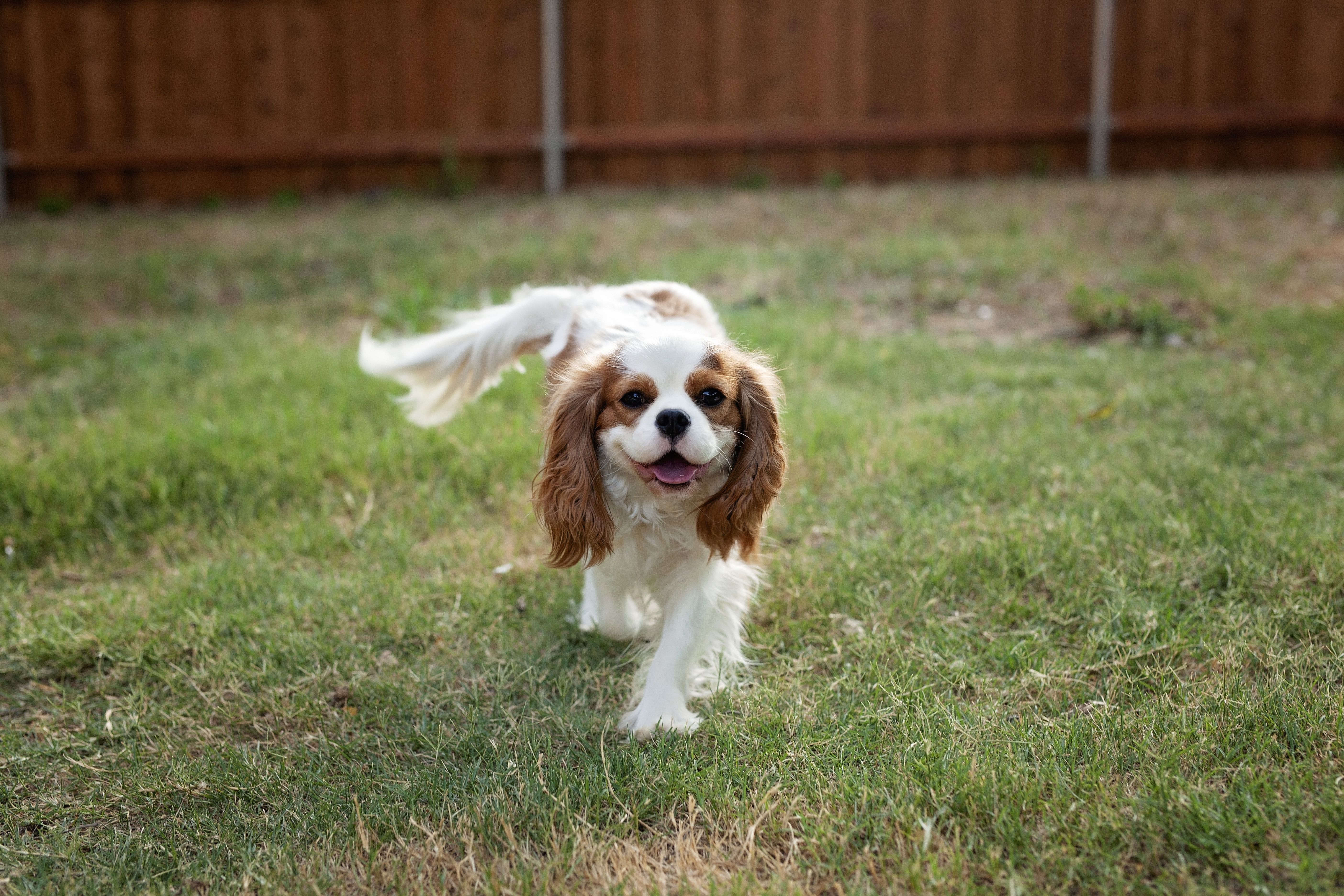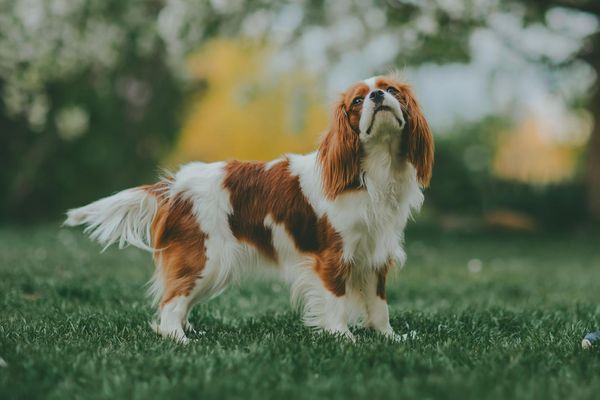
A beautifully groomed Cavalier stands in the grass
Get to know

Cavalier King Charles Spaniels

Written by
Caroline Coile, Ph.D.,
 author of 34 dog books.
Written by
Caroline Coile, Ph.D.,
 author of 34 dog books, including the top-selling Barron's Encyclopedia of Dog Breeds.
| | | | |

Like a plush stuffed animal come to life, the Cavalier King Charles Spaniel is the perfect dog for cuddling and coddling. Affectionate, gentle, playful, and sweet, the Cavalier is the ideal companion for people who want a living love sponge.

If you’re looking for love, meet the Cavalier King Charles Spaniel. The Cavalier descends from royalty, bred to keep Kings and Queens and other blue-bloods company. But the breed is no snob; they’ll be glad to make your home their castle and your lap their throne. Nor will they mind playing court jester on occasion!

At a glance

Low Energy

Energy level

2/5

Low Maintenance

Grooming

3/5

Extra small

Size

Affectionate, gentle, sweet

Temperament

12-15 years

Lifespan

Quick to Learn

Training

4/5

Medium Vocality

Barking

3/5

At a glance

  • Energy level

    Low Energy

  • Grooming

    Low Maintenance

  • Size

    Extra small

  • Temperament

    Affectionate, gentle, sweet

  • Lifespan

    12-15 years

  • Training

    Quick to Learn

  • Barking

    Medium Vocality

Why people love the breed

People love Cavalier King Charles Spaniels because Cavaliers love them back ten-fold. Cavaliers are the embodiment of sweetness, with a sweet face matched only by a sweet personality. They live to love, and love to live.
It’s impossible to feel lonely if a Cavalier is part of your family. They expect to spend days in your lap, nights in your bed, and to share every trip you make to the bathroom. If a stuffed dog could be programmed to come to life and exist just to share your love, it would come to life as a Cavalier King Charles Spaniel. They’re affectionate and are not shy about sharing and showing their love. Not only do Cavaliers like their own family, but they’re welcoming to friends and visitors—even burglars are made to feel welcome. So no, they can’t claim fame as guardians or protectors. They have good manners, get along seamlessly with other dogs and pets, and make great companions for people of every age. Queen Victoria, who was a lover of many dog breeds, described her favorite dog, a King Charles Spaniel named Dash, in a way that would fit any modern Cavalier: "His attachment was without selfishness, his playfulness without malice, his fidelity without deceit."

Appearance

Cavaliers look like stuffed animals. Their baby-doll eyes and plush padded muzzle makes them almost irresistible to kiss. Everything about them is soft and cuddly.
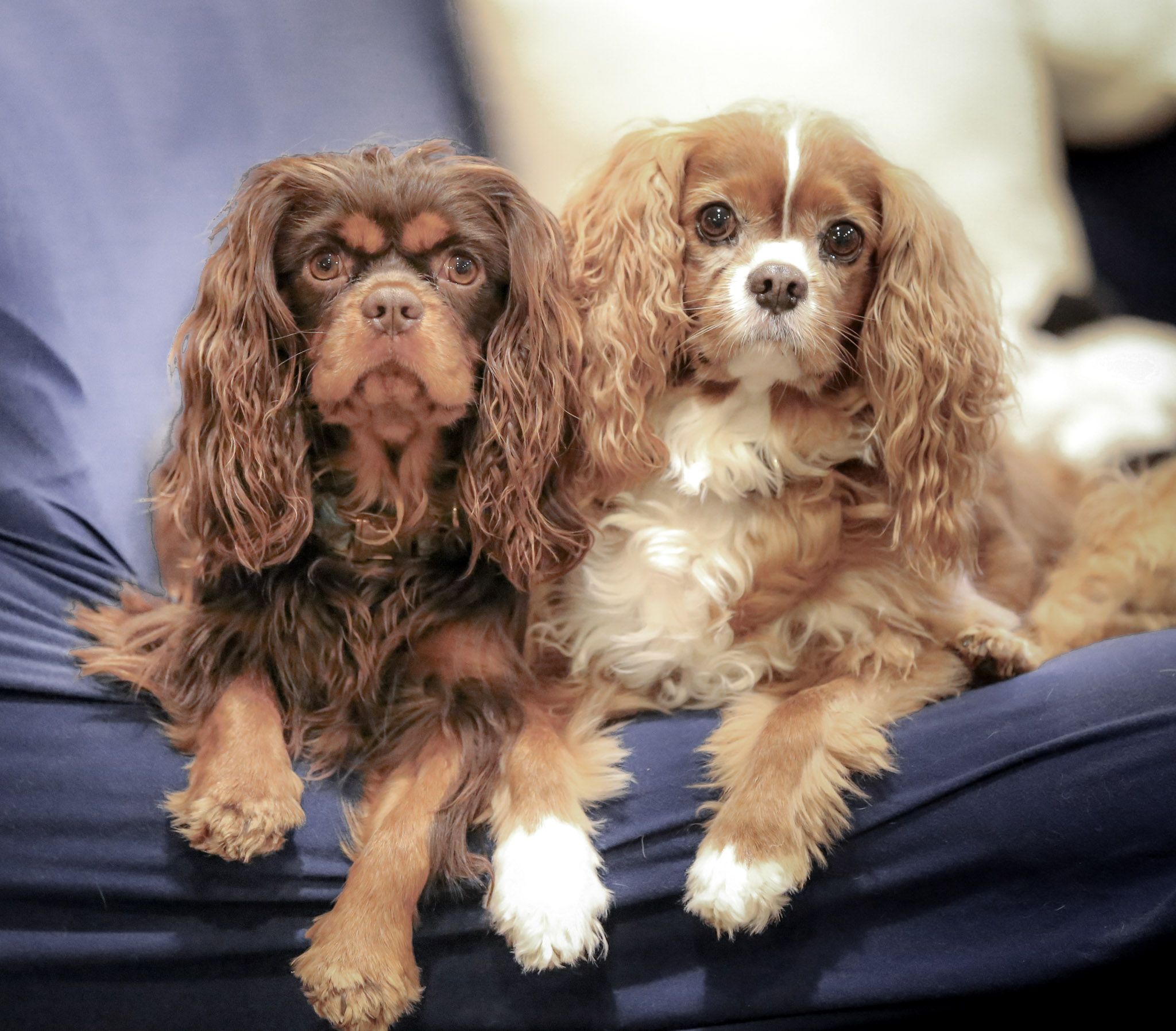
When it comes to appearance, Cavaliers are a combination of cute and regal. The “cute” comes from their big, round doe-eyes, with cushioning beneath that that gives them a soft, endearing almost pleading expression. Add to that a well-cushioned muzzle that’s irresistible for kissing, and long hanging spaniel ears, and abandon all hope when a Cavalier looks at you asking for a bite of your dinner. The “regal” comes from the high head carriage, flowing coat, and well-plumed tail. The Cavalier is a toy spaniel in appearance, longer than tall, with moderate bone size. The head is rounded, with long, high-set, well-feathered ears. The tail may be docked in areas that allow, with no more than one-third removed, but is generally left long. The silky coat is long and feathered, either straight or with a slight wave. The color choices are solid red (called Ruby), chestnut and white (called Blenheim), black & tan, or black, tan & white (called tri-color). As toy spaniels, they are in the American Kennel Club (AKC) Toy group, but they are one of the largest breeds in that group.

Grooming

Cavaliers and their people tend to enjoy the bonding time involved in their grooming. Grooming takes just long enough to lull them to sleep but not so long that it tires you out.
Grooming the long silky coat is fairly easy. Every day or two use a pin brush and comb to keep the coat free of mats. Remove any twigs or sticks immediately, as mats form around them. Regular bathing and conditioning will decrease the coat’s tendency to tangle. The long “bedroom slipper” hair on the feet can be left long, as it’s a breed trait. However, you can clip the hair short on the bottoms of the feet to keep the dog from slipping and from tracking debris into the house. They are not big shedders as they have little undercoat. Cut the nails as needed, and brush the teeth every day. Check the ears weekly for debris, but only clean when needed. Keep the ear canals dry after baths or swimming, as the heavy hanging ears can slow drying, which in turn makes them susceptible to infections.
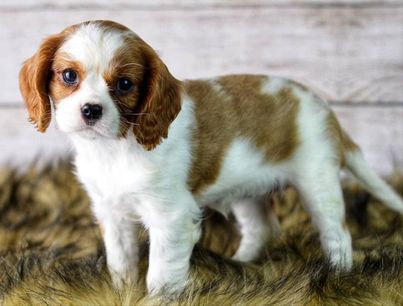
A Cavalier puppy stands on a fur rug
Img:

Arctic Acres Cavaliers

Breed temperament and characteristics

If you want somebody to love, and to love you back, the Cavalier King Charles Spaniel is the ultimate love-machine. They love to cuddle, play, and just be your best friend.
Cavaliers are so keen on sharing the love that they tend to love everyone: strange people, strange dogs, strange animals, kids, elderly…everyone. They tend to make exuberant playmates for children, cuddly bedmates for the elderly, and quiet sofa companions for anyone just needing a break. Their spaniel heritage is not shy about emerging, and they equally love to hike around the block or down the trail, searching for birds along the way. They are adaptable to many situations, and generally happy wherever they find themselves—as long as there are people to love. They are fairly quiet, calm, and seldom bark without good reason. They are gentle, demonstrative and perpetually happy. They are eager to please, and they learn fairly quickly—but precision obedience is not really their forte. While generally calm, they enjoy rowdy but gentle play sessions and vigorous walks where they can sniff and explore the neighborhood.

Exercise

Cavaliers are spaniels at heart, and need to get out and exercise every day. Fortunately, their needs can be met in a small area—even indoors—and within a fairly small time.
Although Cavaliers are calm dogs, like all dogs they need to exercise. Their needs can be met with a walk around the neighborhood, an outing to the dog park (as long as they are not sharing with large or aggressive dogs), games in the yard, or even games in the house. True to their spaniel heritage, they enjoy outings where they can search out different scents. Many also enjoy swimming and retrieving in water. Favorite games include fetch, finding a hidden object, tug, and tag. They do well in agility but prefer lower jump heights. They especially enjoy trick training and challenges that involve using their nose to find hidden scents. They do well in nosework competition, and have even succeeded in tracking trials.
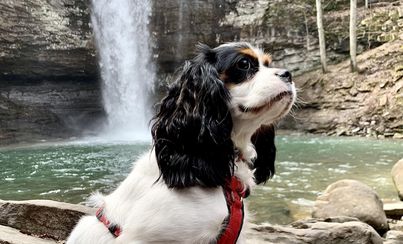
A Cavalier sits by a waterfall in a red harness
Img:

Ayerloom Cavaliers

Training

Cavaliers are eager to please and extremely biddable. But they’re not high energy dogs, so keep training sessions short.
Training a Cavalier is usually very rewarding. They naturally want to please, and they’re smart enough to succeed at it. Their spaniel heritage gives them an inborn ability to follow directions, as was needed when hunting and retrieving in the field. And their subsequent selection for an easy-going companion further produced an easy-going, biddable dog. Nonetheless, don’t expect a hop-to-it obedience wonder dog. Cavaliers tend to take their time but they do get around to doing what you ask. Cavaliers are very sensitive. Reward and praise-based training is much more effective than coercion methods. They learn house rules easily and are generally easy to housetrain. Cavaliers have been trained to the highest levels of obedience, rally, agility, and trick training. Occasionally some Cavaliers can be shy. Socializing them early will help avoid it, but if they become shy don’t push them. Don’t let strangers push themselves at them if they don’t want to be touched. Take it easy and maybe, in a few months, they might be back to their gregarious norm.

Diet and nutrition

Most Cavaliers have no special diet concerns. They just demand that it be tasty.
As puppies, Cavaliers should eat puppy food three to four times a day until ~4 months of age, then two times a day thereafter. For puppies, feed them as instructed by your veterinarian, but if they start to become chubby as older puppies you may have to slightly restrict their intake. Adult Cavaliers will do well on high-quality commercial brand food. Some Cavaliers can become overweight, so be careful that you don’t overfeed as your dog ages and slows down. They’ll need fewer calories then. You should be able to feel the waist and see some indication of a narrowing through the loin from above. You should also be able to feel the ribs with minimal probing. Discuss any special diet concerns with your veterinarian.
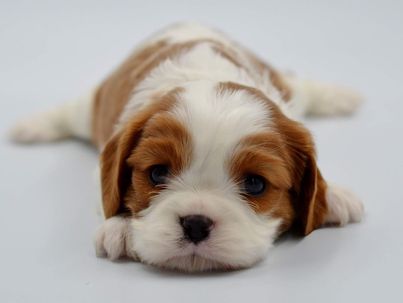
A tiny Cavalier puppy lying down
Img:

Arctic Acres

Health issues

Most Cavaliers can live long lives with appropriate veterinary care, but it’s true that the breed has some serious health concerns. Ethical breeders are working hard to correct these problems.

Lifespan: 12 to 15 years.

Mitral valve disease (MVD)

A common disease of the heart in which one of its valves doesn’t close completely due to degenerative changes, resulting in a heart murmur and eventually congestive heart failure.

Chiari-like malformation

Where the brain is too large for the skull, leading to crowding of the back part of the brain/brainstem and obstruction of the cerebrospinal fluid. Dogs with this condition are predisposed to syringomyelia.

Syringomyelia

A condition in which fluid-filled cavities form within the spinal cord. Signs may include scratching of the shoulders and neck, ataxia, weakness, and/or pain/sensitivity around the neck, ears, or front legs. The pain may become debilitating, and affected dogs may display behavior which is not typical of the breed. Diagnosis is by MRI.

Eye problems

Common eye problems that have been reported include retinal dysplasia, distichiasis , corneal dystrophy, cataracts , and keratoconjunctivitis sicca (dry eye). It is recommended that Cavaliers be examined by a veterinary ophthalmologist before breeding.

Hip dysplasia

Hip dysplasia is the most common hereditary disorder of the joints. It occurs when the head of the femur doesn’t fit snugly into the socket of the pelvis, eventually causing arthritis and lameness.

Patellar luxation

In which the kneecap slides out of the groove in which it is normally seated.

Learn more about health issues that may impact Cavalier King Charles Spaniels

History

The Cavalier King Charles Spaniel has had three incarnations, starting with its first role as a working spaniel, then morphing to a toy short-nosed version that we now call the English Toy Spaniel, and finally being bred back to the longer-nosed dog we call the Cavalier.
The Cavalier’s ancestors were probably smaller spaniels bred to Oriental toy breeds such as the Japanese Chin or possibly Tibetan Spaniel. According to DNA, their closest relative is the Cocker Spaniel. They were called comforter spaniels and used as foot warmers, hot water bottles, and lap dogs for the Tudor blue-bloods. They may have even been used to attract fleas away from their owners. In the United Kingdom, the dogs became so closely associated with King Charles II in the 1700s that they were called King Charles Spaniels. After King Charles’ death the Duke of Marlborough became the breed’s major guardian, he favored the chestnut and white color, which was named Blenheim (pronounced blenim) after the Duke’s estate. They continued to be popular as a pet for the wealthy, but the shorter-nosed ones became much favored. By the early 1900s the show dogs all had flat faces. Then a wealthy American offered a big cash prize for the best “pointed-nose” specimens, and breeders started to produce longer-nosed dogs that looked more like the originals. The longer nosed dogs were renamed Cavalier King Charles Spaniels. Only a few Cavaliers remained after World War I. Six dogs became the foundation of the modern breed. The American Kennel Club (AKC) recognised the Cavalier as a breed in 1996 in the United States. They quickly rose to be one of the more popular breeds. They are in the AKC Toy group. Famous owners include Ronald and Nancy Reagan, Frank Sinatra, Courtney Cox, Jennifer Love Hewitt, Diane Sawyer, Sylvester Stallone and the Osbournes.
About the author

Canine specialist, Caroline Coile, Ph.D., is the author of 34 dog books, including the top-selling Barron's Encyclopedia of Dog Breeds. She’s written thousands of magazine and web articles about dogs. She specializes in canine science, health, breeds and competitions. Caroline has won 20 national dog-writing awards, and was a 2015 Inductee into the Dog Writers Association of America Hall of Fame.

Breed Scorecard

Characteristics and temperament
  • Affectionate with family

    5

  • Watchdog level

    2

  • Playfulness

    4

  • Adaptability

    4

  • Social needs

    5

  • Temperament

    Affectionate, gentle, sweet, calm, trainable

  • Intelligence

    3

  • Good with other dogs

    5

  • Good with cats or other pets

    5

  • Friendly with strangers

    5

  • Good as a service dog

    3

  • Good for apartments

    5

  • Barking level

    3

Appearance
  • Height

    12-13"

  • Size

    Extra small

  • Colors

    Blenheim, Ruby, Black and tan, Black and white (non-standard), Tri-color, Chocolate (non-standard)

  • Coat texture

    Soft, silky

  • Coat length

    Long

Training
  • Trainability

    4

Exercise
  • Exercise needs

    2

  • Exercise time

    1 hour daily

  • Mental exercise needs

    3

  • Favorite activities

    Trick training, nose-work

Grooming
  • Grooming needs

    3

  • Brushing frequency

    Daily

  • Needs professional grooming?

    No

  • Drooling level

    1

Health issues
  • Mitral valve disease (MVD)

  • Chiari-like malformation

  • Syringomyelia

  • Eye problems

  • Hip dysplasia

  • Patellar luxation

Other
  • Bred for

    Companionship

  • Country of origin

    England

  • Popularity level

    5

FAQs

  • On Good Dog, you can search for Cavalier King Charles Spaniel puppies or dogs in rescues and shelters. Adopting a Cavalier King Charles Spaniel from a shelter or rescue is generally less expensive than buying a puppy from a breeder with ethical practices. Across the United States, there are dedicated rescues that specialize in specific breeds and may even help transport a Cavalier King Charles Spaniel dog to you from another part of the country. Although it can be more cost-effective, adopting the exact breed you're looking for is typically more difficult than working with a responsible breeder. Learn more about adopting a dog from a shelter or rescue.

  • The typical price for Cavalier King Charles Spaniel puppies for sale may vary based on the breeder and individual puppy. On average, the price of Cavalier King Charles Spaniel puppies from a breeder is $3,100.

  • They have very little doggy odor, assuming they are groomed. If they have ear infections, that can smell, but they shouldn’t have ear infections. Males can get urine on their side coat when they lift their leg to urinate; that can be solved by cutting the coat short or pinning it out of the way, or bathing the region daily.

  • They are one of the best family pets, great for people of all ages and energy levels. But they crave companionship, so they won’t be happy if they’re left alone all day. Cavaliers are treasured family members, making them one of the most popular breeds and a great addition to any family.

  • No. They bark occasionally but not incessantly.
Caroline Coile, Ph.D.

Caroline Coile specializes in canine science, health, breeds and competitions. Caroline has won 20 national dog-writing awards, and was a 2015 Inductee into the Dog Writers Association of America Hall of Fame. She’s written thousands of magazine and web articles about dogs in addition to 34 dog books.

Content on Good Dog is generated, fact-checked, and evaluated by qualified writers and veterinarians.

Caroline Coile, Ph.D.

Caroline Coile specializes in canine science, health, breeds and competitions. Caroline has won 20 national dog-writing awards, and was a 2015 Inductee into the Dog Writers Association of America Hall of Fame. She’s written thousands of magazine and web articles about dogs in addition to 34 dog books.

Content on Good Dog is generated, fact-checked, and evaluated by qualified writers and veterinarians.