Australian Shepherds: 9 Things You Need to Know
As told by the people who know them best.

By
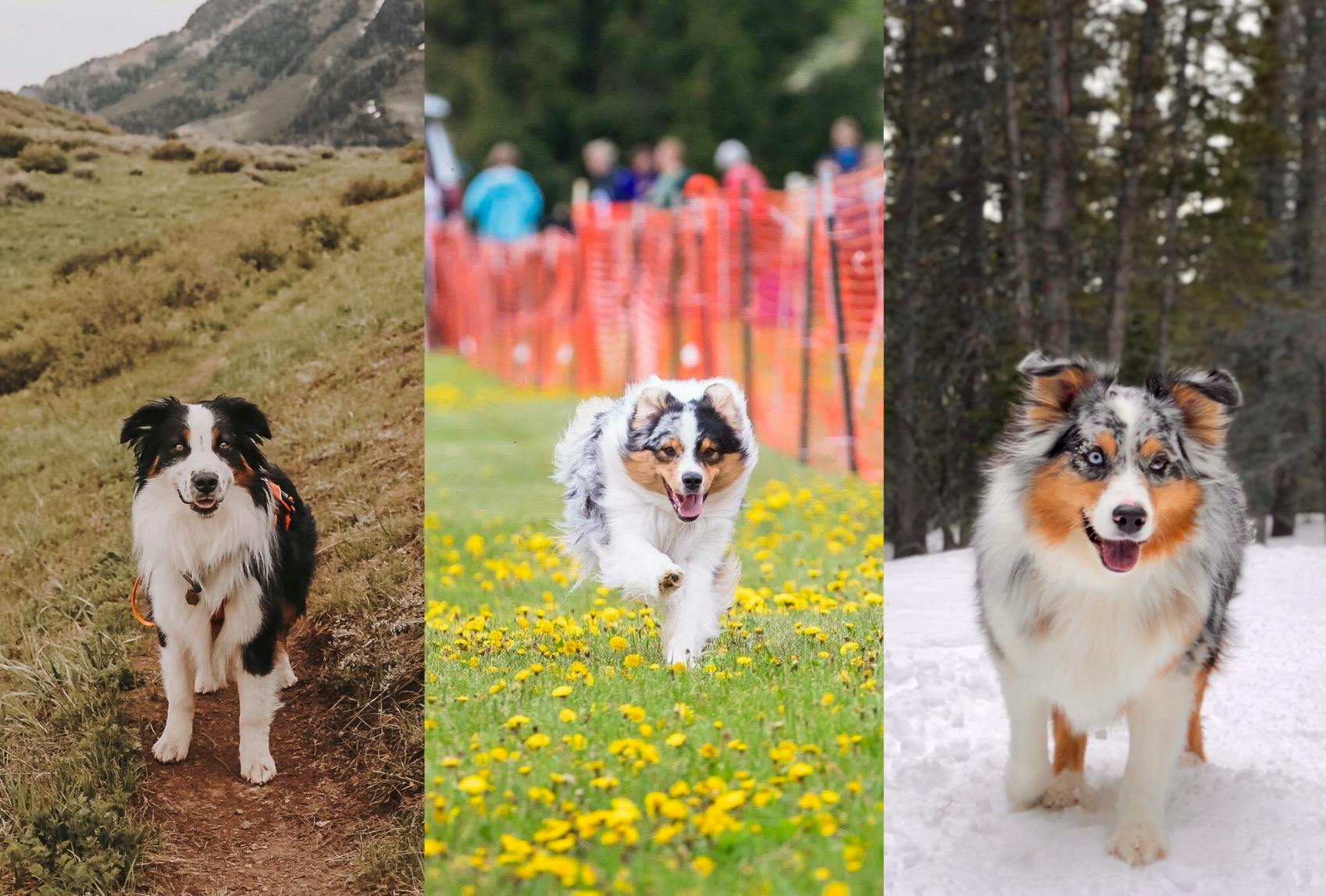
Aussies are always up for adventure. Photos: Regan Abromitis (L), Brittany Greendeer (C), Chris Vandall & Keith Ambuhl (R)
What’s life with an Australian Shepherd really like? To find out, we talked to 14 Australian Shepherd breeders and current and former owners. Here’s what they want you to know.
1. Australian Shepherds are typically loyal and affectionate, but they can take a while to warm up to new people.
Aussies are known for being intuitive, affectionate, and loyal, and owners often describe them as big-time cuddlebugs. (“My pregnant bitch is trying to crawl into my lap right now,” Brittany Greendeer, the breeder behind Riot Australian Shepherds in Plover, WI, told us when we spoke by phone.) They love their people like crazy.
“When I went away to college,” says Natalie Volpicelli, 22, who grew up with a now 13-year-old Australian Shepherd named Rocky, “he’d still go into my room to check on me to make sure I was awake, because he’d go in and get his morning pets when I was there.”
Unlike dogs that flop on their backs for belly rubs as soon as they meet someone new, Aussies can be reserved at first — a tendency that lots of people love. But according to Jill Porter, the breeder behind Faithwalk Aussies in Hillsdale, MI, Aussies can also have qualities that make them “hard to live with.” Case in point: Mikayla Morris’s 15-month-old Aussie, Spider, is so possessive that he still only likes her live-in boyfriend “to an extent.”
“From day one," she says, "he wasn’t a fan.”
The bottom line: Every dog is an individual, with a unique personality and behaviors shaped by a variety of factors. So while there’s a lot to love about Aussies, it’s hard to point to Australian Shepherd temperament or Australian Shepherd personality as some fixed, predictable quality, like the color of a car. Or, as Porter puts it:
“My catchphrase for Aussies is that you can get anything from Lassie to Cujo.”
2. Be ready to put a lot of work into early socialization.
When you talk to good Australian Shepherd breeders, one word comes up again and again: sensitive. Aussies are very aware of their surroundings, and they’re plugged into their people’s emotions. Which makes sense: as Jill Porter of Faithwalk Aussies points out, Australian Shepherds were bred to be vigilant herding dogs, surveying situations and reacting accordingly.
“They’re in the corral with their owner,” she says, “and they have to keep an eye on every cow and make snap decisions.”
A sensitive dog who feels comfortable should be able to calmly process everything happening around them. But when a little fear or anxiety enters the picture, Aussies can become hyper-reactive.
So while all puppies need socialization — careful exposure to new people, animals, sights, sounds, and smells that will help them feel comfortable in the different environments they’ll encounter throughout their lives — it’s a subject that good Aussie breeders tend to bring up a lot. They expose their puppies to all kinds of sensory inputs early in life, but they all stress the importance of sticking with it when you bring your new pup home.
“If you don’t continue to properly socialize that dog,” says Jenna Crans, the breeder behind Agra Australian Shepherds in Waupaca, WI, “you’re going to fail that dog.”
3. Your Aussie will stick to you like glue.
Australian Shepherds get attached to their people. Very attached.
How attached is “attached”? Ask Hannah Weiger, 28, who got her first Aussie, Tazz, as a college student, and has since gone on to get three more.
“I don’t think I’ve gone to the bathroom alone in almost 10 years,” she says. “They’re in your business, 110 percent, no matter what you’re doing.”
Aussies may be a herding breed, but they don’t want to spend time on their own outdoors: What they want is to be with you, every moment of the day. People call them “velcro dogs” for a reason. Aussies need a feeling of inclusion in their person’s life, says breeder Jill Porter — a sense that they’re actively living life right alongside you.
“It’s not that they need your comfort,” says Jenna Crans, the breeder behind Agra Australian Shepherds in Waupaca, WI, referring to Aussies’ velcro tendencies. “It’s that they want to help you.”
You don’t need to have a pasture full of sheep in order to make your Australian Shepherd feel useful and fulfilled. Training and just hanging out together can accomplish the same thing. But if you can’t make a serious quality-time commitment, then an Aussie might not be for you.
4. Australian Shepherds are super smart, which can be a double-edged sword.
“Everyone thinks they have a smart dog,” says Sara Koenig, the breeder behind Nicara Kennel in Mazomanie, WI. “Then they get an Aussie, and they realize that dog was an idiot.”
If you’re excited by the idea of a dog who’s up for a mental challenge, Aussies’ intelligence can be a huge plus. They’re highly trainable, and they aim to please.
But across the board, breeders say those big brains can also test you. Because they can learn quickly and by observation, Aussies may pick up habits you’d prefer they didn’t, like unlatching gates. They’ll figure out who in a household will and won’t let them get away with certain behaviors — and then only present those behaviors to the more lenient person. “It’s not just that they’re smart,” says Koenig. “They’re manipulative.”
Paige Brown, the breeder behind Colockum Australian Shepherds in Entiat, WA, has one garbage-loving Aussie who actually stops his toenails from clicking on the floor so she won’t notice him sneaking off to rummage through the trash.
“If they get in trouble for doing something,” she says, “they’ll find a way around what you told them not to do in a way that’s more sneaky.”
Because Aussies are so smart, good breeders don’t always recommend them to first-time dog owners. Enforcing Australian Shepherd training is no joke.
“They are a high-maintenance breed — they’re better with people who want a project,” says Jill Porter of Faithwalk Aussies. “You have to be as much of a student of your dog as a teacher of your dog.”
5. If you don’t keep your Aussie’s mind stimulated, you’re in trouble.
Because Aussies like to have a job — and have minds that are always churning — they can turn into destructive troublemakers when they’re bored. So it’s really important to make sure they’re getting mental workouts every day.
“People forget that,” says breeder Sara Koenig. “What do you plan to do during the day? Do you have puzzle toys and plan to do training?”
Teaching your Aussie new commands, reviewing old ones, and playing games like hide-and-seek are all great ways to scratch the stimulation itch. Even chewing on “appropriate things,” like a bone, can be an easy, calming activity for Aussies, Koenig says.
Mental stimulation is different from physical exercise, but the two can go hand in hand. When Brittany Butters, 31, is out on a hike with her two Aussies, she’ll let them off-leash to work on having them come back to her when she calls. (Nami, Butters’s 2-year-old “wild child,” tends to see red when she comes across a rabbit or deer, so she stays on leash more than Kiba, 7.) And when Chris Vandall, 46, and Keith Ambuhl, 53, are out for walks with Archer, their 3-year-old Aussie, they make him sit and wait at every intersection until they give him the go-ahead.
6. Every Aussie has their own exercise needs, but make a plan to get outside every day.
For Brittany Greendeer of Riot Australian Shepherds, Australian Shepherds’ reputation for needing tons of exercise is a little bit overblown.
“They’re not the monsters people make them out to be, where you have to run them 5 hours a day,” she says.
Still, Aussies are a high-energy breed, and they do need a good amount of physical exercise to go along with mental stimulation. The exact amount required will depend on the individual dog. For example, one owner told us that she tries to take her Aussie on two 5-7 mile walks every day, while another said that just a 30-minute walk plus a chunk of play time in the backyard can do the trick.
If you’re an active person, Australian Shepherds can be great companions for sports or outdoor adventures. In Arizona, Brittany Butters takes her two Aussies on mountain bike rides of 6-8 miles and 3-4 mile hikes. Butters and her partner are big skiers, and during the winter, they’ll take the dogs skinning (basically hiking up the slope while wearing skis, then skiing down). “They love that,” she says.
Breeders say that Aussies are up for anything, but can also chill out when you want to. “They have an ‘off’ switch,” says Jenna Crans of Agra Australian Shepherds. “They can go work all day with you, or they’re content sitting on the couch with the family.”
7. Are Australian Shepherds good with kids? It’s complicated.
“I’m not saying that people with kids can’t get an Aussie,” says breeder Brittany Greendeer, “but it’s something I’d definitely make sure to think about first.”
The main issue is that, as herding dogs, Australian Shepherds have an innate — if variable — drive to bring order to chaos. If an Aussie with a strong herding instinct feels the need to get a rowdy group of kids under control, they might bark, body-check someone, or even nip a little one’s arms or butt.
“They’re a rough breed,” says breeder Jenna Crans.
But here’s the tricky part: Not all Aussies have a strong herding drive. It varies depending on the dog’s lineage and their individual personality. For example, Paige Brown of Colockum Australian Shepherds says that one of her Aussies couldn’t care less about groups of kids, but another has such a strong herding drive that she can’t be outside with children who are running and playing. So it’s really about the individual dog and your own willingness to put work into training.
By the way: The Australian Shepherd herding instinct can make Aussies a challenge to have around lots of adults, too. Natalie Volpicelli says that her family’s Aussie, Rocky, used to have trouble with big groups of people.
“My family’s Italian, and when we do family events we have about 30 people, up to 40,” she says. “Until Rocky got much older, we could never have him there because he would get so stressed out and run all over the place trying to herd everyone.”
8. Ready your vacuum: Australian Shepherd shedding is real.
“Oh god,” says Hannah Weiger, owner of three Aussies. “There’s a running joke that they shed twice a year for six months at a time.”
Australian Shepherds are not necessarily the heaviest-shedding breed out there, but still, expect to see tumbleweeds of fur blowing around your house all the time. “It’s so much shedding,” says breeder Brittany Greendeer. “You will notice it.”
And that’s just the everyday shedding. Australian Shepherds are a double-coated breed, and roughly twice a year, their undercoat, which helps insulate them in the cold and heat, will suddenly start coming out “in snowballs,” as breeder Sara Koenig puts it. It’s called “blowing their coat,” and it’s exactly as intense as it sounds.
“When they’re blowing their coat,” says Weiger, “there is no escaping it.”
You can offset the shedding with frequent brushing — at least once per week — which will keep at least some of your Aussie’s fur from ever hitting the floor. But there’s only so much you can do. Mikayla Morris brushes out her Aussie, Spider, every day at the doggy daycare where she works, and even that level of grooming is not enough to stem the furry tide.
“It limits the shedding in my house,” she says, “but that doesn’t mean my vacuum doesn’t fill up.”
9. If you can give your Australian Shepherd everything it needs, you’ll have an incredible companion for life.
Australian Shepherds are not for the faint of heart. They’re devilishly smart, they need plenty of mental and physical exercise, and they shed like nobody’s business. But if you can meet their needs — and you want a best friend who will trail you around all day — Aussies are amazing.
“They’re crazy and they’re weird, but they’re wonderful dogs because they give you 110 percent,” says Hannah Weiger. “You’re their whole universe. I’m so glad I got Tazz, my first Aussie, because I can’t imagine what life would be like without them.”
Brittany Butters calls her two Aussies, Kiba and Nami, a “huge support system.” Australian Shepherds, she says, are keenly attuned to your emotions — and they know exactly when to come rushing in to give you attention.
“When I’m having a hard time, they’ll cuddle up against me and lick the tears off my face,” she says. “They’re goofy, they’re so smart, and they just are always there for you.”
