Caring for your Newborn Puppies
Essential care the first 3 weeks after your puppies are born.
These courses are for educational and informational purposes only and are not a substitute for professional veterinary advice, diagnosis, or treatment. Always consult your veterinarian before making decisions about your dog's health, including administering supplements, changing their diet, or implementing training techniques that could affect their wellbeing.
Caring for Your Newborn Puppies
The first 2 days after birth are when pups are the most fragile. It is essential to monitor your puppies’ health at least twice a day, if not more frequently, in the first week.
APGAR Scoring
(Appearance, Pulse, Grimace, Activity and Respiration)
We recommend APGAR scoring to assess all neonates shortly after birth, to assess probability of survival and to target puppies in need of immediate assistance.
APGAR scoring was developed to assess human infants but has since been adapted for use in other animals. It requires assessing each newborn puppy for the following:
- Does the puppy have a heartbeat?
- Count each puppy’s breaths per minutes
- Check each puppy’s gums for color
- Is the puppy moving or wiggling?
- If you place the puppy gently on their back, do they attempt to roll over/right themselves? Do they vocalize at all when doing so?
APGAR scoring should be conducted shortly (ideally, within five minutes) after birth. For each of the five areas, score the puppy with a zero, one or two, then add up the scores. Calculate APGAR scores using this form.
This APGAR system is based on 2019 research that tested it with breeders. Slightly different versions are available.
Area | 0 | 1 | 2 |
|---|---|---|---|
Heartbeat | Absent | Absent | |
Breathing | <6 breaths per minute or Absent | Weak, irregular | >15 breaths per minute, rhythmic |
Mucus membranes | Pale or cyanotic (Blue or purple) | Slightly pale or cyanotic | Pink |
Movements | Absent | Weak movements | Normal, active movements |
Reflexes | No turning, No vocalization | Turns in 5–10 seconds, Weak vocalization | Turns in <5 seconds, Clear vocalization |
Puppies can receive an APGAR score between 0 and 10. Scores less than 6 are concerning, and puppies with scores less than 4 are at high risk of dying.
APGAR Scoring Examples
(Click on the photos to enlarge)
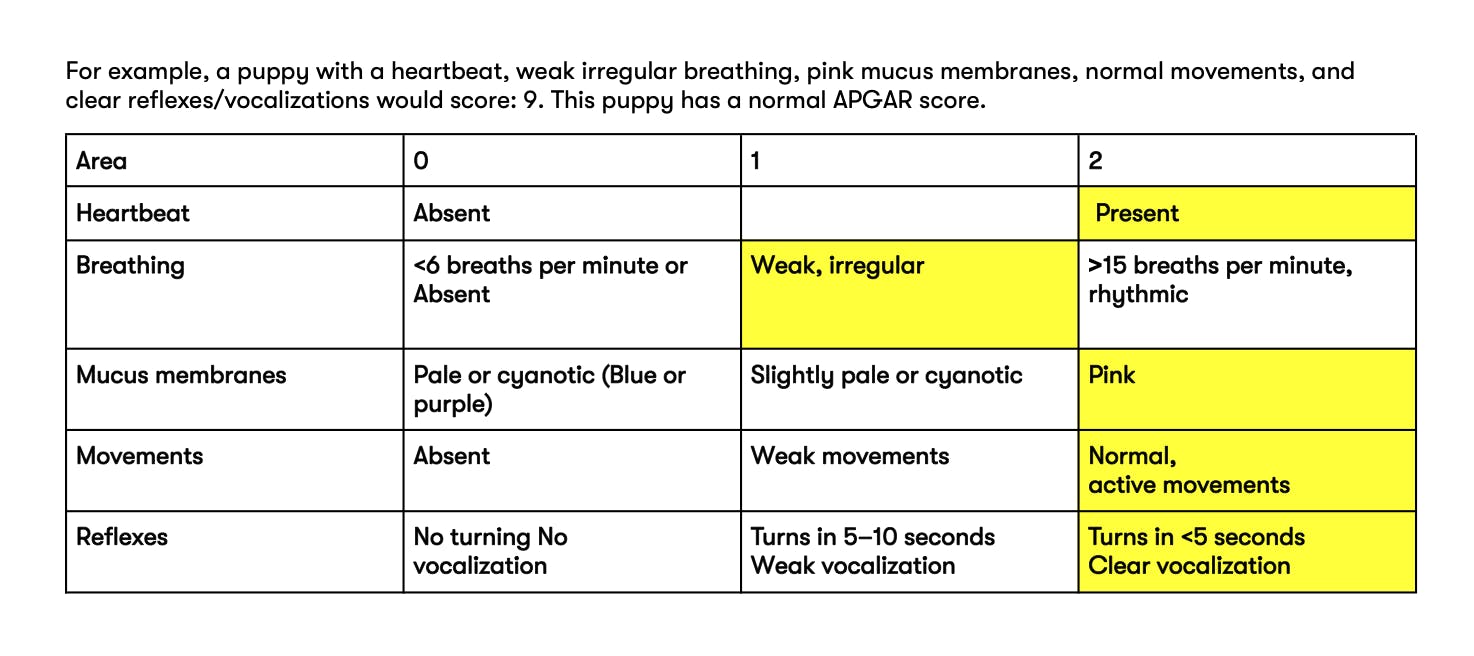
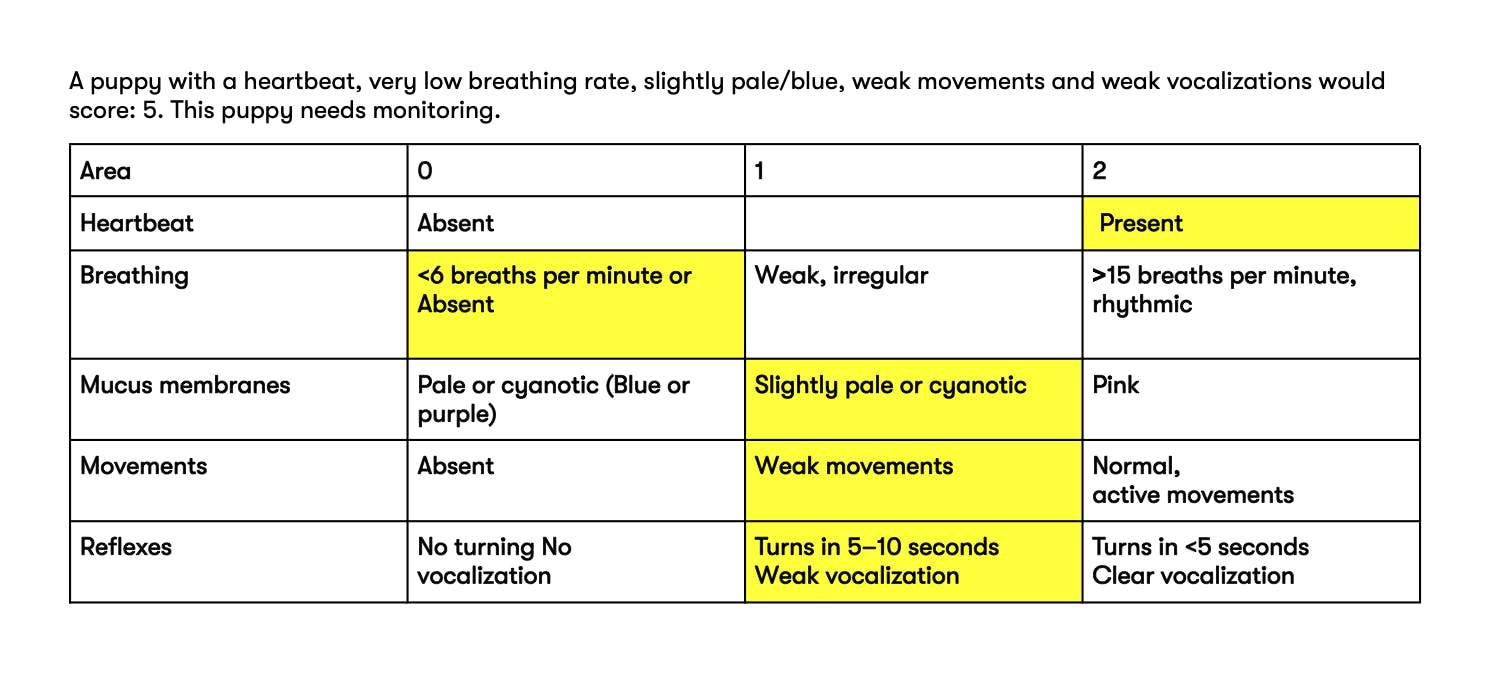
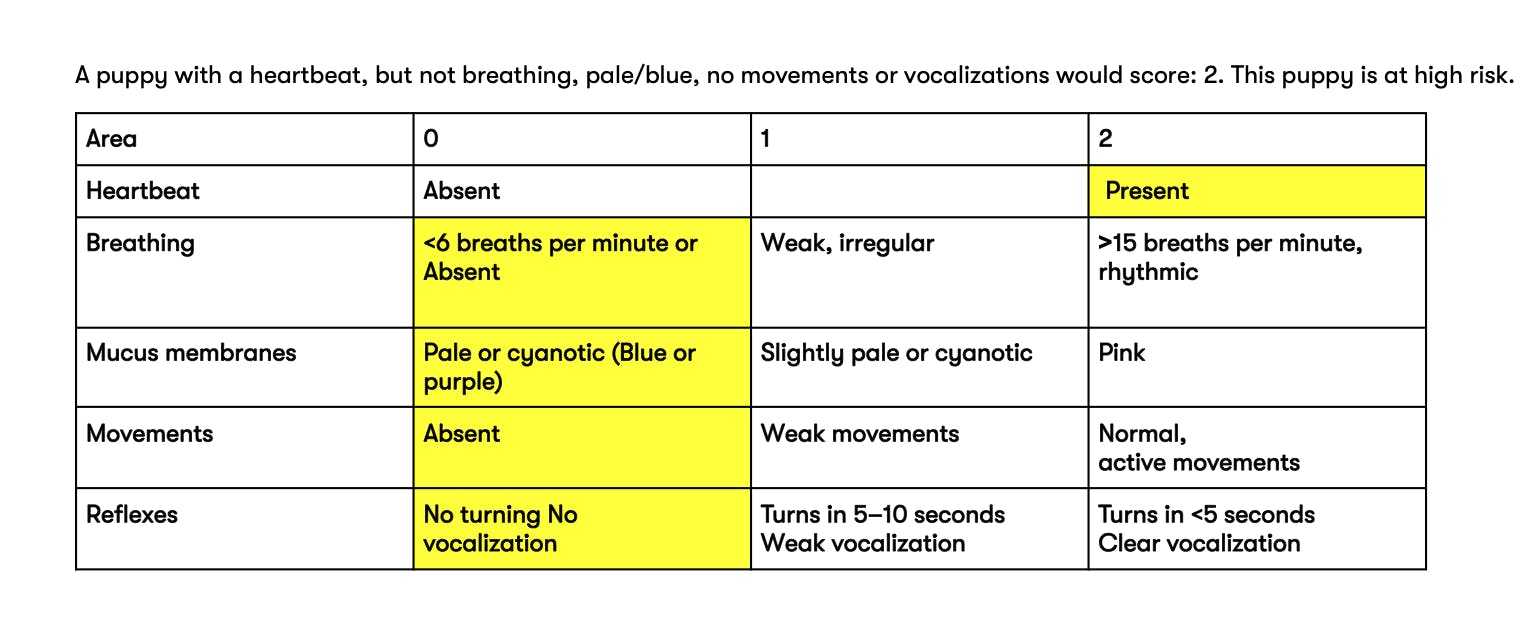
Neonatal Puppies
“Fading puppy syndrome” is a frustrating phenomenon when a seemingly healthy puppy starts to fade. Early veterinary intervention is critical to help puppies who fail to thrive.
Puppies with APGAR scores less than 6 will need additional monitoring in the first 3 weeks as they can die quickly.
Pups that aren’t thriving may show any of the following signs:
- Do not gain weight or are losing weight
- Do not move around
- Do not nurse or make weak efforts to nurse when awake
- Often cry a lot or continuously or not at all
- Do not twitch when sleeping
- Are often separated from other pups in the whelping box
- Have a temperature below 96F or above 98F
- Have rattling in their chest
- Have a bloated or distended belly
- Feel limp or flaccid
- Have red-currant-jelly poop (blood and mucus)
- Have obviously yellow urine
- Have a purple abdomen and pads
- Have a blue cast, tongue and nose
Monitoring Neonatal Puppies
Careful monitoring of weight gain, rectal temperature, hydration, and overall well-being will indicate whether some or all puppies need supplemental feeding. The Puppy Vital Signs Tracking Form can be used to track the below parameters for each puppy. Please make a copy of The Puppy Vital Signs Tracking Form after you open the spreadsheet. If you prefer to download a PDF version of the form or do not use Chrome as your browser, you can download The Puppy Vital Signs Tracking Form here.
Parameters to track:
- Weight at birth and at least 2x/day (Puppy Weight Tracker)
- Temperature at least 2x/day
- HR and RR at least 1x/day
- Hydration (Urine color at least 1x/day)
- Glucose (if monitoring)
- MM (mucous membrane) color at least 1x/day
- Stool character at least 1x/day
- Supplemental feedings, amount and frequency, if any
- Medications, if any
Weight Gain
The most important thing for you to monitor in your puppies is their weight. Weight gains are the best indicator of a puppy’s vigor and health. Be sure to record the weight of each puppy at birth and then weigh the pups at least twice a day and record each time. Many puppies lose weight in the first 24 hours after birth but this should not exceed 10% of their birth weight. A bitch’s milk usually doesn’t come in for 2-3 days post-whelping so don’t worry if she isn’t producing mature milk immediately, the pups are getting all-important colostrum (first milk) during this period.
For more information on maternal immunity and colostrum, read Maternal immunity and puppy vaccinations
Healthy puppies should gain on average 5-10% of their birth weight per day (or 1-2 gms/day/lb of the expected adult weight). A general rule of thumb is that they should double their birth weight by 7-10 days of age.
Rectal Temperature
To take your puppies’ temperatures, use a digital thermometer with the tip coated in petroleum jelly. Gently insert the tip of the thermometer into a puppy’s rectum. In the first week, their temperature should be 96-98 F (35.6 to 36.1 C).
- If the pup’s temperature is lower than 96 F, start warming them immediately on a heating pad or in a warming box/incubator. Decreased temperature (hypothermia) will shut down all of the pup’s organ systems, including digestion. Never feed a puppy until their temperature is above 96 F.
- If the pup’s temperature is above 98-99 F in the first week they may have a fever. If all the puppies' rectal temperature is above 98 F they may all be sick or the whelping box may be too warm. Move the puppy out of direct contact with any heat source (heating pad or lamp) and recheck their temperature after a few minutes. If the puppy still has an elevated temperature (>98 F), contact your veterinarian.
Week | Puppy rectal temperature | Ambient room temperature |
|---|---|---|
1 | 96-98 F | 75-80 F |
2 | 96-99 F | 70-80 F |
3-4 | 100 F | 70-75 F |
Hydration
Check for dehydration by:
- First: Assessing the color of their urine. If it is dark yellow in color, the puppy is likely dehydrated. This is the most accurate way to assess puppy dehydration.
- Check their gums. They should be smooth and moist to the touch. If they are tacky, sticky, or dry the puppy is likely dehydrated.
- Tenting the skin on the back of their necks is NOT a valid measure since all pups will tent in their first week.
- If you suspect dehydration, talk to your veterinarian about fluid therapy.
Overall well-being
Respirations
Indicators of illness include noisy, labored, open-mouthed, rapid, or abdominal breathing. If the pup is not breathing well, hold them with their head tilted down at a 45-degree angle. Rub their back and sides vigorously with a soft towel and suction the pup’s airway with a Delee catheter or bulb syringe to remove any fluid. Newborn puppies who are having difficulty breathing may need supplemental oxygen. Your veterinarian can train you in setting up an incubator as an oxygen chamber. Watch this video to learn how to use a Delee catheter.
Hypoglycemia
- If you have a glucose monitor you can check the puppies blood glucose. Note: It can be difficult to get enough blood from a neonate pup to check their blood glucose. It may take cutting two or more nails too short and quickly getting the drops of blood on the test strip. We recommend consulting with your veterinary team.
- If the puppy is weak OR blood glucose level is below 70, you can give them a small amount of glucose by putting a drop of Karo syrup on their tongue.
Abdominal bloating
If a puppy’s belly is bloated, they may have gas or constipation.
- Make sure the puppy is sufficiently warm.
- Give the pup a few drops of infant oral simethicone.
- Try to stimulate the puppy to defecate by massaging their anus with a cotton ball dampened with warm water. The feces should be yellow, orange, or brown. If their stools are red, black, or white, contact your veterinarian, as this can indicate blood in the stool or malabsorption.
- If the pup does not defecate, insert a lubricated thermometer (no more than ¾ of an inch) to stimulate the pup to defecate.
- If none of this helps, take the pup to your veterinarian for an exam.
Supplementing Newborn Puppies
Signs of inadequate nutrition or hypoglycemia include crying, inability to nurse or suckle well, and weakness or decreased movement. If a pup is not gaining weight daily, you will need to intervene and supplement them.
Private nursing sessions: Put larger pups in the warming box and give the smaller pups time to nurse without their littermates.
Kickstarts: Sometimes smaller or weaker pups need a kickstart to energize them so they can nurse or bottle feed. Formula is not a kickstart because digestion takes energy. Kickstarts give pups energy without the energy demands of digestion.
Karo Syrup/Frosting – The sugar in these products can provide energy to neonatal pups that are struggling. Put a drop of Karo syrup or a small dab of frosting on the pup’s tongue. Do not repeat as puppies can quickly become hyperglycemic (elevated blood sugar).
If they still will not nurse from their mother at this point, reach out to your veterinarian about whether tube-feeding is the appropriate next step, or whether the puppy should be brought in for more intensive treatment.
Bottle-feeding is great for “topping off” strong puppies that just aren’t gaining enough weight.
Some pups take to bottle feeding immediately while others resist it vigorously. Once the pups figure the bottle out, they are usually eager to feed but initially, it can be frustrating. Here are a few tips:
- Find bottles and nipples the puppies like. Be sure to check the opening to the nipple so the flow rate is not too rapid causing aspiration or pneumonia. The hole is the correct size if when you turn the bottle upside down, milk replacer drips from the nipple with only a gentle squeeze of the bottle.
Here are a few suggested brands:
Dr Brown’s Baby Bottles
Miracle Nipples for Puppies
MAM Bottles - Squeeze a few drops of mom’s milk on the nipple before offering it to the pup.
- When you bottle-feed pups, do not cradle them as you would a human child on their backs in your arms. Replicate the position they would be in while nursing, with their stomach facing down.
- Pups often want to press their front legs against something while nursing so use a towel (and keep those toenails short).
- Play with the angle of the bottle to find the right position.
Steps to bottle feeding:
- Warm the formula to your body temperature.
- Sit in a chair with your thighs parallel to the ground.
- Lay the puppy on their stomach on your lap facing away from you.
- Put the nipple in the pup’s mouth and then angle the bottle slightly upwards with the bottom pointing away from you.
- Once done, put the pup over your shoulder and pat their back until the puppy burps.
- Watch the video.
- Log how much you feed each pup.
Tube feeding is best for very weak pups that don’t have the strength to nurse, as well as orphaned pups or those whose mom is very sick. It is the most efficient means of getting nutrition into pups without them having to expend calories.
Every breeder should know how to tube feed puppies because it is often the only way to save a weak or ill puppy. Your veterinarian can walk you through the tube feeding process, where a tube is inserted down a puppy’s throat into its stomach to give them formula. The absolute most important step is to measure and mark your tube. Never skip that step!
Begin by reading the Tube Feeding Puppies Report then watch the videos below.
Calculating How Much to Tube or Bottle Feed a Pup
If a pup is getting all of their nutrition from tube or bottle feeding, you will need to weigh them twice a day and determine how much to feed based on their bodyweight. In the first few days, you should be feeding six times a day around the clock. It is better to feed multiple small meals than to exceed the puppy’s stomach capacity with fewer, larger feedings.
- Puppies need 20-26 calories (also known as kcal) per 100 grams of body weight per day.
- Their stomach capacity is around 1 milliliter (ml) per 1 oz of body weight..
- An individual meal should be no more than their stomach capacity.
- 100 grams = approximately 3.5 ounces. You can also use a calculator to convert grams to ounces or vice versa.
- Check the label on your milk replacer for calories per ml of formula. Most puppy milk replacers provide approximately 0.9 calories per ml of formula.
To calculate daily calories needed:
- Puppy’s weight in grams/100 x 20 calories = calorie requirement per day
- Daily calorie requirement/calories per milliliter (ml) of formula = Total amount of formula needed per day (in milliliters)
- Total amount of formula per day/stomach capacity of pup = Number of feedings per day
Example 1:
- A newborn puppy weighs 2.75 oz (78 g)
- The puppy needs .78 x 20 calories = 16 calories per day
- To provide 16 calories, a puppy will need 16/0.9 = 18 ml of formula a day
- The puppy has stomach capacity of around 3 ml
- 18/3 = 6 meals a day of 3 ml each
Example 2:
- A newborn puppy weighs 5.25 ounces (149 grams)
- The puppy needs at least 1.49 x 20 calories per day = ~30 calories per day.
- 30/0.9 ml of formula = 33 ml of formula a day.
- A 5.25 oz puppy has a stomach capacity of around 5-6 ml.
- 33 ml/6 = 5.5 so this puppy will need approximately 5-6 meals a day of around 5-6 ml each.
Example 3:
- A one week old puppy weighs 2 pounds (32 ounces = 907 g)
- The puppy needs 9.07 x 20 calories per day = 181 calories per day
- 181/0.9 = 201 ml of formula a day
- The puppy has stomach capacity of around 36 ml
- 201/36 = 5-6 meals a day of 36 ml each
Here’s a handy table for puppy bottle feeding & stomach capacity.
If a pup is getting some nutrition from nursing, increase or decrease the amount you are supplementing based on their weight gain.
Formula (Milk Replacers)
We recommend using commercial milk replacers specifically made for puppies since they are formulated to be nutritionally complete. Puppies fed goat’s milk or homemade formulas are at increased risk of developing cataracts.
Caring for your Newborn Puppies Quiz
Pass the quiz with a score of 80% or higher to receive a certificate of completion.
Join our Good Breeder community
Are you a responsible breeder? We'd love to recognize you. Connect directly with informed buyers, get access to free benefits, and more.

