Minimizing neonatal puppy loss
A closer look at “Fading Puppy Syndrome.”
Good Dog is on a mission to educate the public, support dog breeders, and promote canine health so we can give our dogs the world they deserve.

Good Dog is on a mission to educate the public, support dog breeders, and promote canine health so we can give our dogs the world they deserve.
Good Dog is on a mission to educate the public, support dog breeders, and promote canine health so we can give our dogs the world they deserve.
by Dr. Mikel Delgado, PhD
Newborn, or neonatal, puppies are incredibly vulnerable, and unfortunately a fair amount (10-30%) pass away in their first few weeks of life. These losses can be unexpected, or can happen very quickly in puppies without specific signs of illness.
These losses are often attributed to “fading puppy syndrome (FPS).” When a puppy is labeled as fading, sometimes it is assumed there is nothing that can be done. But FPS is not a diagnosis or a disease; describing symptoms under this umbrella term ignores the many possible causes for puppy mortality, many of which can be treated, once they are properly assessed and diagnosed.
Those caring for newborn puppies should work with their veterinarian to address the underlying issues leading to a pup’s failure to thrive.
What are the signs of a puppy at risk?
One of the most common warning signs of a struggling puppy is their failure to consistently gain weight. Puppies should gain weight every day - ideally 1 to 1.25 grams per day for each pound of their expected adult weight. Puppies who have abnormally low birth weights, or who have birth defects may also be at higher risk.
Because the dam typically stimulates her puppies to eliminate, consuming their waste, it can sometimes be hard to detect diarrhea or constipation, both of which can be dangerous to puppies. Orphaned puppies or those receiving supplemental feeding and care will need manual stimulation to eliminate, and should be monitored closely for diarrhea or constipation.
Behaviorally, you may notice puppies not nursing adequately, vocalizing excessively, or resting separately from the rest of their litter. Puppies may also not show normal reflexes such as nursing (suckling when in contact with a nipple), rooting (pushing toward the mother) or righting (being able to turn over when on their backs).
Why are newborn puppies so vulnerable?
- Newborn puppies cannot regulate their body temperature, so they must rely on their mom and littermates for warmth for the first few weeks of life.
- Puppies are susceptible to dehydration and hypoglycemia (low blood sugar), especially if they are having difficulties nursing
- Puppies have an immature immune system. Although they acquire some protective antibodies from mom, they are susceptible to various infections and parasites
Prevention of puppy loss
The first 48 hours of a puppies life are the most critical; but helping puppies survive begins even before they are born:
- Breed healthy dogs: older dams are at higher risk of dystocia and puppy loss. Ensure your bitches are healthy and test for infectious disease such as brucellosis prior to breeding.
- Preventative care: Bitches should be routinely vaccinated and given preventative care for parasites.
- The nursery: The whelping area should be clean and the dams’ stress minimized. Keep the area warm and draft free, monitoring the ambient temperature regularly.
- Cleanliness: Wash your hands before entering the whelping box, and keep other animals out of the whelping area.
Once puppies are born:
- Ensure puppies get colostrum: Colostrum is the antibody-rich milk that dams produce immediately after whelping. Puppies need to receive colostrum in the first 12-24 hours of life to ensure that some maternal immunity to infection is acquired.
- Ensure puppies are nursing successfully and remaining hydrated: Puppies should be monitored to ensure all are nursing regularly. You can monitor their hydration status by examining their mucous membranes (like adults they should be moist and pink, not tacky or pale).
- Weigh puppies daily: One of the most important metrics of neonatal puppy health is daily growth. Observation of nursing is not enough: studies have reported that puppies who died often had empty stomachs despite appearing to nurse.
- Supplemental feed and heat when necessary: Puppies who are not successfully nursing may need supplemental bottle or tube feeding. Your veterinarian can train you on how to safely tube feed. Puppies who are limp or resting apart from the litter may be chilled, and should be gently warmed before feeding. Puppies can be carefully warmed in an incubator or with heating pads wrapped in towels, while regularly monitoring the puppy and environmental temperature to make sure they do not overheat.
Signs of a healthy puppy
Routine observations and a quick daily health check of your puppies can help you determine if your puppies are doing well. Healthy puppies:
- Gain weight daily
- Can crawl around
- Have typical reflex responses (nursing, rooting & righting)
- Spend most of their time either sleeping (90%) or nursing, and in contact with mom and littermates
- Are plump and warm to the touch
When to intervene
Early intervention will give puppies the best chance of survival. It is critical to prevent dehydration, hypoglycemia, hypothermia, and infection.
Contact your veterinarian if your newborn puppies are showing any signs that they are not thriving. Delaying assessment reduces the likelihood of successful treatment. Your veterinarian will likely check the puppy’s vital signs (such as mucous membranes, respiratory and heart rate, hydration) or do diagnostics (such as blood tests) to help determine the best way to provide supportive care.
Unfortunately, it is unclear exactly what factors consistently cause puppies to die. Prognosis for puppies who fail to thrive can be poor, but we encourage breeders to do what they can within their programs to minimize loss and to ensure that puppies have the best chance of survival. If several puppies in your program have passed, your veterinarian can help you assess what might be contributing and necropsies can help you obtain more information about what may have contributed to the puppy’s death.
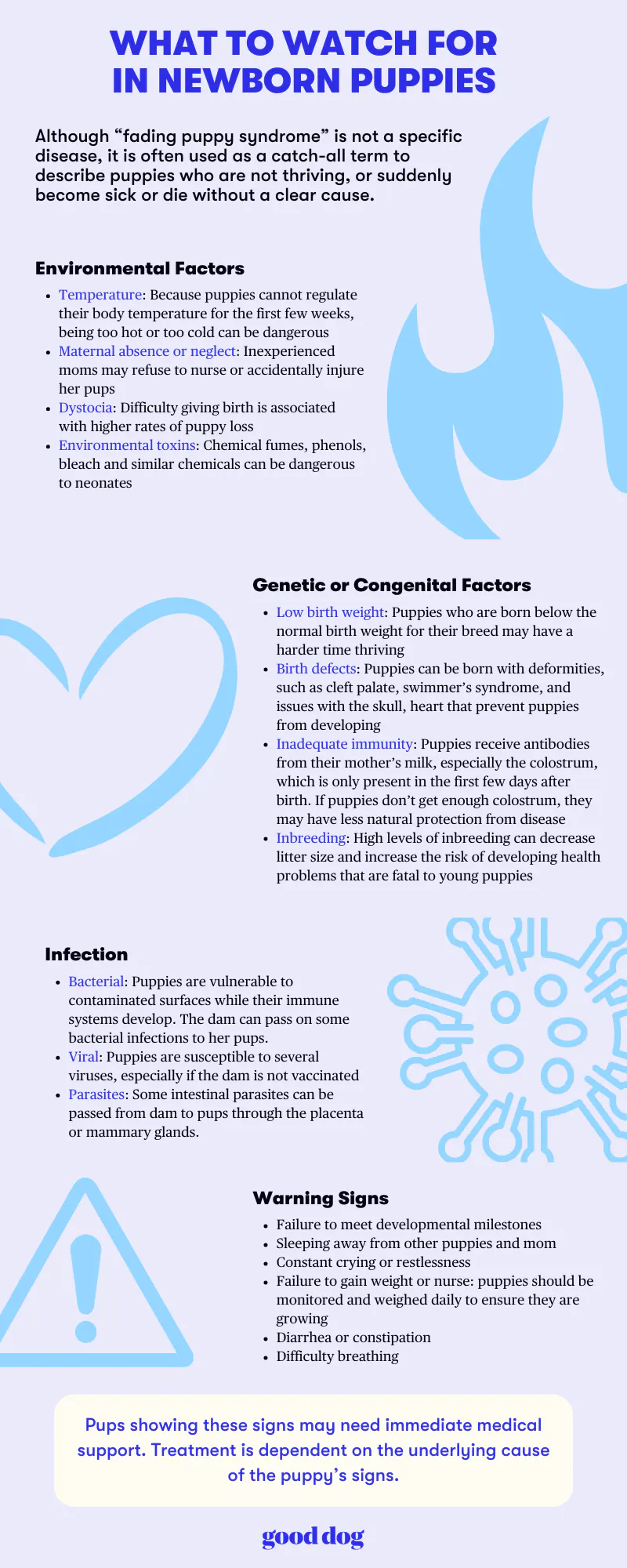
For any easy way to share this information, we created the below infographic which you can download and print to share with your communities!
Resources
VCA: Fading Puppy Syndrome in Dogs
Royal Canin: Fading Puppy Syndrome
Blunden, T. (2012). Fading puppies–reality or myth?. In Practice, 34(6), 314-321.
Hoskins, J. D. (2001). Puppy and kitten losses. Veterinary Pediatrics, 57.
Moxon, R. (2010). Managing husbandry to increase puppy survival rates. Veterinary Nursing Journal, 25(3), 17-20.
Moxon, R., & England, G. (2012). Care of puppies during the neonatal period: part 2 care of the sick neonate. Veterinary Nursing Journal, 27(2), 57-61.
Ranjan, A. (2010). Fading puppy syndrome: An overview. Veterinary Practitioner, 11, 171-173.

Join our Good Breeder community
Are you a responsible breeder? We'd love to recognize you. Connect directly with informed buyers, get access to free benefits, and more.