All About Dog Poop
This course will teach you everything you need to know about dog poop: what's normal, what's not, and frequently asked questions
Good Dog is on a mission to educate the public, support dog breeders, and promote canine health so we can give our dogs the world they deserve.
Good Dog is on a mission to educate the public, support dog breeders, and promote canine health so we can give our dogs the world they deserve.
These courses are for educational and informational purposes only and are not a substitute for professional veterinary advice, diagnosis, or treatment. Always consult your veterinarian before making decisions about your dog's health, including administering supplements, changing their diet, or implementing training techniques that could affect their wellbeing.
Good Dog is on a mission to educate the public, support dog breeders, and promote canine health so we can give our dogs the world they deserve.
What is Poop?
Poop, feces, stool, #2. What is this stuff and where does it come from? Many organs play a role in our dog’s digestive system. Knowing which does what when will help you understand how and why things might go wrong so you are better able to resolve problems.
What is Normal Poop Like?
Knowing what normal poop looks and smells like is important to being able to identify problems quickly. In this video, we cover the key characteristics of normal dog poop: color, consistency, frequency, odor, size, and sound.
What is Abnormal Poop Like?
How do we know when things are going wrong with our dog’s GI tract. In this video, we cover what problem poop is like, what it means, and when we need to head to the vet. We consider the color, consistency, frequency, odor, size, and sound of abnormal poop.
What to do When Poop is Abnormal
Sometimes abnormal poop means a vet visit, sometimes it means an ER visit, but sometimes you can handle it at home. Here are some ways to deal with diarrhea, constipation, flatulence, food intolerances at home.
Keeping Dog Guts Healthy
Preventing digestive problems by taking a few steps to keep our dogs’ guts healthy is well worth it. Here are some steps you can take to support your dog’s gut. In addition, we cover a few exciting advances now that science is making great strides in better understanding our dogs’ guts.
Section Summary
Signs that your dog's gut is healthy
- Coat, eyes, skin, activity, and behavior are normal
- Gut is quiet - no gurgling, farting, rumbling
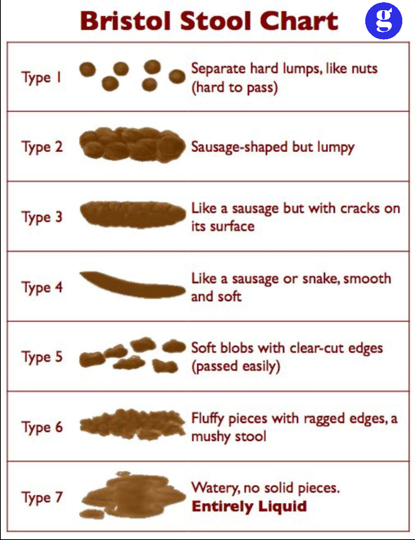
- Type 3 or 4 stools produced 2-3 times a day (see section 2 for more info); type 2 or 5 occasionally (see Bristol Stool Chart)
- Pup can control defecation once house-trained
- Abdomen isn't bloated or hard
Keeping your pup's gut health
- Monitor your dog's GI tract, stool, anal glands
- Fitness and exercise
- Feed what the dog does well on
- Give probiotics and prebiotics regularly
- Control parasites - round, tape, whip, hookworms
- Keep dog's stress level low
- Resolve type 1, 6, and 7 stools quickly
Gut Health Products
Probiotics
Prebiotic
All About Poop Webinar Questions and Answers
Resources and Research
- Bristol Stool Chart
- Probiotics
- Dewormers and Dosing
- Diarrhea Treatments
- Constipation Treatments
- Managing Anal Glands
- Sequencing Your Dog’s Gut Microbiome
- Fecal Transplants
Bristol Stool Chart
Probiotics
There are many dog probiotics on the market for you to choose from. Chris and Gayle use these two:
Geneflora
Geneflora Digestive Enzymes and Probiotics for Dogs — scoop included. Give the following scoops each day in your dog’s food:
- Dogs up to 20 pounds: 1 scoop per day
- Dogs 21-50 pounds: 1.5 scoops per day
- Dogs 51-80 pounds: 2 scoops per day
- Dogs over 80 pounds: 3 scoops per day
Fortiflora
Purina Fortiflora Canine Nutritional Supplement Give one package a day with food.
Dewormers and Dosing
Roundworms
If you see roundworms in your dog’s stool, you should either deworm him yourself or head to the vet for a fecal exam and dewormer. The treatment of choice is the active ingredient fenbendazole. Fenbendazole also treats hookworms, whipworms, one species of tapeworms, and giardia. Fenbendazole is available without a prescription online and at some stores, such as Walmart and pet stores. Confirm dosing with your vet.
Products with fenbendazole include Panacur C and Safeguard, either granules or liquid you put in your dog’s food. Do not use Panacur Equine! If your dog won’t eat it in its regular food, try feeding it in a small amount of really delicious food, like green tripe, human baby food (meat), or canned cat food.
Treat your dog for three consecutive days for round worms. Five consecutive days for giardia.
Panacur C or Safeguard for Dogs Granules dose is 1 gram per 10 pounds body weight for three (or five) consecutive days. Each link is for 3 days of treatment:
- For dogs up to 10 pounds: 1 gram
- For dogs from 11-20 pounds: 2 grams
- For dogs from 21-30 pounds: Purchase 1 box each of 1 gram and 2 grams treatments. Give one envelope from each box each day.
- For dogs from 31-40 pounds: 4 grams
- For dogs from 41-50 pounds: Purchase 1 box each of 1 gram and 4 grams treatments above. Give one envelope from each box each day.
- For dogs from 51-60 pounds: Purchase 1 box each of 2 grams and 4 grams treatments above. Give one envelope from each box each day.
- For dogs from 61-70 pounds: Purchase 1 box each of 1 gram, 2 grams, and 4 grams treatments above. Give one envelope from each box each day.
- For dogs from 71-80 pounds: Purchase two boxes of 4 grams treatment. Give two envelopes each day.
- For dogs over 80 pounds: combine the above products to give 1 gram for every 10 pounds.
Safeguard for Goats Liquid Calculator
This calculator will assist you in determining how much Fenbendazole 10% Liquid dewormer to give your pups over 2 weeks and dogs:
- Dose by mouth for 3 consecutive days for round, whip, and hookworms.
- Dose by mouth for 5-10 consecutive days for giardia.
For unweaned pups, syringe slowly between their check and jaw. For weaned pups and dogs, you can either syringe in or put into some food and feed it to them. Beware that fenbendazole can cause diarrhea in pups under 4 weeks so be prepared to treat symptomatically.
To get started, enter your pup or dog's weight in pounds.
Tapeworms
If you see tapeworms, or what looks like bits of rice, in your dog’s stool, you should either deworm him yourself or head to the vet for a fecal exam and dewormer. The treatment of choice is the active ingredient of praziquantel. While you treat for tapeworms, also treat for fleas since dogs get tapeworms from swallowing fleas. Confirm dosing with your vet.
Bayer Tapeworm Dewormer, 5-count bottle. For dogs and pups over 4 weeks of age and 5 pounds of body weight.
Dosing by body weight
- 5 pounds: ½ tab
- 6-10 pounds: 1 tab
- 11-15 pounds: 1 ½ tabs
- 16-30 pounds: 2 tabs
- 31-45 pounds: 3 tabs
- 46-60 pounds: 4 tabs
- Over 60 pounds: 5 tabs
Diarrhea Treatments
If your dog has loose stools or diarrhea (Stool Type 5-7) but no fever and is feeling well otherwise, you might want to try these treatments at home. Check dosing with your vet and don’t hesitate to take your dog to see your vet if things aren’t improving.
Fasting
Fasting is one of the best treatments for dogs over 6 months of age. Fast your dog for 24 hours (say, from dinner one night to dinner the next night). Then offer boiled white rice and either chicken breast or hamburger. If your dog’s stools improve, gradually substitute his regular food for the meat and rice over 3-4 days.
Pepto Bismol
Pepto Bismol is bismuth subsalicylate a relatively safe anti-diarrheal treatment for non-pregnant dogs. Many owners find it easier to get the tablets down their dog, rather than the liquid, which can make quite a mess. But if your dog is refusing to eat, syringe the liquid into your dog’s cheek.
- Pepto Bismol liquid dosing: 1 teaspoon for every 10 pounds body weight every 4 to 6 hours for up to 5 days
- Pepto Bismol tablet dosing:
- Under 10 pounds: ½ tablet
- 10-25 pounds: 1 tablet
- 25-50 pounds: 2 tablets
- Over 50 pounds: 3 tablets
Kaolin Pectin
Kaolin Pectin is a traditional treatment for simple diarrhea (no fever) that can be quite effective with few side effects. Kaolin is a clay-like powder believed to work by attracting and holding onto the bacteria that may be causing the diarrhea. Pectin is the old kaopectate, before bismuth subsalicylate was added. Give 1-3 teaspoons, 4-6 times a day.
Monmoillonite or Bentonite Clay
Monmoillonite or Bentonite Clay. A 2017 review of research on bentonite clay supported many of the health claims made about it. It can resolve diarrhea caused by a variety of problems. Give small dogs, ½ -1 teaspoon daily. Give medium to large dogs, 1-2 teaspoons daily.
Slippery Elm
Slippery Elm is an herb that is useful in treating diarrhea, constipation, kennel cough and bronchitis. Follow the package directions or give ¼ teaspoon of powder mixed with water or food for every 10 pounds of body weight.
Pumpkin (canned or cooked)
Cooked pumpkin is a terrific source of fiber, minerals and water that can resolve diarrhea, constipation, bloating, stomach upset and gas. It can also help dog’s lose weight, when used as a replacement for a portion of higher calorie food. Give 1-4 tablespoons per meal.
Pumpkin (Firm Up!)
Pumpkin powder is great to have on hand at home or while traveling. Like cooked pumpkin, this product can help diarrhea, constipation, bloating, stomach upset and gas. Dose according to bag.
Fortiflora Probiotic
Fortiflora probiotic can be helpful in controlling stress or travel diarrhea. Give one package a day with food.
Constipation Treatments
If your dog has hard stools that it struggles to pass (Stool Type 1) but isn’t vomiting and is able to pass at least some stool, you might want to try these treatments at home. Check dosing with your vet and don’t hesitate to take your dog to see your vet if things aren’t improving.
Psyllium Powder
Psyllium Powder is an excellent source of fiber that can help constipated dogs but also keep healthy dog’s guts more stable.
Slippery Elm
Slippery Elm is an herb that is useful in treating diarrhea, constipation, kennel cough and bronchitis. Follow the package directions or give ¼ teaspoon of powder mixed with water or food for every 10 pounds of body weight.
Pumpkin (canned or cooked)
Cooked pumpkin is a terrific source of fiber, minerals and water that can resolve diarrhea, constipation, bloating, stomach upset and gas. It can also help dog’s lose weight, when used as a replacement for a portion of higher calorie food. Give 1-4 tablespoons per meal.
Pumpkin (Firm Up!)
Pumpkin powder is great to have on hand at home or while traveling. Like cooked pumpkin, this product can help diarrhea, constipation, bloating, stomach upset and gas. Dose according to bag.
Managing Anal Glands
Your dog’s two anal glands are located on either side of its anus. These glands are used to identify individual’s scents and marking territory. Healthy glands secrete a little fluid each time your dog defecates.
However, some dog’s glands don’t empty normally. You’ll know that when your dog scoots its butt on the ground or licks excessively. When you see this, your first step is to examine the glands, looking and feeling them to ensure there isn’t an infection or tumor. If you aren’t sure, go to your vet. They can examine and express them, which is squeezing the fluid out of the gland to relieve the pressure.
You can also express glands yourself at home. It’s not difficult, though it is mighty smelly! Do it in the bathroom or grooming area, with a paper towel, and your dog will be happier for it.
Sequencing Your Dog’s Gut Microbiome
AnimalBiome.com offers genomic sequencing of the bacteria in your dog’s gut. Gayle tested it with her dogs but is still waiting to hear from the company to discuss the dogs’ results.
Here are Glee and Ready’s results. What is interesting is that these two dogs live in the same home and eat the same diet (K9 Kraving raw) yet have very different microbiomes. In both cases, AnimalBiome says they are “below average” when compared to a “healthy dog.” Yet, both Glee and Ready are healthy, active dogs with no GI problems, regular Type 3 stools, and no indications of disease or even poor keeping.
Fecal Transplants
AnimalBiome.com also offers fecal transplants for dogs with serious GI disease, that hasn’t resolved with more standard treatments. Several universities also offer this service.