Wildside Acres

- Kalamazoo, MI ·
Meet the breeder
I'm Kathy P., the breeder behind Wildside Acres located in Kalamazoo, MI. Our dogs are bred for temperament, structure, and health. We raise our puppies using Early Neurological Stimulation & Puppy Culture. Puppies are microchipped and started on crate training, potty training, and basic commands. We provide a health guarantee and lifetime breeder support.

Q. & A. with Kathy
Why did you start breeding?
Breeding has been a passion of mine since I was a child. I wanted to make sure I understood everything about breeding, from genetics and health to conformation and socialization, prior to breeding.What makes your program special?
We health test all parent dogs. One of the sires we use is in the top 5% of all submissions to PennHip. We use Puppy Culture and Early Neurological Stimulation, offer lifetime support, and are extensively involved with our puppies from birth. We carefully observe the temperament and drive of each puppy to make sure it is matched to the perfect homeWhat are the different breed coat colors in your program?
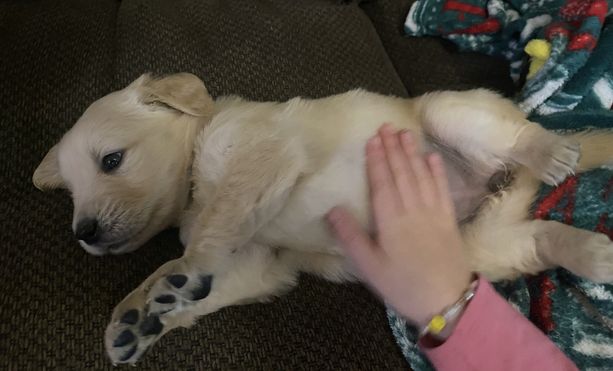
Our puppies are golden. Colors will vary depending on the parent dogs.Where do your breeding dogs live?
They live in my home.

Matched dogs
These dogs are already reserved or have gone home.
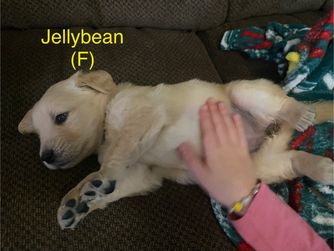
Jellybean
Went homeFemale

Bubblegum
Went homeFemale
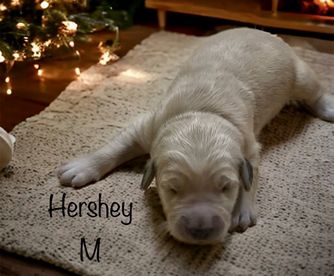
Hershey
Went homeMale
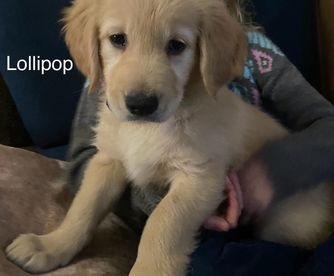
Lollipop
Went homeFemale
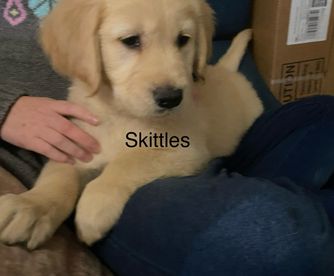
Skittles
Went homeFemale
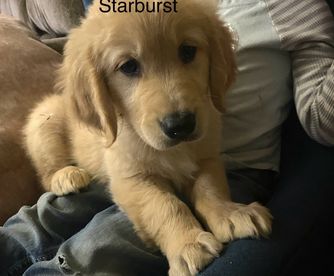
Starburst
Went homeFemale
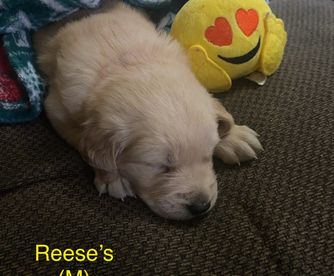
Reese’s
Went homeMale

Girl 1
Went homeFemale
Getting a puppy from Kathy
Kathy has been certified by Good Dog’s screening team for responsible and trusted breeding practices. When you’re ready, reach out to ask about the puppies or anything else on your mind. You’ll get to know each other through messaging, phone, or video and pay securely, all on Good Dog.
Together, you’ll choose the puppy that’s right for you, stay in touch with regular updates, and plan how to bring your new puppy home.
Price
“Price also includes vaccinations, deworming, microchipping, and a new puppy packet (treats, food, toys, a blanket with mom’s scent, collar and leash, and food bowls). We don’t collect a deposit until puppies are on the ground. The deposit is only refundable if we do not having a puppy for you and you wish to go elsewhere. It can be transferred to future litters.”
Contract & health guarantee
Kathy may provide a written contract or health guarantee when you purchase a puppy. This helps protect both you and your breeder, ensuring that you both have a clear understanding of the terms of your puppy purchase. If Kathy offers a contract or guarantee, the details will be personalized by them. If you have any questions or want to know more, don't hesitate to reach out to Kathy directly.
You’re protected
on Good Dog
When you pay and communicate on Good Dog, you’re covered by Payment Protection.
What's included
From Good Dog
- Lifetime support from Good Dog’s Care Team
- 10% lifetime discount on Figo pet insurance
- Puppy Training Program & private community
Puppy health practices
- Vet check
- First round of shots and deworming
Location & pick-up
You can drive or fly to pick up your puppy from Kathy.
Breeder's location
Meet in Kalamazoo, MI
4229 miles away
·
Other pick-up locations
Meet at Detroit Metro Wayne County Airport
4151 miles away
·
More about Kathy
Certifications & recognitions
Puppy Culture Breeder.
Kathy has been a member of Good Dog for over 5 years
Kathy was screened for responsible practices and has been a member since 2021.

Kathy is a trusted Good Dog breeder
Wildside Acres meets or exceeds our community standards in these areas:
- Responsible breeding practices
- Health of breeding dogs and puppies
- Puppy environment and enrichment
- Buyer education and policies
Parent dogs

Journey, mom
Golden Retriever
About Journey
Journey is a female Golden Retriever. Carefully selected as a great representative of her breed, Kathy decided to make her part of their program. Kathy has passed Good Dog’s screening process, which involved a review of their breeding practices, environment, and the mental and physical health of their dogs.

Ruby, mom
Golden Retriever
About Ruby
Ruby is a female Golden Retriever. Carefully selected as a great representative of her breed, Kathy decided to make her part of their program. Kathy has passed Good Dog’s screening process, which involved a review of their breeding practices, environment, and the mental and physical health of their dogs.
Parent health testing
Excellent level
Wildside Acres reports to performing the health tests below on their breeding dogs. Ask your breeder about the tests performed on the parents of your litter. Learn more about health testing for Golden Retrievers.
Hip Dysplasia (Preliminary), Hip Dysplasia
Hip testing reduces the chance of passing down hip dysplasia, which is primarily found in large breed dogs and can cause hip pain and the eventual loss of the function of the hip joint.
Elbow Dysplasia (Preliminary), Elbow Dysplasia Finals (OFA, BVA, SV, FCI)
Elbow testing reduces the chance of passing down elbow dysplasia, which is primarily found in large breed dogs and can cause arthritis in the elbow joint and front leg lameness.
Eye Certification (CAER, registered with OFA)
Eye testing reduces the chance of passing down a wide range of hereditary eye illnesses including retinal dysplasia, lens luxation, and glaucoma, which can cause impared vision or blindness.
Cardiac Evaluation (registered with OFA)
Heart testing reduces the chance of passing down congenital heart disease, which can cause a range of symptoms ranging from trouble exercising to heart failure.
Polyneuropathy 3, Leonberger and Saint Bernard Type
A breeder may perform additional tests on their dogs that do not fall into these general categories. These tests may be more uncommon or very specific to a particular breed.
Canine Multiple System Degeneration, Kerry Blue Terrier Type, Thrombopathia, Basset Hound Type, Chondrodysplasia/Dwarfism, Craniomandibular Osteopathy (CMO), Skeletal Dysplasia (SD2), Osteochondrodysplasia, Miniature Poodle Type, Osteogenesis Imperfecta (OI), Dachshund Type, Osteogenesis Imperfecta (OI), Beagle Type, Hereditary Vitamin D-Resistant Rickets (HVDRR), Cleft Palate (ADAMTS20), Ehlers-Danlos Syndrome, Lethal Acrodermatitis (LAD), Bull Terrier Type, Musladin-Leuke Syndrome (MLS), Hereditary Nasal Parakeratosis (HNPK), Ichthyosis, American Bulldog Type, Ichthyosis, Great Dane Type, Ichthyosis (KRY10), Adult Paroxysmal Dyskinesia, Episodic Falling Syndrome (EFS), Intestinal Cobalamin Malabsorption (IGS), Komondor Type, Intestinal Cobalamin Malabsorption (IGS CUBN Exon 8), Border Collie Type, Intestinal Cobalamin Malabsorption (IGS CUBN Exon 53), Border Collie Type, Malignant Hyperthermia (MH), Pyruvate Dehydrogenase Phosphatase 1 Deficiency (PDP1), Hypocatalasia, Myotubular Myopathy, Labrador Retriever Type, Myotonia Congenita, Australian Cattle Dog Type, Myotonia Congenita, Schnauzer Type, Centronuclear Myopathy (CNM), Great Dane Type, Exercise Induced Collapse (EIC), Centronuclear Myopathy (CNM), Juvenile Dilated Cardiomyopathy, Long QT Syndrome, Dilated Cardiomyopathy 2 (DCM2), Dilated Cardiomyopathy 1 (DCM1), Polyneuropathy 2, Leonberger and Saint Bernard Type, Polyneuropathy 1, Leonberger and Saint Bernard Type, Acral Mutilation Syndrome (AMS), Juvenile Laryngeal Paralysis & Polyneuropathy (JLPP), Multiple System Degeneration, Chinese Crested Type, Narcolepsy, Dachshund Type, Narcolepsy, Labrador Retriever Type, Polyneuropathy (NDRG1), Alaskan Malamute Type, 2,8-Dihydroxyadenine (2,8-DHA) Urolithiasis, Neuroaxonal Dystrophy (NAD), Papillon Type, Neuroaxonal Dystrophy (NAD), Spanish Water Dog Type, X-Linked Tremors, Shaking Puppy Syndrome (SPS), Hypomyelination, Weimaraner Type, Neuroaxonal Dystrophy (NAD), Rottweiler Type, Juvenile Myoclonic Epilepsy (JME), Hereditary Ataxia, Cerebellar Ataxia, Spinocerebellar Ataxia (SCA), Late Onset Ataxia, Spinocerebellar Ataxia (LOA, SCA), Cerebellar Ataxia, Finnish Hound Type, Neonatal Cortical Cerebellar Degeneration (NCCD), Alexander Disease, Encephalopathy, Alaskan Husky Type, Persistent Müllerian Duct Syndrome, Familial Enamel Hypoplasia (FEH), Italian Greyhound Type, Globoid Cell Leukodystrophy (GCL), Terrier Type, Gangliosidosis GM2, Japanese Chin Type, GM2 Gangliosidosis, Poodle Type, GM1 Gangliosidosis, Portuguese Water Dog Type, GM1 Gangliosidosis, Alaskan Husky Type, GM1 Gangliosidosis (GLB1), Shiba Inu Type, Neuronal Ceroid Lipofuscinosis 2 (NCL2), Neuronal Ceroid Lipofuscinosis 10 (NCL10), American Bulldog Type, Neuronal Ceroid Lipofuscinosis 12 (NCL12), Australian Cattle Dog Type, Neuronal Ceroid Lipofuscinosis 8 (NCL8), Setter Type, Neuronal Ceroid Lipofuscinosis 8 (NCL8), Australian Shepherd Type, Neuronal Ceroid Lipofuscinosis 5 (NCL5), Border Collie Type, Neuronal Ceroid Lipofuscinosis 4A (NCL4A), American Staffordshire Terrier Type, Neuronal Ceroid Lipofuscinosis 1 (NCL1), Dachshund Type, Lagotto Storage Disease (LSD), Phosphofructokinase Deficiency (PFK), Mucopolysaccharidosis VII (MPS VII GUSB), Shepherd Type, Mucopolysaccharidosis VII (MPS VII), Brazilian Terrier Type, Mucopolysaccharidosis IIIA (MPS IIIA), New Zealand Huntaway Type, Mucopolysaccharidosis IIIA (MPS IIIA), Dachshund Type, Glycogen Storage Disease Type IIIA, GSD IIIA, Glycogen Storage Disease Type II or Pompe's Disease (GSD II), Fucosidosis, Renal Cystadenocarcinoma and Nodular Dermatofibrosis (RCND), X-Linked Anhidrotic Ectodermal Dysplasia, Shepherd Type, Dry Eye Curly Coat Syndrome (CKSID), Primary Ciliary Dyskinesia, Kartagner Syndrome (PCD), Familial Nephropathy, English Springer Spaniel Type, Familial Nephropathy, Cocker Spaniel Type, Protein-Losing Nephropathy (PLN; NPHS1 Gene Variant), Calcium Oxalate Urinary Stones (Research), Polycystic Kidney Disease (PKD), Cystinuria Type II-B, Miniature Pinscher Type, Cystinuria Type II-A, Australian Cattle Dog Type, Cystinuria Type 1A, Labrador Retriever Type, Cystinuria Type 1A, Newfoundland Type, Congenital Stationary Night Blindness (CSNB), Primary Lens Luxation (PLL), Hereditary (Juvenile) Cataracts (HC; JC), Australian Shepherd Type, Gondysgenesis and Glaucoma, Border Collie Type, Primary Open Angle Glaucoma (ADAMST17 Exon 11), Primary Open Angle Glaucoma (ADAMST10 Exon 17), Glaucoma (BCG), Border Collie Type, Multifocal Retinopathy 1 (CMR1), Coton de Tulear Type, Day Blindness, Achromatopsia, Cone Degeneration, Collie Eye Anomaly (CEA), PRA3, Tibetan Terrier and Spaniel Type, X-Linked Progressive Retinal Atrophy (XL-PRA), PRA, Cone-Rod Dystrophy 4 (PRA-crd4), PRA, Cone-Rod Dystrophy 1 (PRA-crd1), PRA, Basenji Type, PRA (PRA1), Papillon Type, PRA, Shetland Sheepdog Type, PRA, Rod-Cone Dysplasia 3 (rcd3), PRA, Irish Setter Type, Severe Combined Immunodeficiency Disease, X-Linked (XSCID), Corgi Type, Severe Combined Immunodeficiency Disease, X-Linked, Basset Hound Type (XSCID), Severe Combined Immunodeficiency Disease, Frisian Water Dog Type, Severe Combined Immunodeficiency Disease, Terrier Type, Compliment 3 Deficiency (C3), Congenital Hypothyroidism with Goiter, Terrier Type (CHG), Congenital Methemoglobinemia, Pomeranian Type, Pyruvate Kinase Deficiency (PKD), Cairn Terrier Type, Pyruvate Kinase Deficiency (PKD), Beagle Type, Pyruvate Kinase Deficiency (PKD), Pug Type, Prekallikrein Deficiency, Fletcher Trait, May-Hegglin Anomaly, Glanzmann's Thrombasthenia, Otterhound Type, Elliptocytosis, Congenital Macrothrombocytopenia, Leukocyte Adhesion Deficiency, Type III, von Willebrand Disease II (vWD II), von Willebrand Disease III (vWD III), Shetland Sheepdog Type, von Willebrand Disease III (vWD III), Scottish Terrier Type, von Willebrand Disease III (vWD III), Kooikerhondje Type, von Willebrand Disease III (vWD III), Thrombopathia, American Eskimo Dog Type, Factor VII Deficiency, P2RY12 Receptor Platelet Disorder, Multiple Drug Sensitivity (MDR1), Osteogenesis Imperfecta (OI), Golden Retriever Type, Duchenne Muscular Dystrophy, Golden Retriever Type, Degenerative Myelopathy (DM; SOD1A), Neuronal Ceroid Lipofuscinosis 5 (NCL5), Golden Retriever Type, Ichthyosis, Golden Retriever Type 1, von Willebrand Disease I (vWD I), Neonatal Encephalopathy with Seizures (NEwS), PRA, Rod-Cone Degeneration (PRA-prcd), PRA, Golden Retriever 2, PRA, Golden Retriever 1
Genetic testing reduces the chance of passing down a wide variety of hereditary diseases of differing prevalence and severity such as Progressive Retinal Atrophy (an eye disease) and Von Willebrand's Disease (a blood disease).