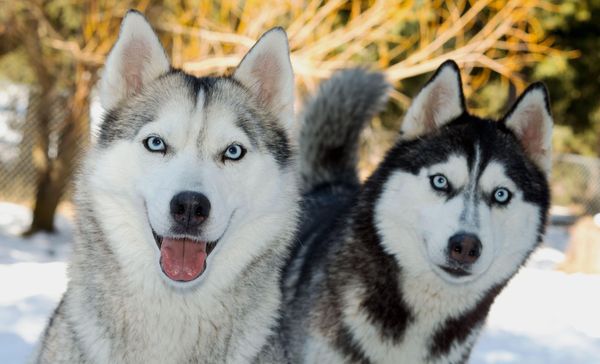
2 siberian huskies look at the camera. they are outside with a snowy backdrop.
Get to know

Siberian Huskies

Written by
Caroline Coile, Ph.D.,
 author of 34 dog books.
Written by
Caroline Coile, Ph.D.,
 author of 34 dog books, including the top-selling Barron's Encyclopedia of Dog Breeds.
| | | | |

Ready to take a walk on the wild side? Or better yet, a sled dog ride?

The Siberian Husky is up for an adventure. All you have to do is try to keep up.
Browse available puppies

Connect with reputable breeders to find the dog of your dreams
At a glance

High Energy

Energy level

4/5

Low Maintenance

Grooming

3/5

Large

Size

Clever, adventurous, energetic

Temperament

12-14 years

Lifespan

More Challenging

Training

1/5

Medium Vocality

Barking

3/5

At a glance

  • Energy level

    High Energy

  • Grooming

    Low Maintenance

  • Size

    Large

  • Temperament

    Clever, adventurous, energetic

  • Lifespan

    12-14 years

  • Training

    More Challenging

  • Barking

    Medium Vocality

Why people love the breed

People love their Huskies because they are mischievous, fun-loving, and freethinking—dogs who are their co-pilots rather than their followers(co-pilots that occasionally put the plane into a tailspin just to see what happens!).
Siberian Huskies are not the kind of dog to hang on your every word, waiting in eager anticipation for your next command. They’re free spirits, busy thinking up the next adventure. After all, their ancestors saved an entire town and explored both poles. If you want a dog that could figure out how to rob a bank or escape from Alcatraz, that’s a Husky! Huskies are part jokester, part world explorer, and all best friend. They are equally at home curled up sleeping under the snow or by your side. But they definitely have a taste for mischief and mayhem. They’re typically not easy to train, but that’s part of their appeal. They always seem to have a fun take on things, so even when they’re trotting away after you've told them to come, you can’t help but share in their joy of disobedience-–at least just a little. Nobody can accuse a Siberian Husky of being complacent. Or boring.

Appearance

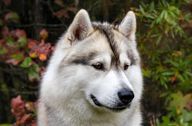
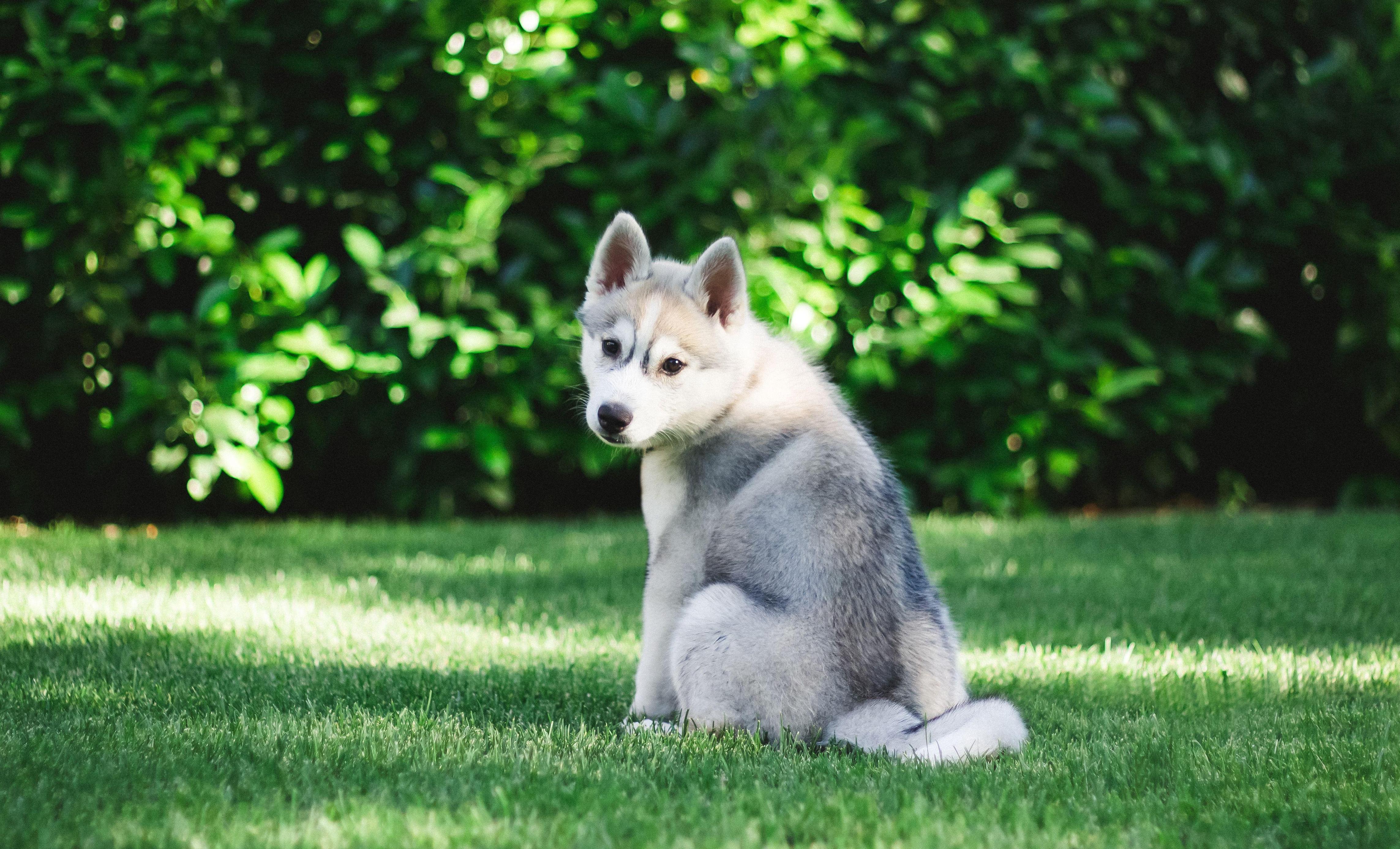
Siberian Huskies have a wolf-like appearance, but they are really part of the northern breed and spitz family.
The Siberian Husky has a fairly typical northern breed appearance, with features that help protect them from cold temperatures. The small, furred ears retain heat; they can sleep with their nose buried in their bushy tail; and their thick double coat repels moisture with its outer guard hairs while retaining heat with its dense wooly undercoat. The skull is slightly rounded, the neck arched and proudly carried. Unlike many spitz breeds, Huskies don't carry their tail curled forward over the back, but let it hang down or carry it out behind in a sickle-curve. Huskies are built for speed rather than strength, having specialized in pulling light sleds for great distances over the snow rather than pulling heavy sledges over short distances. Their almond-shaped eyes may be brown, blue, or they may have a brown eye and blue eye. The thick double stand-off coat comes in almost all ranges of the allowable colors (which are black, gray, agouti, sable, red, and white) but most commonly is seen with a darker body and lighter mask and extremities.

Grooming

Most of the time, grooming is relatively simple. Twice a year, when they shed, it is not.
The hair doesn’t usually mat or tangle, and dirt tends to fall right out of the coat. A weekly brushing with a pin brush is all that’s needed. But twice a year, when they shed, be prepared for a snowstorm of fur inside. The undercoat sheds and sheds, and one should try to brush and comb it at very least daily, even more if possible. A slicker brush or shedding rake can help remove the excess coat. Washing in warm water can loosen the hairs from their follicles and hasten the shedding. Other than shedding season, Huskies present few grooming challenges. Cut their nails as needed, check their ears for debris weekly, and brush their teeth daily.
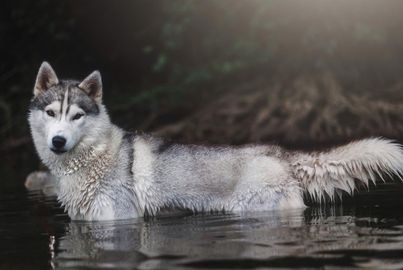
Gray husky with brown eyes stands in the water looking at the camera
Img:

North River Siberians

Breed temperament and characteristics

Huskies were bred to be tireless, to never give up, and to think for themselves. The mischief they added all on their own.
Although sled dogs do take directions from a musher, and as they say, “If you're not the lead dog, the scenery never changes,” Siberian Huskies are surprisingly independent dogs. Lead dogs actually make many decisions without the musher’s directions, even disobeying directions if they perceive danger. Mushers are thankful for dogs that assert themselves, which has saved many lives. Part of being a team member is both following the lead of other dogs but also thinking independently at times. Huskies like to run and explore, and typically need a well-fenced yard with a high fence. They are infamous for just taking off and running for miles. They are equally infamous for performing some of the most amazing home destruction jobs ever seen (usually when they don’t get adequate exercise). Huskies are high energy dogs with a friendly nature. They play well with others and can be gentle with the elderly and with toddlers, and up for an adventure with adults. They tend to be pack animals and crave human or canine companionship. Although not typically overtly aggressive, most have high prey drives and may see smaller animals, like neighborhood cats or household pocket pets, as potential snacks. Careful socialization is required for Huskies to live harmoniously with smaller companions. They are typically not good watch dogs nor good protection dogs. They are known as being vocal dogs —with assorted howls and almost human speech—which most owners adore.

Exercise

Siberian Huskies were the foundation of the 938 mile Iditarod dog sled race. They’re going to need a lot of exercise.
Huskies were bred to run and run. They need more than a walk around the block. They make good jogging partners in cooler weather. Some owners even have sleds or carts for their Huskies to pull. Most Huskies prefer to just run but some will also play fetch games. Some, but not all, enjoy swimming but it’s not a priority. Hiking is a favorite activity, but they need to be kept on leash as they chase wild animals and may wander off. They like nothing better than a frigid day with snow on the ground. This is not really an ideal breed for hot climates, as their need for exercise can be difficult to mix with their tendency to get hot due to their thick double coat. Given a snow day, expect your Sibe to want to spend the entire day outside in it. Mental exercise is a necessity alongside physical exercise, so be sure to include training and puzzles into your exercise regime. They’re not known as great agility dogs or obedience dogs, although some have excelled at these sports. They really want to pull a sled—the farther and faster the better.
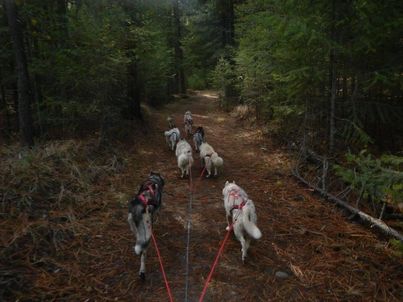
Team of 9 siberian huskies dryland mushing.
Img:

Keahi Siberian Huskies

Training

If training involves anything to do with pulling a sled, Huskies are naturals. Anything else may not go as smoothly.
Huskies tend to think they know better than you do, and they trust their own instincts over yours. This was a useful trait when pulling sleds across dangerous terrain with snow covered crevasses and cracking ice, and many seem to retain it today. So don’t expect your Sibe to obey your commands without question. They can appear stubborn and headstrong, but again, pushing on in the face of adversity was a necessary trait when pulling a sled through white-outs and blizzards. It may take a little longer than with some other breeds, but Siberians can be trained to perform exceptionally once you convince them it’s to their advantage, usually with especially tasty treats. They enjoy learning tricks, and have performed at top levels in obedience competitions. They are notoriously poor at recall training and most will never be able to have reliable enough recall to be safe off-leash.

Diet and nutrition

Because of their high energy, you may need to feed your Siberian Husky a food high in calories, fat, and protein.
Racing sled dogs need high calorie foods, and while your Husky may not be in competition, it’s possible he runs a lot. Monitor their weight to make sure they’re neither too fat nor too thin. They should have a slight tuck up at the belly, and be thinner at the loin than the ribs cage when viewed from above. Many special diets are available for various medical conditions. Your veterinarian is the best resource for this. For example, Siberian Huskies and a few other northern breeds are prone to zinc-responsive dermatosis which requires medical management.
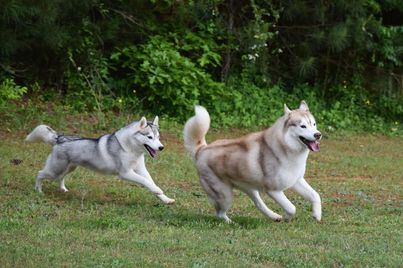
a red and gray siberian husky run together in a field, they look like they might be playing.
Img:

Velox Siberians

Health issues

Huskies are an extremely healthy breed, less often plagued by elbow or hip dysplasia compared to other breeds their size.

Lifespan: 12 to 14 years.

Epilepsy

This is reported at a higher rate in Huskies compared to other breeds. The exact cause is unknown but a genetic basis is suspected in many breeds. No specific gene has been identified, so no genetic testing is available.

Hypothyroidism (underactive thyroid gland)

This is reported at a higher incidence in Huskies compared to other breeds.

Zinc-responsive dermatosis (type 1)

This is seen in only a few northern breeds, including Siberian Huskies. It causes crusting around the eyes, lips, and nose.

Alopecia X (also called follicular dysplasia)

Some Siberian Huskies are affected by this condition common to many spitz breeds, which causes hair loss. It can occur in Huskies, but is not common.

Other health issues

The following conditions, albeit uncommon, are more prevalent in Huskies compared to other breeds: thyroid tumors, spontaneous pneumothorax, ectopic ureters, eosinophilic disease, glaucoma, and bronchiectasis.

Learn more about health issues that may impact Siberian Huskies

History

The Siberian Husky is an ancient breed that has helped humans survive in extreme conditions and to explore both poles.
The Siberian Husky is in the American Kennel Club (AKC) Working group. According to DNA, Huskies are one of the most ancient of all breeds, emerging from Northeast Asia with the nomadic Chukchi people. The Siberian Husky shares a close genetic relationship with the Alaskan Husky and Alaskan Malamute. Dog sled racing became popular in Alaska during the Gold Rush. It was dominated by large sled dogs until a team of much smaller Chukchi huskies from Siberia competed and won a major race. These small dogs came to dominate not only racing, but sledding jobs where speed was more important than power. In 1925, relays of Huskies traveled 674 miles in 5 ½ days to deliver life-saving diphtheria serum to Nome, Alaska. The present day Iditarod commemorates this “Great Race of Mercy.” Lead dog Togo covered 260 miles but fame went to Balto, who ran 56 miles and led the final team into Nome. New York City's Central Park is home to a statue of the Balto with a plaque reading: "Dedicated to the indomitable spirit of the sled dog that relayed antitoxin six hundred miles over rough ice across treacherous waters through arctic blizzards from Nenana to the relief of stricken Nome in the winter of 1925. Endurance. Fidelity. Intelligence." Admiral Byrd brought about 50 Siberian Huskies on his trip to Antarctica in 1933. During World War II Siberian Huskies served as search & rescue dogs. Huskies starred in the movies "Eight Below" and "Snow Dogs”. Celebrity owners include Michael J. Fox, Miley Cyrus, Jarod Leto, and Kate Jackson.
About the author

Canine specialist, Caroline Coile, Ph.D., is the author of 34 dog books, including the top-selling Barron's Encyclopedia of Dog Breeds. She’s written thousands of magazine and web articles about dogs. She specializes in canine science, health, breeds and competitions. Caroline has won 20 national dog-writing awards, and was a 2015 Inductee into the Dog Writers Association of America Hall of Fame.

Breed Scorecard

Characteristics and temperament
  • Affectionate with family

    5

  • Watchdog level

    3

  • Playfulness

    4

  • Adaptability

    3

  • Social needs

    4

  • Temperament

    Clever, adventurous, energetic, mischievous

  • Intelligence

    4

  • Good with other dogs

    3

  • Good with cats or other pets

    3

  • Friendly with strangers

    5

  • Good as a service dog

    2

  • Good for apartments

    1

  • Barking level

    3

Appearance
  • Height

    20-23"

  • Size

    Large

  • Colors

    Gray and white, Black tan and white, Brown and white, Sable and white, Red and white, Agouti and white, Black and white, White, Black

  • Coat texture

    Fairly harsh overcoat, soft undercoat

  • Coat length

    Medium double coat, straight, stand-off, without facial furnishings

Training
  • Trainability

    1

Exercise
  • Exercise needs

    4

  • Exercise time

    1.5 to 2 hours daily

  • Mental exercise needs

    3

  • Favorite activities

    Sled pulling, running in snow, hiking, carting, weight pulling

Grooming
  • Grooming needs

    3

  • Brushing frequency

    Weekly (daily when shedding)

  • Needs professional grooming?

    No

  • Drooling level

    1

Health issues
  • Epilepsy

  • Hypothyroidism (underactive thyroid gland)

  • Zinc-responsive dermatosis (type 1)

  • Alopecia X (also called follicular dysplasia)

  • Other health issues

Other
  • Bred for

    Sled pulling

  • Country of origin

    Russia

  • Popularity level

    5

FAQs

  • On Good Dog, you can search for Siberian Husky puppies or dogs in rescues and shelters. Adopting a Siberian Husky from a shelter or rescue is generally less expensive than buying a puppy from a breeder with ethical practices. Across the United States, there are dedicated rescues that specialize in specific breeds and may even help transport a Siberian Husky dog to you from another part of the country. Although it can be more cost-effective, adopting the exact breed you're looking for is typically more difficult than working with a responsible breeder. Learn more about adopting a dog from a shelter or rescue.

  • The typical price for Siberian Husky puppies for sale may vary based on the breeder and individual puppy. On average, the price of Siberian Husky puppies from a breeder is $1,300.

  • Siberian Huskies arose in one of the toughest places on earth, and helped humans survive there. They’ve saved lives in heroic marathon sled trips. They are survivors. And they have a great sense of humor. You can’t live with a Husky without laughing.

  • Huskies are only high maintenance during twice yearly shedding seasons, when they will need to be brushed at least daily for about two weeks.

  • Yes, but they can be frustrating if you want a dog that minds you no matter what. Huskies can ignore your directions, run away, and refuse to return until they feel like it. You have to appreciate their independence. They are gentle dogs though, and very affectionate and social.
Caroline Coile, Ph.D.

Caroline Coile specializes in canine science, health, breeds and competitions. Caroline has won 20 national dog-writing awards, and was a 2015 Inductee into the Dog Writers Association of America Hall of Fame. She’s written thousands of magazine and web articles about dogs in addition to 34 dog books.

Content on Good Dog is generated, fact-checked, and evaluated by qualified writers and veterinarians.

Caroline Coile, Ph.D.

Caroline Coile specializes in canine science, health, breeds and competitions. Caroline has won 20 national dog-writing awards, and was a 2015 Inductee into the Dog Writers Association of America Hall of Fame. She’s written thousands of magazine and web articles about dogs in addition to 34 dog books.

Content on Good Dog is generated, fact-checked, and evaluated by qualified writers and veterinarians.