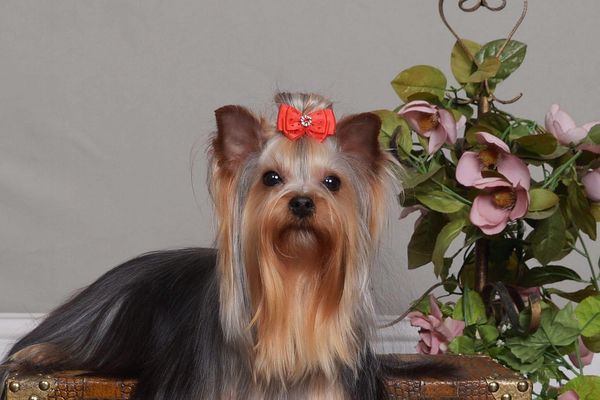
well groomed yorkie with a red bow in its fur lays on a briefcase
Get to know

Yorkshire Terriers

Written by
Caroline Coile, Ph.D.,
 author of 34 dog books.
Written by
Caroline Coile, Ph.D.,
 author of 34 dog books, including the top-selling Barron's Encyclopedia of Dog Breeds.
| | | | |

Despite their glamor dog image, they come from tough stock.

Did you know a Yorkie was a war hero? If you know Yorkies, that should come as no surprise.
Browse available puppies

Connect with reputable breeders to find the dog of your dreams
At a glance

Very Low Energy

Energy level

1/5

High Maintenance

Grooming

5/5

Extra Small

Size

Bold, energetic, curious

Temperament

11-15 years

Lifespan

Average Trainability

Training

3/5

Vocal

Barking

4/5

At a glance

  • Energy level

    Very Low Energy

  • Grooming

    High Maintenance

  • Size

    Extra Small

  • Temperament

    Bold, energetic, curious

  • Lifespan

    11-15 years

  • Training

    Average Trainability

  • Barking

    Vocal

Why people love the breed

People love their Yorkies for many reasons: they’re fun, feisty, convenient, small—but mostly, they’re cute!
Like dynamite in a pint, the Yorkie packs a lot of personality in its small body. Yorkies are brimming over with enthusiasm, ready to take on the world at one moment and take over your bed the next. They have no problem ruling your house from your lap—or your yard from your window. They’re brave and adventurous, and can travel with you everywhere. If you want a lapdog with a sense of fun and feistiness, the Yorkshire Terrier may be your answer. They are smart and learn quickly, but do have a penchant for mischief. Fortunately for them, their baby-doll face more often just makes their people smile even as they’re being naughty. Yorkies are everything a big dog is, but in a much more convenient package.

Appearance

The Yorkshire Terrier is one of the smallest breeds of dogs, with one of the most distinctive and glamorous coats.
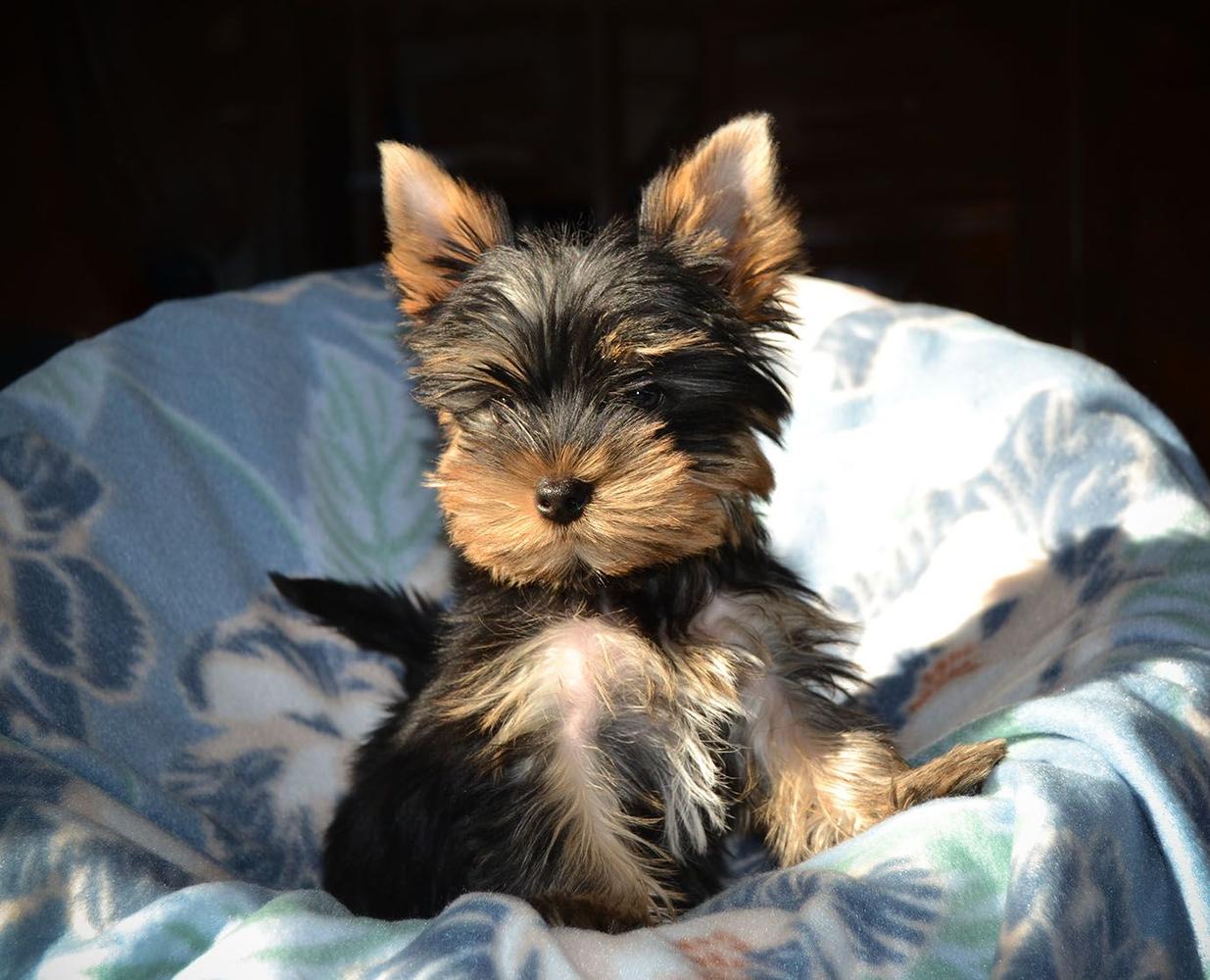
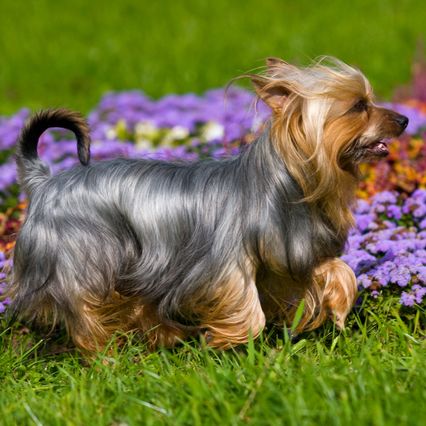
The diminutive Yorkie stands only about 7 to 8 inches at the shoulder, and should weigh less than 7 pounds. It has a compact body, slightly longer than tall. Their most distinctive feature is their long silky coat, colored a dark steel blue with clear tan trim. The hair is long all over, even on the face, and is usually held back in a top knot. Many people choose to clip their Yorkies for a cuter look. Yorkies are born black, with a bit of tan. As they mature, the black gradually fades to blue. If you want an adult Yorkie with a standard coat, choose one born black and tan; not gray and tan, any solid color, or spotted. And choose one with a thinner silkier coat over one covered with a thick, fluffy coat. The topline is level, with the tail carried slightly higher than the back. In countries where it is legal, the tail is traditionally docked to a medium-short length. The head is fairly small, topped with naturally erect small V-shaped ears. The eyes are medium sized. You may hear the term doll-face Yorkie, which refers to a Yorkie with larger eyes and a more babyish face.

Grooming

The Yorkie’s dramatic long tresses are a show stopper, but require meticulous, daily care. Most people elect to clip their Yorkies short instead.
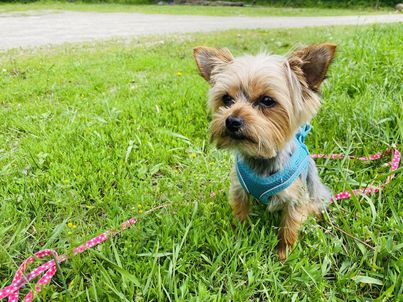
If you want your Yorkie’s coat to look like the ones you see in the show ring, be prepared to comb it every day and wash it often. You may need to restrict your dog from running where it can get mud, twigs, and leaves in the coat. Carpeting can even break the delicate hair. Even if you don’t want to show, the long side hair of a male dog can get coated in urine and you’d need to keep that pulled out of the way. Females may benefit from a “hygiene” clip to make sure no urine or excrement gets in the coat. You’d also maybe need to learn how to place the hair on the forehead into a topknot. More likely, you’ll find the ease of caring for a clipped Yorkie preferable. This way your dog can run and swim without worry. Most people have a professional groomer clip their Yorkie every 4 to 6 weeks. Groomers usually clip the body short but leave more on the head to give the dog a cuter look. You still need to comb the longer hair every few days, and may need to wash between grooming appointments. Yorkies shed very little.
Img:

North Idaho Yorkies

Breed temperament and characteristics

The Yorkie’s look of pure innocence belies a feisty terrier heritage. This is the prototypical “big dog in a little body.”
The “terrier” in “Yorkshire Terrier” should be your first clue. Despite their reputation as a glamorous lap dog, the Yorkie’s roots lie in the rough and tumble world of a wharf ratter. As much as they may look pristine and even baby-like nestled in their robes of silk and satin, give this dog a rat to catch, and they won’t hesitate to get down and dirty and dive in after it. Despite their small size, Yorkshire Terriers are feisty, and that goes for standing up to larger dogs as well. Unfortunately, they don’t have the bulk to back up their threats, so you have to protect them from starting things they can’t finish. That said, a century of breeding for companionship has seriously diminished the Yorkie’s quest for a brawl. They still appreciate creating mayhem around the house, but it tends to be aimed at less dangerous targets such as attacking stuffed toys, chasing squirrels, or barking at passersby.

Exercise

While fairly active, they’re also very small, so they can get a lot of steps into a small space.
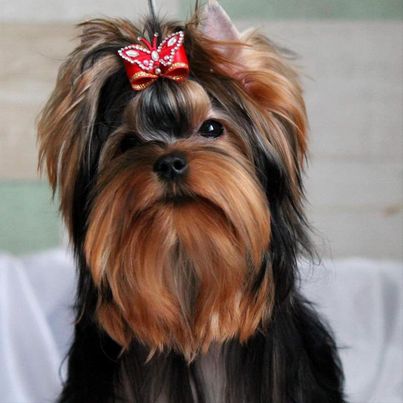
Yorkies take several steps for every one step you take. They can actually get plenty of exercise running around a large house, or even by playing games inside a small apartment. They can fetch, play keep-away, tug and get more exercise inside than many dogs can get in a yard. Of course, they also need the chance to get outside and walk around the yard or neighborhood and sniff the smells and see the sights. Always beware of the possibility of aggressive dogs when you walk your Yorkie, and have a plan to safeguard your dog if necessary. They’re not ideal for dog parks because of their propensity to look for trouble combined with their tiny size. Most dog sports are just on too large a scale for a tiny dog. They can do agility, but it may take forever for the teeter to come down. Dock diving would be like high-diving for them. You could knock them unconscious if you tried to play Frisbee. Weight pulling would be futile. And while they might enjoy attack dog training, they couldn’t reach high enough to grab the bite sleeve! Mental exercise is equally important. Brain games like little obstacle courses or trick training are great for tiring their minds.
Yorkshire terrier stands on a log in the outdoors
Img:

Yogo Yorkies of Montana

Training

Yorkies are quick to learn new things, and sometimes, just as quick to refuse to do them. They love to show off how smart they are, but it’s not always in your favor...
Yorkies are typical terriers in their ability to learn quickly but also decide on their own terms whether they want to mind you or not. They can be incredibly stubborn. That said, Yorkies have reached the highest levels of competition in obedience and agility. They work well for treats but don’t do well when forced. They are extremely good at learning tricks, even circus tricks, and can jump and balance with the best of circus dogs. They require a moderate amount of socialization as puppies. But it can be done! They have a tendency to bark a lot, but most can be trained to reduce their barking to a more tolerable level.

Diet and nutrition

Yorkies need a diet that packs a lot of nutrients in a small portion. They need to fuel their high activity level, grow their luxurious coat, and avoid becoming overweight.

Tiny dogs need more calories per pound of body weight compared to larger dogs. But Yorkies have tiny tummies, so you have to make sure the food has sufficient calories in it. When feeding tiny dogs the balance of the diet becomes harder to maintain. If you hand your big dog a few fallen potato chips it won’t make much impact on their diet, but if you do the same with a tiny dog those chips will become a huge part of their daily intake. They can unbalance the diet and/or add way more calories than you planned to feed. So you have to be extra careful when feeding tiny dogs. Their teeth may have difficulty crunching up some kibbles, but you don't want them to swallow pieces whole. The answer is to get a high quality commercial food especially formulated for small dogs, and even a Yorkie-specific diet. When choosing treats, beware that many commercial dog treats are choking size for small dogs, so you may want to squish or break some of them. Yorkie puppies, especially very young or very small ones, must be guarded against hypoglycemia. Hypoglycemia occurs when the level of sugar in the blood drops too low, usually because a young puppy has gone too long between meals. Aim to feed your young Yorkie puppy at least every 4 hours. Don’t have your baby puppy exercise before bed, when no food will be available overnight. Hypoglycemia is potentially fatal, and a real emergency. Signs start with the puppy being hard to rouse, and acting wobbly. You can help to increase blood sugar by rubbing corn syrup on the puppy’s gums and rushing to the emergency vet. As your puppy ages, you can gradually cut back to three meals a day. Fortunately, most Yorkies will outgrow this danger by the time they’re 6 months old, and then go to two meals a day.
2 yorkies sit on a bench together. one has drop ears and the other has prick ears
Img:

Sharon Gellerman's Yorkshire Terriers

Health issues

Yorkies are long-lived, but as with many popular breeds, they have a list of diseases that seem to occur more commonly in them compared to other breeds.

Lifespan: 11 to 15 years.

Patellar luxation

In which the kneecap slips out of the groove in which it should be nested, causes lameness and arthritic changes. It occurs mostly in small breed dogs.

Legg-Calves-Perthes

Yorkshire Terriers are at an increased risk for developing Legg-Calves-Perthes disease. This disease, which again is seen mostly in small dogs, occurs when the head of the femur temporarily loses its blood supply and starts to necrose, resulting in rear leg lameness.

Tracheal collapse

In which the trachea (windpipe) collapses causing coughing and difficulty breathing. It occurs more frequently in middle-aged to older dogs.

Portosystemic shunts, or liver shunts

These occur when blood bypasses the liver due to abnormal vessels and is reported at a higher rate compared to other breeds.

Dental disease

Like most small dogs, Yorkies are predisposed to dental disease. In fact, according to one study, tooth and gum issues are a common problem and the most frequent reason Yorkies of all ages are taken to the veterinarian. It starts with plaque build-up, which in turn leads to tartar, gingivitis, gum recession, and tooth loss.

Other health issues

Other health conditions that occur in Yorkies include protein-losing enteropathy, dry eye (keratoconjunctivitis sicca), and retained testicles (cryptorchidism).

Learn more about health issues that may impact Yorkshire Terriers

History

From blue-collar ratter to blue-blooded lapdog, the Yorkie could win an award for “most changed.”

Yorkie ancestors were ratters along the wharves of England called Broken-haired Terriers. Born in 1865, a dog called "Huddersfield Ben," is considered the father of the breed. Ben was a show dog with a fancy, silky coat. He sired many puppies and set the look for the breed. The smallest war hero on record was a 4-pound Yorkie named Smoky. She went on 12 combat missions and was awarded eight battle stars, including one for crawling 70 feet through an 8-inch culvert half-filled with dirt in order to carry a wire from one side to the other. Smoky is credited as being the first therapy dog from her work visiting wounded troops for 12 years during and after the war. Yorkies have held several records as the world's smallest dog. The smallest dog on record is a Yorkie named Sylvia, born in 1943, who weighed a hard-to-believe 4 ounces and stood 2.9 inches at the shoulder. She died before the age of two. The Yorkshire Terrier was recognized as a breed by the American Kennel Club (AKC) in 1885. Yorkies were the second most popular breed in America in 2006. Celebrity owners include Joan Rivers, Britney Spears, Justin Timberlake, Mariah Carey, Orlando Bloom, Jeff Gordon, Brett Favre, Venus Williams and Tiger Woods.
About the author

Canine specialist, Caroline Coile, Ph.D., is the author of 34 dog books, including the top-selling Barron's Encyclopedia of Dog Breeds. She’s written thousands of magazine and web articles about dogs. She specializes in canine science, health, breeds and competitions. Caroline has won 20 national dog-writing awards, and was a 2015 Inductee into the Dog Writers Association of America Hall of Fame.

Breed Scorecard

Characteristics and temperament
  • Affectionate with family

    3

  • Watchdog level

    5

  • Playfulness

    4

  • Adaptability

    3

  • Social needs

    4

  • Temperament

    Bold, energetic, curious, gentle

  • Intelligence

    4

  • Good with other dogs

    2

  • Good with cats or other pets

    3

  • Friendly with strangers

    3

  • Good as a service dog

    1

  • Good for apartments

    5

  • Barking level

    4

Appearance
  • Height

    7-8"

  • Size

    Extra Small

  • Colors

    Gold (non-standard), Liver (non-standard), Tan and white (non-standard), Chocolate and tan (non-standard), Chocolate, tan and white (non-standard), Parti (non-standard), Black and tan, Blue and gold, Black and gold, Tan (non-standard)

  • Coat texture

    Silky, fine drop coat with facial furnishings

  • Coat length

    Long

Training
  • Trainability

    3

Exercise
  • Exercise needs

    1

  • Exercise time

    Half an hour to one hour daily

  • Mental exercise needs

    3

  • Favorite activities

    Obedience, tricks

Grooming
  • Grooming needs

    5

  • Brushing frequency

    Daily

  • Needs professional grooming?

    Yes

  • Drooling level

    1

Health issues
  • Patellar luxation

  • Legg-Calves-Perthes

  • Tracheal collapse

  • Portosystemic shunts, or liver shunts

  • Dental disease

  • Other health issues

Other
  • Bred for

    Originally rodent hunting; now companionship

  • Country of origin

    5

  • Popularity level

    5

FAQs

  • On Good Dog, you can search for Yorkshire Terrier puppies or dogs in rescues and shelters. Adopting a Yorkshire Terrier from a shelter or rescue is generally less expensive than buying a puppy from a breeder with ethical practices. Across the United States, there are dedicated rescues that specialize in specific breeds and may even help transport a Yorkshire Terrier dog to you from another part of the country. Although it can be more cost-effective, adopting the exact breed you're looking for is typically more difficult than working with a responsible breeder. Learn more about adopting a dog from a shelter or rescue.

  • Prices for Yorkshire Terrier puppies for sale vary by breeder and individual puppy. On Good Dog today, Yorkshire Terrier puppies are typically around $2,500. Because all breeding programs are different, you may find dogs for sale outside that price range.

  • True to their terrier roots, many Yorkies can bark a lot. They will definitely sound the alarm at intruders or company, but seldom just sit there and bark for no reason.

  • If you choose to grow their coat long, they are extremely high maintenance. But most people instead choose to have them clipped down every six weeks, in which case they are medium to low maintenance.

  • Yorkies are great family dogs, which is why they’ve been ranked as high as #2 on the popularity list. They are fun with young children, sensitive with elderly people, and responsive with adults. They are gentle. They’re not super obedient but close enough.
Caroline Coile, Ph.D.

Caroline Coile specializes in canine science, health, breeds and competitions. Caroline has won 20 national dog-writing awards, and was a 2015 Inductee into the Dog Writers Association of America Hall of Fame. She’s written thousands of magazine and web articles about dogs in addition to 34 dog books.

Content on Good Dog is generated, fact-checked, and evaluated by qualified writers and veterinarians.

Caroline Coile, Ph.D.

Caroline Coile specializes in canine science, health, breeds and competitions. Caroline has won 20 national dog-writing awards, and was a 2015 Inductee into the Dog Writers Association of America Hall of Fame. She’s written thousands of magazine and web articles about dogs in addition to 34 dog books.

Content on Good Dog is generated, fact-checked, and evaluated by qualified writers and veterinarians.