Get to know

Goldendoodles

Written by
Caroline Coile, Ph.D.,
 author of 34 dog books.
Written by
Caroline Coile, Ph.D.,
 author of 34 dog books, including the top-selling Barron's Encyclopedia of Dog Breeds.
| | | | |

Goldendoodles have taken the world by storm, combining two of the best-natured breeds—the Golden Retriever and Poodle–in one package.

Browse available puppies

Connect with reputable breeders to find the dog of your dreams

At a glance

Moderate Energy

Energy level

3/5

High Maintenance

Grooming

5/5

Under 25 to over 51 pounds (Petite to Standard)

Size

Friendly, biddable, playful

Temperament

12-15 years

Lifespan

Highly Trainable

Training

5/5

Medium Vocality

Barking

3/5

At a glance

  • Energy level

    Moderate Energy

  • Grooming

    High Maintenance

  • Size

    Under 25 to over 51 pounds (Petite to Standard)

  • Temperament

    Friendly, biddable, playful

  • Lifespan

    12-15 years

  • Training

    Highly Trainable

  • Barking

    Medium Vocality

Why people love the breed

Goldendoodles are the good ol’ boy version of the Poodle, like a luxury pick-up truck.
They combine the biddability and intelligence of both breeds, adding the Poodle’s curly coat and the Golden’s robust build. Goldendoodles are perpetually happy and good-natured, great with everyone, and equally at home in the field or den. They shed far less than Golden Retrievers but the trade-off is they need a lot of professional grooming. They come in different sizes depending on the size of the Poodle parent. Finally, not only do owners love Godendoodles, but people on the street do too. Everybody seems to want to stop and say hi to the dog with the wildly wagging tail.

Appearance

The Goldendoodle is a moderately built dog in almost every way.
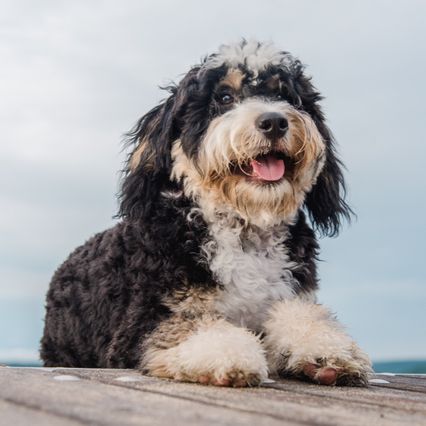
Their bone and body are of moderate heaviness, they are slightly longer than tall, and even the largest and smallest are not as small or as tall as some Poodles. The topline is fairly level, with a slight dip behind the withers and slight rise over the loin. They have a noticeable but not extreme tuck-up, with a short croup. The tail is fairly long. The head is fairly broad, with the muzzle slightly shorter than the back skull. The skull and muzzle are on parallel planes. The muzzle is slightly square and straight, somewhat more Golden Retriever-like than Poodle-like. All colors are acceptable except those, such as double merles, associated with health problems. The Golden Retriever side of the family comes in only shades of gold, from dark orange to light cream. The genes responsible for this are recessively inherited, and they cover up genes for other colors. Poodles come in a variety of colors, including black, chocolate, apricot, white, and silver. Some, but not all, of these colors may be expressed in a first generation cross. For example, chocolate Godlendoodles should not arise in a first generation (F1) cross because Golden Retrievers don’t have the recessive chocolate gene in their gene pool. The same is true for spotted dogs. Second generation (F2) and backcross Goldendoodles can exhibit the entire spectrum of colors in either breed. Brindle, merle, or tan-pointed Goldendoodles are more likely indicative of a cross to yet another breed, as neither pattern should appear in either purebred Golden Retrievers or Poodles. There are three approved coat types: curly, wavy, and straight, all with furnishings including facial beard and whiskers. First generation crosses should only result in curly coats. Later generations can be any type.

Grooming

Goldendoodles need a lot of grooming, even more than either parent breed.
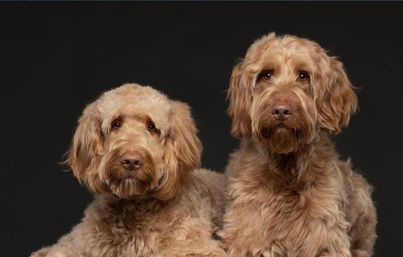
The F1 Goldendoodle combines the curly, continuously growing coat of the Poodle with the thick undercoat of the Golden. Professional groomers report that the Goldendoodle is one of the most challenging breeds they groom, especially because owners too often neglect their daily grooming. Goldendoodles should be groomed daily using a slicker brush, pin brush, and long toothed metal comb. Have the dog lie on its side and brush the coat in layers so you can make sure to reach all the way down to the skin. Professional groomers report that a major problem is that owners too often brush only the surface, often believing they are brushing to the skin, when in fact the undercoat has matted into a solid layer along the skin. In these cases the dog must be shaved to the skin and the hair allowed to start over. It is unfair to the dog or groomer to expect such a coat to be salvaged. Bathing can be a long process, and it may be better to just let the professional groomer do it. Your Goldendoodle will need to be professionally groomed every four to six weeks. You may wish to call around in your area to find out what the range in prices is. Although the groomer will clip the nails, you should also clip them every two weeks. Check the ears for signs of infection, such as inflammation or waxy accumulation. Brush the teeth every day if possible.
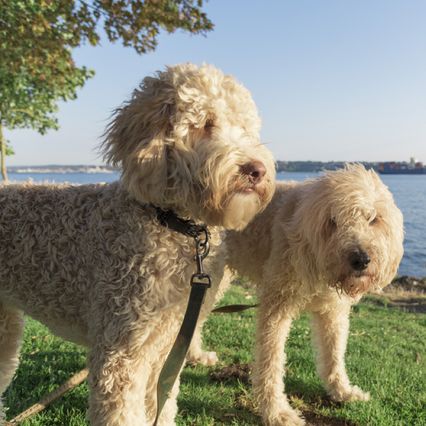
Img:

Cynology Doodles

Breed temperament and characteristics

Golden Retrievers and Poodles are among the most biddable and amiable of dogs. It’s no surprise the Goldendoodle is as well.
Everyone knows the Golden Retriever was bred to retrieve from water, but not everyone realizes the Poodle was as well. Retrievers have in common biddability, which is the tendency to learn easily and obey directions. If a water retriever ignored commands, they could end up just swimming around in circles looking for a downed bird. Or worse, swim out to sea. Those that paid attention to the hunter’s directions were the ones that were bred to continue the breed. This is why retrievers in general are some of the best dogs for obedience. Goldendoodles weren’t bred to retrieve, but both their parent breeds were. This trainability made retrievers popular as guide dogs. Poodles were also used, but not as commonly because they were harder to maintain and often not large enough. The first “doodles” were an attempt to create a hypoallergenic guide dog by crossing Labrador Retrievers with Poodles. It was only natural that Golden crosses were just as successful. Goldendoodles are happy dogs that love to please. They make great playmates for children, adventurous partners for adults, and steadfast companions for the elderly. The larger ones can be overly boisterous and overpowering, so choose your size accordingly. Goldendoodles get along well with people of all ages, including strangers, as well as other dogs and pets.

Exercise

Like both parent breeds, Goldendoodles are energetic but not hyperactive.
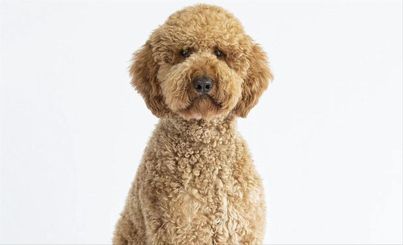
Goldendoodles are always up for adventure, and if you don’t give it to them, they will make their own inside your house. Fortunately, their adventurous needs can be met with an hour of backyard play, a jog around the neighborhood, or a visit to the dog park. The larger the Goldendoodle, the more ground you’ll have to cover, but the time commitment is still about the same. Favorite activities include swimming, fetching, and combining swimming and fetching. They also enjoy hiking or just leisurely walks around the block. Most Goldendoodles do well at dog parks, so that’s another possibility. As for organized activities, they especially enjoy dock diving and agility.
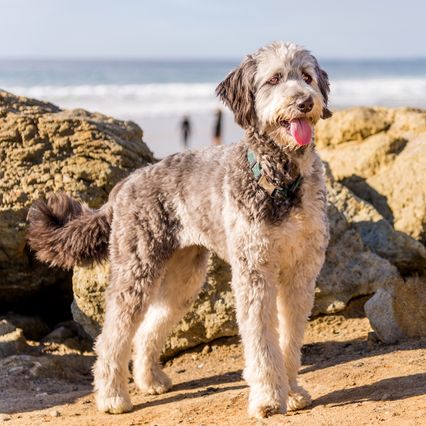
Img:

Porch Swing Pups

Training

Goldendoodles learn quickly and enjoy doing as you wish.
Their retriever background makes them extremely biddable, and they enjoy working with people to accomplish a common goal. They don’t enjoy being forced into compliance, and are strong enough to resist, but they will work eagerly in exchange for treats and toys. They especially enjoy having a ball or toy thrown for them as a reward for a job well done. Often their biggest challenges in obedience training is learning to calm down, and to take things slowly, or stay when told to do so. A wagging tail is a hallmark of their attitude when training. They excel at formal obedience, agility, rally, and trick dog competitions.

Diet and nutrition

The Goldendoodle’s diet depends in part on how large the dog is.
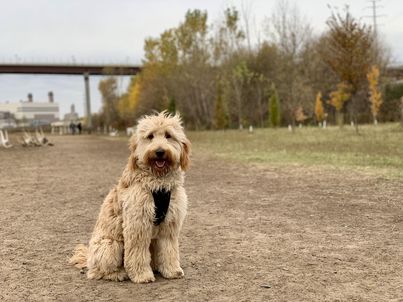
Standard Goldendoodles (or any expected to mature at over 50 pounds) should be fed as any large breed. This means that puppies should be fed a food formulated for large breeds, which slows the rate of growth while still attaining the same ultimate size as puppies fed a standard diet. Slowing the growth rate has been shown to protect the dog from hip dysplasia, which does occur in Goldendoodles. Smaller Goldendoodles can be fed regular puppy foods. Feed them three times a day up until four months of age, then twice until a year. Then they can eat once or twice daily. The smaller the puppy in size, the more often it should eat during the day. Goldendoodles have a tendency to overeat and to become overweight. This is especially true if they are neutered or spayed. You need to feel through the coat to make sure you can easily feel the ribs without pushing through fat. The same is true of the backbone and hipbones. Like all dogs, some Godlendoodles can develop conditions that profit from prescription diets. Your veterinarian can advise you on these.
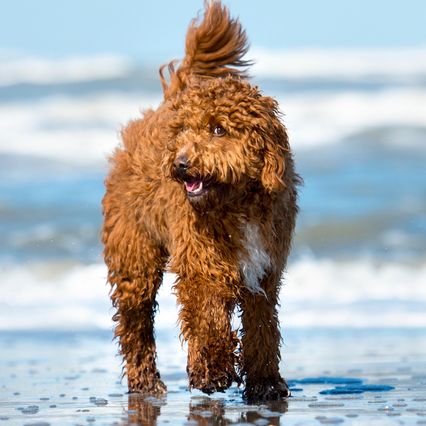
Img:

Timber Rock Doodles

Health issues

Although doodles and other mixes are touted as a healthier alternative to purebreds, they can also have hereditary problems—especially if the same problem exists in both parent breeds. In addition, they are just as prone to conditions that plague dogs of certain sizes no matter the breed.

Lifespan: 12 to 15 years.

Unfortunately, Goldendoodles are not included in most statistical reports, so the incidence of health problems is largely unknown. This means it’s also hard to know when a breeder has proper health clearances for their breeding stock.

Hip dysplasia

Both parental breeds can have hip dysplasia, and the condition is more common in large, heavy-bodied dogs in general—like the Standard Goldendoodle.

Cataracts

Cataracts in young dogs are reported in both breeds, so could likely also occur in Goldendoodles.

Epilepsy

Epilepsy is reported in both parent breeds, so again, could occur in Goldendoodles.

Most commonly reported conditions

The most commonly reported conditions are hip dysplasia and elbow dysplasia (in large dogs), cataracts, cancer, subvalvular aortic stenosis, ear infections, and patellar luxation (in small dogs). However, these are based on general impressions without statistics or research to back them up.

Learn more about health issues that may impact Goldendoodles

History

The Goldendooles history starts with the history of Golden retrievers and Poodles, both European waterfowl retrievers that became repurposed as great companion dogs in the 120th century.
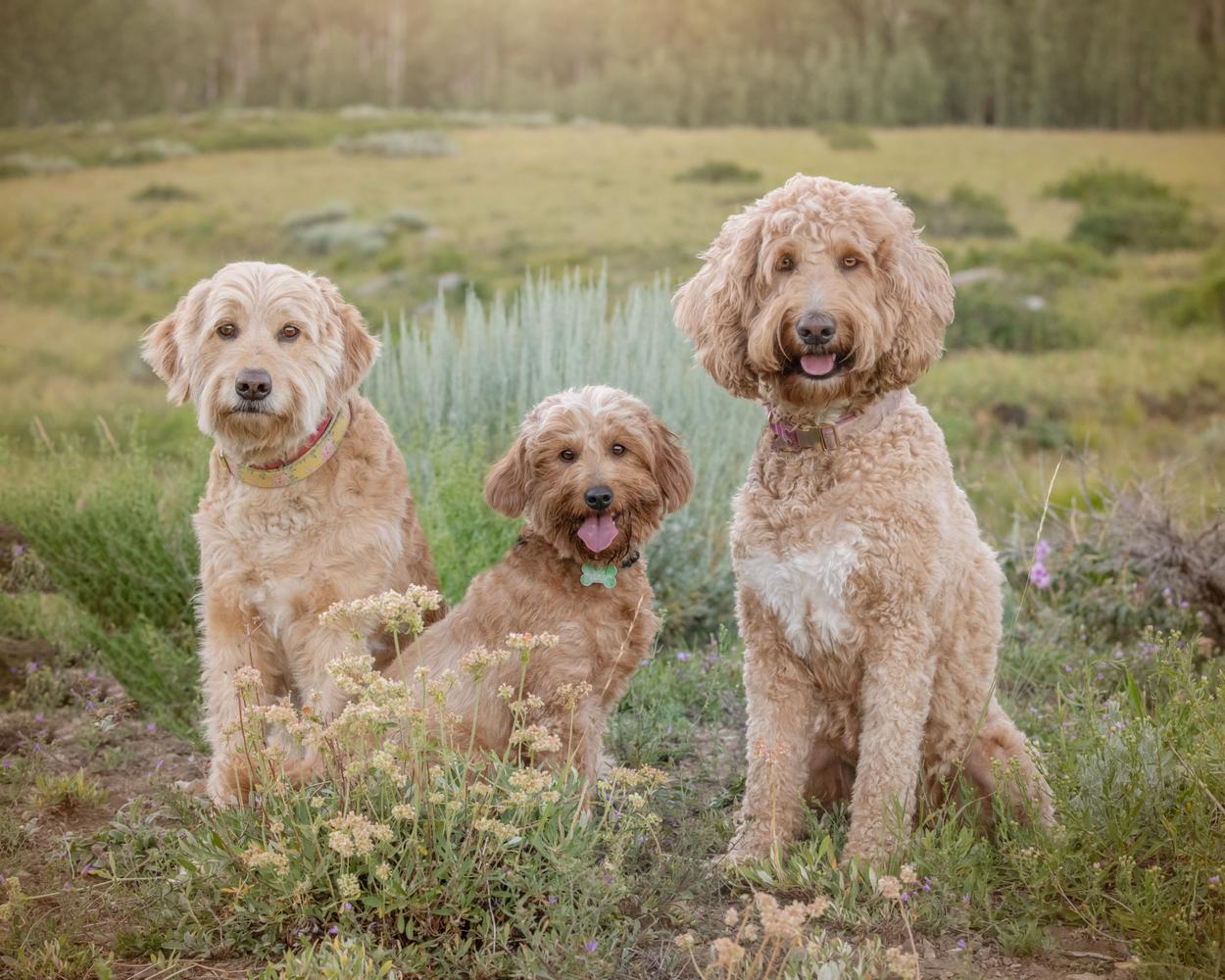
Cockapoos and Pekapoos were already popular mixes by the time the Labradoodle was created in an attempt to create a hypoallergenic guide dog. In the 1990s crosses between Golden Retrievers and Poodles were made as an alternative to the Labradoodle. The cross gained in popularity and is now one of the most popular hybrid dogs. They have been used as service dogs, therapy dogs, as well as contraband detective dogs. Their major role is as a companion. Celebrity owners include Usher, Tiger Woods, Perez Hilton, Ashley Tisdale, Kenny Chesney, and John Travolta.
About the author

Canine specialist, Caroline Coile, Ph.D., is the author of 34 dog books, including the top-selling Barron's Encyclopedia of Dog Breeds. She’s written thousands of magazine and web articles about dogs. She specializes in canine science, health, breeds and competitions. Caroline has won 20 national dog-writing awards, and was a 2015 Inductee into the Dog Writers Association of America Hall of Fame.

Breed Scorecard

Characteristics and temperament
  • Affectionate with family

    5

  • Watchdog level

    3

  • Playfulness

    4

  • Adaptability

    5

  • Social needs

    5

  • Temperament

    Friendly, biddable, playful

  • Intelligence

    4

  • Good with other dogs

    4

  • Good with cats or other pets

    5

  • Friendly with strangers

    5

  • Good as a service dog

    5

  • Good for apartments

    1

  • Barking level

    3

Appearance
  • Height

    14-21"

  • Size

    Under 25 to over 51 pounds (Petite to Standard)

  • Colors

    Sable, Silver, Cream, Apricot, Red , Chocolate, Black, Phantom, Merle, Parti

  • Coat texture

    Curly

  • Coat length

    Long

Training
  • Trainability

    5

Exercise
  • Exercise needs

    3

  • Exercise time

    One to two hours daily

  • Mental exercise needs

    5

  • Favorite activities

    Swimming, retrieving, training

Grooming
  • Grooming needs

    5

  • Brushing frequency

    Daily

  • Needs professional grooming?

    Yes

  • Drooling level

    1

Health issues
  • Hip dysplasia

  • Cataracts

  • Epilepsy

  • Most commonly reported conditions

Other
  • Bred for

    Companionship

  • Country of origin

    United States

  • Popularity level

    5

FAQs

  • On Good Dog, you can search for Goldendoodle puppies or dogs in rescues and shelters. Adopting a Goldendoodle from a shelter or rescue is generally less expensive than buying a puppy from a breeder with ethical practices. Across the United States, there are dedicated rescues that specialize in specific breeds and may even help transport a Goldendoodle dog to you from another part of the country. Although it can be more cost-effective, adopting the exact breed you're looking for is typically more difficult than working with a responsible breeder. Learn more about adopting a dog from a shelter or rescue.

  • The coat care is their main negative.

  • Yes. They are generally well behaved, as long as they get a lot of exercise. Without enough exercise they can be destructive.

  • Yes. They need a lot of maintenance coat care as well as professional grooming every month or two. They also need a fair amount of exercise and attention.
Caroline Coile, Ph.D.

Caroline Coile specializes in canine science, health, breeds and competitions. Caroline has won 20 national dog-writing awards, and was a 2015 Inductee into the Dog Writers Association of America Hall of Fame. She’s written thousands of magazine and web articles about dogs in addition to 34 dog books.

Content on Good Dog is generated, fact-checked, and evaluated by qualified writers and veterinarians.

Caroline Coile, Ph.D.

Caroline Coile specializes in canine science, health, breeds and competitions. Caroline has won 20 national dog-writing awards, and was a 2015 Inductee into the Dog Writers Association of America Hall of Fame. She’s written thousands of magazine and web articles about dogs in addition to 34 dog books.

Content on Good Dog is generated, fact-checked, and evaluated by qualified writers and veterinarians.