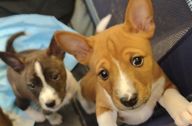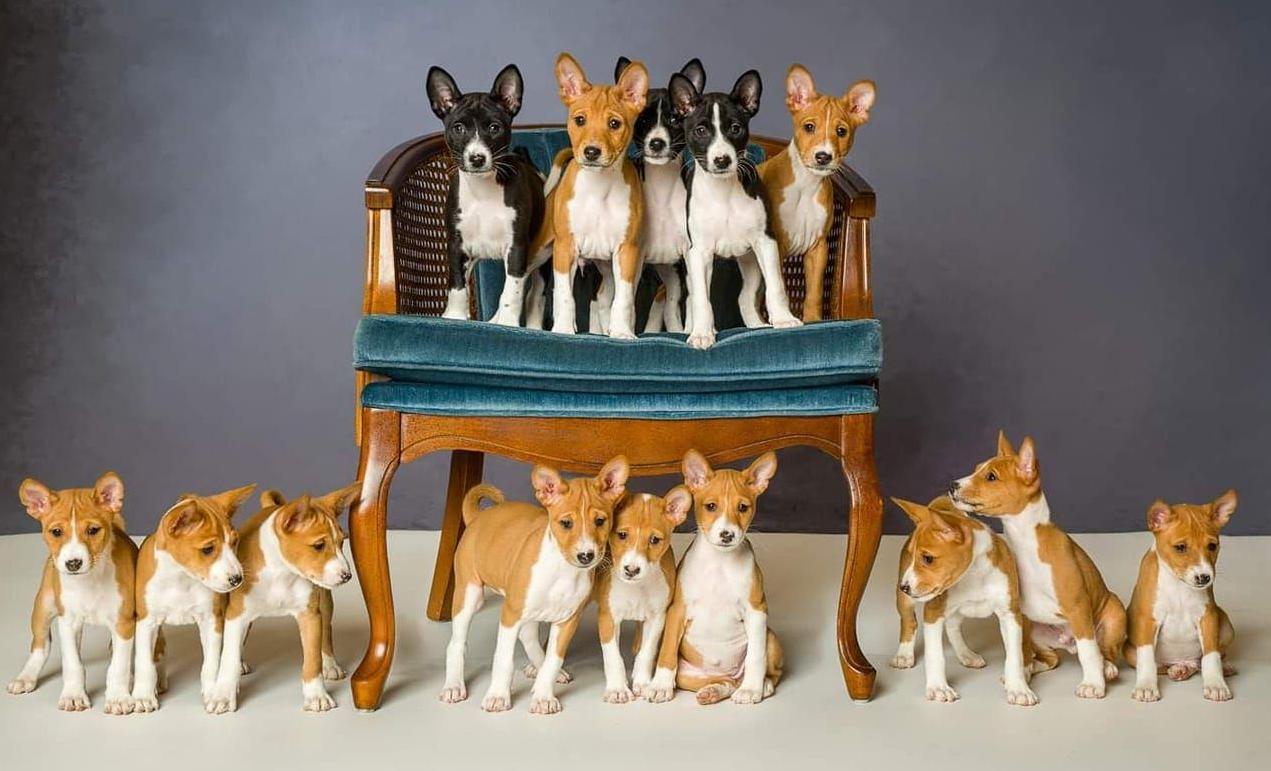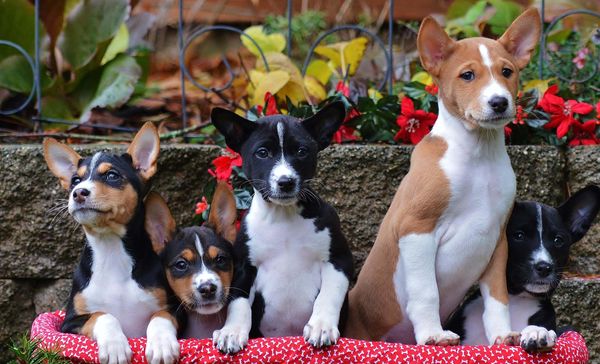
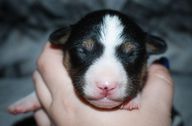
Five Basenji puppies
Get to know

Basenjis

Written by
Caroline Coile, Ph.D.,
 author of 34 dog books.
Written by
Caroline Coile, Ph.D.,
 author of 34 dog books, including the top-selling Barron's Encyclopedia of Dog Breeds.
| | | | |

Ready for a walk on the wild side?

The Basenji may be the dog for you if you appreciate a free spirit who takes the Born to be Wild phrase as a personal mantra. They are great-looking dogs with fascinating backgrounds. But they are also one of the most challenging breeds you can find!
Browse available puppies

Connect with reputable breeders to find the dog of your dreams
At a glance

Moderate Energy

Energy level

3/5

Minimal Maintenance

Grooming

1/5

Small to medium

Size

Independent, strong-willed, inquisitive

Temperament

12-14 years

Lifespan

Moderate Trainability

Training

2/5

Quiet

Barking

1/5

At a glance

  • Energy level

    Moderate Energy

  • Grooming

    Minimal Maintenance

  • Size

    Small to medium

  • Temperament

    Independent, strong-willed, inquisitive

  • Lifespan

    12-14 years

  • Training

    Moderate Trainability

  • Barking

    Quiet

Why people love the breed

Basenjis are hard to love for some people, and impossible not to for others.
Basenji lovers are among the most dedicated in the world. They love their dog’s imaginative misadventures and can laugh about their sometimes—well, often—willful disobedience. They admire their independence and don’t want what they consider an obsequious follower as a partner in crime. They also love the Basenji’s unique history, clean habits, wash and wear fur, and handy size. Basenjis are an eye-catching breed with clean-cut lines and quick cat-like grace. Although known as the barkless breed, they produce a wide variety of yodels, chortles and other odd sounds.

Appearance

Basenjis are clean-cut, dapper dogs with cat-like grace and agility. They always turn heads because of their unusual appearance and proud carriage.
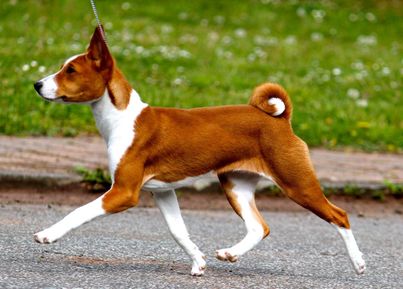
They are a handy sized dog, small enough to fit in any car or bed but large enough to avoid being caught underfoot. Their body is square-proportioned, short-backed with long legs, and with light rather than heavy bone. Its upstanding posture and erect ears give the Basenji a perpetually “on alert” appearance. The distinctive tail is short and curled over the back and to the side, sitting snugly alongside the dog’s croup. The muzzle is about as long as the backskull, and small tight wrinkles form on the forehead when the ears are erect. There's no docking or cropping. The fur is short and tight-fitting. They come in chestnut red, pure black, tricolor, or brindle; all with white feet, chest and tail tip. They may also have white legs, blaze and collar. The Basenji’s movement is long-striding, with the head held high. They cover tremendous ground for their size. At a gallop, they are quite fast, and able to employ the double-suspension.

Grooming

The Basenji’s coat is wash and wear. They require no special trimming or other grooming.
If you hate to groom, the Basenji is the dog for you. They need only an occasional bath, and their short coat can’t tangle or mat. They do shed, so you’ll need to brush with a rubber bristle brush during those times, but even that is not the shedding you see in most other breeds. Many Basenjis lick and groom themselves like cats. They are extremely clean and fastidious, and have very little doggy odor. There’s no trimming or special needs grooming. Trim the nails as needed, brush the teeth daily, and check the ears for debris weekly.
Basenji trotting on lead
Img:

Haus Annandael Basenjis

Breed temperament and characteristics

Basenjis are considered a primitive breed, and like most such dogs, have a mind of their own. If you like free-thinkers–with a penchant for mischief—you’ve met your match with a Basenji!
Basenjis are a unique breed basically plucked from life as a village dog, or pariah dog, within the last century or so. Even in the African villages they belonged not to one family in particular but to the whole village. They hunted with minimal human direction. All of these factors shaped a dog that evolved to be self-sufficient and independent. In a famous set of dog behavior studies, Basenjis and several other breeds were given a variety of tasks and tests. Of the tasks that required human direction, the Basenjis came in last. Of the tasks that required problem-solving and independent thinking, Basenjis came in first. Don't be surprised when they use this problem solving ability to figure out how to open your cupboards and climb out of your yard! Basenjis like their people but aren’t overly demonstrative. They are very playful. They are apt to chase cats but can bond with household cats. They can be somewhat feisty and don’t mind an occasional scrabble, but these tend to be quick skirmishes rather than true dog fights. They do not believe in coming when called unless they happen to feel like it. They are very clean in the house. They are also fairly quiet, but just because they don’t bark don’t expect silence. They make a variety of weird yodels and chortles. They only come in season once a year.

Exercise

Basenjis are fairly energetic dogs that like to be in the midst of family activities. Without enough exercise they can be particularly mischievous.
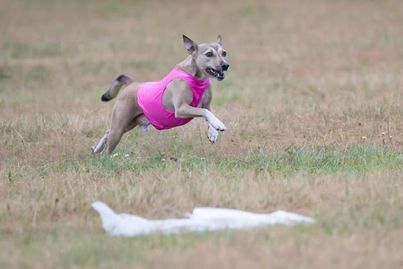
Plan on giving your Basenji one to two hours of good exercise daily. This can be walking or jogging, or playing games in the yard. They’re not good about coming back once off leash, so in most cases a fenced exercise area is a requirement. Some may do well at dog parks while others can be quarrelsome. A favorite activity is lure coursing or any of the related activities such as Fast CAT. They also like to chase a lure on the end of a lunge line, which can be very handy for exercising them quickly or in a small area. They can also enjoy barn hunt, nosework and Frisbee catching. Most Basenjis consider water to be the same thing as battery acid, and they are not avid swimmers. And most are too independent to excel at dog sports such as obedience or agility.
Basenji lure coursing in a bright pink coursing jacket
Img:

Dibu Basenjis

Training

Basenjis are crazy-smart but they are not inclined to waste their intellect following your orders. You’ll have much better luck convincing them that what you want them to do is really their idea.
You have to be a bit of a psychologist to train a Basenji. They’re more like a human teenager who thinks he knows better than you. Using force will only have your Basenji digging in his heels, so you have to use treats and let him think he’s training you. Basenjis are not known as great obedience or agility contenders because they tend to blow off their handler and do whatever they please. That said, if you can convince one that obeying is fun and rewarding, they can perform with amazing precision. More than most breeds, early socialization is essential for young Basenjis. They should be socialized to people, other dogs and even other pets and situations. Early training will also help them learn that training is fun.

Diet and nutrition

Most Basenjis do well on a high quality commercial or home-prepared diet (only following consultation with a veterinary nutritionist). A few may have special nutritional requirements.
Adult Basenjis thrive on almost any quality balanced diet. Puppies should eat a diet formulated for puppies, but have no special needs compared to other breeds. Although Basenjis don’t suffer from obesity, any dog—especially neutered or spayed ones—can become overweight so watch your Basenji’s body condition and adjust the food accordingly. A few Basenjis are affected by Fanconi syndrome, which affects the kidneys. These dogs may need a special diet. Commercial diets formulated for dogs with kidney disease may meet these criteria.
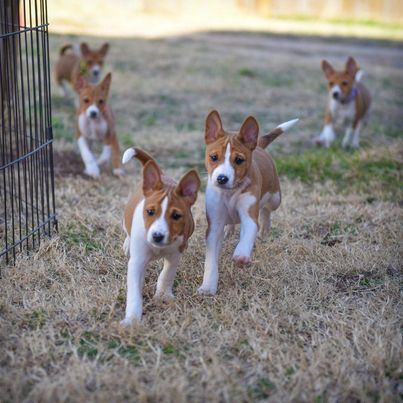
Basenji puppies running in the grass
Img:

Steadfast Farm (SFF)

Health issues

Basenjis are in general a very healthy breed. They do have a couple health problems that breeders have worked hard to eliminate.

Lifespan: 12 to 14 years.

Fanconi syndrome

This is a hereditary condition affecting the kidneys. It results in several problems and is managed with supplements, diet, and other supportive treatment. A DNA test is available for the hereditary form.

Persistent pupillary membrane

In which strands of iris are stretched across the pupil opening to the extent it sometimes affects vision, is found at an increased incidence in the breed.

Learn more about health issues that may impact Basenjis

History

One of the most ancient and primitive breeds of dogs, the Basenji is not closely related to any other AKC breed.
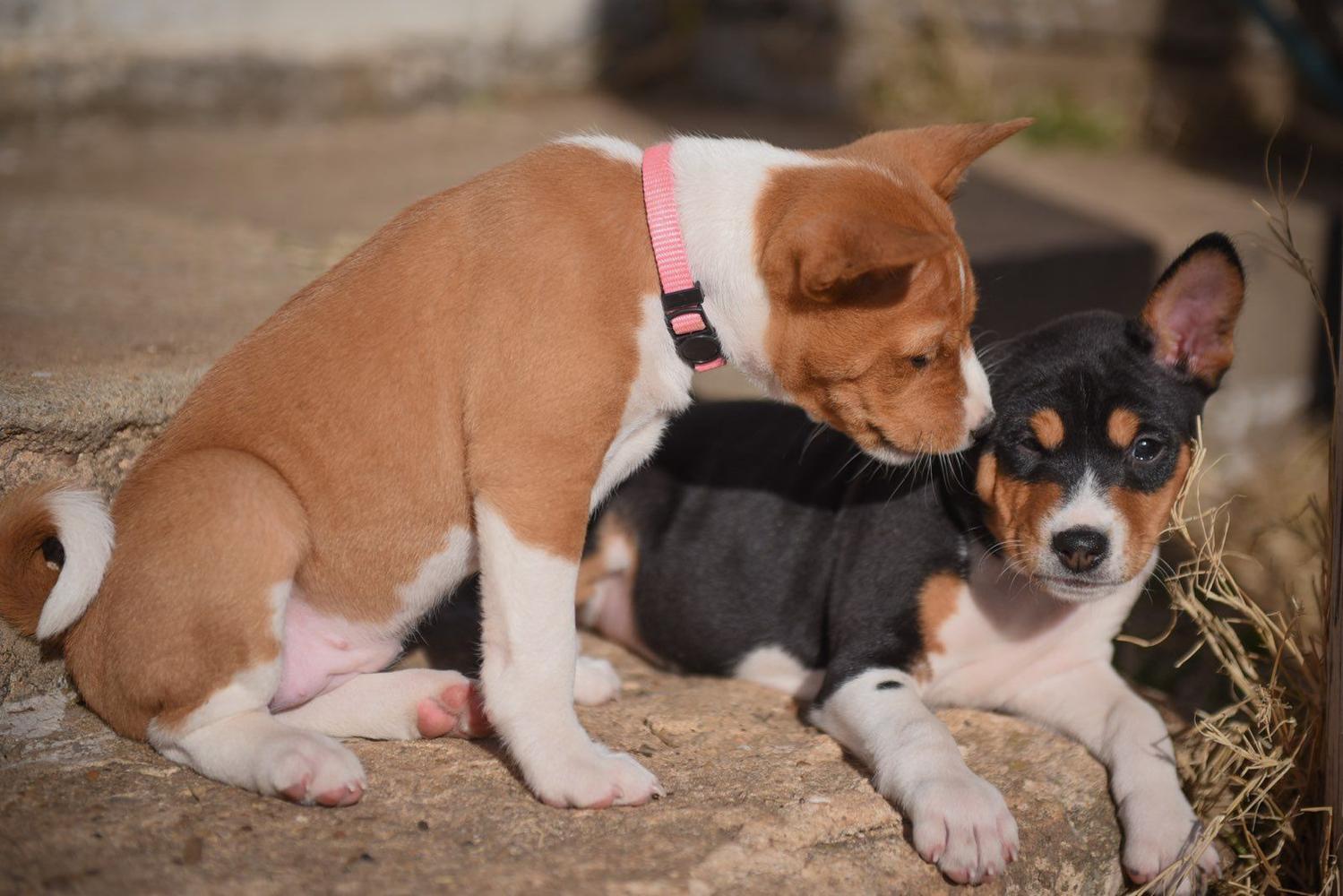
DNA studies show the Basenji is one of the oldest breeds of dogs in the world. It is considered a primitive breed, meaning it has changed very little from how it was thousands of years ago. The breed was developed in Central Africa, although early specimens are thought to have been brought to Egypt as gifts to the Pharaoh. They lived in Africa as village dogs, roaming the village and being cared for by various people. They were gathered up to accompany the men on hunts, where they often wore large bells to scare game into nets. Basenji means “bush thing.” When they first came to England in the 1920s they were called Congo Terriers. The American Kennel Club (AKC) recognized them as a breed in 1943, placing them in the AKC Hound group. Throughout much of the world they are instead in the "Spitz and Primitive Dogs" group. The 1956 movie "Goodbye, My Lady" starred a Basenji as Lady and popularized the breed in the United States of America. Starting in the 1980s, the AKC made a special exception to allow certain approved Basenjis from the African Congo to be brought to America and enter the AKC Basenji gene pool. This was an effort to improve the health of the breed. It also introduced the brindle coat pattern. Celebrity owners include Kelsey Grammer and Courtney Thorne-Smith, as well as royalty from Egypt, Rumania and Thailand.
About the author

Canine specialist, Caroline Coile, Ph.D., is the author of 34 dog books, including the top-selling Barron's Encyclopedia of Dog Breeds. She’s written thousands of magazine and web articles about dogs. She specializes in canine science, health, breeds and competitions. Caroline has won 20 national dog-writing awards, and was a 2015 Inductee into the Dog Writers Association of America Hall of Fame.

Breed Scorecard

Characteristics and temperament
  • Affectionate with family

    3

  • Watchdog level

    5

  • Playfulness

    3

  • Adaptability

    2

  • Social needs

    2

  • Temperament

    Independent, strong-willed, inquisitive

  • Intelligence

    4

  • Good with other dogs

    2

  • Good with cats or other pets

    1

  • Friendly with strangers

    3

  • Good as a service dog

    1

  • Good for apartments

    2

  • Barking level

    1

Appearance
  • Height

    16-17"

  • Size

    Small to medium

  • Colors

    Black brindle and white (non-standard), Cream and white (non-standard), Sable and white (non-standard), Blue cream and white (non-standard), Mahogany tan and white (non-standard), Black and white, Black tan and white, Brindle and white, Red and white, Tri-color

  • Coat texture

    Soft

  • Coat length

    Short, straight, close-fitting

Training
  • Trainability

    2

Exercise
  • Exercise needs

    3

  • Exercise time

    About 1 to 2 hours daily

  • Mental exercise needs

    3

  • Favorite activities

    Lure coursing, nose work, barn hunt

Grooming
  • Grooming needs

    1

  • Brushing frequency

    Monthly

  • Needs professional grooming?

    No

  • Drooling level

    1

Health issues
  • Fanconi syndrome

  • Persistent pupillary membrane

Other
  • Bred for

    Pack hunters, driving game into nets

  • Country of origin

    Central Africa

  • Popularity level

    3

FAQs

  • On Good Dog, you can search for Basenji puppies or dogs in rescues and shelters. Adopting a Basenji from a shelter or rescue is generally less expensive than buying a puppy from a breeder with ethical practices. Across the United States, there are dedicated rescues that specialize in specific breeds and may even help transport a Basenji dog to you from another part of the country. Although it can be more cost-effective, adopting the exact breed you're looking for is typically more difficult than working with a responsible breeder. Learn more about adopting a dog from a shelter or rescue.

  • The typical price for Basenji puppies for sale may vary based on the breeder and individual puppy. On average, the price of Basenji puppies from a breeder is $2,000.

  • Basenjis can be left alone. They may climb all over your house like cats while alone, however.

  • Basenjis are generally friendly but prefer to make the first overtures to strangers.

  • Some Basenjis do actually bark but most don’t. But they still make an assortment of odd yodeling-like noises.
Caroline Coile, Ph.D.

Caroline Coile specializes in canine science, health, breeds and competitions. Caroline has won 20 national dog-writing awards, and was a 2015 Inductee into the Dog Writers Association of America Hall of Fame. She’s written thousands of magazine and web articles about dogs in addition to 34 dog books.

Content on Good Dog is generated, fact-checked, and evaluated by qualified writers and veterinarians.

Caroline Coile, Ph.D.

Caroline Coile specializes in canine science, health, breeds and competitions. Caroline has won 20 national dog-writing awards, and was a 2015 Inductee into the Dog Writers Association of America Hall of Fame. She’s written thousands of magazine and web articles about dogs in addition to 34 dog books.

Content on Good Dog is generated, fact-checked, and evaluated by qualified writers and veterinarians.