Good Dog’s Coat Color in the Labrador Retriever & Dilute Policy
We developed a policy on coat colors and the dilute gene in the Labrador Retriever that aligns with the Labrador Retriever Club's position.
Good Dog is on a mission to educate the public, support dog breeders, and promote canine health so we can give our dogs the world they deserve.
Good Dog is on a mission to educate the public, support dog breeders, and promote canine health so we can give our dogs the world they deserve.
Good Dog is on a mission to educate the public, support dog breeders, and promote canine health so we can give our dogs the world they deserve.
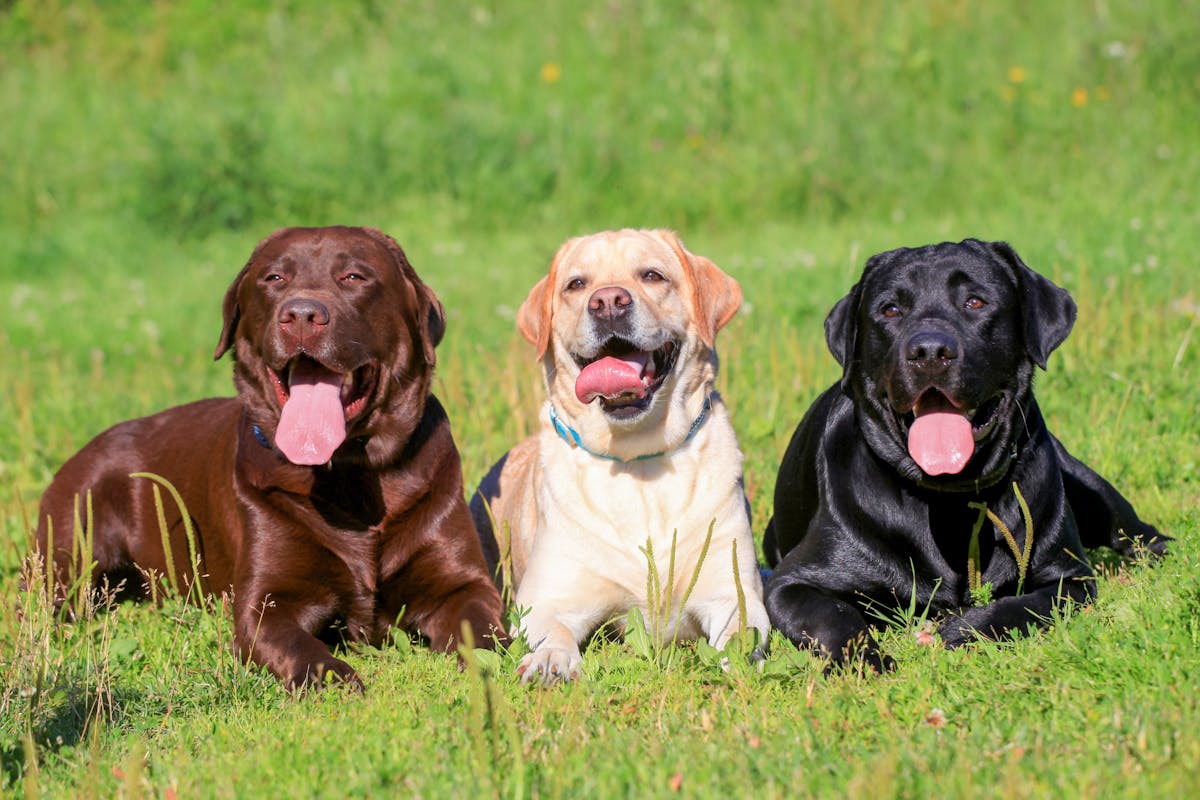
The Labrador Retriever Club (also known as the LRC or the parent club) recognizes only the following three coat colors as purebred Labrador Retrievers: black, yellow (from fox-red to light cream), and chocolate (light to dark shades). Dogs with the silver, charcoal or champagne coat color (known as the dilute coat colors) are not recognized by the LRC, despite the fact that they can be registered with the American Kennel Club (AKC) under the foundation or base color (yellow, black or chocolate).
Good Dog’s position and policy align with the LRC as they define the breed standard and, accordingly, Good Dog only recognizes black, yellow, and chocolate colors as Labrador Retrievers.
What is a Dilute Retriever?
Melanocytes are a certain type of cell in the skin and hair that produce black (eumelanin) and red (pheomelanin) pigment (or coloring). Pigment dilution is the result of either decreased production or decreased transfer of pigment. Several areas (or locus) on the dog chromosome have been identified as influencing pigment and coat color, including the tyrosinase (Chinchilla) locus, the brown locus and the D (dilute) locus. Mutations within or near the melanophilin (MLPH) gene in the D locus have been shown to cause dilute coat color in several breeds of dogs including the Weimaraner, Doberman Pinscher, Beagle, and Greyhound. These genetic mutations in the D locus are also responsible for modification of color in the Labrador, resulting in dilution of yellow to champagne, black to charcoal, and chocolate to silver.
Some associated health conditions have been identified in dilute Labradors. One is a form of alopecia. Color Dilution Alopecia (CDA) has been identified in breeds such as the Doberman Pinscher and is caused by a variation of the dilute gene (dl ). CDA is a recessive trait that causes patchy, thinning or loss of hair. These dogs are at increased risk of bacterial infections of the skin, in some cases with dry, itchy, scaly skin. There is no cure for CDA so breeding of affected dogs is not advised. A form of alopecia has been identified in silver Labradors although it is unknown if it is CDA or another form of alopecia.
Can Dilute Colored Labradors be Registered?
Dilute colored Labradors can be registered with the American Kennel Club (AKC) under the foundation or base color (yellow, black or chocolate). This is because the AKC registry is based on parentage, they do not assess ‘purity’.
What is Good Dog’s Policy on Labrador Retrievers and Dilute Retrievers and Why?
Good Dog recognizes breeding programs producing black, yellow, and chocolate coat colors as Good Breeders of Labrador Retrievers. Programs that produce dilute coat colors, including silver, champagne, and charcoal, will be recognized as breeders of Dilute Retrievers.
Feedback
Our community is founded on a commitment to listen, learn, and as with so many issues in the dog world, sometimes people have very different opinions and it can take time for us to determine what makes sense for our community. If you disagree with anything about our approach or have any questions or feedback for us, please feel free to contact us anytime at feedback@gooddog.com.
Thank you so much for your time.
Reference & Further Reading
Fadok, V and Vitale, C. 2012. Alopecia in silver Labrador retrievers. In Advances in Veterinary Dermatology. Proceedings of the Seventh World Congress of Veterinary Dermatology, Vancouver, CA. Ed. Sheila M.F. Torres, coed Linda Frank, Ann Hargis, pg 248. Blackwell Publishing West Sussex, UK. Kaelin, K and Barsh, S. 2012. Molecular Genetics of Coat Colour, Texture and Length in the Dog in The Genetics of the Dog 2nd ed. (Ed) Ostrander and Ruvinsky, pg 65-66. CABI Cambridge, MA
Philipp U, Hamann H, Mecklenburg L, Nishino S, Mignot E, Gunzel-Apel AR, Schmutz SM, and Leeb T. 2005. Polymorphisms within the canine MLPH gene are associated with dilute coat color in dogs. BMC Genetics, 6:34. doi:10.1186/1471-2156-6-34.
Sebbag L, Riggs A, and Carnevale J. 2019. Oculo-skeletal dysplasia in five Labrador Retrievers. Veterinary Ophthalmology. 00:1-8.
Smith, Frances O. The issue of the Silver “Labrador”. Labrador Retriever Club, Inc. Genetics Committee. https://thelabradorclub.com/wp-content/uploads/2018/05/The-Issue-of-the-Silver-Labrador-Fran-Smith.pdf
Welle M, Philipp U, Rufenacht S, Roosje P, Scharfenstein M, Schutz E, Brenig B, Linek M, Mecklenburg L, Grest P, Drogemuller M, Haase B, Leeb T, and Drogemuller C. 2009. MLPH Genotype-Melanin Phenotype Correlation in Dilute Dogs. J of Heredity. 100:S75-S79. doi:10.1093/jhered/esp010.
Join our Good Breeder community
Are you a responsible breeder? We'd love to recognize you. Connect directly with informed buyers, get access to free benefits, and more.