Good Dog’s Dog Size Policy
Good Dog is on a mission to educate the public, support dog breeders, and promote canine health so we can give our dogs the world they deserve.
Good Dog is on a mission to educate the public, support dog breeders, and promote canine health so we can give our dogs the world they deserve.
Good Dog is on a mission to educate the public, support dog breeders, and promote canine health so we can give our dogs the world they deserve.
Currently, Good Dog does not recognize breeding programs that intentionally produce dogs of extreme sizes outside of the applicable breed standard.
How does Good Dog define extreme sizes in dogs?
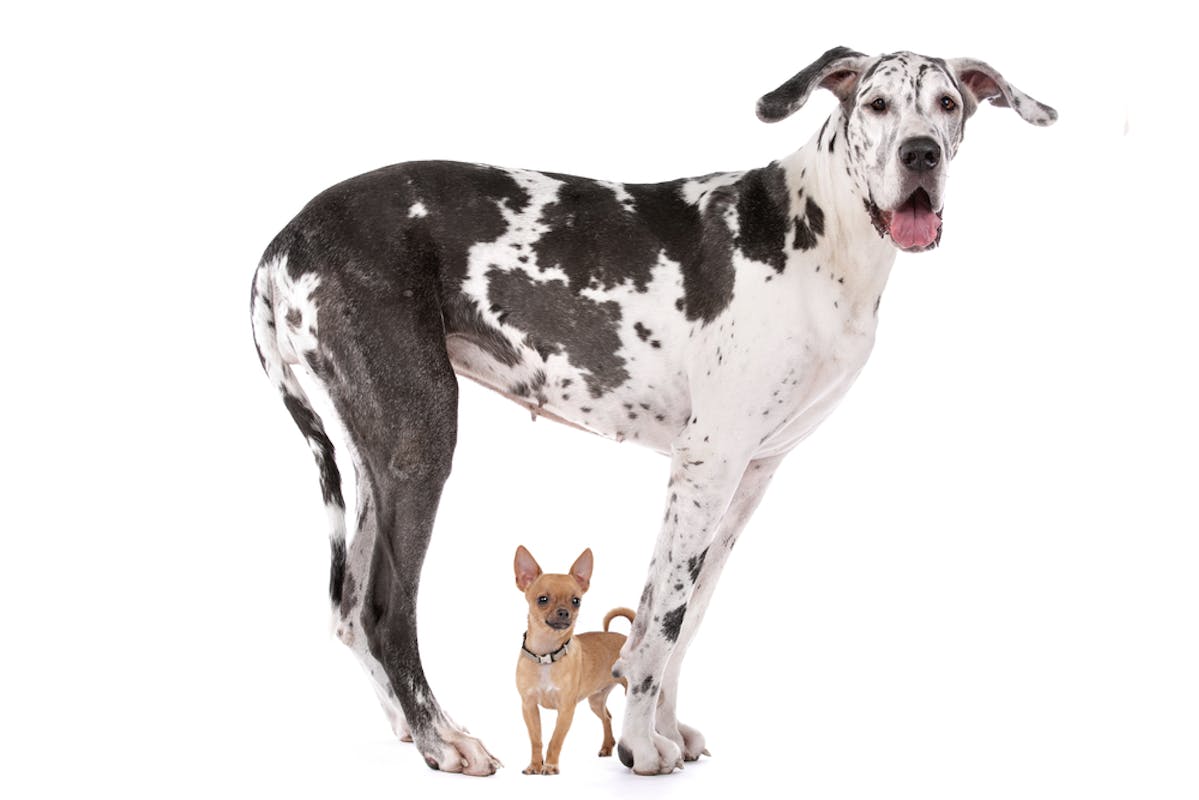
Good Dog defines extreme dog sizes as those outside of the breed standard or deviating from breed norms. Some examples of extreme sizes may include:
- Micro
- Teacups
- Imperial
- XL/XXL
- King
Why does Good Dog have a size policy?
At Good Dog, the health and well being of breeding dogs is at the core of our mission to work towards population-wide improvements. That’s why our community standards aim to evaluate programs based on breeding practices, environment and health of the program’s breeding dogs.
Research has demonstrated increased health risks in both toy dogs (e.g., leg fractures, persistent fontanelles, hypoglycemia, hydrocephalus), and large/giant breed dogs (shorter lifespan, degenerative joint disease).
Clinical evidence suggests that the same patterns are found when dogs are bred for more extreme sizes. These risks are exacerbated when dogs are primarily bred for size rather than other factors such as health, structure, and temperament. Until there is further research, we have made the decision to be cautious in our approach to recognizing breeding programs that intentionally produce dogs of extreme sizes outside of the applicable breed standard.
What are breed standards?
Most breed standards specify the acceptable size range for dogs of a given breed. For example, Shih Tzus and Pomeranians have strict minimum size requirements. Other breed clubs (e.g., the Chihuahua Club of America) have recommendations, preferences, or statements about the use of terms such as “teacup,” “miniature,” “micro,” and the like.
Good Dog’s community standards, including this size policy, are subject to change as new research becomes available and we will update our policies as needed.
Feedback
Our community is founded on a commitment to continuously listen, learn, and grow, together. If you have any questions or feedback for us, please feel free to contact us anytime at help@gooddog.com.
References and further reading
Bell, A. L., Rozanski, E. A., & Babyak, J. (2022). A multicenter retrospective comparison of trauma in toy breeds versus giant breeds: A Veterinary Committee on Trauma registry study. Journal of Veterinary Emergency and Critical Care, 32(1), 26-33. https://onlinelibrary.wiley.com/doi/full/10.1111/vec.13136
Brianza, S. Z., Delise, M., Ferraris, M. M., D’Amelio, P., & Botti, P. (2006). Cross-sectional geometrical properties of distal radius and ulna in large, medium and toy breed dogs. Journal Of Biomechanics, 39(2), 302-311. https://www.sciencedirect.com/science/article/pii/S0021929004005767
Farrell, L., Schoenebeck, J., Wiener, P., Clements, D., and Summers, K. The challenges of pedigree dog health: approaches to combating inherited disease. Canine Genet Epidemiol. 2015. 2:3. doi: 10.1186/s40575-015-0014-9
Farstad, W. (2018). Ethics in animal breeding. Reproduction in Domestic Animals, 53, 4-13.
Harvey, N. How old is my dog? Identification of rational age groupings in pet dogs based on normative age-linked processes. Front Vet Sci. 2021. 8:643085. doi: 10.3389/fvets.2021.643085
Kirkwood, J. K. (1985). The influence of size on the biology of the dog. Journal of Small Animal Practice, 26(2), 97-110.
Kiviranta, A. M., Rusbridge, C., Lappalainen, A. K., Junnila, J. J., & Jokinen, T. S. (2021). Persistent fontanelles in Chihuahuas. Part II: Association with craniocervical junction abnormalities, syringomyelia, and ventricular volume. Journal of Veterinary Internal Medicine, 35(4), 1848-1856.
O’Neill, D. G., Church, D. B., McGreevy, P. D., Thomson, P. C., and Brodbelt, D. C. Longevity and mortality of owned dogs in England. The Vet J, 2013. 198(3), 638–643. doi:10.1016/j.tvjl.2013.09.020
Šebková, N. F., Chaloupková, H., & Zavadilová, L. (2020). Average Life Expectancy, the Most Common Cause of Death and Illness of Giant Dog Breeds. Scientia Agriculturae Bohemica, 9 - 14.
Yordy, J., Kraus, C., Hayward, J. J., White, M. E., Shannon, L. M., Creevy, K. E., ... & Boyko, A. R. (2020). Body size, inbreeding, and lifespan in domestic dogs. Conservation Genetics, 21(1), 137-148.
Royal Canin: The small dog trend: impact of size on pet health