Good Dog’s policy on hip and elbow screening
Read about Good Dog's policy on hip and elbow screening, and how that affects Good Breeders.
Good Dog is on a mission to educate the public, support dog breeders, and promote canine health so we can give our dogs the world they deserve.
Good Dog is on a mission to educate the public, support dog breeders, and promote canine health so we can give our dogs the world they deserve.
Good Dog is on a mission to educate the public, support dog breeders, and promote canine health so we can give our dogs the world they deserve.

As part of Good Dog’s continuing efforts to improve canine health and well-being, and to provide full transparency to potential puppy buyers, we are formalizing our position and policy on OFA preliminary hip and elbow screening. Our policies are guided by the best available scientific data. As new data are published, our community standards, including policies with respect to preliminary screenings, will be subject to revisions.
Good Dog has developed a three-level system to distinguish both breeding programs and individual breeding dogs based on health testing practices. Programs that self-report to meet our entry-level health testing requirements for the breed are identified as “Good.” Programs that self-report additional testing that exceeds these minimum requirements are identified as “Great” or “Excellent” as outlined in our Guide to Health Testing Levels. In addition, we award health testing recognition at the individual breeding dog level (i.e., sires and dams) for breeding dogs who meet the criteria above by providing verifiable health testing information. More information can be found in our Guide to Health Testing Levels.
What is Good Dog’s Policy on Preliminary OFA Hip And Elbow Evaluations?
Preliminary OFA hip screening will only be accepted for the Good level IF:
- The results are scored as excellent or good AND
- The dog is over 12 months of age when the radiographs were taken AND
- Results have been registered with OFA
Hips that are graded fair or below by OFA must have a definitive (final) OFA, PennHIP report, or a report generated from screening and grading by another recognized organization (e.g. BVA, SV, FCI) following the validated process and minimum age for that organization in order to meet Good Dog’s requirement for hip dysplasia screening.
Preliminary elbow screening will be accepted for the Good level IF:
- An OFA preliminary report indicating the dog’s elbows are scored as normal AND
- The dog is over 12 months of age when the radiographs are taken AND
- Results have been registered with OFA.
To advance to the Great or Excellent level, breeding programs and/or breeding dogs must have definitive (final) OFA hip and elbow reports (radiographs taken when the dog is over 2 years of age) or definitive reports from another recognized screening and grading program (e.g. PennHIP, BVA, SV, FCI) following the validated process and minimum age for that organization as appropriate for the breed.
To provide transparency to potential puppy buyers, hip and elbow screening reports will be denoted on the breeder’s profile as either Preliminary or Definitive.
How do preliminary and definitive (final) OFA Screening for Canine Hip Dysplasia differ?
Definitive OFA Hip Evaluation
Dogs must be at least 2 years of age to undergo definitive OFA screening as this is the minimum age that the assessment is most reliable and predictive (Adams, 2000; Corley et al., 1997).
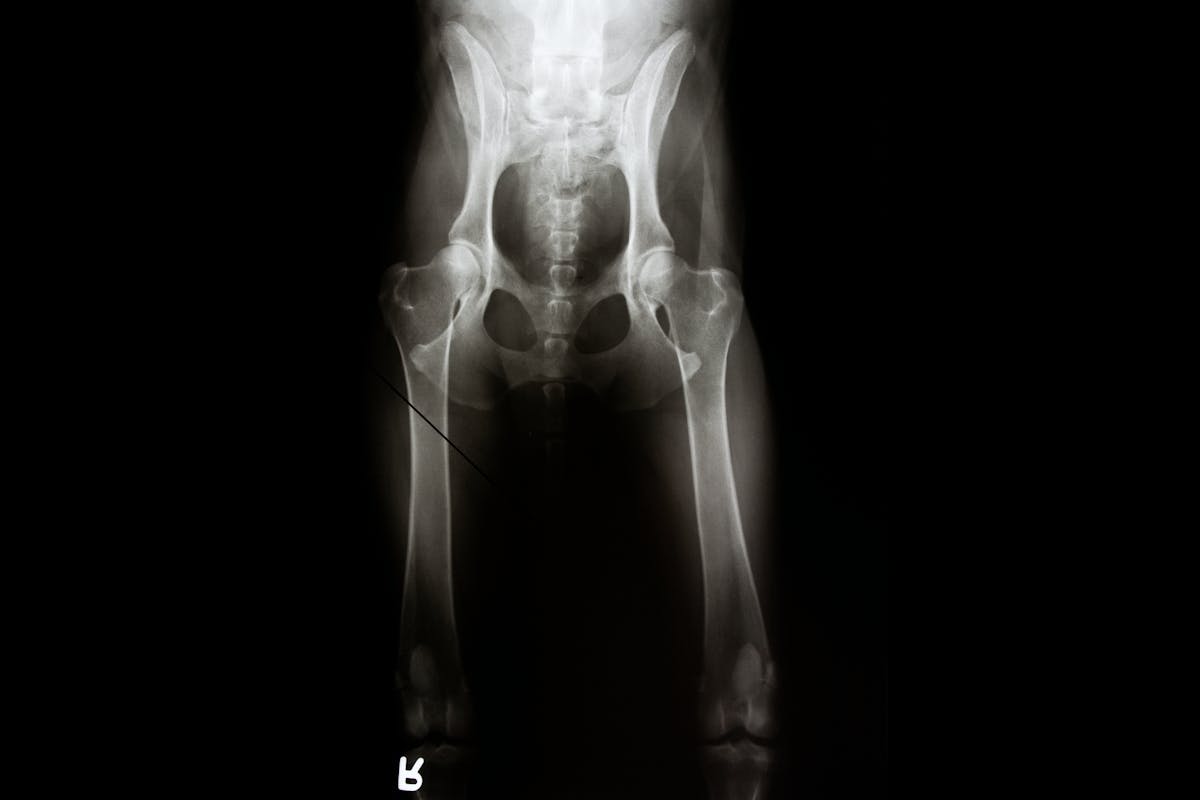
Radiographs (x-rays) submitted to the Orthopedic Foundation for Animals (OFA) for definitive review for hip dysplasia are sent to three randomly selected, board-certified veterinary radiologists. Each radiologist independently reviews the radiographs, assessing nine different anatomic areas of the joint for abnormalities consistent with hip dysplasia. Factors including the breed, age, and sex of the dog are also considered in the assessment. A grade is assigned based on the phenotype (observable characteristics) of the hip conformation: a normal phenotype includes the grades excellent, good and fair; dysplastic phenotype includes mild, moderate or severe. Hips that can’t be determined to be either normal or dysplastic are termed “borderline.”
Preliminary OFA Hip Evaluation
Preliminary OFA screenings are available for dogs less than 2 years of age. Preliminary radiographs are reviewed using the same assessment method but are graded by a single in-house radiologist, a less rigorous assessment procedure. Preliminary screening is a useful tool for breeders to make decisions about whether to retain a dog for future breeding or to place a dog in a pet home earlier, thereby reducing the amount of time and resources expended on a dog that will not be bred.
While preliminary screenings were not designed to make final breeding decisions, a study assessing the agreement between preliminary assessments and definitive assessments found that prelims graded as excellent or good were reliable predictors of normal hips at 2 years of age and the reliability increased with increasing age of assessment (Corley, et al., 1997).
How does PennHIP screen for Canine Hip Dysplasia?
PennHIP uses a unique assessment protocol in which laxity of the hip joint is measured via three different radiographic views or positions. Research has shown this to be a reliable and accurate method to identify individuals at risk of developing hip dysplasia and PennHIP has been found to be a reliable screening method in dogs as young as 16 weeks of age (Smith et al., 1993). Dogs are given a distraction index (DI), which is a measurement of the laxity in the hip joint. The individual dog’s DI can be compared to the breed average DI to aid breeders when making breeding decisions. Ideally, dogs with a lower DI than the breed average should be included in the breeding population to decrease hip dysplasia in the breed. Veterinarians need to complete specialized training to do the screening. Help with finding a veterinarian trained to do PennHIP in your area can be found here.
How do preliminary and definitive (final) OFA Screening for Canine Elbow Dysplasia differ?
As with hip dysplasia, dogs must be at least 2 years of age for OFA to certify an elbow as having a normal phenotype.
Definitive OFA Elbow Evaluations
Elbow radiographs submitted to the OFA for definitive review are sent to three randomly selected board-certified veterinary radiologists for independent evaluation. Each radiologist independently reviews the radiographs, assessing the joint for the three different characteristics that constitute a diagnosis of elbow dysplasia. Elbows are graded either as normal or dysplastic, with three different levels of severity for dysplastic elbows – Grades 1 to 3 corresponding to mild, moderate, or severe radiographic changes.
Preliminary OFA Elbow Evaluations
Preliminary OFA elbow screenings are available for dogs less than 2 years of age. Preliminary radiographs are reviewed and graded by a single in-house radiologist; this is a less rigorous assessment procedure. There have been no studies to date assessing the reliability or predictive value of preliminary elbow screening.
We want to assure you that Good Dog is here to support you. Please do not hesitate to contact us at screening@gooddog.com if we can help in any way.
As you’re planning your testing, we invite you to take advantage of the health testing discounts we offer our Good Breeders, including $10 off any screening test including x-rays, thyroid panel, cardiac, eye or patella exams, OFA registration or Holter monitor rental. You can apply this discount up to 10 times per calendar year.
This policy is effective June 7th, 2022 for all new Good Breeders. This Policy on Preliminary Hip and Elbow Screening is effective as of the date noted below. If we update this policy, we will revise the date on the Policy and will notify you via email before any changes are effective.
Last modified: June 7th, 2022
References & further reading
Adams. Radiographic Diagnosis of Hip Dysplasia in the Young Dog. Veterinary Clinics of NA: Small Animal Practice. Vol 30, No 2, March 2000.
Baers et al. Heritability of unilateral elbow dysplasia in the dog : A retrospective study of sire and dam influence. Front. In Vet Sci. 22 Nov, 2019.
Corley et al. Reliability of Early Radiographic Evaluation for Canine Hip Dysplasia Obtained from the Standard Ventrodorsal Radiographic Projection. JAVMA. Vol 211, No. 9, November 1997.
Genevois et al. Hip dysplasia: epidemiologic considerations based on the analysis of 9738 radiographs. Revue Med Vet. 151, 2000.
Ginja et al. Diagnosis, genetic control and preventative management of canine hip dysplasia: A review. The Veterinary Journal. 184, 2010.
Oberbauer et al., Long-term genetic selection reduced prevalence of hip and elbow dysplasia in 60 dog breeds. PloS One. Feb, 2017
Reagan. Canine Hip Dysplasia Screening Within the United States. Vet Clin Small Anim, 2017.
Smith et al. Coxofemoral joint laxity from distraction radiography and its contemporaneous and prospective correlation with laxity, subjective score, and evidence of degenerative joint disease from conventional hip-extended radiography in dogs. Am J Vet Res. Vol 54, No 7, 1993.
Verhoeven et al. Worldwide Screening for Canine Hip Dysplasia: Where Are We Now? Veterinary Surgery. Vol 40, 2012.
Zhang et al. Estimation of heritabilities, genetic correlations, and breeding values of four traits that collectively define hip dysplasia in dogs. AJVR. Vol 70, No. 4, April 2009.
Canine Hip Dysplasia: Early Diagnosis in Bibliovet The Encyclopedia of Veterinary Medicine. Last updated October 26, 2012.