Primary lens luxation (PLL)
If the lens of the eye moves out of place, it can cause problems for your dog
Good Dog is on a mission to educate the public, support dog breeders, and promote canine health so we can give our dogs the world they deserve.
Good Dog is on a mission to educate the public, support dog breeders, and promote canine health so we can give our dogs the world they deserve.
Good Dog is on a mission to educate the public, support dog breeders, and promote canine health so we can give our dogs the world they deserve.
by Dr. Mikel Delgado, PhD and Dr. Nate Ritter, DVM
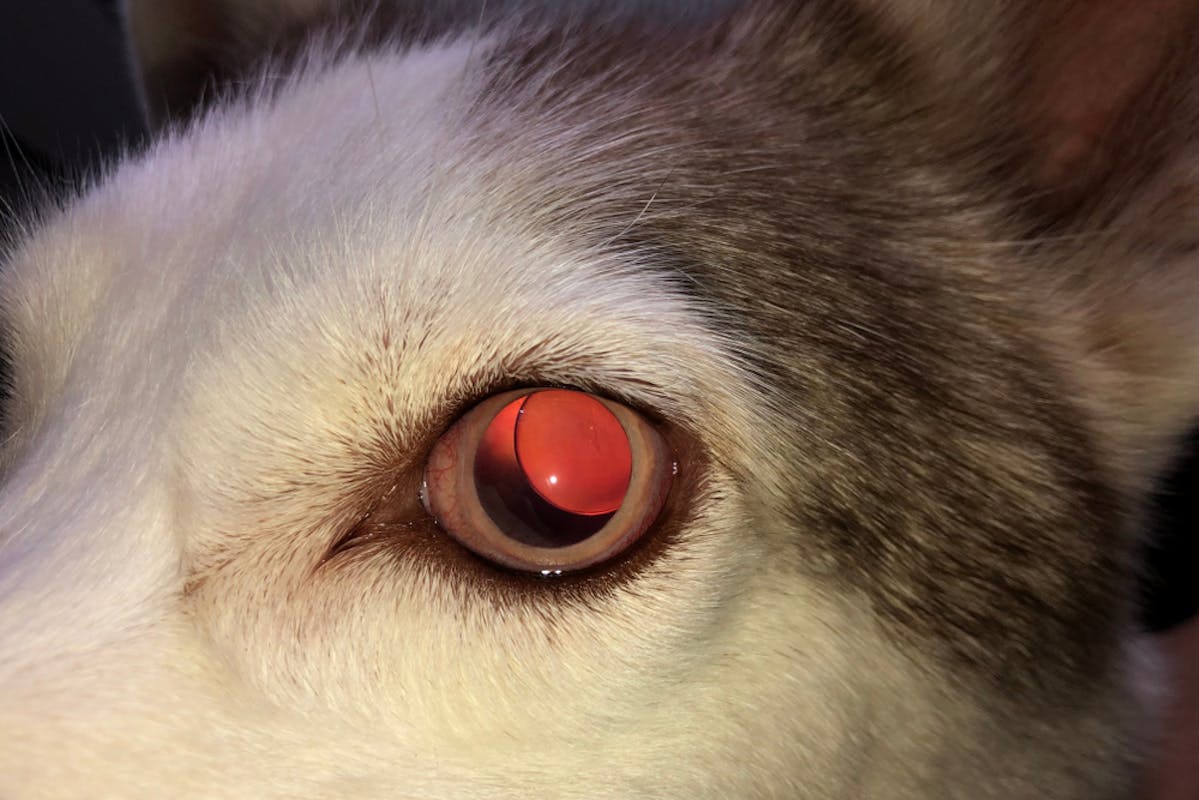
The lens of the eye is a flexible, elastic structure that helps focus light on the retina at the back of the eye, allowing us to see sharp images. Sometimes, the zonules (fibers that support the lens and hold it in place) can weaken. When these fibers are weak or break, the lens can wobble, and possibly fall forward or backward within the eye. The symptoms and outcome are highly dependent on what happens with the lens.
Primary Lens Luxation (PLL) is most commonly observed in dogs when they are between 3 and 8 years of age. PLL is a genetic disorder, but some luxation cases can occur due to trauma or a secondary medical issue.
A posterior lens luxation is when the lens falls backward; this rarely causes pain or discomfort. The immediate damage in this case tends to be less acute, but may be harmful over time.
Anterior lens luxation is unfortunately much more problematic. The lens falls forward, blocking fluids from draining and increasing pressure in the eye. This increased pressure can lead to glaucoma and retinal detachment, and can result in blindness. Unlike posterior lens luxation, anterior lens luxation can be very painful.
In some cases, the lens becomes loose, and “wobbles” before the full luxation occurs (this is called sub-luxation).
Signs of lens luxation in dogs
You may not notice if your dog is experiencing posterior lens luxation. Your veterinarian may notice it during a routine physical exam. Owners typically see signs of an anterior lens luxation, including:
- Squinting or tearing of the eye
- Redness of the eye
- Changes in the size and shape of the pupil of the eye
- Cloudiness of the eye
- Vision loss
An anterior lens luxation is an emergency situation, and your veterinarian may recommend referral to a veterinary ophthalmologist.
Treatment of Canine PLL
For sub-luxation, your veterinarian may recommend surgery to prevent the complications that follow anterior lens luxation, or may just recommend medication and monitoring. Posterior lens luxation may also be handled surgically or medically (utilizing eye drops).
Anterior lens luxation typically necessitates pain control and monitoring or treatment of increased eye pressure until surgery to remove the lens can be performed. Surgical removal of the lens is the only available treatment for the luxation itself. After surgery, your dog will need post-operative care and regular eye exams. Surgery allows most dogs to retain some of their vision, although they may be more farsighted and their sight may be blurrier than it was previous to experiencing PLL. In some cases, enucleation (removal of the eye) may be necessary.
Dog Breeds at risk
Although any dog can develop PLL, several breeds are at higher risk, including Terriers, Shar Peis, Poodles, Beagles and Border Collies.
Inheritance and DNA testing
Although it is likely that multiple genes are involved, PLL has been associated with a mutation on the ADAMTS17 gene. Several genetic companies offer tests for this mutation.
PLL is inherited in an incomplete dominant manner, meaning that a dog with one copy of the ADAMTS17 mutation is at risk of developing PLL, but a dog with two copies of the mutation is at greater risk. Unaffected dogs can produce affected puppies. Because of its late onset, many dogs will appear fine when bred, but will develop PLL later in life. For this reason, genetic testing of dogs before breeding is recommended, and known carriers should not be bred.
Resources
Curtis, R., & Barnett, K. C. (1980). Primary lens luxation in the dog. Journal of Small Animal Practice, 21(12), 657-668.
Curtis, R., Barnett, K. C., & Lewis, S. J. (1983). Clinical and pathological observations concerning the aetiology of primary lens luxation in the dog. The Veterinary Record, 112(11), 238-246.
Farias, F. H., Johnson, G. S., Taylor, J. F., Giuliano, E., Katz, M. L., Sanders, D. N., ... & Mellersh, C. (2010). An ADAMTS17 splice donor site mutation in dogs with primary lens luxation. Investigative ophthalmology & visual science, 51(9), 4716-4721.


Join our Good Breeder community
Are you a responsible breeder? We'd love to recognize you. Connect directly with informed buyers, get access to free benefits, and more.