Umbilical hernias in puppies
Some puppies are vulnerable to forming a hernia - when should you be concerned?
Good Dog is on a mission to educate the public, support dog breeders, and promote canine health so we can give our dogs the world they deserve.
Good Dog is on a mission to educate the public, support dog breeders, and promote canine health so we can give our dogs the world they deserve.
Good Dog is on a mission to educate the public, support dog breeders, and promote canine health so we can give our dogs the world they deserve.
What is an umbilical hernia?
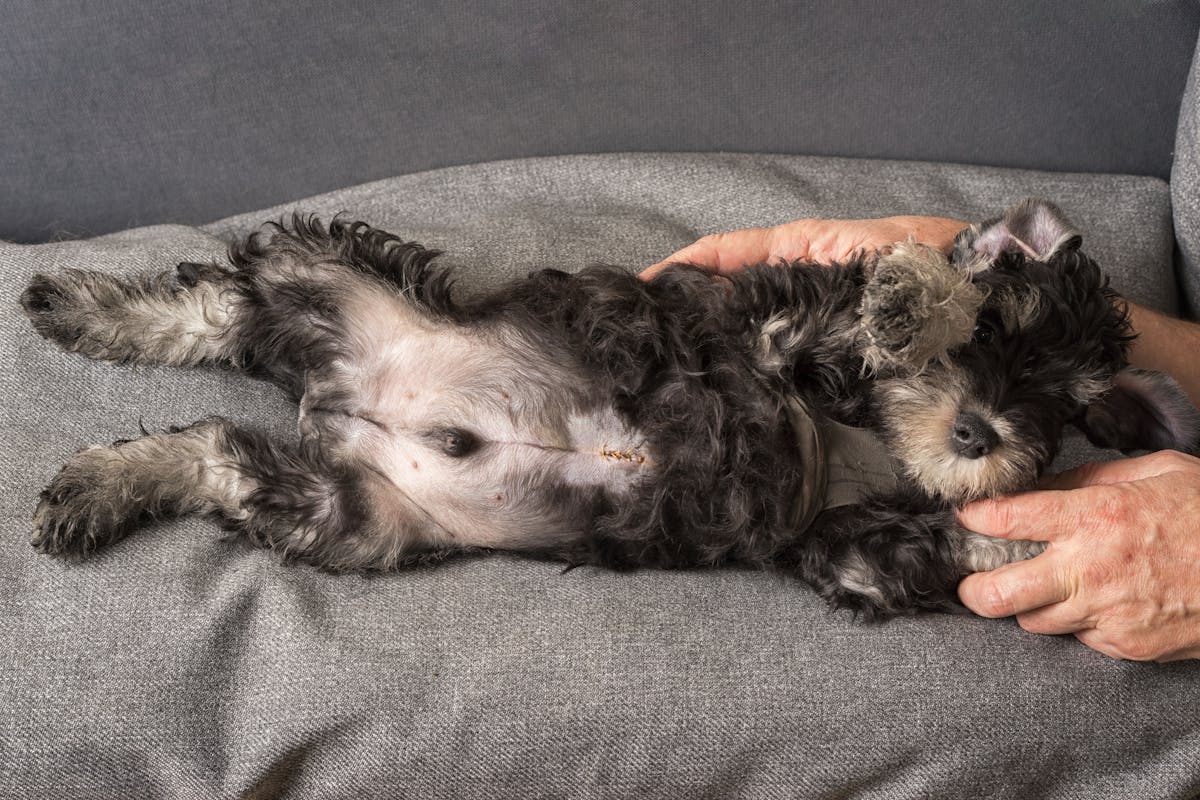
An umbilical hernia is when the muscle layer where the umbilical cord was connected (more commonly known as the navel or belly button) fails to close after birth, resulting in part of the abdominal lining, organs, or fat protruding. When puppies are in the womb, the umbilical cord delivers oxygen and nutrients. Once puppies are born, the umbilical cord breaks off, leaving behind a small scar, and the area heals over. When the area does not close and heal completely, puppies may be vulnerable to developing a hernia.
Most umbilical hernias are harmless, but should be treated if they do not close on their own. If your puppy has a larger or non-reducible hernia, it can be a concern. When hernias are larger, there is a greater risk that organs (such as part of the intestines), and not just fat, are protruding. In this case, the protruding tissue can become strangulated (when the blood supply is reduced or cut off as a result of compression of blood vessels), leading to tissue damage or intestinal blockages. The most common signs of a problematic hernia include pain, vomiting, and a lack of appetite. In this case, your dog needs emergency care and surgery.
How to know if your puppy has an umbilical hernia
Some dog owners may notice a small bump on their pup’s belly, but you might not notice it, especially if your dog has longer fur. When your veterinarian does a full examination on your puppy, they will palpate the abdomen and check for any lumps and bumps, and will let you know if they appreciate a hernia.
Genetic influences and breeding decisions
Umbilical hernias are very common and in most cases, not harmful. The exact cause is unknown, but they appear to be more frequent in some family lines suggesting a genetic influence, but it is possible for any puppy to develop an umbilical hernia.
As there is currently no genetic test for umbilical hernias, breeders must rely on pedigree information to make breeding decisions. Ideally, affected dogs should not be bred as they may pass on the trait to their offspring. However, it may be unrealistic to eliminate every dog who may be carriers from the gene pool, without increasing the risks of reducing genetic diversity in other ways. However, if breeders are producing a large number of puppies with umbilical hernias, they should make adjustments to their breeding program accordingly.
Treatment
If the hernia is small, it may be reducible, meaning a veterinarian may be able to push the tissue or protrusion back into the abdomen. Some umbilical hernias will even “self-repair,” and close on their own.
An irreducible or non-reducible hernia is one that does not self-correct. Surgery is typically recommended for any hernia that does not close on its own. Often surgery to repair a hernia can be done at the time your pup is spayed or neutered. For small hernias, there is a low risk of recurrence or surgical complications. For larger hernias, expedited surgery is often necessary.
Prognosis
For small hernias, many dogs recover quickly from the minor surgical procedure. With larger hernias, accelerated treatment may be critical for a good prognosis. Your dog may need a few days of rest after the procedure and there will be aftercare for the surgical site.
Resources
Tufts University: What To Do About Your Dog’s Umbilical Hernia
Veterinary Partner: Umbilical Hernias in Puppies and Kittens
Phillips, J. M., & Felton, T. M. (1939). Hereditary umbilical hernia in dogs. Journal of Heredity, 30(10), 433-435. https://doi.org/10.1093/jhered/30.10.433
Robinson, R. (1977). Genetic aspects of umbilical hernia incidence in cats and dogs. The Veterinary Record, 100(1), 9-10. https://pubmed.ncbi.nlm.nih.gov/835209/

Join our Good Breeder community
Are you a responsible breeder? We'd love to recognize you. Connect directly with informed buyers, get access to free benefits, and more.