Good People, Good Pups: Larry Brantley on Voicing ‘Wishbone’ and His Lifelong Friendship With Dogs
The actor shares his incredible tale.

By
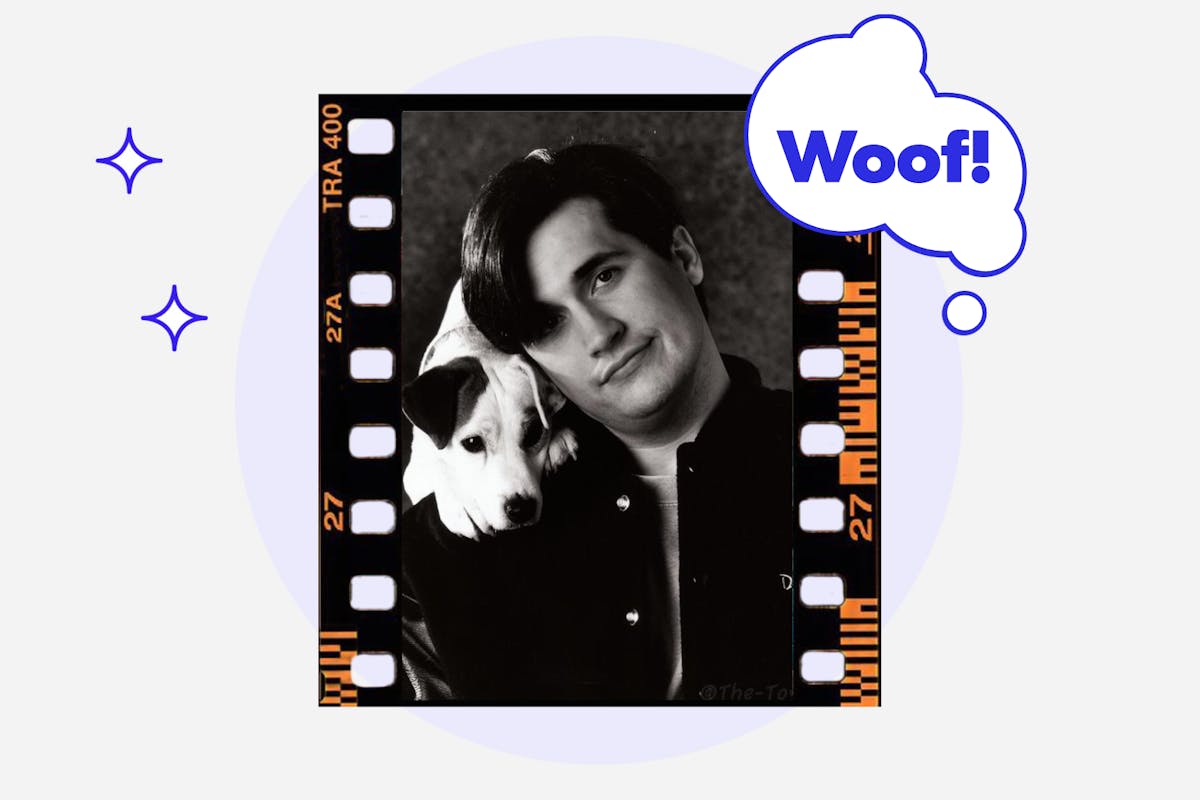
Larry Brantley and Soccer, AKA Wishbone the dog. (Credit: Larry Brantley/Natalie Ullman/Good Dog)
Larry Brantley, aka the voice of Wishbone, is a dog person through and through.
Though he's worked (and played) alongside pups his entire life, '90s kids know Brantley best for his work on PBS's hit show about an imaginative Jack Russell Terrier who explored classic works of literature. Twenty-six years later, Brantley and of course, Wishbone — whose real name was Soccer — are treasured for helping a generation fall in love with learning.
We caught up with Brantley to find out more about his special bond with dogs on and off-camera.

Good Dog: Have you always worked with dogs or kept them as pets?
Larry Brantley: Yeah, that started early. I was just a wee thing living on my grandparents' farm in a little place called Jollyville, Texas, right outside of Austin. I had a rat terrier there named Buster and he was my first dog.
There were other dogs around when I was a kid, too. My grandmother's sister had a cattle ranch also in the Hill Country of Texas in a place called Marble Falls. It was on my Aunt Lillian's ranch that I learned how to ride horses and work cows and how to bale hay and all that stuff. She had an Australian Shepherd named Boots to help out with the animals, and Boots was one of the smartest dogs I ever met. Just knew how to do everything — really an incredible dog.
My aunt also had a couple of Dachshunds that she kept close to the house. She would never let them go out because she was always afraid the cows were going to step on them. They were tiny!
So yeah, growing up, I was always around dogs with the exception of when I was in the military.
Let's fast forward a few decades later. How did you land the lead on a show about a talking Jack Russell?
LB: So I moved to Dallas on New Year's Day in 1993 to start my acting career, which of course meant I got a job working in a restaurant. But my agent called me in October of 1993 and said, "I'm sending you on a voice audition," and I said, "That's great, what's a voice audition?"
She explained to me that instead of standing in front of a camera, I was going to stand in front of a microphone and read some copy. She really didn't know much about it, except that it was a pilot for a show and a dog was involved. They were being fairly hush-hush about the whole thing. And so when I arrived at the studio to do the audition, I had some questions, but the audio engineer was just as in the dark as I was about the whole thing.
Sounds mysterious.
LB: Very. Now, you have to remember that in 1993, the most popular children's program on the planet was "Barney and Friends.” So when I started to read the copy and realized it was a kids' program, my first thought was, "If I get this gig, am I going to have to dress up in a dog costume and dance around on stage?" Because I would have done it for the right amount of money, I just wanted to prepare myself.
The audition got me a callback, which in actor parlance means a “second interview,” and that’s how it all started.
What was it like the first time you met Soccer the dog?
LB: So the callback was at a house, which is where they were shooting part of the pilot. There were several other voice actors there that I knew. Someone came in to explain to us how the audition was going to work, and that was the first time I saw Soccer.
Jackie Kaptan, his trainer, walked him through the room and it all clicked. I was like, “Oh, okay, so I am not going to have to dress up in a dog costume and dance around.”
How did they run the audition?
LB: It was pretty interesting — they were going to have Jackie put Soccer through a series of moves and behaviors, and the voice actors would read the copy that had been presented to them and try to make it match up with Soccer’s actions.
The guy who went in front of me was a seasoned voice actor. I mean, this guy really knew his stuff. But he walked out of the room like a deer in the headlights, so I was like, “Oh boy.” I was really nervous and did not feel confident at all.
Yikes.
LB: I walked in and met Rick Duffield, the executive producer, and Betty Buckley, the producer. The room didn’t even have a microphone — just a boom box they were using to record my voice track on. Jackie and Soccer were there too of course.
They gave me some copy and they said, “Okay, here we go,” and at that exact moment, Jackie said, “Hey, guys, actually, Soccer’s been working a lot. He needs a break.”
Now, when I heard he “needs a break,” I thought that meant he needed to go outside and take care of some business. But what happened was she took a tennis ball out of a pouch on her belt. And when she took that ball out, Soccer lost his mind. I mean, he really lost his mind. And when she tossed it to him, he basically began to have a game of catch with himself.
So in that moment — and I think I only did this because I was completely ignorant — I just threw the copy away. I started improvising what I thought must be going through the dog's mind as he played catch with himself. I could never replicate it now, but my voice would go up a bit and I would get really excited about the ball. This went on for about two minutes, I don’t remember much, but I vaguely remember there being some laughter in the room.
At some point, Jackie swooped down and grabbed the ball and put it back in her pouch. And I looked over at Betty Buckley and said, “Okay, are you guys ready to start the audition?” And she goes, “Oh, no, we got the audition. That was great.”
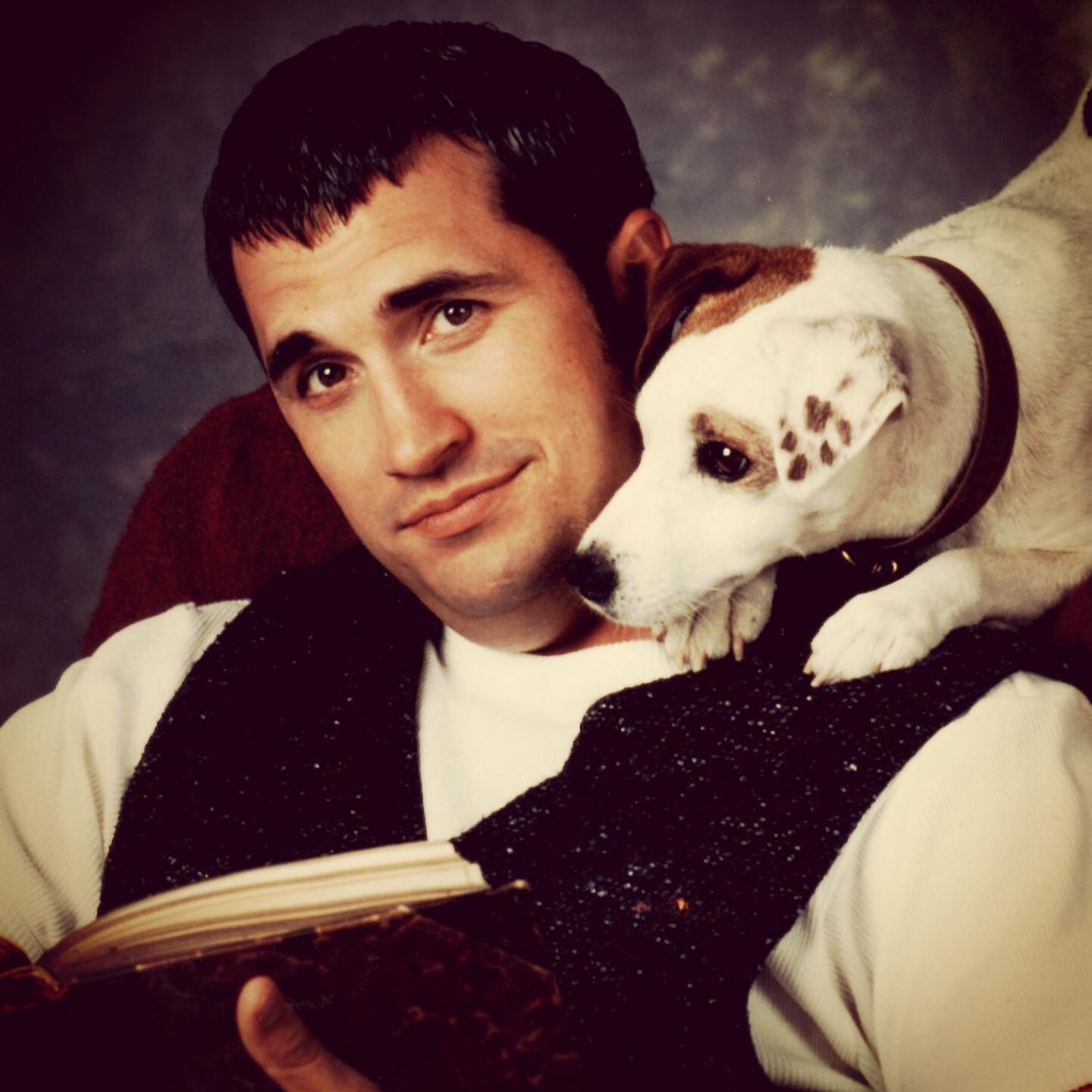
Larry Brantley and Soccer. (Credit: Larry Brantley)
Do you think growing up around dogs — and having dogs yourself — helped you get the role?
LB: I think so. Rick Duffield told me later it was the ability to be in the moment with the dog, which was something that I’ve always done with my pets. It was always fun for me, even as a kid, to imagine what might be going on through my dog's head and to see the world from their point of view.
I mean, one could argue that's where I learned empathy — putting myself in my dog's paws, so to speak.
But yeah, I used to get giggles from my family and friends speaking in the voice of their dog. They thought it was funny. Never in a million years did I say, “You know, someday I could parlay this into a pretty good career.” That never entered my mind. But you know, it turned out to be not a bad gig at all.
What was it like working with Soccer on set?
LB: I was never really together with him a lot on set, but I would study him quite a bit, particularly off-camera. It was always interesting to me to observe his relationship with Jackie, who was his principal trainer and owner. I liked getting to know what he considered fun, which almost always involved playing with some kind of a toy.
Soccer loved his break time, but at the end of the day, he was a dog who really understood the difference between work and play. He would walk onto the set with so many distractions and he would still be so focused on Jackie. Definitely a professional.
Of course, that wasn’t always the case. There were times in almost every episode where he would wander off-script. A lot of times he would do something funny or cute or something the camera captured that there were no words for. And that was when I would have to come up with the words. Having studied him off-set and gotten to understand his personality a little bit, that generally was not so difficult to do. It’s where a lot of the throwaway humor from the show came from.
One funny thing about Soccer was how he sometimes reacted to costumes. A lot of times the actors would be wearing period dress from whatever book we were portraying, like The Three Musketeers, for example. I remember one episode where one of the actors had this big hat with a huge feather on it. That feather bothered soccer no end, because the actor would move his head around and the feather would bob back and forth. Every time he moved his head up a little bit, Soccer was like, “Dude, I'm not too sure about that.”
Jackie was able to train and desensitize him to the feather so we could finish the rest of the episode because he really was not into it.
Did Soccer ever get to let loose and hang out with the cast?
LB: So because Jack Russells are a very specific working breed of animal, it wasn't in his best interest to just let him fraternize all over the set with all the cast and crew. First of all, there were way too many people. And second of all, it was really important that when he did have scenes where he had to work closely with certain actors, that he was totally focused on those actors.
You don't want to ask an actor for an autograph when he's on set in front of a camera because he’s working so he’s distracted. For that reason, I never really hung out with him a lot. I didn't go around and pet him or whatever. I understood he had boundaries because I have dogs too, so I just got it.
Really, the only times we were ever on camera together were for some of the promo shots. There's one famous one that still exists where I'm sitting in a big red chair and I've got this big book open and he's sort of sitting over my shoulder reading the book. But again, we didn’t hang out much. I was friendly with his stunt doubles though.
Wait, doggy stunt doubles?
LB: Oh yeah. So every stunt double had a very specific thing that they could do. And, you know, from a distance they mostly looked like Soccer.
There was Tisch, Phoebe, Shiner, Slugger, and Bear. Those were all the doubles. Bear was actually a pup that was being groomed — had we gone further on with more seasons, he probably would have become the next Wishbone.
But Phoebe and I just had an amazing relationship. I can't explain it. I still don't understand it. From day one I remember we were on the backlot and I was sitting down on an apple box or something, and one of the animal trainers had let Phoebe off-leash. She ran right up to me, and the animal trainer told me later that Phoebe never did that sort of thing.
I picked her up and Carol Kaelson, our stills photographer, got a few pictures of it. Phoebe and I just instantly became pals. It was kind of funny. She wasn't on set all the time, but when she was there, I always made an effort to go and hang out with her or give her some kibble — you know, just play with her a little bit. Jackie would actually let me play with Phoebe because she was a stand-in so it was technically okay.
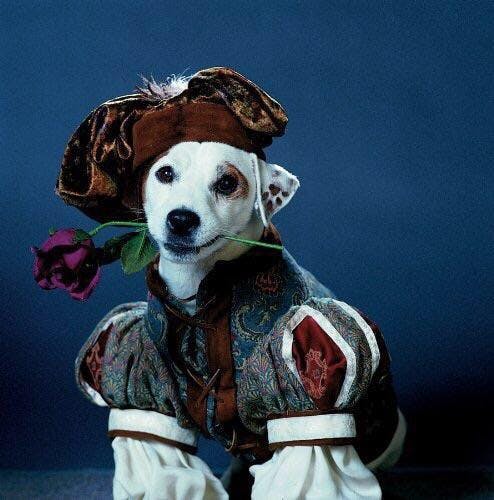
Soccer the dog in costume. (Credit PBS)
I don’t know why the idea of puppy stunt doubles is so funny to me, but it actually makes a lot of sense.
LB: Yeah, you know, Soccer was the star of the show. You can't run the risk of anything happening to your star.
But the stunt doubles, they all had very special things they could do. So like, Tisch could do the thing where she could stand up on her hind legs and then fall over dead. Now, that was a behavior that Soccer couldn't get. He just couldn’t.
Shiner was awesome, he was our agility dog. He was super agile. He could jump over stuff, run around stuff, run through stuff. It didn't matter. He loved that kind of challenge. And he was a little younger than Soccer, who I think by the second season was going on nine or 10, so he just wasn't as fast as he used to be.
And then Slugger was our boy that you could do just about anything with. You could run him through the mud, you could put him in water, whatever, he just didn't care. You could see he was just so happy to be working.
So, yeah, everybody had their thing that they could do that wasn't necessarily a dangerous thing because, of course, we were super careful with all of our stars on set. They just happened to have behaviors that they were better at than Soccer.
That’s the biz for you. When you were actually filming Wishbone, did you have a dog at the time?
I did. I had an Irish Setter named Grady Green, and, yeah, he was my boy. I loved that dog. I raised him from the time he was a puppy.
And it’s funny, you know, I worked on a TV show with dogs and dog trainers all day. And I like to watch. I tend to be observant. And so I would see off-set how Jackie and the other trainers would be with the dogs. They taught me what “bridging” was, and whether a dog was food-driven or toy-driven in terms of rewards. I learned about setting a mark and training specific behaviors. So I would go home at the end of a long day and I would try to stuff out on Grady. And I started having some success, which was really kind of cool, especially because he was a bit of a wild man up through his first year.
My first wife would get so flustered because she just didn't know what to do with him — he was a barker. And then Jackie taught me how to teach my dog only to speak when I told him to. That was really cool. He became a really incredible dog from the training I was able to learn on the show.
Unfortunately, Soccer is no longer with us. I was wondering what it was like when you found out he had passed.
LB: I can't quite remember what year it was, but we had all gone our separate ways and I'm not even sure how I got the message. I think [executive producer] Rick Duffield called me and was like, “Hey, Jackie told me Soccer passed,” and it was kind of surreal.
You know, on the one hand, I was very sad. I was sad for Jackie because she was very attached to him, obviously.
On the other hand, I thought about that little dog's contribution and the legacy that he left behind. That show, I mean, 25 years later and I still get fan mail from people about it. They say, “You know, I'm a lifelong reader because of the show,” or “I'm teaching my kids to love reading because of the show,” that kind of thing.
I don't think that anybody gets into this business with the idea that they’re going to “leave a legacy.” I think that's a recipe for disaster if that's your motivation. Our motivation was to introduce kids to this rich world of literature that might seem intimidating at first, but we cracked the code — and what better way to crack the code through the lovable character of a dog.
It’s amazing how much material you were able to introduce to kids — myself included, as a young bookworm back in the ‘90s — through Wishbone: Phantom of the Opera, The Prince and the Pauper, The Odyssey, and so many other classics.
LB: All of these stories are so universal. We all had the same idea at the time, which was really our head writer, Stephanie Simpson's, rule. She told us all before we started the show: “I don't want you to think because we're doing a show with a dog as the main character that this isn't a complex show. We will never write down the kids. We will never talk down to kids. We will always give them the benefit of the doubt that they either understand it or that if they don't, they will still be curious enough to want to find out.”
Soccer was the vehicle that allowed that curiosity to happen, and I think that’s pretty cool. I can think of no better legacy for him.
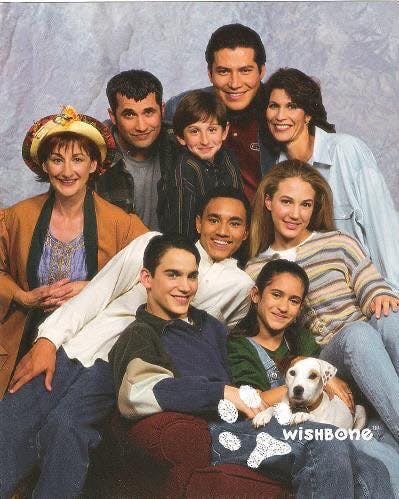
The cast of Wishbone. (Credit: Larry Brantley)
After so many years of working with dogs like Soccer and having your own dogs as pets, what is it about them you love so much? What draws you to them?
LB: I think it's honesty. Soccer committed honestly and 100% to anything he ever did. And that's what I've loved about every dog I've ever had — they're just honest. They don't wear a lot of different faces; they just have one face. And you can see a lot of expressions on that face, but at the end of the day, they are who they are.
I loved Soccer’s honesty. I loved that he was honest enough as a creature that when he was tired, he let you know. When he was done with the scene, when he was done being in that costume, or when he was done hitting his mark for the fiftieth time, he let you know.
And I miss that about him — his honesty.
Dogs will always let you know where you stand with them.
LB: That's the other part of the honesty, right? They will always let you know where you stand. They love unconditionally, even though sometimes it feels like it's conditional, like, ”I’ll love you more if you put that food in my dish right now.” But no, they love you forever, no matter what. They are utterly dependent upon you for their survival, and I think that requires some honesty in return and some appreciation for such a deep relationship. That’s something to be treasured.
I think that instinctively kids know this. I think that was another big draw of the popularity of the show — not just the fact there was a little dog with a big imagination, but that he had this family and he knew this family was always going to be there for him through thick and thin. I think that's something that kids gravitate toward. They want the security of knowing that somebody is going to be there for them.
And that requires a very specific kind of honesty and empathy, too.
