Why are Huskies so ‘Loud’ and ‘Dramatic’? A Scientific Investigation
We spoke to canine researchers to get to the bottom of the age-old mystery.

By
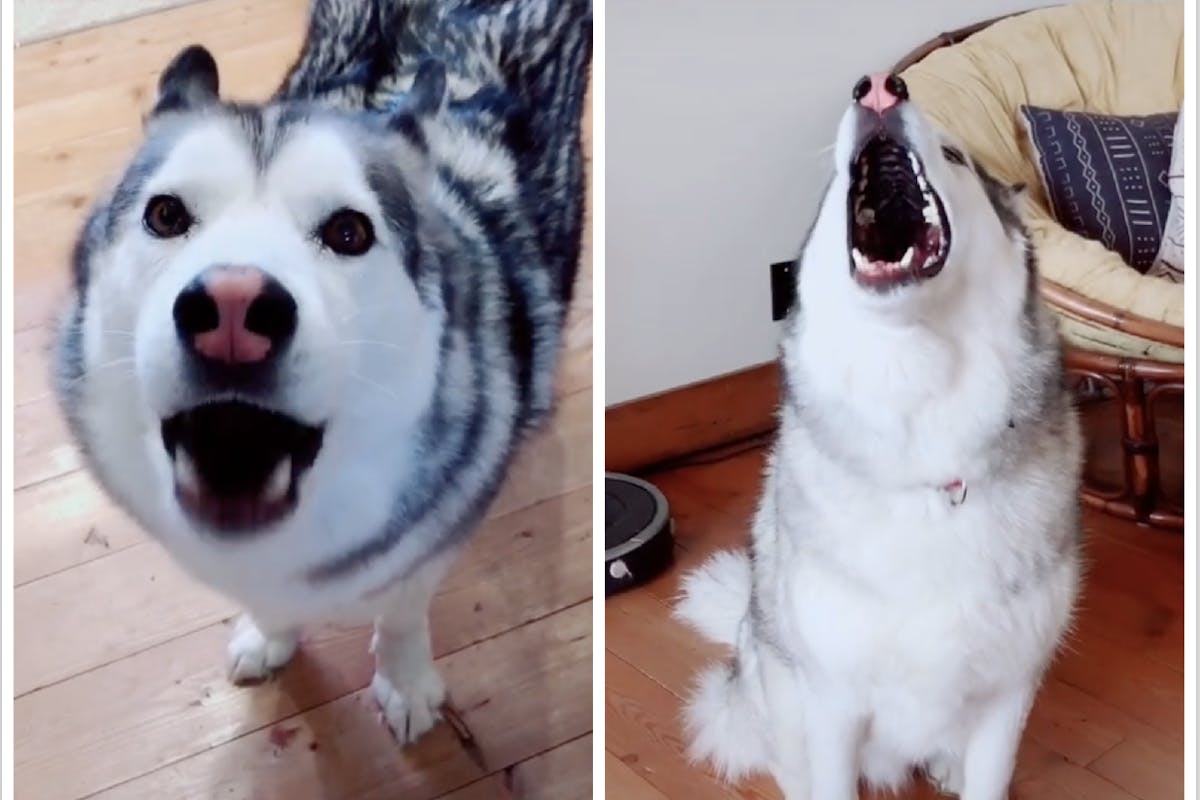
Credit: Chris Boudens
As the old adage goes, “every dog has its day,” and Huskies are certainly having theirs on Tiktok, where they’ve become famous for enthusiastically screaming about nothing.
Chris Boudens’s two Siberian Huskies and angelic Golden Retriever — Nico, Jackson, and Zoey respectively — have recently gone viral for their theatrical vocalizations. He says just about anything can get his Huskies to start howling, but for some reason, Billy Joel’s 1973 hit “Piano Man” seems to be the biggest trigger.
“There are a few songs that get them going, and ‘Piano Man’ is number one for sure,” Boudens told Good Dog. “But the Huskies have been chatty since the first day they came home at eight weeks.”
It’s not just a ploy for TikTok fame. Husky parents and enthusiasts are well aware of the breed’s loquaciousness. In fact, some of the top Husky-related searches on Google are: “why are huskies so dramatic,” “why are huskies so vocal,” “why are huskies so loud,” and my personal favorite: “why are huskies so weird?”
“With my two Huskies, just one of them grumbling can turn into a 'yah yah yah' fest of who can make the most noise,” Husky owners Stephanie McAlinden and John Dyer told Good Dog. "The only time they're quiet is when they're asleep.”
So why are Huskies so infamously, well, like that? Is there some sort of scientific basis for their yowling, or are we really to believe that an entire breed is biologically predisposed to Billy Joel fanaticism for reasons we can’t explain?
The answer is, in short, we don’t know.
“There’s surprisingly little research about dog vocal repertoires,” Dr. Holly Root-Gutteridge, a researcher who did her Ph.D. on wolf howls, told Good Dog. “There is some information on their growls and their barks, but overall it just hasn’t been that well studied.”
Still, scientists have some ideas on why Huskies make the distinct sounds they do, especially around their families. We spoke to canine researchers (people who study dogs, not dogs in lab coats), to get to the bottom of Huskies’ supposed histrionics.
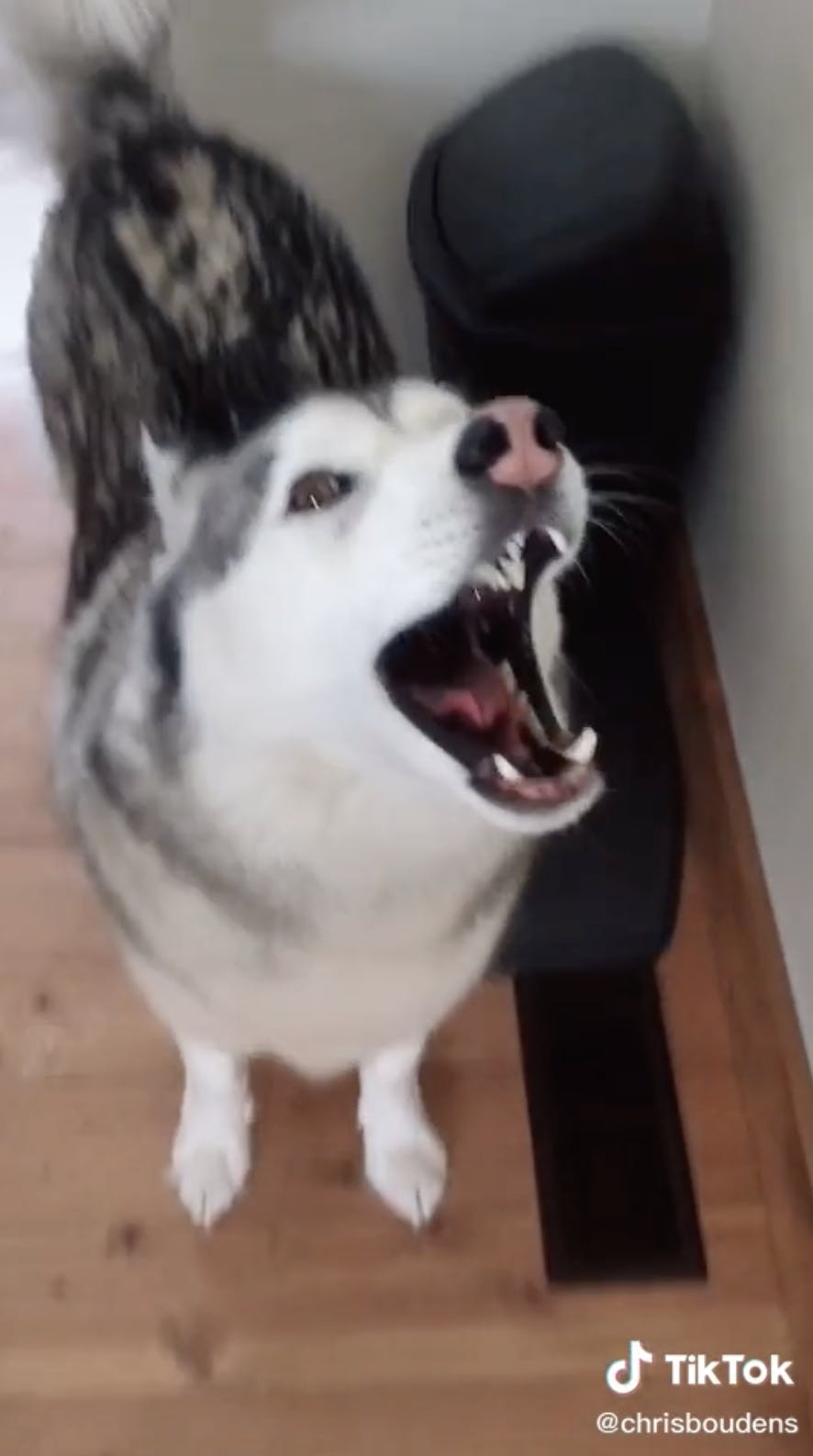
Credit: Chris Boudens
Do dogs talk?
To understand specific Husky noises, it’s important to first contextualize them based on what we know about all sorts of dog vocalizations.
Several studies point to a few main takeaways: that dog barks can be classified into some nondescript number of discrete categories, and that different kinds of barks may mean different things.
For example, a study from Eötvös Loránd University that focused on a Hungarian herding dog breed (Mudi) identified six distinct kinds of dog barks. Other research from veterinarian and animal behaviorist Sophia Yin suggests that the acoustic structure of various dog barks means different sounds have different uses. Stanley Coren, a scientist and psychology professor emeritus at the University of British Columbia, has also studied dog vocal patterns and posits their “language” can be understood by pitch, duration, and frequency.
“We have a reasonable idea of how many vocalizations dogs make as a general thing, but the categories are fairly broad,” Dr. Root-Gutteridge said. “We know dogs have a lot of communicative contexts for these calls, from pain (e.g. whine, yelp, scream), fear (e.g. scream, yelp, growl), anger (e.g. bark, snarl, growl), and play (e.g. bark, growl).”
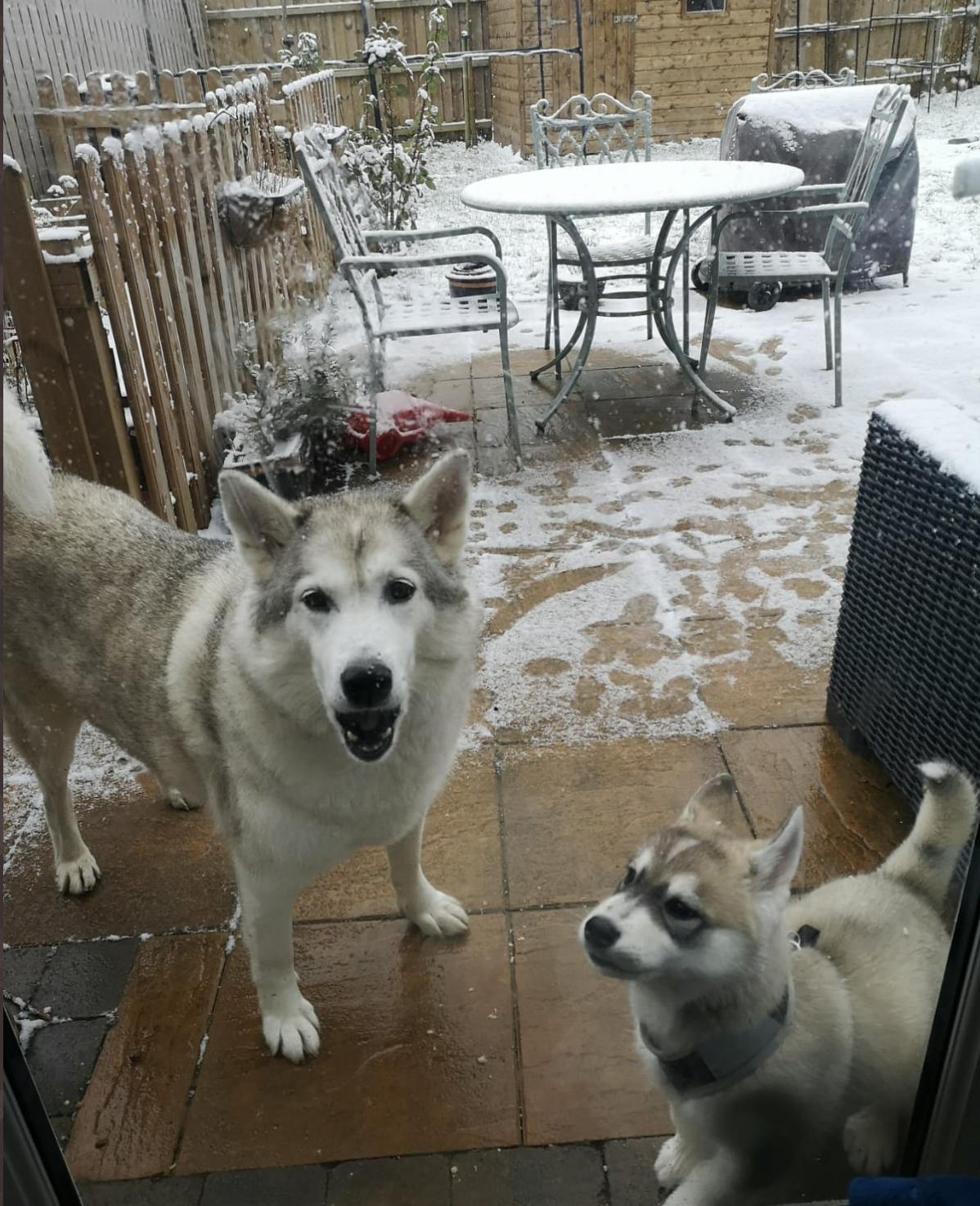
Satine and Ziggy are famous at home for their "woos," "grumbles," and "demands." (Credit: Stephanie McAlinden and John Dyer)
What are Huskies doing in those viral videos?
Certain breeds are known for making specific noises, and Huskies unofficially have their own. Basenjis, for example, are famous for “yodeling” instead of what we typically call “barking.”
There doesn’t seem to be a scientific phrase for every piece of a Husky’s’ vocal repertoire (e.g. RARARAAAA!!!!! and “YoooOOOOoooOOOWW!!!!”), but researchers have some ideas — especially around the TikTok-famous stuff.
“In most of the ‘talking’ Husky videos the calls they use are moans,” Tamás Faragó, an ethologist at the ELTE in Budapest, told Good Dog. “That is an intermediate call between growls and whines. In the case of wolves, it’s linked to ambivalent inner states, and used in playful interactions.”
Huskies can also howl, as many people who have them will anecdotally confirm. Though this is not unique to their breed — any dog can howl — it does seem to be a characteristic Huskies are known for, probably because they look a lot like wolves.
“Some dogs have been bred with the vocal, nasal, and musculature to howl ‘better’ than others," said Dr. Shelly Volsche, a researcher at Boise State University who studies the human-animal bond. “My pug actually howls because she learned from my beagle mix when she was young.”
It's important to note that not all Huskies make the same noises and some simply aren't as chatty as others. All dogs have their own personalities and propensities for loud existential shrieking.
"Sometimes there is more variation in a given trait within a breed than between breeds," Dr. Sarah-Elizabeth Byosiere, the Director of the Thinking Dog Center at Hunter College, explained.
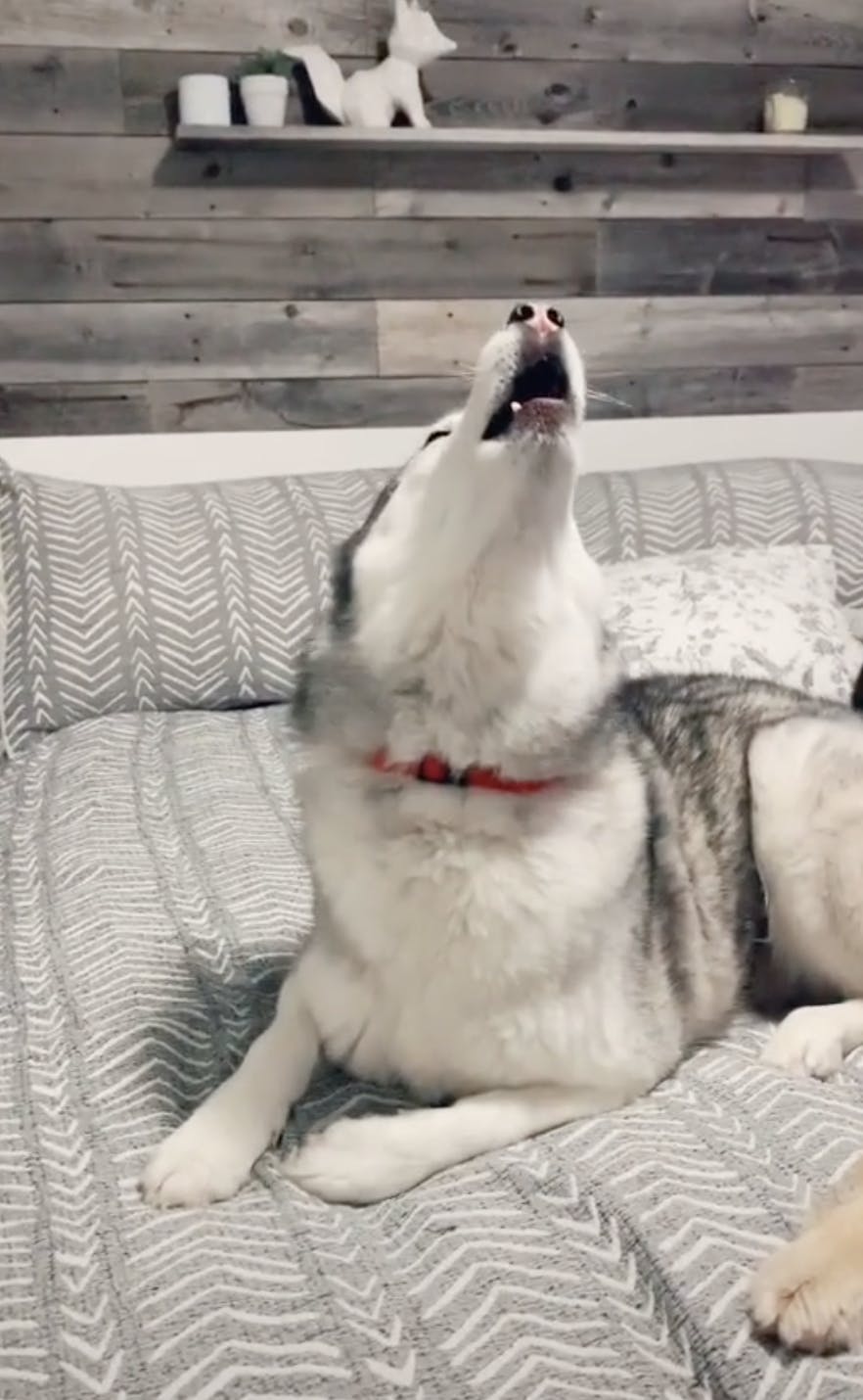
A picture you can hear. (Credit: Chris Boudens)
Okay, but why do Huskies do that thing? The screamy thing?
We simply don’t have enough genetic research to know why Huskies make the noises they do. Crossbreeding over thousands of years has made it more complicated to trace the history of any breed, including Huskies, which are mistakenly thought of as “wolf hybrids.”
Still, it’s not impossible that modern-day Husky vocalizations could have something to do with how their predecessors were domesticated and what traits were deemed advantageous to different groups of people over time.
“This is just speculation, but probably during domestication, humans probably selected for more barky dogs as these could signal the intruders at the borders of the camp,” Faragó said. “That later became the village and nowadays the house or the flat.”
Is it our fault?
Maybe — at least a little bit. But how could it not be?
When we praise or encourage dogs for a certain behavior, typically, they’ll continue to do it. That’s the principal rule of many dog training philosophies, like positive reinforcement, for example. So when Husky owners laugh or join in on the howling, a dog may interpret it as praise or attention and continue to do it more frequently.
“I think external factors like family are a huge influence in husky vocalizations,” Volsche said. “Dogs learn from us, even when we aren’t technically training, in very similar ways to children. As a result, their mannerisms and responses are shaped by our encouragement or discouragement.”
It’s hard — and in some cases, impossible — to tune out a Husky when they want something, whether it’s food, play, or your undivided attention. It might be inconvenient in a Zoom meeting or during a Lord of the Rings rewatch, but overall, Husky noises are part of what makes them so special.
For Huskies, all the world’s a stage. And not unlike Billy Joel’s narrator in “Piano Man,” they’re happy to put on a show for anyone willing to listen.
