The Art of Communication
So what language do we use with our dogs? It is called operant conditioning.

By
Good Dog is on a mission to educate the public and make it simple for people to get dogs from good sources and for reputable breeders, shelters and rescues to put their dogs in good homes.
Good Dog is on a mission to educate the public and make it simple for people to get dogs from good sources and for reputable breeders, shelters and rescues to put their dogs in good homes.
I am always a bit amused when I arrive at a new client’s home to help them with their new puppy. More often than not during our first lesson I hear the owners saying “come,” “sit” or “no” over and over again, frustrated because the puppy is not doing what it is asked. It reminds me of when I was in China on a choral tour with 80 high school students. One day we were in a restaurant and one of the kids wanted another bottle of Coke.
As the waiter walked by the student said loudly and slowly – “Can I have another Coke?” The waiter continued by him, not realizing that the kid was talking to him. When he passed by again, the kid again said in a louder voice, even more slowly, “Can I have another Coke?” The waiter continued on his way.
The third time it happened the student was getting angry and said to his friends, “What is he, stupid?” They all laughed. At that point I caught the waiter’s eye, smiled, picked up the empty bottle of coke and pointed to it. He quickly left the room and came back with a new bottle of Coke. The students said, “How did you do that?” I said, “I spoke to him in a language we both understand.”
Good Dog is on a mission to educate the public and make it simple for people to get dogs from good sources and for reputable breeders, shelters and rescues to put their dogs in good homes.
So what language do we use with our dogs? It is called operant conditioning. Most people don’t care about the science of dog training, they just want to be successful at it. Rather than spending time on the science of why, this article will focus on the how, so that you can “just do it,” as they say. If you are one of the few who loves the science behind it, you can learn more about it, just Google “Operant Conditioning.”
In a nutshell, all animals repeat behaviors with positive outcomes and avoid behaviors with negative outcomes. We take advantage of a pup’s natural tendency to repeat the behaviors we like by rewarding those behaviors. But first we need a way to tell her exactly what she is being rewarded for. Ideally we would do that by delivering the reward the instant the pup does the behavior. In most cases, that’s simply not possible. So we use something called a marker that can be heard by the pup the instant she does something we like and then we quickly deliver her treat.
Conditioning The Marker Marker
In order for your pup to make the connection between the sound and the reward we have to pair the marker to the reward. This is called conditioning the marker. Two things you need to decide before you start:
- What to use as your marker
- What to use to reward your puppy
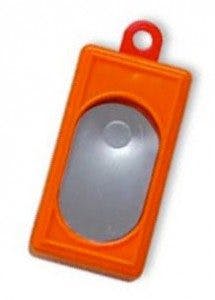
The Marker
Your marker should be a sound. Many people use a clicker, like the one shown to the right, or a word like “yes.” What is most important when picking your marker is that it be short, crisp and easy for your dog to hear. You can condition more than one marker, but be sure to do them separately. I use both the clicker and the word “yes.”
The Reward – You should choose small pieces of soft, easy-to-swallow, DELICIOUS food as rewards. For medium to large breed puppies, the treats should be about 1⁄4″ square. If your puppy has to take time to chew the treat it will slow down the training. So be sure to have lots of treats that your pup likes on hand and ready to deliver!
Let’s Get Started
Note: Whenever it says “mark” in this article you should either press and release the clicker one time or say the word you chose for your marker.
Pick a room where there are few distractions. Often a bathroom is a good choice. Bring your puppy, about 20 treats, and the clicker, if you plan to use one, into the training location.
Have the treats in a place where your puppy cannot see them, such as on the counter. You want the treat to appear out of nowhere after your puppy hears the marker.
There are only three rules during this process:
- You must deliver a treat after every click
- You never mark when your pup is doing something you do not like
- Never mark your pup more than two times without her moving in some way
To start, your puppy does not have to be looking at you. Although the situation with every puppy will be different, here is how a session might look:
- Mark and go to wherever your pup is to give her a treat.
- When she moves, mark and go give her another treat.
- If she sits, mark and give her another treat.
- If she gets up from the sit, mark as she gets up and give her another treat.
- If she remains seated, mark and give her another treat.
- If she again remains seated, move to another area of the room and as she gets up, mark and give her another treat.
- As she continues toward you, mark and give her another treat.
- Give her some time to become distracted, mark and give her another treat.
Over a two-minute period of time you want to mark and reward your puppy at least 20 times. Your goal is to see your puppy respond to the sound of the marker. You will know she has paired the sound to the treat when you see her consistently not only turn but move toward you when she hears the marker. For some dogs this will only take one session. For others it may take two or three sessions. Those sessions can be done all in the same day. It does not matter how long it takes your puppy to figure it out, just let her learn at her own pace. In the end, once she has paired the marker to the sound, you are ready to start using that marker in training.


