Bitch Fertility
By
Good Dog is on a mission to educate the public, support dog breeders, and promote canine health so we can give our dogs the world they deserve.
Good Dog is on a mission to educate the public, support dog breeders, and promote canine health so we can give our dogs the world they deserve.
Good Dog is on a mission to educate the public, support dog breeders, and promote canine health so we can give our dogs the world they deserve.
- Endometrial atrophy
- Recommendations to increase bitch fertility
- Full spectrum lights
- Progesterone and probiotics
Endometrial atrophy
Q: Please explain endometrial atrophy, how it can be prevented and/or managed or cured.
A: Endometrial atrophy is characterized by a reduction in the thickness of the endometrium, which is the lining of the uterus. Unfortunately, when the uterine lining is thin, we often have problems with the bitch’s fertility as they are not able to sustain implantation and pregnancy. I have attached a link to a paper you might find interesting that lightly touches on atrophy as it discusses other diseases of the canine uterus. The research that I have done would have me discussing monitoring your girl’s estrogen and progesterone levels, along with her complete bloodwork with your Reproductive Veterinary specialist. Sadly, there is very little research on this for canines.
https://onlinelibrary.wiley.com/doi/pdf/10.1111/rda.12064
Recommendations to increase bitch fertility
Q: We have a 3 ½-year-old Newfoundland that can not get pregnant. She had one healthy litter and nothing since despite trying with our male. We do know he is fertile as well. She is an excellent example of the wonderful Newfoundland breed and we would really like to continue her line. I have looked into having her thyroid checked, and I read from another long-time breeder that even if her thyroid tests normal, putting her on medication for hypothyroidism could greatly help her fertility. Do you have any experience with this, or other ways to increase fertility?
A: Fertility is a two-sided challenge, where both the stud dog and the bitch need to be evaluated as fertility can change due to seasons, or toxin exposure, or even illnesses such as Lyme disease. If this were my situation, I would start with doing complete blood work on both dogs, including T3 and T4, along with a complete tick panel. By doing this, you now have a baseline for your health data. You do not want to put her on any medication that is not needed.
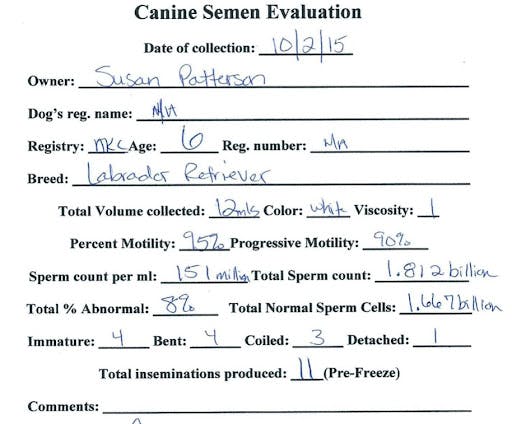
For your boy, you should have complete morphology done on him. Once collected, your Vet will be looking at the color and turbidity of the collection. The turbidity or opacity of semen provides a rough indication of concentration. Commonly, the turbidity of a sample is graded on a subjective scale of 0 to 5, with 5 being the most opaque, as in the color of whole milk. A clear sample contains no spermatozoa. Next, they will look at volume, and while volume is not an indicator of quality, it is essential in calculating the number of sperm in the sample. Motility is next and expressed in the report you will receive as a number from 1-100. Normal sperm are 70% motility or greater. Ideally, you want 90% or higher, and there will be another number percentage calling out the forward motion, also called progressive motility. You will then see that they are looking for a percentage of abnormal sperm, immature sperm, bent sperm, coiled or detached. There will also be a comment if there are proximal drops on the sperm, as they negatively impact fertility.
Below is a screenshot of one of my boys, done a few years ago, so you can see what you are looking for. After this is done, you will have a baseline showing your boy’s fertility parameters. Last week I talked about supplements that you can use with your boys to support their fertility. You might want to refer back to that article if you find that his numbers are low.
After the bloodwork, I would work with your vet to do an ultrasound for your girl, and you are looking for cysts. Cysts can impact fertility and are often something that happens with age. Once she comes into season, you can also do a guarded culture where you are looking for bacteria that is out of whack and can be addressed with appropriate Rx antibiotics. Next, you can also choose to do a Surgical Implant (SI) which allows the Vet to see the condition of both the uterus and the ovaries by doing a manual inspection.
Finally, timing, I cannot emphasize enough how critical progesterone testing is to maximizing conception. Even when doing a live cover, it is still very important. Just because your girl “thinks” she is ready, she might not be. Progesterone and estrogen are supposed to work together, but occasionally they don’t, and that that is why your girl thinks she is ready, and she is not. Additionally, your boy’s nose may be great, but it can be fooled. However, numbers never lie, and that is why progesterone testing is one of your best friends when trying to get your girl pregnant. I hope this helps, and good luck!
For more information about semen evaluation and breeding soundness exams.
Full spectrum lights
Q: I’d like to look into getting the proper lights that you suggested to support breeding bitches! Is a full spectrum light (that quilters use - Ott lights) good enough?
A: I am not familiar with the Ott Lights. I do know that the full spectrum lighting has been used for years in the equine industry to increase photoperiod (day length) when days are shortest (e.g. December and January in the northern hemisphere) to ‘trick’ mares into coming into season earlier than they would naturally. In horses they have now actually gone to light masks! Isn’t science fun!!
The findings are that light in the blue spectrum (465-485 nanometers) is very efficient, so the full spectrum lighting you are looking for will be more blue-ish than bright white. You can purchase bulbs for your fluorescent fixtures or regular overhead lighting that meets these guidelines. Most places like Lowes or Home Depot have charts to help you in your bulb selection.
My anecdotal observations* are that we are keeping dogs in much lower light conditions, especially toy breeds who are not outside. Once they are in a more regulated light environment using full-spectrum lighting, it has improved heat cycles, etc. Sled dog breeders, in particular, seem to be especially sensitive to light impacting fertility and other livestock guardian breeds as well. For dogs who do not have a lot of outdoor time, you want to make sure they have 10-12hrs exposure to the lights.
*While we have good evidence of the effect of day length in other species, including horses and sheep, it is not as definitive in dogs. Find further information below.
Seasonality in oestrus and litter size in an assistance dog breeding colony in the United Kingdom
Diagnosis and Treatment of Abnormal Ovarian Function in the Dog and Cat
Control of Oestrus and Ovulation in Dog and Cat: An Update
Progesterone and probiotics
Q: Thank you for your previous help with the bacteria issue I was having with my girl. She was swabbed again on Monday and all looks well. She has been on probiotics since Saturday. How long do you think I should continue this?
Also, regarding Progesterone. My girl missed her breeding in October. She ovulated on Day 11 last time. I had a draw yesterday (Day 10) and she was only 0.2 ng/ml. I have to drive 2 1/2 days to the stud. My vet wants me to come back on Friday for another draw. I would get that back Saturday. That would be 3 days since her last draw. I'm curious if things will start taking off faster now and I should just hit the road and f/u at my destination or hang around. I hate to be rushed. Thanks for any advice. I'm sure I'm just being anxious.
A: I would continue the probiotics through whelping and lactation. The bitches body goes through so many changes during pregnancy and nursing that the stress can impact gut health, and the probiotics truly help keep things on an even keel.
They are definitely called bitches for a reason! Doesn’t it just make you pull your hair out when each season is so different! With the progesterone so low, a 0.2ng/ml, I would do as your vet advised and wait to draw the blood. Even if you hit a 3 ng/ml on Friday, found out the number on Saturday and then drove 2 days to do a live cover or side by side AI, I think you would be fine. Remember it is the 2-3 days post ovulation that matters, not the number. I would also run a number once you get to the stud dog’s house. You know me, I love the numbers and the information that they give us for planning our litters.