Testing Hips and Elbows: OFA vs PennHip
By
Good Dog is on a mission to educate the public, support dog breeders, and promote canine health so we can give our dogs the world they deserve.
Good Dog is on a mission to educate the public, support dog breeders, and promote canine health so we can give our dogs the world they deserve.
Good Dog is on a mission to educate the public, support dog breeders, and promote canine health so we can give our dogs the world they deserve.
Q: In the past I have always tested my dogs through OFA for hips and elbows. Can you discuss the benefits of using PennHip instead? I am contemplating making a switch to PennHip. I don’t really understand the scoring system though.
A: I have used both PennHIP and Orthopedic Foundation for Animals (OFA) for hip evaluations. (PennHip does not evaluate elbows.) Each hip procedure gives you different information to help you make an informed decision about your breedings. The OFA focuses on the hip conformation, while PennHIP primarily considers hip laxity. Both also look for overt evidence of osteoarthritis. Together, they give a rich picture of a dog’s hips.
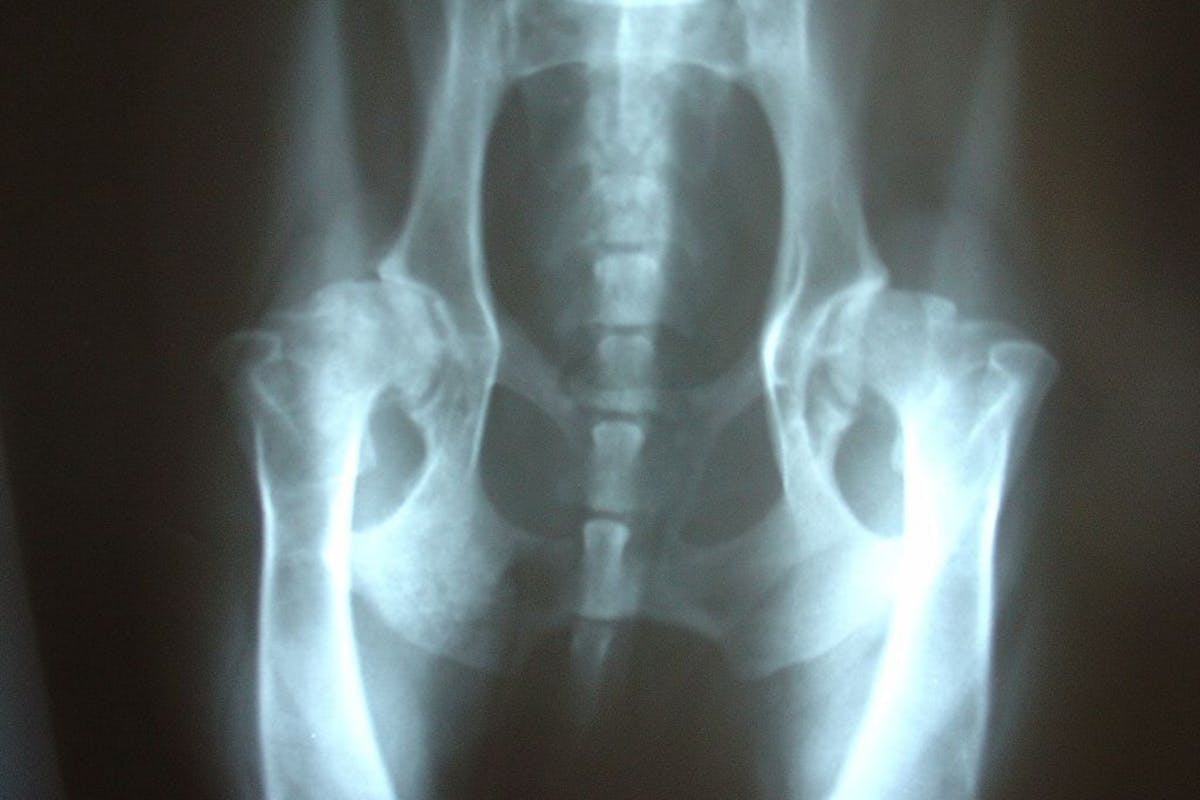
For a definitive or final OFA evaluation, you submit a single extended-view hip x-ray, which the OFA sends to a panel of three board-certified veterinary radiologists. These experts independently evaluate nine anatomical regions of the joint, looking for deviations consistent with hip dysplasia, such as structural abnormalities and laxity. OFA results are most predictive if the dog is 24 months or older when x-rayed. More on OFA hip evaluations here.
PennHIP uses three different radiographic views to measure the laxity of each hip joint. One of the views is the same as the OFA extended view so your vet can make two copies of this x-ray to submit to both organizations. The other two x-rays are carefully measured and result in the distraction index (DI). The higher a dog’s DI, the greater the risk of developing hip dysplasia. Dogs with scores of a 0.3 or LESS have a very low risk of hip dysplasia. Dogs with a DI of .7 or higher have an extremely high risk of hip dysplasia.
Since breeds vary greatly with regard to the prevalence of hip dysplasia, PennHIP also compares each dog to its breed’s average DI, reporting what percentage of the breed has worse DIs than the dog. This is called the percentile so a dog in the 90th percentile has tighter hips than 90% of the dogs in its breed. The accuracy of this percentile depends upon how many dogs in that breed have been evaluated by PennHIP. Find out more about PennHIP here.
PennHip requires that all results are reported, the good, the bad and the ugly, while OFA does not. Since OFA allows owners to choose to report their results publicly or not to share them on the OFA website, the publicly available database is biased tilted toward a lower rate of hip dysplasia. Here is a comparison of these two methods.
Neither OFA and PennHIP are 100% accurate but generally, the poorer the conformation of the hips or the higher the distractive index, the greater the likelihood of a dog developing clinical signs of hip dysplasia and arthritis.
Many owners erroneously think a dog’s PennHIP and OFA evaluations should match. They expect that OFA Excellent dogs should have tight hips and OFA Fair dogs should be looser. This is not the case. In fact, this study found little correlation between the OFA’s hip extended view and PennHIP with 50% of their OFA Excellent dogs being at risk for developing arthritis. This study found that although OFA Excellent dogs had lower DIs than the average dog, 80% of dogs evaluated as normal by the OFA often had DIs above 0.3.
If you are not making progress improving hips based on OFA evaluations, you might want to consider adding PennHIP to your program. Using this additional information will allow you to put additional accurate selection pressure on hips. The benefit of PennHIP have been found in The Seeing Eye and a 2020 study in detection dogs. They found that using OFA alone did not improve hips in the colony but when both PennHIP and OFA measurements were used for the selection of breeding stock, hip joint quality scores improved significantly. I know Gayle has had similar results, moving from average hip results to 0% hip dysplasia by adding PennHIP to her breeding program.