How to Protect Yourself Against Scammers
The Good Dog legal team discusses how you can protect yourself and your puppy buyers from online scammers.
Good Dog is on a mission to educate the public, support dog breeders, and promote canine health so we can give our dogs the world they deserve.

Good Dog is on a mission to educate the public, support dog breeders, and promote canine health so we can give our dogs the world they deserve.
In a recent Good Breeder Webinar, the Good Dog legal team discusses how to protect yourself, your breeding program, and your puppy buyers from online scammers. We cover what steps you can take to hold scammers accountable in the event you or your breeding program is targeted and the free services Good Dog provides breeders to help safeguard your reputation and protect you and your intellectual property. Hear inspiring stories from your fellow breeders about how, together, we’ve succeeded in shutting scammers and scam sites down.
Good Dog is on a mission to educate the public, support dog breeders, and promote canine health so we can give our dogs the world they deserve.
Watch how to protect yourself against scammers:
Good Dog’s Mission to Put an End to Online Pet Scams
The system for getting a new dog is broken. It is easier than ever to set up a fraudulent storefront online, creating ample opportunities for pet scams. Well-intentioned people, who just want to give a dog a good home, don't know who they can trust. We started Good Dog to change all that. Good Dog is on a mission to use technology as a force for good to make it simple for people to get dogs from responsible sources and provide all the support and guidance dog breeders and potential buyers need to feel confident every step of the way.
In a world full of scammers, Good Dog strives to ensure our breeders and buyers are protected. Good Dog offers our breeders and buyers protection from online scammers, including free legal support, and even works with members of the United States Secret Service to track online scams and catch scammers in the act and work toward putting an end to online fraud. Good Dog is launching a Weekly Scam Alert Series, where we will share new and current scams and highlight scams that are affecting the dog world and our breeder community so our breeders and buyers can protect themselves from opportunistic scammers.
And to further combat scammers, Good Dog is preparing to launch the first ever secure online payment system built specifically for breeders. We are so excited to launch this new product, because this new secure payment system will bring accountability to the dog world and the process of finding a dog online and help put an end to online pet scams, helping us accomplish our mission to make it simple and safe for people to get dogs from responsible sources.
Scammers and COVID-19
Scammers are capitalizing on fears surrounding COVID-19, and it is important to be on high alert as scammers grow more sophisticated in their attempts to steal the public’s money and personal data.
As of mid-April, the Federal Trade Commission (FTC) had taken 18,235 reports of COVID-19-related scams of all types nationwide. The FTC issued guidance to avoid these coronavirus scams. The FTC recommends not responding to texts, emails or calls about checks from the government, being wary of ads for COVID-19 test kits (most of which have not been approved by the FDA), hanging up on robocalls, using caution when viewing emails claiming to be from the Centers for Disease Control and Prevention (CDC) or the World Health Organization (WHO), and being careful before donating to any causes (and never donating in cash, via gift card or by wiring money). The Better Business Bureau has reported a significant increase in phone calls, text messages, and emails related to social security scams asking people to provide personal information in order to receive the economic impact payments from the U.S. Government. And ConEdison has received reports of scammers posing as utility representatives, threatening to shut service off in order to obtain a customer’s personal or financial information.
One popular scam related to COVID-19 that has popped up recently is referred to as the “Blessing Loom.” Through this scam, a direct message is sent via social media inviting someone to join a “Blessing Loom.” The direct message says that it is an opportunity to make money while also “blessing others,” which is appealing given that the pandemic has led to an uncertain economy and tight finances for many people. People are asked to make a small investment of approximately $100 paid through PayPal, Venmo, or other digital payment service, and promised that they will see a huge return on that investment if they recruit other people to invest. However, this “Blessing Loom” is actually a pyramid scheme that ends up with many participants losing the $100 they initially invested. The Better Business Bureau (BBB) warns to always be skeptical before participating in any offers via social media and to use caution whenever sending money through peer-to-peer payment services (like Venmo, PayPal or Zelle) that often do not shoulder the cost of fraud and scams.
Spike in Pet Scams
Unfortunately, the dog community is not immune to this increase in scams. Now, more than ever, bad actors are preying on vulnerable people desperate to buy a dog, and dog breeders are being targeted by criminals seeking to steal their hard work, pictures, website content, and reputations in order to defraud the public. New data from the BBB Scam Tracker shows that pet scams have exploded since COVID-19 took hold in the U.S., with more reports about fraudulent pet websites in April than in the first three months of the year combined. The BBB reports that uncertainty surrounding the COVID-19 pandemic, along with some quarantined families’ decisions to adopt a pet sight unseen, has created fertile ground for fraudsters, and experts believe that at least 80% of the sponsored advertising links that appear in an internet search for pets may be fraudulent. A 2017 report for the BBB on dog scams traced many of these scams to Cameroon, where scammers set up websites advertising dogs at low prices. Often the sites use dog pictures stolen from other sites and dog breeders, and sometimes copy entire websites from breeders and insert their own contact information. Scammers’ international home bases typically keep them protected from the reach of U.S. law enforcement and civil courts.
An example of such a pet scam recently reported to the BBB is a Mokena family that thought the coronavirus pandemic presented the perfect opportunity to train a puppy at home, so they found an Australian Shepherd online and made arrangements to buy the dog. The family said they were so desperate for a dog that they were “willing to almost play ignorant” when they thought they’d found one. When communicating with the online pet seller, the family noticed a few suspicious things, including the seller mislabeling female dogs as male, and that the seller claimed via email to be in Texas but said the dog could be picked up in Virginia. The seller also pressured the family to use a payment service that lacked the fraud protections of other payment options. The family sent money to the seller, but received no ownership paperwork, only a fraudulent certificate with a stamp from the “USA General Attorneys Pets Advocate,” a non-existent entity. The family demanded a refund, but the scammers stopped responding to all communications.
Nationwide, the BBB has received 371 complaints about similar dog scams in April, up from 118 during the same month last year. The BBB issued tips to the public to help them avoid such scams, including avoiding wiring money or using peer-to-peer payment services such as PayPal, Venmo, Facebook Pay or Zelle or gift cards, which often offer no recourse to get money back in the event of fraud. AARP offered similar advice, urging the public to be aware of common warning signs indicating a puppy scam, including that the asking price for a dog is far below the normal rate for that breed, communications from the seller have poor spelling and grammar or the seller requires payment by money transfer (such as Western Union), gift card or prepaid debit card. AARP advised that credit cards are always a better method of payment because charges can be disputed in the event of a potentially fraudulent transaction.
Recent Scams Affecting our Good Breeder Community
Below we have highlighted three scams that have recently been brought to our attention so our breeders and buyers can recognize the warning signs of such scams and protect themselves.
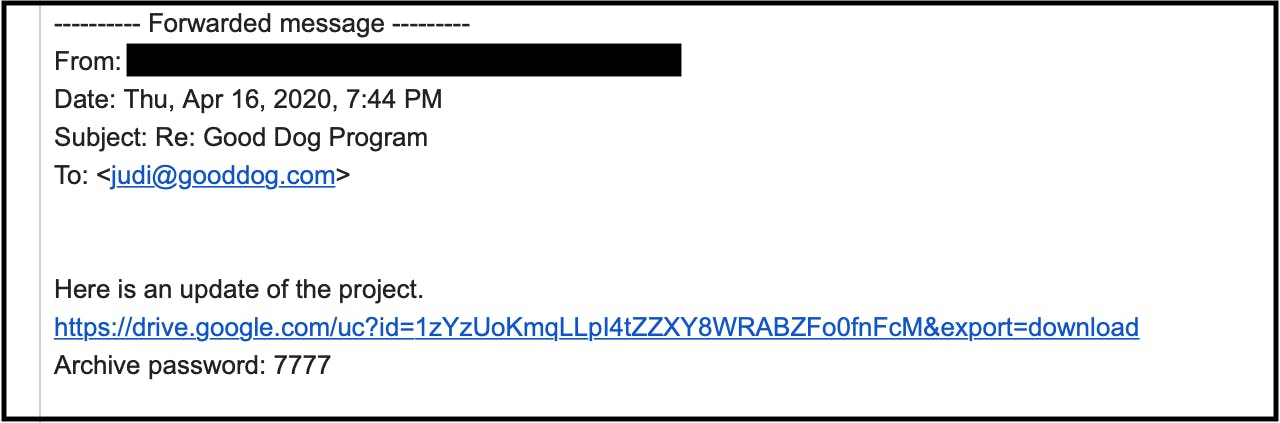
We became aware of a phishing scam in which the recipients receive what resembles a Google Drive link that requires a password or code. You can see an example of this scam below. Please remember not to click on any suspicious links from people you don't trust and remember to reset your email account password if a scam like this is sent from what appears to be your email address!
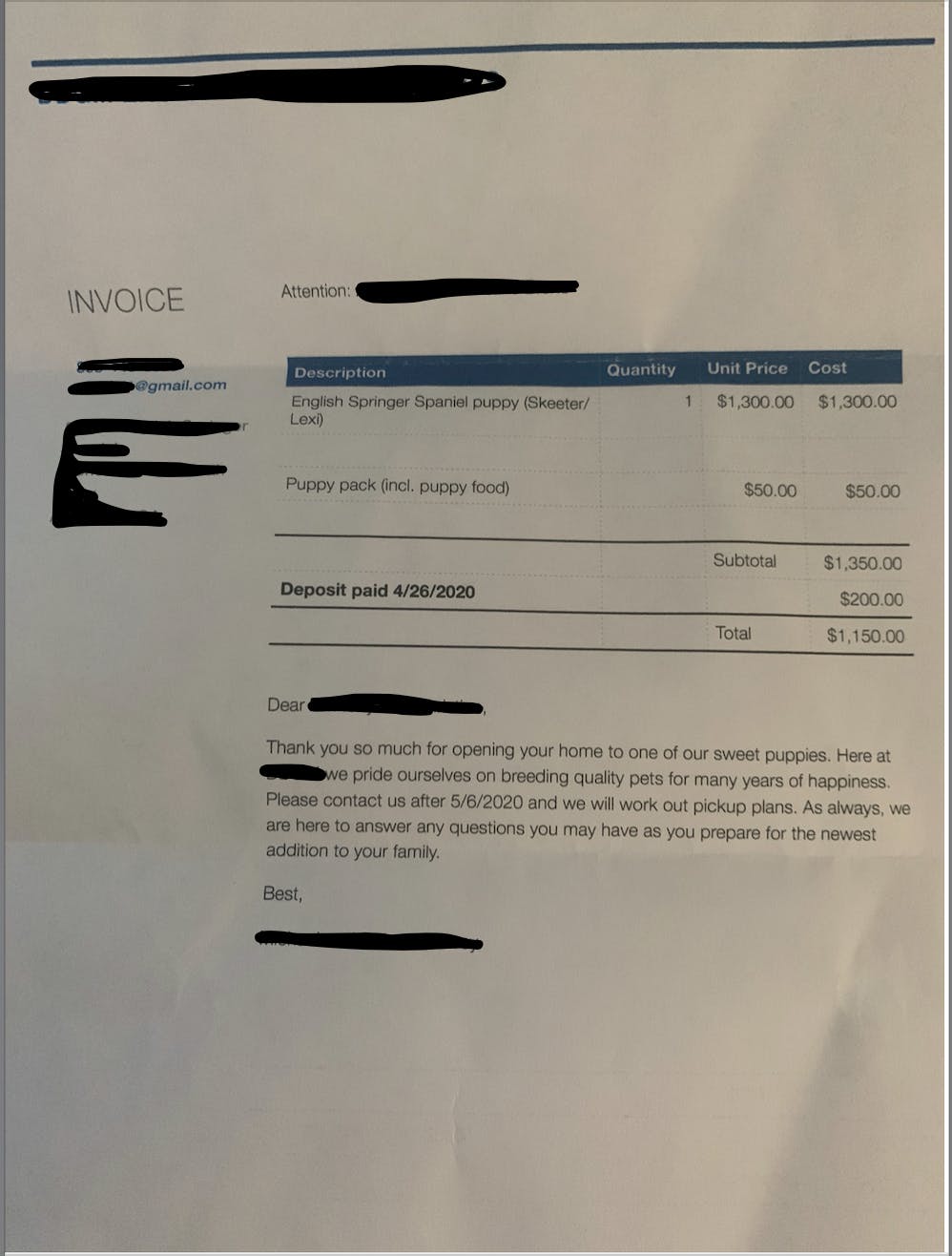
We also recently helped one of our breeders who believed her buyer was the victim of a scam. The buyer received a paper invoice in the mail that said it was from the breeder, though the breeder had never sent such an invoice. The buyer immediately reached out to the breeder who confirmed she had not sent the invoice and that the buyer should not reach out to or pay the contact listed on the invoice. This demonstrates just how important clear lines of communication between breeders and buyers are! You can see an example of this mailed paper invoice scam below.
We also recently helped Jessica Sammons from Rocking LJ Breeding who had her website content stolen and used by a scam site to defraud the public. Jessica immediately contacted Good Dog to inform us of the situation, and also contacted local law enforcement and the FBI’s Cyber Division. Good Dog was able to have the scam site disabled and Jessica’s content removed.
Jessica offered some advice to other breeders about how she helps safeguard her breeding program and buyers against scams. First, Jessica requires that all puppy buyer applicants (whether they contact Jessica through Good Dog or elsewhere) fill out an application through Good Dog and make all deposits through Good Dog. Jessica believes this streamlined approach ensures that all potential puppy buyers know that they are doing business with Rocking LJ Breeding (and not a scam site impersonating the breeding program), and that potential buyers can feel confident when paying Rocking LJ Breeding through Good Dog because Good Dog offers a safe and secure payment platform and stands behind breeders and their buyers who use it. Jessica also recommended that breeders use whatever resources available to them, including free legal support available through Good Dog, if they believe they are a victim of a scam.
What to do if you believe you are the victim of a scam
If you believe you have been the victim of a scam, you should report it to the BBB Scam Tracker and the Federal Trade Commission. You also can report it to petscams.com, which catalogs puppy scammers, tracks complaints and endeavors to get fraudulent pet sales websites taken down. And you can always reach out to legal@gooddog.com for immediate assistance if you believe you have been scammed. For more information, you can also check out the recording of Good Dog’s Good Breeder Webinar on Defense Against Scams to learn how to protect yourself from online scammers, what steps you can take to hold scammers accountable in the event you are targeted, and about the free services Good Dog provides to help safeguard breeder’s reputations and intellectual property.

Transcription
Cat Matloub [0:02] Thank you all so, so much for joining us this evening. We’re always so grateful for your time. I know how valuable it is. We love these opportunities to chat with you all and answer your questions. This week, what we’ll be talking about is scams and the unfortunate reality that what we’re seeing out there is an increase in scams across the board. People trying to take advantage of the fact that a lot of folks are feeling anxious and vulnerable right now and may even be expecting to get some funds from the government, or something like that, and so they’re not as primed for thinking about being careful with respect to who they’re sharing their information with. That was a large part of the impetus for us wanting to have a topic around this. It’s also obviously something I’m sure you all are at least familiar with the prevalence of in the dog world, generally: the high percentage of scams that we see in, particularly, the online dog world, even before Covid. I think there’s a couple of different topics that we’re going to touch on here, all of which really are around the topic of protection and of making sure that you’re empowered and informed and know how to protect yourself and also to know what actions to take if your privacy or your intellectual property has been violated. If you’ve had something stolen, what you can do about that. Also, just talking through some of the different contexts and circumstances that typically we see patterns of with scams, so you can know and be primed and on the lookout for those. In the past couple of months, we’ve seen reports by the Better Business Bureau, Federal Trade Commission, the Department of Social Security, ConEdison—all of which are reporting a huge increase in scams, whether it’s robo-calls or people fraudulently representing these different organizations. That’s the starting place for this. I’m excited because I think we can hopefully help you all feel a lot better equipped and able to know how to defend yourself and what actions to take. That leads me right into Monica, who will be talking about some of those general protections against scams that you can take. Take it away, Monica.
Monica DeBosscher [03:17] Thanks, Cat. I think as we’re going over these, they all sort of seem like common sense, sort of, just pieces of advice. But I think it’s important to remember that when you’re in the middle of a scam, it’s hard to think about these common sense things that we all know. I think the first thing is really to just be alert to the fact that scams exist. They happen to everyone. As Cat said, they’ve really increased right now. No one is immune to them. Just generally being cautious, especially during this time, is a really important thing to do. Whenever you’re dealing with anyone you don’t really know, if you’re contacted by a friend or an acquaintance that doesn’t quite seem right or that doesn’t seem like someone you’re aware of, you should just be really cautious. And if something feels a little off to you, it probably is. So go with your gut.
If you are contacted by someone you’re not sure you know or by a company or by a government agency that you’re not typically engaging with, you should really take some time to do your own research about them. Do some online research about them, just to confirm that you are speaking to the person you think you are. I think a good example is if someone calls you over the phone and says they’re from the IRS and they need your bank account info so they can send you a stimulus check from the government, you might just want to do a quick Google search: Is the IRS calling people to get their bank account info to send a check? If you’re being scammed, there are definitely a lot of other people who are also being scammed, and you’ll be able to find it online. You’ll be able to protect yourself and not fall prey to that same scam. I think it’s sort of the same way you all probably protect yourself in your screening processes with buyers. So if a potential buyer contacts you, it’s a good process to check their social media, find their LinkedIn—confirm that the person you’re speaking to is really who they say they are.
I think another one that’s coming up a lot right now with the stimulus checks being sent out and Covid updates are a lot of scam texts and emails. If you’re getting texts and emails from numbers or addresses that you don’t know and they have links or attachments, just don’t click on them. If it seems even a little fishy, just delete it. Don’t take the risk and click on something, exposing yourself to any kind of virus or scam.
I think another important one is to keep your personal details secure. Shred your bills. Shred important documents (your tax returns!) before you throw them out. You don’t want anyone to be able to get your personal details. You want to keep your passwords and PIN numbers in a safe place. It’s probably not a great idea to write all of your passwords and put them in a pad right next to your computer. You want to protect yourself a bit more than that.
I think we’re all big social media users and you want to be really cognizant of what you’re sharing on social media, particularly on Facebook. If you’re sharing a lot of personal information, if your privacy settings aren’t secure and you’re sharing things publicly, it’s really easy to open yourself up to a scam. People can get personal details about you. That’s a way that they can pretend to know you and loop you into a scam. So you just want to be sure that you’re sharing what you’re comfortable sharing (which hopefully is not much personal information because it is online) and that your privacy settings are set securely, so that you’re only sharing them with your friends and your family and your network who you really know.
You also want to be sure to keep your mobile devices, your computer, and all of those things secure. Your laptop, your phone—they should all be password protected, so people can’t just get into them. Your WiFi network that you’re using at home, that should be password protected. You’ll want to be sure if you go to a public place and you’re using their WiFi network that you’re not accessing personal information there that someone could easily break into the network and get. So if I’m going to a Starbucks and I sign onto their WiFi, I probably don’t want to go on my online banking network or even on my PayPal account. It’s really easy for scammers to get into those networks, so you want to protect yourself there.
I think the last thing to mention is to be really wary of unusual payment requests. If you’re in a situation where you’re the buyer (if you’re buying something online, maybe through Craigslist), scammers will often ask you to pay in unusual ways. So maybe with a gift card, a preloaded debit card, iTunes cards. You should only be paying people in legitimate ways, unless they’re people you know. And if people are asking to be paid in these strange ways, it’s a pretty good guess that they are a scam.
You also want to think about how you and your buyers are paying. Credit cards are probably one of the most secure ways to pay. They have significant fraud protection built in. If someone steals my credit card and goes on a shopping spree, my credit card company is going to protect me. They’re not going to make me pay for those fraudulent charges. But if I’m using something like Venmo or Facebook Pay, there’s just no protection there. So, just be cognizant that using those kinds of forms of payment, you’re not protected. And you want to be sure that, if you’re doing any kind of business with someone you’re not typically engaging with, just pay in the way you’ll be most protected.
Again, they seem very common sense. So we should all remember them when we’re in the middle of something that seems a little fishy. Cat, do you want to touch on how scams are sort of affecting the dog world and possibly our breeders?
Cat Matloub [9:33] Yeah, so as I’m sure you’re familiar with… Examples of scams both on the breeder side of things as well as on the puppy buyer side of things: I think last year the FDC had 111,000 reports to them (most incidents are not reported, so that’s a fraction of the total instances of money exchanging hands online and no dog ever being received). That coupled with what we’re seeing recently is they’re now estimating that 80% of all online pet ads are fraudulent. That’s kind of what the puppy buyers are up against. And then on the breeder side of things, we’ve started to see new and different kinds of behavior where scammers are trying to send more money to someone than they owe so that they can kind of move the money around. So what we’ve seen is literally scammers offering to send breeders $4,000 for a $2,000 dog. It seems like why would you [worry]… because they’re the ones trying to give you money? There’s an explanation about how that money needs to get somewhere else, and someone needs to give it to someone. Obviously there’s also, depending on the payment method that you use, things like fraudulent chargebacks or cancelled payments where, after the fact, the buyer can pull out from that. Obviously, bounced checks. Again, the odd payment requests and the odd methods. And the other thing that I’ll say, which I think emphasizes Monica’s point that these things all—when we’re sitting here talking about them—sound obvious, but the way that they’re successful is that the scammer is able to incite a level of anxiety and urgency and make you feel bad. Whatever the circumstances are, they make you feel bullied into doing something or pressured. If you feel pressured, that’s a number one sign that it’s a scam. I know you guys are amazing and wonderful, and so you’re inclined to be kind and that’s awesome, but if you’re starting to feel pressure of any kind, then it’s a real red flag. Again, emphasizing Monica’s point: we’re always here for you. You can always come to Good Dog. You can always email us. You can always call us. You can text us. We can help you figure out what’s going on. Those are some of the examples that we’ve seen. What will be really hopefully interesting and helpful for some of you as well is Monica recently worked with one of our breeders, Jessica, who is on this webinar as well and had an experience around this, so we’re going to turn it over to the two of them, so you guys can really see what we’re talking about and what we’re seeing happening in our community.
Monica DeBosscher [13:08] Perfect. Jessica, are you there?
Jessica Sammons [13:21] I am!
Monica DeBosscher [13:24] Amazing! Jessica, thank you so much for joining. Do you want to just take a second and introduce yourself to the group?
Jessica Sammons [13:46] Yeah, my husband and I have Rocking LJ Breeding. We have Corgis. We’re pretty new into this breeding world. We’re only on our third litter. So, all of this is new to us. To start out and have this experience right off the bat was a little bit discouraging, but we were able to work through it, and Good Dog was amazing to help us from the beginning, when all of this started, about three or four weeks ago.
Monica DeBosscher [14:23] Thank you so much for saying that, Jessica. I know we’ll really get into the scam that happened a couple of weeks ago, but before this, had you had any sort of issues with scammers or was this your first issue?
Jessica Sammons [14:37] No, we had never had any issues. This was the very first. We started the base of our breeding on Facebook with a breeding profile, and then on Instagram. We had a very small following, until we got connected with Good Dog, and it’s expanded from there. We didn’t have a lot of communications with other outside—besides our friends and family. And they had shared our Facebook page amongst their friends and family, so pretty small. We’re not real, real big in comparison to some other breeders who’ve been around for a long time.
Monica DeBosscher [15:19] That makes sense. Now that you’re growing, it’s something that you’ll have to be a bit more cognizant of, I would guess. So, can you tell us a little about this most recent experience? I think you were contacted by a buyer, right? He came across a scam site that was stealing some of your photos.
Jessica Sammons [15:35] Yeah, I had been messaged by someone on our Facebook breeding page, asking some odd questions. It started out by asking specific travel questions. They were in Canada and must have been trying to purchase a dog in the United States, I would assume. They somehow came across our Good Dog breeding page, and that’s where they found our pictures that were linked to the website that they had made a payment to and not received the dog from. That’s how the correlation came together, through the photos that they had seen and then they got onto our Good Dog page and messaged us through our Facebook link.
Monica DeBosscher [16:30] So they contacted you after they had made a payment to these scammers.
Jessica Sammons [16:35] Correct. They were helpful. They were willing to give us information and show us where the website was, so we could also look at it and see what they were talking about. I think that was the most helpful part of the conversation. We were able to go directly to where they had been scammed, so we had a trail to go back through to help in figuring out what to do.
Monica DeBosscher [17:06] That makes sense. When this buyer contacted you, what were some of the first steps that you took to have these photos taken down and to protect yourself and this buyer?
Jessica Sammons [17:18] The first thing we did was actually contact our Good Dog rep that’s helped us from the beginning. From interview processing, getting everything set up, the contact we have has been awesome. He’s helped us with other just general breeding questions and how we should take care of certain things just to be good in our business.
Monica DeBosscher [17:43] Is this Trevor?
Jessica Sammons [17:44] It is Trevor! Yeah.
Monica DeBosscher [17:47] Oh good! We’ll have to tell him.
Jessica Sammons [17:49] He’s been awesome. We’ve had lots of conversations. He’s been so, so helpful. I was beside myself. I had so many emotions that afternoon. I was angry that they had stolen pictures of my sons, my husband—ultimately, pictures of my family—and put them on this website. And he was so understanding and helpful and helped us sort it out the next day. (Because this happened on a Sunday.) We contacted our local law enforcement. They referred us to make a report on the FBI Internet Scam site. We never did hear back from them. But Good Dog continued, through their Legal Department. You guys were the ones that were able to get our pictures taken down and the website closed.
Monica DeBosscher [18:44] Amazing.
Cat Matloub [18:47] That was Monica’s.
Monica DeBosscher [18:50] We had to have the fraudulent site taken down!
Cat Matloub [18:56] We take so much satisfaction out of being able to shut these websites down, because they are the very essence of what’s wrong with the online dog world, and it sickens us. We derive a lot of satisfaction out of being able to bring the hammer down whenever we can. It’s a good win–win for you guys and for Monica.
Monica DeBosscher [19:25] Well especially if they had taken photos of your family! And they had actually scammed someone out of money. It’s awful. I know that you and I have spoken about it, but I think you said that you take a lot of steps—all the steps that you can—to protect yourself and your buyers, Jessica, so that they have confidence that they’re doing business with you, and not someone pretending to be you. Could you talk to us a bit about those, just to give our breeders some ideas?
Jessica Sammons [19:58] We love our Good Dog breeding page that you guys have for us, and we make it a requirement that whether they’re family, friends, or someone we don’t know, they are required to fill out a puppy application. We won’t continue a conversation with someone if they are unwilling to fill that out. Then it’ll be passed through the process, and then ultimately, we get to look at that. We feel like that application is so important, and we feel so blessed that you guys monitor those before we get them. That’s so helpful. Once they’re approved and we’ve decided that we want to work with them, we will only accept a deposit on a puppy through the Good Dog Pay. We explain to them that that’s a secure platform, and we can guarantee that they are doing business with a legitimate breeder and that they will receive a puppy. We have given our dog owners options to pay either through the Good Dog when they purchase the puppy or cash. After this experience, we’ve talked, and I think we’re going to make everybody pay directly through the Good Dog and not give them another option, just for the extra security for us and for them.
Monica DeBosscher [21:24] I think that is so smart. You’re taking all the steps you can. It’s just so hard when people are online. It’s so hard to know who they’re dealing with and if they can feel secure, and I feel like you’re really trying to do everything you can to protect not only yourself but the people who are interested in buying a puppy from you. You mentioned using the Good Dog application and using Good Dog Pay, both of which I think are really great ways to protect you and your buyers. Are there any other Good Dog features that you might recommend that breeders can look into to help protect themselves?
Jessica Sammons [22:00] Those are the only ones that we use. We’re fairly new, so we haven’t gotten to use all of the options I’m sure that are available. We are actually open to hearing other stuff that you guys have that would even better protect us, because we’re still learning. We feel like we can change and do better, and having this support system behind us is just awesome.
Monica DeBosscher [22:31] I think one of the biggest things that I think Good Dog offers that you mentioned is if you feel like you’ve been the victim of a scam or one of your buyers has been scammed, I think just reaching out to us immediately is really key. Cat and I are both lawyers. We have a lot of experience with scammers. Like she said, we really like to have these scam websites taken down, so I would encourage anyone who thinks that they’ve been the victim of a scam to just get in touch with us immediately and we can help. You’ve given us lots of great advice, Jessica. We’re so happy you were able to come. Do you have any other advice for breeders that you might want to share? (Although you’ve already shared so much!)
Jessica Sammons [23:17] In the last three weeks, we have had a huge amount of puppy applications coming through our program to the point that we’ll never be able to fulfill them in a timely manner. We only have two adult females right now, so we can’t even come close. But we have been talking to everyone and really encouraging them to only use Good Dog breeders. Really, really getting out there that there are scams and to be so careful. Even if we can’t help you in our breeding program, there’s lots of awesome breeders on the Good Dog breeding program. Coming together and helping each other. Even if you can’t provide a puppy, have somebody else in your breed. Get to know them. Try to really get some good relationships, so you can all work together. It’s one of our biggest things that we’re really trying to put out there for people. We know we can’t help these people because we’ll never have enough puppies. But if everybody in the Good Dog community can really work together and help as many puppy buyers as possible, that would be our goal in our program.
Monica DeBosscher [24:30] That’s incredible, Jessica. I love what you said. I love having this community. I hope having these webinars and our Facebook group really gives all of our breeders a chance to make those connections and come together and support each other. It’s really amazing. Cat, Judi—do you have anything else for Jessica?
Judi Stella [24:52] No, but thank you so much, Jessica, for coming on and telling your story. It’s very helpful. And I love that you are part of the community and recognize the benefits of being part of the community. It’s great.
Cat Matloub [25:05] Exactly what you just explained: the time that you spend educating people and trying to help folks and trying to connect them with good breeders, that was the inspiration for Good Dog. We saw breeders like that. We saw how many amazing, good breeders there were out there who individually—day after day, week after week, for years—were spending the time doing that and helping puppy buyers on a one-to-one. I think it’s really powerful to think about how we can hopefully light a fire under that community with technology, using this as a way to really bring the community together even more and be more connected. It’s just amazing. Jessica, we’re so blessed to have you in our community. We really appreciate you sharing your story. It was a very obviously unfortunate thing to happen, but a nice opportunity for us to get to know you more, Jessica.
I’ll respond to a couple of questions. How do you know if someone has stolen your pictures or other information? Typically, it’s just if someone sees it. If we see it, or if a puppy buyer potentially sees it and then they flag it for you because they’re confused. Sometimes in our screening, we’ll identify it. We’ve had people come to us and say, “Hey, so and so just happened to be on this site and noticed my picture. Will you help me get it taken down?”
Watermarking! I just Slacked around a link to an article on Good Dog. This is actually a pretty straightforward step-by-step process for getting pictures taken down and websites taken down. We’ve actually gotten so quick that now the fastest we’ve done is in less than 24 hours, we can have something taken down. The more relationships we develop with the websites’ registrars, the quicker they respond to us. I encourage all of you to take a look through this guide, but obviously this is something that can be tricky to figure out and we are here to help. Even though this is up there, reach out to us! But basically, so that you guys know, if you take a look through it, it’s numbered steps. The process to get the information down that we’ve found to be most effective is you go to a website that allows you to search for the registrar of the offending website, the website where the images or the photos are appearing that have been stolen from you. You use this online tool to find the registrar, who the registrar is, and then you look at the registrar’s policies. They have policies on how you can use their domains, their URLs. Basically what you do is you follow the steps set forth in their policy to eventually lodge a complaint. You lodge a complaint saying, “This person has infringed on my intellectual property.” It walks you through very straightforward steps: “Put a link to your website here. Put a link to the offending website here. Take a screenshot of the image that’s from your website here. Take a screenshot of the image from the offending website here.” Again, I know that for some of you that is going to sound like foreign language, so don’t worry about it! Take a look through but always feel free to just come to us, and we can handle that for you. But, like I said, we have found this to be the fastest, quickest way. Please feel free to point breeders towards that and pull us in for help at any time.
Aw, you guys are the best! Good Dog Pay! Fantastic question. It’s actually a very opportune time to bring it up. As some of you may know, as some of you may have used, we have had payment in a pilot program mode for a while. I apologize if I’m repeating myself, but the way that our website is set up is sort of similar to Airbnb in that people who come to our site (puppy buyers) and pay through our platform (pay through Good Dog), if they and their breeder decide that that’s what they want to do, then the puppy buyer will pay a vetting and support fee. That fee goes to help us run Good Dog and vet our breeders. It’s really at the core of our approach as a company, because it represents the restructuring of the system, the restructuring of things in the dog world. You have puppy buyers actually supporting and compensating—money going towards the good sources, to the good breeders. We see a huge, huge willingness on the puppy buyer side of things for that peace of mind, for that security. When they’re spending thousands of dollars online, and particularly in today’s world, there’s such anxiety and there’s such a lack of peace of mind. What our approach is is payment through Good Dog, which is the first electronic payment method built specifically for responsible dog breeders. It has all sorts of details that are relevant (or might be relevant) for you. You can assign a litter, you can assign a puppy, you can mark it as a deposit, you can mark it as the full price of the dog. There’s automatic record-keeping, invoicing, receipts, what have you. And then we stand behind and protect the payment 100% for both you and your puppy buyer. Your puppy buyer pays the vetting and support fee, and then they get the peace of mind knowing that there’s a company standing behind that thousands of dollars. We also provide lifetime support. And then you, as the breeder, don’t have to worry about anything: fraudulent chargebacks or cancelled payments or anything like that. We also provide mediation services for free for the life of the dog. Where we are now is we’ve had payment in pilot program mode because everything that we do is really built around feedback. We’re always learning, and we’re learning from you. A couple of the things that we are figuring out in pilot program mode right now before hopefully launching payment in the next few weeks to our whole community (which we’re super, super excited about because we’ve had a real kick in the butt with everything that’s going on with scams). We’ve had puppy buyers coming to us left, right, and center saying, “Hey, we want to pay with payment through your system so it’s safe and secure.” We’re working on a couple of things to make sure that that is going to be something that you all (and your puppy buyers) love.
A couple of different things that I’m actually really curious to get your feedback on are: Is this something you guys would be interested in using? If so, one of the questions that we’re working out is what that fee would be. Right now, in pilot program mode, the fee has been ranging from 6–9% of the price of the dog. It varies with the price of the dog. But what we’re trying to figure out is: Is a percentage amount the right way to do it? Our protection amount obviously varies based on the price of the dog, so Good Dog is on the hook for more when it’s a $3,000 dog than a $1,000 dog. Is percentage the right way to think about it, or would it be more clear to have it be a dollar amount rather than a percentage? If so, what percentage sounds reasonable? What fee amount sounds reasonable to you guys? We see this huge demand on the puppy buyer side, but we’re also cognizant of you guys having your own way of doing things, so we want to make sure it’s something that you would like or that your puppy buyers would like.
We’ll take a poll! The puppy buyer pays the fee. So breeders do not pay anything. Breeders cannot pay to be a part of our community. That’s why the restructuring here is: we see a huge demand from well-intentioned puppy buyers who want to do the right thing, who understand. They want to pay more to get a dog in the right way. This allows them to do that. I think a set fee to buyers.
One other way to think about it is: we could do a dollar amount. Say, a $100 fee for a dog up to $1,500, and then a $150 fee for a dog that costs up to $3,000. And then above $3,000, call it $175. That’s another way where we can use a dollar amount to have it be a little clearer, but then also have it be tiered. Different breeds have different price points. That would make sense to have tiered, set amounts. Awesome.
Let me ask you this: Is there anything that would make you not want to use Good Dog, and are there any key questions you would have about it that you want to know? Things that would make you not want to use it.
With respect to what breeders report to their breeding business, that’s completely their own prerogative. We don’t have anything to do with that. We just help make those connections.
What we charge buyers for the services is kind of exactly what we’re talking about. It’ll be a fee that, if they pay through Good Dog, they’ll pay that vetting and support fee.
How do you transfer the money to breeders? We use something called a payment processer. It’s called Stripe. If you think about any website where you go and you pay for something on the site… Airbnb! If you book something there, they have a payment processor behind the scenes that’s processing that payment for you, and that payment is going directly to the host. All we do is provide that facilitation, and then the transaction is directly between you and the puppy buyer.
The thing about PayPal is, because dog sales are not technically endorsed on their platform, you don’t get any protection with it. Yes, you can do friend to friend and then not pay a fee, but then there’s no recourse if gosh-forbid something happens and there’s an issue with that payment and it gets cancelled.
Invoicing is automatic. It’s all automatic. We’ll get you set up with Good Dog Pay, so that you can see if you’re interested. I can show you guys a demo of what it looks like.
What if a buyer is unsatisfied and wants to reverse the charge? They can’t do that. They can come to us, and they can plead their case, and they can explain. We stand behind our breeders, but we provide mediation and support to basically make sure that both sides are happy. What we’ve seen in a lot of cases already is just the sheer fact of having an objective third party involved in the conversation… Obviously dogs are so emotional, especially if you’re talking about a sick dog. We’ve seen the unfortunate cases where puppy buyers get a puppy and the puppy is sick, and it’s totally fine, but it’s unfortunately sometimes par for the course when a dog’s in transit. They’re stressed. The environment has changes. They’re expose to different things. It’s nothing the breeder’s done. We’ve seen puppy buyers react negatively. To be able to explain to them, talk to them, talk to their vet, make sure they understand… I can’t give you an absolute to “What if a buyer is unsatisfied and wants to reverse the charge?” I would say if the breeder provided them with a different dog, if their dog doesn’t meet their specifications… it’s about whatever was agreed to between the breeder and the buyer. It’s about whether or not the breeder has delivered to the puppy buyer what they said that would do. We always stand behind our breeders, and we’ll always make it right. Even if that means we have to take the fall. Maybe Good Dog gives some compensation to the puppy buyer, like, “Thank you very much. Let’s just have this calm down.” Then we’ll step in and we’ll have your back in that way, too.
Initial deposits—same thing. Venmo, Zelle—they’re not. In fact, actually, we had a scammer recently who was online targeting dog people using Zelle, and we actually called Zelle, and we were on the phone with Zelle when this scammer who we were trying to take down called back in. Zelle was basically like, “We can’t do anything about it.” These no fee ones that are convenient, you don’t get any security with them.
Monica DeBosscher [41:29] On Venmo and Facebook Pay, we see lots of issues with breeders. There are no buyer protections at all when it comes to those.
Cat Matloub [41:40] The difference here, when you ask about how it differs from Stripe, is it’s not Venmo and Zelle for Stripe. It’s what Venmo and Zelle offers, versus what Good Dog offers. Good Dog uses Stripe to process the payments, but Good Dog itself as an organization stands behind and guarantees the payments ourselves. It’s not Stripe doing it. That’s us. That’s what the difference is here. There is a third party that’s putting our stamp of approval and standing behind payments. That’s the key difference.
With Good Dog Pay, there’s definitely deposits. Like I said, you’ll see (when we roll it out for you guys) there’s different records where you indicate what payments are, whether it was for a deposit, which puppy it was for, if it was a full transaction—and all of these things can automatically be recorded and saved for you in your records, in your Good Breeder dashboard, and also automatically when you click Request Payment for a puppy buyer of yours, they will automatically get that notification. It will pop up super easily. They’ll be able to click a button and pay you, and then both you and that puppy buyer will automatically have an invoice in your email inboxes. It’s also really hoping to help with record keeping as well.
Buyers can use a credit card through Good Dog Pay, or they can use a bank account. Debit or credit. For you (as the breeder), we also offer alternative payout methods, or we plan to, which means that even if your puppy buyer wants to pay with a credit card, if you would rather get money in the form of a check, we can actually do that for you. We literally will make it whatever is best for you because, like I said, we know that you have (in a lot of cases) your own way of doing things. We just want to be a help for that, if we can.
When would the fee apply? That’s something we’re figuring out. I think the way it’s going to work is it’ll be a very small fee, probably just the processing fee for a deposit. It’ll be a very small amount, $5–$10 or something for a deposit. I’ll have to double-check on that. Obviously, it depends on the deposit. But I think it’ll be an amount, and it’ll be a nominal amount for that, to pay for the processing fee that we have to pay. Then the full fee will be paid upon payment of the full price of the dog. What that means is a couple of things. Everyone can always come to our website and find breeders and not pay through us. That’s still an option. Again, we’ve seen such a desire and we think we can add so much value here; we’ve seen a lot of interest by the puppy buyers. But we want to emphasize that this is not mandatory. We know that you guys have puppy buyers you may have had from before that don’t want to use this—whatever the reason is. From our perspective, we need to make enough to keep the lights on, but at the end of the day, if folks are coming to our site and finding good breeders and avoiding the bad ones, that’s our goal. I just want to emphasize that it’s an optional thing for breeders in our community.
Hopefully in 3 weeks [it will launch], although I told Lauren that’s crazy! (No, it’s not.) We move quickly. It’s all up and running. It’s just kind of figuring out how to make sure we deliver an amazing experience. One of the big, big things on our mind is we want to make sure that from a puppy buyer perspective, all of the information around the fee (what it is, what it means, what you get with it) is very transparent and very upfront and very clear. We’re doing some user testing and stuff like that to make sure that we feel really strong about that, but we are really eager to get it out there ASAP, particularly because of what we’re seeing. Of all times, it’s never been more critical because of what’s going on with Covid. We’ll 100% keep you posted, and I’m so excited that you guys are excited about it. From our perspective, it feels like one of the most immediate, tangible ways to push people away from bad sources and towards good, because it’s such a strong statement to have a badge of trust to the tune of thousands of dollars. It sends a pretty powerful message. For puppy buyers who see a breeder who doesn’t have that, they wonder why isn’t there an organization standing behind this program, putting their money where their mouth is? So we’re very excited about it, and I think it’ll also hopefully help with saving you guys time and record-keeping. Dealing with money is not the most pleasant thing in the world, so if we can make this a better part of the experience for everybody (secure, convenient), I think it’ll hopefully be really good.
Ah, yes, the fee. The buyer pays a vetting and support fee if they pay for a dog through our platform. The breeder never pays. Breeders cannot pay to be a part of Good Dog. They just have to meet our standards. The fee is currently in pilot program mode. It has been 6–9% of the price of the dog, varying with the price of the dog. We’re finalizing our approach before launching it to the community, and we’re debating moving to a dollar amount, tiered system to make it a little simpler.
I think, Judi, you’re up!
Judi Stella [48:14] Okay! So I think my part is going to be pretty quick. I just wanted to remind everybody to make sure that, along with all these other scam things and stealing pictures, people will steal your health tests and links to OFA and your OFA documents and genetic testing. And they will change names, and we’ve seen this quite frequently, sadly. So make sure that you save those documents as well. We love when breeders are transparent and post all of their health testing on their websites or on Good Dog, but we also want you to be really careful about that. If you could watermark your documents, that’s a good way to do it. If you don’t feel comfortable with that, it’s also something that we 100% understand, and we stand behind you. We do ask for verification often, and if it’s not on the website and somebody writes in or wants to verify, we do ask you for that. But we will keep that internal. We keep it really safe. We have all kinds of cyber security and those types of things. It will be kept to just the group of people that actually needs to see it. We will never tell anybody what the results of any of that testing is. What we will say is, “Yes, they are doing these tests,” and we leave how you’re utilizing those results within your breeding program up to you. I think that’s pretty much it. I just wanted to make a quick, little statement about that, just to make sure that you all know to keep your health testing private. If you need any help with anything, or if anybody ever questions that, if any buyers have questions about that and think that you’re not being upfront with them, let us know. We’re happy to mediate and explain that to them. I think that’s it. Just a quick, little blurb on health testing!
AKC registrations is another thing. Make sure you keep your AKC registration numbers private. We’ve heard of people stealing OFA X-rays and resubmitting them—like, stealing the image of the X-ray and resubmitting them to OFA as their own dogs. We’ve heard all kinds of things. Just assume the worst (sadly). Be really careful and make sure you keep your documents safe.
Monica DeBosscher [51:02] I feel like this webinar became a real downer.
Cat Matloub [51:06] Oh, yes, you definitely will be able to use Good Dog Pay with non-Good Dog buyers. Your representative (yes, Jessica mentioned her representative) is whoever did your screening interview, so I think they’re more formally going to be stepping into those roles as we keep growing and expanding altogether and with you. We’re growing as an organization as well, which is nice.
Judi Stella [51:48] I think heavy watermarking is one thing that’s a really good idea. And then also just removing your dog’s registration number. Don’t have all of that information on the document. You can just black out the registration number. Or, you can provide links to OFA, and that’s another way to do it. The other thing that you can do is—I mean, we want people to be transparent. We want puppy buyers to have access to this information. But just be careful about who you’re sending it to, if you’re emailing it to people. We have a lot of breeders that will show it to the puppy buyers when they come to visit or come to pick out a puppy. We can show them the documents at that time. They won’t have a copy of them; just physically show them the documents. That’s another option.
Cat Matloub [52:42] You have been screening folks and being careful, so we also don’t want to freak you out too much. You guys are smart. You’ve been doing this for a long time. Don’t get too freaked out. Don’t worry too much. Don’t always think the worst. No matter what, you guys can always come to us, and we can help sort things out as well.
That’s a really great idea. I hadn’t really thought about the watermarking that much until this conversation, and then I started realizing. I wonder how we can help with this generally, also.
These have been good questions for us. We’ll sync up internally and see if we can get some guidance on the best way for you guys to handle this, whether it’s a water mark feature that we can get out to all of you and it’ll provide some protection.
Judi Stella [54:00] I think we’ve seen all of it. Some people black out their registration number. Some people watermark it. Some people just have the documents available upon request. It’s just whatever you feel comfortable with. It’s just another layer of protection, honestly.
Cat Matloub [54:20] Exactly. I think it’s all about what you feel comfortable with. You can do any of this. Also you can even just—we used to call it redacting—where you insert a textbox on top of your document and PDF and then you fill it in with white or black or whatever to block out the markings. If you have any trouble figuring out how to do this, your Good Dog representative or any of us, you can send us a copy of it. We’ll watermark it or redact it or whatever and give it back to you and have you with a copy. Also, our homework is to talk to our product team and see about if there’s something we can actually offer additionally, maybe a systematized way of doing it.
Judi Stella [55:15] I think OFA links are secure too, right? That’s a public database and nobody can get the actual certificates from OFA, so if you are registering with OFA, posting links is a really safe way to do it.
Cat Matloub [55:34] Yeah. Awesome! Well, thank you all so, so much. Another amazing conversation. You guys have such awesome suggestions, and you make us think. It’s always so helpful to get your feedback and make sure that we’re thinking about things in the right way and thinking about the right things and making sure we’ve got watermarks in our view as well. As always, don’t hesitate to reach out with any follow-up questions. Also, please tell any of your breeder friends, if anyone outside of Good Dog ever has their information stolen or attacked or anything like that, they can absolutely come to us as well. We’re always, always here to help. A huge thank you to Jessica! Thank you so much, Jessica. We really appreciate your time. We really enjoyed chatting with all of you guys tonight. Thank you! Talk to you soon.