Straight from the Center of the Ring: Problem Solving in the Show Ring
Here are Laura Reeves' expert tips on solving some of the most common show ring problems.
Good Dog is on a mission to educate the public, support dog breeders, and promote canine health so we can give our dogs the world they deserve.
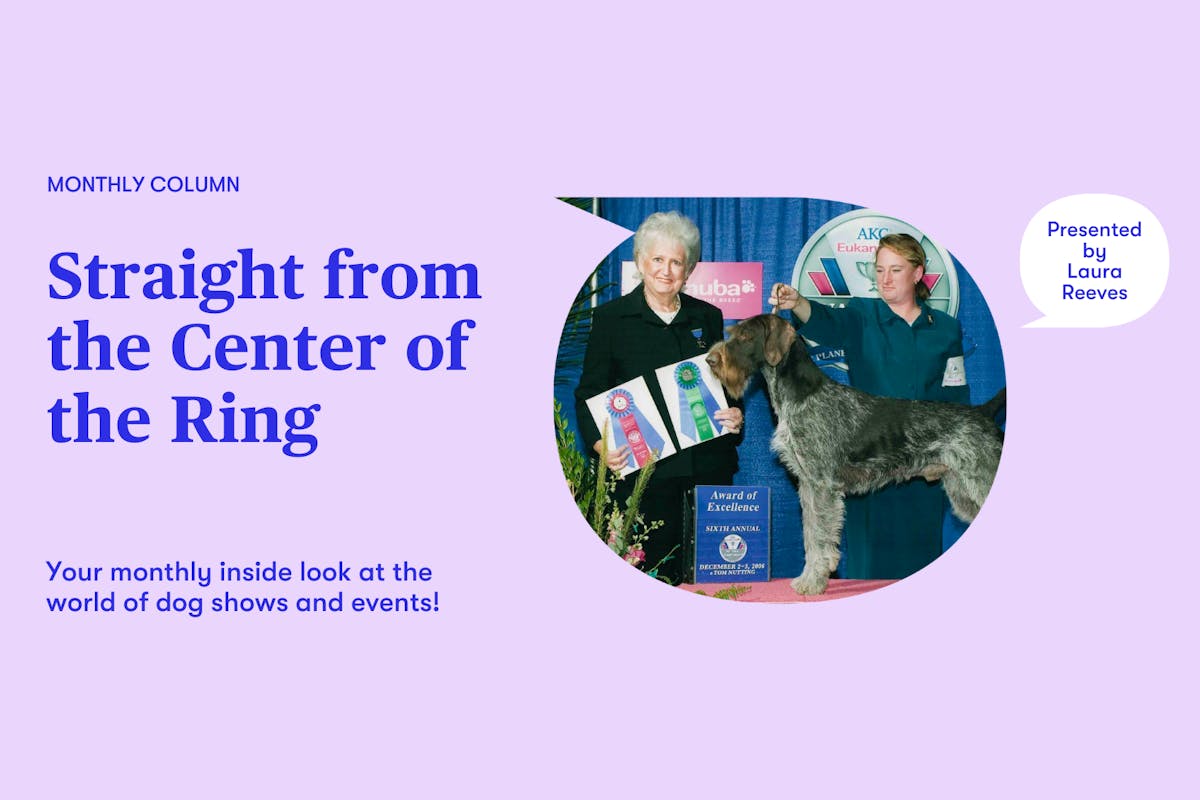
Good Dog is on a mission to educate the public, support dog breeders, and promote canine health so we can give our dogs the world they deserve.
Good Dog is on a mission to educate the public, support dog breeders, and promote canine health so we can give our dogs the world they deserve.

We are going to work through a couple of the most common problems that are encountered in the show ring. Anybody, and I mean anybody, from beginner to master, can run into these issues.
“Show me the bite, please”
One of the toughest things that people run into, particularly beginner exhibitors with new dogs, is how to show the bite and not have the dog pull away. Wrestling with your puppy to show the bite, not knowing what to do with the leash or collar, or how to let the judge see what they are looking for can be a hot mess.
The first problem is that it makes dog shows not fun. It's not fun for your dog, it's not fun for you, it's not fun for the judge. Secondly, this is going to make it more difficult for you to win because you’re not leaving a good first impression.
Join our Good Breeder community
Are you a responsible breeder? We'd love to recognize you. Connect directly with informed buyers, get access to free benefits, and more.
Prevention is the Best Cure
The best way to start is to prevent the problem in the first place. Dogs need to be trained from when they’re babies. Start with your puppy. Every single day you're checking the bite by very gently just lifting their lips, so that the concept of someone touching their mouth isn't bizarre.
If you have a breed that needs to have their mouth opened all the way, like a Doberman Pinscher or Rottweiler, or Chinese Shar-pei, where the judge needs to look at the color of the tongue, practice that also. Start practicing it as early as you can get your hands on the puppy. Prevention is 90 percent of the cure.
When the puppy is old enough, you can start taking him to a handling class. Show the bite, praise and give a treat. You are going to keep building on this like you do anything else, a little bit at a time.
Practice and Proof
The AKC strongly recommends the exhibitor show the bite rather than have the judge potentially spread germs by examining the mouth themselves. So, you need to know how to properly show the bite so that the judge can see the teeth.
Practice this at home and at the dog show. When the judge asks to see the bite, use your right hand to place the collar snugly behind the dog’s ears, hold the collar with the last three fingers of your right hand under the dog’s chin. Use your index finger and thumb on the lower jaw while your left hand tilts the dog’s muzzle up slightly and raises the flews.
It’s important to know if your breed requires the judge simply to see the intermeshing of the incisors (front teeth), sides or an open mouth. Each breed is different based on its standard. Some breeds, including Pugs and other brachycephalic breeds, require what’s called a “thumb exam” whereby the judge simply rests their thumb on the front of the dog’s mouth to verify the jaw is properly placed.
For a breed requiring side teeth to be shown, follow the above procedure, then use the left hand to lift the flews away, and show the judge’s side jaw first and then the off side. In an open mouth breed, follow all of those procedures and then use both hands to open the jaws sufficiently for the judge to see all of the teeth.
When you show the dog’s bite, how you hold the collar and leash, as well as your mental and physical body language, matter. If you're nervous about this, the dog is going to be nervous about it as well. Remember, what goes on in your head, what goes on in your gut, goes right down the leash.
Houston, We Have a Problem
When you get to that first dog show, if your dog goes sideways, (in other words we haven't managed prevention and we're now at the problem part) make a point of getting to the dog show early the next day. Ask every single human that you can find to go over your dog.
Each time you find a new person for this project, stack your dog up just like you're in the ring. Follow the 1,2,3,4,5 stacking process to reinforce the muscle memory for both of you. Ask your volunteer to approach the dog from the front. That's almost always going to be more comfortable for the dog than the judge that comes in from the side. If the dog fights with you or pulls away from this approach, just stop, turn the dog in a circle and restack. Avoid a correction. We want the dog to be more comfortable, not less comfortable. Managing your frustration becomes a big part of the puzzle.
Once the dog has done it right, praise and do it again. I try to have several different people in a row, with a break and reset the dog each time. My preference is to get three solid performances in a row, where the dog holds still and allows you to show the bite before you go in the ring.
Can't Touch This
If the dog is backing away from the entire exam, it might be that showing the bite is the issue, but it also might be simply that the dog isn’t comfortable. The cause or causes of the behavior vary. It might be that you are nervous. It might be that the dog lacks confidence. It might be how the judge is approaching the dog. All of these can come into play when a dog backs away from any part of the exam. We have to narrow that down to see what needs to be fixed.
A confident handler makes a confident dog. Unfortunately, the opposite is also true. I've had people tell me, ‘I'm not nervous in the ring,’ and I watch them tighten their hand on the collar when the judge comes to examine the dog. The dog is reacting to your nonverbal cues. If you're confident, comfortable, and secure, the dog is going to be much more liable to stand up and accept the examination from the judge.
There are occasionally judges who dogs find intimidating for many reasons. Some of these judges don't have good hands on the dogs. Some of the judges are just physically imposing. Some of these judges want to make direct, staring eye contact. These things happen and you need to be able to proof your dog to accept the examination from anyone. That's where your training and your confidence come in.
We've got a couple different things that we can do to mitigate when the dog is backing away. First, practice-- a lot. Happy practice. You are happy, your voice is happy and the dog is having a fun and positive experience. That is something that we can control. Then we don't have to let the circumstances of what else is going on around us impact our dog’s performance.
Second, giving the dog a “focus” point will help them overcome their concern about the exam. In a previous column and on our Facebook Live, I talked about the watch command. That's really useful in this particular situation. Proof your “watch” command away from home, at the dog show, wherever you go together.
Pro Tip:
Consistency is the best solution to training problems with any dog. Consistent means that if a behavior is unacceptable, it is always unacceptable and vice versa. For example, this weekend in your sweats you might say, ‘Yay good boy, good boy, jump up on me, hug me, mommy loves you’ and Monday morning when you come out in your work clothes the same behavior gets ‘Wait, no, no, bad dog, get off me you filthy beast.’ That doesn't work for a dog. They don't understand it. It is confusing and leads to insecurity because the dog never knows what’s right and what’s wrong. Consistency is probably the single most undervalued training skill that I can talk to you about.
We also need to think about the dogs we’re exhibiting. I used to get paid to fix a lot of problem behaviors, and I could usually solve most of those issues. When you have a dog that's shy, nervous, terrified, aggressive or any combination of that, and doesn't respond to a change in handling or training, we need to keep in mind that dog shows are about evaluating breeding stock.
If a dog can't adjust to the minimally invasive hands-on contact by a competent and friendly stranger, it's time to rethink whether they need to be shown and/or bred at all. We need to really consider temperament and the genetic component of it as we move forward in our breeding programs.
Pacing Movement
Next on the list of common problems that we run into is pacing. We talked a bit about this in last month’s Facebook Live about moving with your dog, so you can check that out on the Good Breeder Center Facebook page for more insight.
Pacing is what happens when you're moving a dog and instead of trotting nicely next to you, the dog is sort of lurching and rolling. Pacing is a mode of travel that is easy for some dogs. It might be the dog isn't built just right, or it might be that the dog’s just kind of lazy. When a dog paces, the legs on each side of the dog move forward at the same time. Rather than right front, left rear coming together and then left front, right rear, the dog will carry both the right front and the right rear and then the left front and the left rear together. When they're doing that, their body is shifting and their topline is going crazy. This isn't something that you want to have the judge see. You should be able to feel that on the leash. It's awkward and very obvious to an experienced observer.
Fixing a pacing dog involves giving a little bit of a lift to adjust his balance. You can do this by the leash and collar, just lift a little bit before you go. Both when you're training and when you're in the ring, if your dog paces, I recommend a courtesy turn.
What that means is after your exam, you're getting ready to move on your down and back, you go behind the judge, gather your leash, start your acceleration and by the time you are moving forward in the down part of the down and back, the dog should be moving in a proper, smooth manner.
I normally teach handlers to move their dogs in a 1, 2, 3… go and a gradual increase in speed. With the pacing dog, what you're trying for is 1, 2 … lift… go. With that big courtesy turn, ideally the “lift” happens behind the judge’s peripheral vision.