Eye certification for your dog through OFA
What you need to know about testing and registering dogs who are from breeds at risk.
by Dr. Mikel Delgado, PhD
The OFA Companion Animal Eye Registry (CAER) provides breeders with information regarding canine eye diseases. This helps breeders make informed breeding decisions and produce healthier dogs. Many of the diseases and disorders that affect the eyes are genetic and can be passed from parent to offspring.
Note: Registration of test results is imperative for advancing canine health. Data from health registries support research efforts into canine diseases, establish validated diagnostic criteria, and maintain the reported test results in a reliable public database. Registered data can be used to identify newly emerging conditions, monitor the efficacy of interventions in decreasing the prevalence of conditions, and help breeders make informed breeding decisions.
Step 1:
Visit the American College of Veterinary Ophthalmologists website at www.ACVO.org to find a board certified ophthalmologist near you. While scheduling the appointment ask if the veterinarian will be using the triplicate form or the online system. Be sure to create an account with OFA before your appointment: https://www.ofa.org/online
Step 2:
If using the triplicate form bring your dog’s information to the exam.
Note: Required information includes registration number, owner’s name and contact information, dog’s registered name, date of birth, sex, breed/variety, and if applicable, permanent identification (via microchip or tattoo).
Step 3:
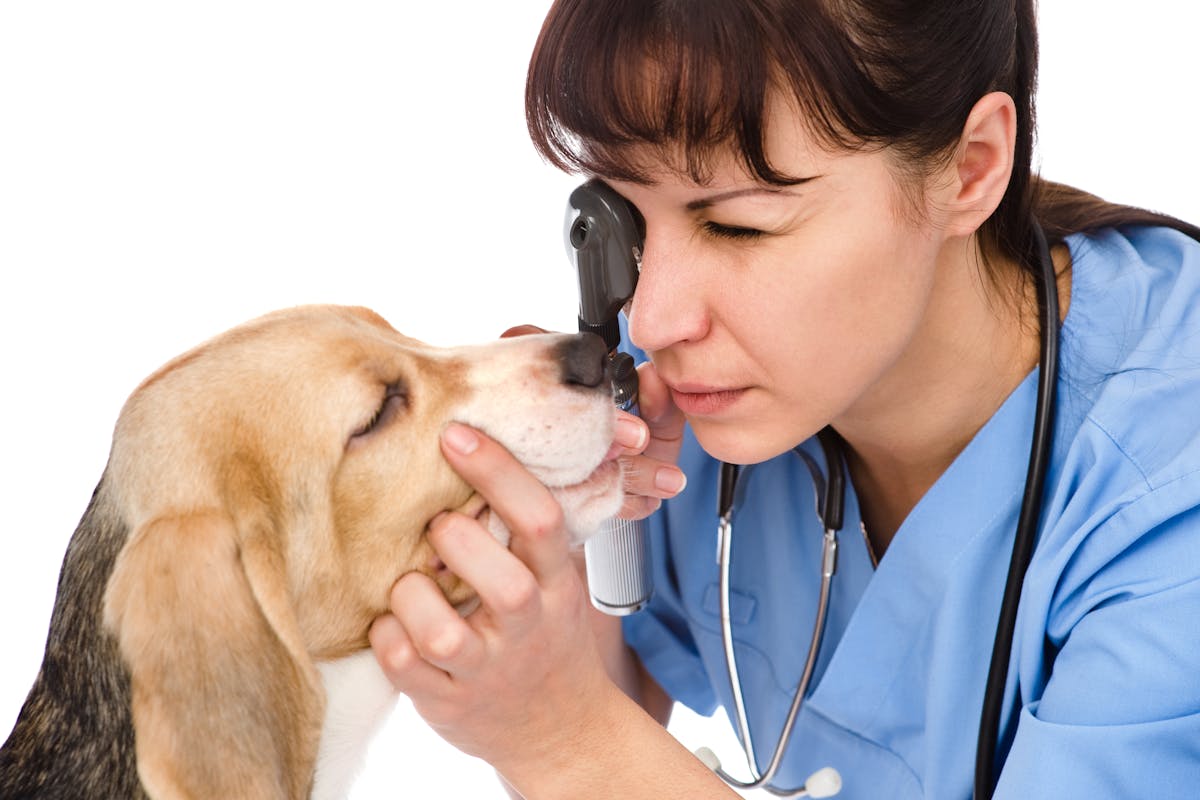
The veterinarian will place dilating eye drops in your dog’s eyes, then conduct a painless examination 30-40 minutes later.
Step 4:
The ophthalmologist will complete and submit the OFA Companion Animal Eye Registry (CAER) form, noting any abnormalities that were found.
Step 5:
Breeding advice will be offered based on guidelines established for that particular breed by the Genetics Committee of the American College of Veterinary Ophthalmologists and published in the Blue Book.
Step 6:
Once the OFA receives the form, the information will be added to the database to help monitor breed specific trends. This information will NOT be released on the OFA website, and will NOT result in a certification number unless the owner submits their copy of the form.
Note: The owner has the option of sending their copy of the form, along with appropriate payment, to the OFA for entry into the CAER. Dogs with passing results are issued certification numbers. A report is generated and emailed to the owner, and the results are published on the OFA website.
Important Information: Certification is valid for 12 months from the date of the eye exam. Annual re-examination is recommended.
Fees (as of July 2022):
- Initial Application (any age): $15 each dog
- Resubmission: $8 each dog
- There is no fee to register a dog with an abnormal exam result into the open database.
Further information:
- There is no minimum age requirement to perform an eye clearance exam on a dog (eyes must be open on a puppy). However, it is advised to check in with your parent club as each breed has different requirements for minimum age and frequency of eye certification.
- The eye exams are not a comprehensive ocular health examination, but rather an eye screening exam.
- Eye Certification exams do not entail measuring tear production, staining the eyes for the presence of corneal ulcers, or measuring intraocular pressures thus, dogs with goniodysgenesis, glaucoma, keratoconjunctivitis sicca, early lens luxation/subluxation or some early cases of progressive retinal atrophy might not be detected without further testing.
undefined - The diagnoses obtained during an OFA CAER exam refer only to the observable clinical appearance of an animal. Thus it is possible for a clinically normal animal to be a carrier (abnormal genotype) of genetic abnormalities.
- There are ten conditions that prevent eligibility for an OFA CAER Number, these conditions can be found on OFA’s CAER page. In general, the OFA does not recommend breeding dogs who are carriers for these conditions.
References
ACVO Genetics Committee. (2015). Ocular disorders presumed to be inherited in purebred dogs. In American College of Veterinary Ophthalmologists. aka "The Blue Book" which can be accessed at: https://www.ofa.org/wp-content/uploads/2016/09/Blue-Book-2015-8th-Edition.pdf

Join our Good Breeder community
Are you a responsible breeder? We'd love to recognize you. Connect directly with informed buyers, get access to free benefits, and more.