OFA examination and registration of osteochondrosis
A painful condition of the shoulder that is heritable in some dog breeds: what you need to know.
Good Dog is on a mission to educate the public, support dog breeders, and promote canine health so we can give our dogs the world they deserve.
Good Dog is on a mission to educate the public, support dog breeders, and promote canine health so we can give our dogs the world they deserve.
Good Dog is on a mission to educate the public, support dog breeders, and promote canine health so we can give our dogs the world they deserve.
by Dr. Mikel Delgado, PhD
How can osteochondroisis dessicans affect dogs?
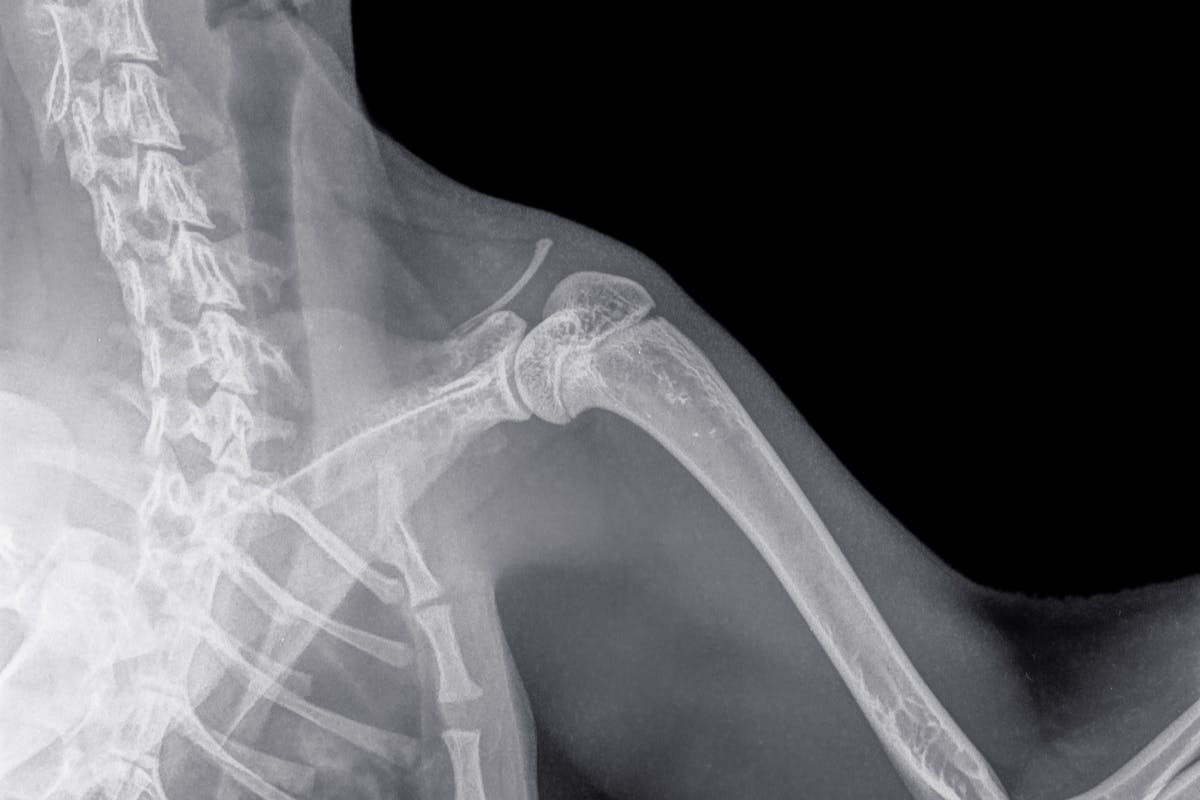
Shoulder osteochondrosis dessicans (OCD) is caused by a disruption in endochondral ossification (when cartilage is replaced by bone). The cartilage at the end of a bone becomes inflamed, thickened, and often separates from the underlying bone. This condition leads to pain, lameness and/or stiffness after exercise and/or rising, and eventually, osteoarthritis. OCD often improves after rest. Shoulder osteochondrosis dessicans is often observed in large, fast-growing dogs including Great Danes and Labrador Retrievers. OCD is more commonly observed in male than female dogs. The exact causes of OCD are unknown but genetics are thought to be a significant contributing factor, in addition to rapid growth, trauma, diet, and hormonal factors.
OCD typically impacts young dogs. Signs often develop between 4 and 8 months of age, and affected dogs are typically symptomatic by 12 months of age. Because it is expected to be heritable, dogs at risk should be screened prior to breeding; breeding dogs diagnosed with OCD is not recommended.
Shoulder clearances can be obtained through the Orthopedic Foundation for Animals (OFA). Dogs who are at least 12 months of age can receive a clearance and will be assigned a number in the OFA database. Dogs under 12 months of age can receive a consultation with OFA.
Screening requires a simple physical examination of dogs at least 12 months of age. A licensed veterinarian can take radiographs (x-rays) of both shoulders which will be reviewed by a radiologist at OFA. Dogs can be cleared, or be assessed as having unilateral OCD (one shoulder) or bilateral OCD (both shoulders).
Note: Registration of test results is imperative for advancing canine health. Data from health registries support research efforts into canine diseases, establish validated diagnostic criteria, and maintain the reported test results in a reliable public database. Registered data can be used to identify newly emerging conditions, monitor the efficacy of interventions in decreasing the prevalence of conditions, and help breeders make informed breeding decisions.
Getting your dog tested
Step 1
Schedule an appointment with your veterinarian, letting them know that your dog will need radiographs. Download, print, and bring the OFA form to your appointment (found here).
Step 2
The veterinarian will perform x-rays of your dog’s shoulders. Details about required positioning are outlined on the application form.
Step 3
Your veterinarian will assist you with completion of the OFA form.
Once the application form is completed either you or your veterinarian will then submit the radiographs as detailed here.
Note: It is recommended that the permanent identification of the dog (e.g., tattoo, microchip) is verified by the veterinarian at the time of the evaluation.
Step 4
Once the application form is completed, the breeder will need to send the form and fee to OFA.
Send to: Orthopedic Foundation for Animals
2300 E Nifong Blvd, Columbia, MO 65201
Phone (573) 442-0418 / Fax (573) 875-5073 / www.ofa.org
Fee schedule (as of July 2022)
- Dogs 12 months or older: $35
- Shoulder in addition to hips & elbows: $5 on top of hip/shoulder fee
- A litter of 3+ dogs submitted together: $120 total
- Kennel Rate (5+ dogs submitted together): $25 per dog
**Submitting all evaluations, whether normal or abnormal, improves our understanding of the true prevalence of the condition in the population.
Step 5
Once received by OFA, the radiographs will be assessed by a qualified veterinary radiologist. A number will be issued to all dogs found to be normal at 12 months of age or older. This OFA number will contain the age at evaluation. Owners are encouraged to test dogs under 12 months of age, however, preliminary evaluations are not issued a number in the database.
References
Denny, H. R., & GIBBS, C. (1980). Osteochondritis dissecans of the canine stifle joint.Journal of Small Animal Practice,21(6), 317-322.
Slater, M. R., Scarlett, J. M., Kaderly, R. E., & Bonnett, B. N. (1991). Breed, gender, and age as risk factors for canine osteochondritis dissecans.Veterinary and Comparative Orthopaedics and Traumatology,4(03), 100-106.
Wall, C. R., Cook, C. R., & Cook, J. L. (2015). Diagnostic sensitivity of radiography, ultrasonography, and magnetic resonance imaging for detecting shoulder osteochondrosis/osteochondritis dissecans in dogs.Veterinary Radiology & Ultrasound,56(1), 3-11.

Join our Good Breeder community
Are you a responsible breeder? We'd love to recognize you. Connect directly with informed buyers, get access to free benefits, and more.