Good Dog’s Quick Guide to AI (Artificial Insemination)
What you need to know about alternative ways to get your bitch pregnant.

What is artificial insemination?
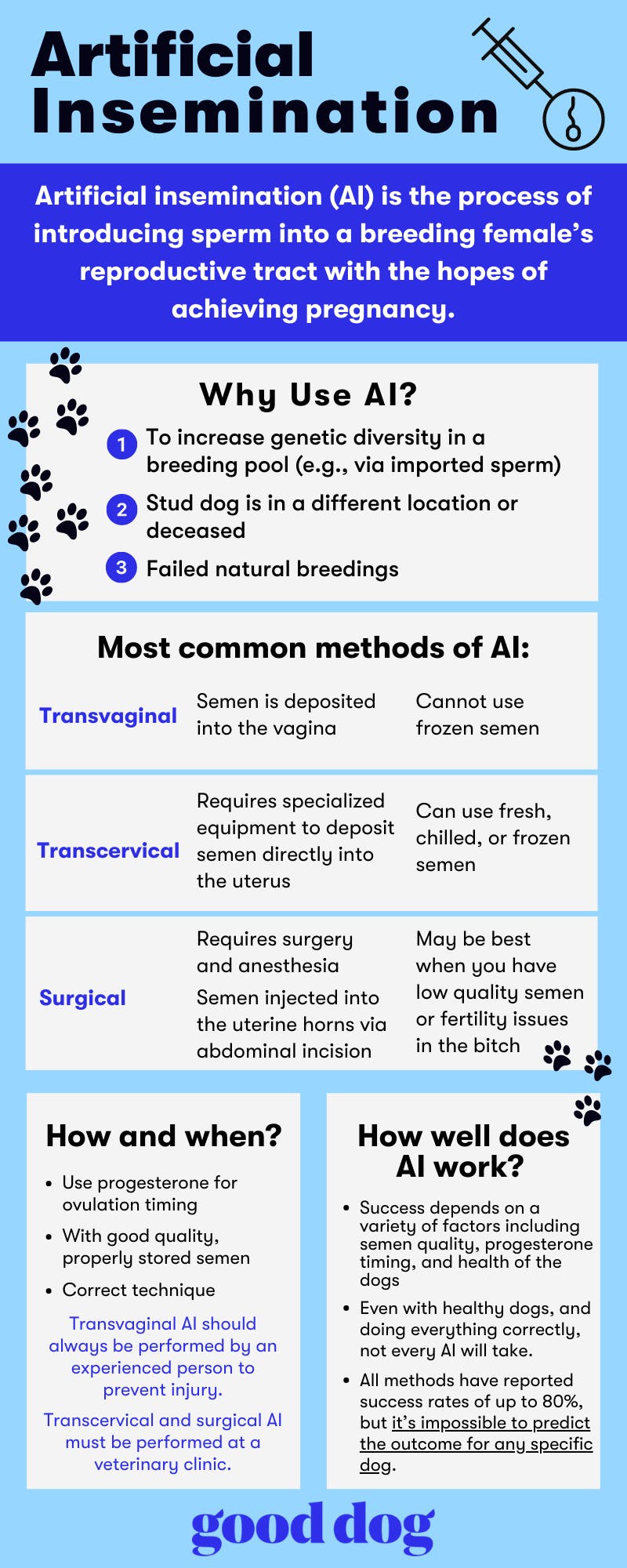
Artificial insemination is the manual introduction of fresh, chilled, or frozen semen into the bitch’s vagina or uterus, carefully timed to increase the chance of pregnancy.
When should you consider artificial insemination?
Breeders may turn to artificial insemination if they have experienced difficulties with getting their dogs to mate or conceive naturally. This may be due to behavioral issues (e.g., inexperience) or reproductive or other health issues in either the stud or the bitch (e.g., semen quality, abnormal cycling patterns, conformational issues).
Artificial insemination can also be used to increase genetic diversity in a breeding program, and allows breeders to use semen from a stud dog who has passed or is not local.
When should you have artificial insemination done?
If you’ve experienced difficulty getting two dogs to mate naturally, it may be time to talk to a canine reproductive specialist. They can help you assess whether artificial insemination may be helpful for you, and which method would be most appropriate.
Methods of artificial insemination
- Transvaginal insemination: Fresh or chilled semen is deposited into the vagina with a pipette and syringe, attempting to deposit the semen as close to the cervix as possible. If done incorrectly, transvaginal AI can cause damage to a dog’s reproductive tract, and should only be done by someone who is experienced with the procedure.
- Transcervical insemination: Fresh, chilled or frozen semen is deposited directly into the uterus using specialized equipment (e.g., an endoscope and catheter). Most dogs do not need sedation, and when done properly, the procedure is safe and painless.
- Surgical insemination: Fresh, chilled or frozen semen is injected into the uterine horns through an incision in the abdomen. This procedure requires anesthesia. If there are fertility issues in the bitch, or the semen sample is of low quality, this procedure may be more successful.
Note: Transcervical and surgical AI must be performed at a veterinary clinic
How should artificial insemination be done?
Ideally, a breeding soundness examination should be performed on both dogs to ensure general health. This is also a great time to make sure that any breed-specific testing for heritable diseases has been done.
A semen analysis can alert you to any concerns about the quality of your semen sample. Semen analysis will assess the gross appearance of the sample, the volume of the sample, the concentration of sperm in the sample, the motility (or efficient movement) of the sperm, and alert you to any significant abnormal morphology in the sperm (such as in the head or the tail).
Timing is critical to artificial insemination. A bitch’s most fertile time is during estrus 2-3 days after ovulation. This is the ideal time for natural mating or insemination to occur. Although there are behavioral signs that estrus has started, such as when a bitch starts standing for a male, the most accurate ways to determine ovulation include:
- Progesterone and luteinizing hormone assays (blood testing): these blood tests determine hormone levels that signal ovulation. This is by far the most accurate way to determine ovulation timing.
- Vaginal cytology: assessing a slide with a vaginal smear to determine the number of cornified epithelial cells, which are abundant during ovulation
- Vaginoscopy: using an endoscope to assess the vagina tissues, which change with hormonal variation
For any easy way to share this information, we created the below infographic which you can download and print to share with your communities!
Additional Resources
Vet Folio: Canine Artificial Insemination
Revival Health: Artificial Insemination (AI) for Dogs
The Veterinary Nurse: How to carry out artificial insemination using fresh semen
Join our Good Breeder community
Are you a responsible breeder? We'd love to recognize you. Connect directly with informed buyers, get access to free benefits, and more.