Progressive retinal atrophy (PRA) in dogs
a group of inherited, degenerative eye conditions that affect the retina of the eye

Reviewed by
Dr. Judi Stella, PhD
Head of Standards & Research at Good Dog
Dr. Judi Stella, PhD is Head of Standards & Research at Good Dog. She earned her bachelor's degree in Animal Sciences from The Pennsylvania State University and her Ph.D. in Comparative and Veterinary Medicine, with an emphasis on applied ethology and animal welfare science, from The Ohio State University College of Veterinary Medicine. She was a USDA Science Fellow with the APHIS-Center for Animal Welfare and a visiting scholar at Purdue University College of Veterinary Medicine.
Reviewed by
Dr. Judi Stella, PhD
Head of Standards & Research at Good Dog
Dr. Judi Stella, PhD is Head of Standards & Research at Good Dog. She earned her bachelor's degree in Animal Sciences from The Pennsylvania State University and her Ph.D. in Comparative and Veterinary Medicine, with an emphasis on applied ethology and animal welfare science, from The Ohio State University College of Veterinary Medicine. She was a USDA Science Fellow with the APHIS-Center for Animal Welfare and a visiting scholar at Purdue University College of Veterinary Medicine.
Reviewed by
Dr. Judi Stella, PhD
Head of Standards & Research at Good Dog
Dr. Judi Stella, PhD is Head of Standards & Research at Good Dog. She earned her bachelor's degree in Animal Sciences from The Pennsylvania State University and her Ph.D. in Comparative and Veterinary Medicine, with an emphasis on applied ethology and animal welfare science, from The Ohio State University College of Veterinary Medicine. She was a USDA Science Fellow with the APHIS-Center for Animal Welfare and a visiting scholar at Purdue University College of Veterinary Medicine.
by Dr. Mikel Delgado, PhD
Progressive retinal atrophy (PRA) is a group of inherited, degenerative eye conditions that affect the retina of the eye. The retina is a layer along the back of the eye that is composed of two different types of light-sensitive cells, rods and cones, which send signals to the brain for processing. Rod cells detect movement, and are especially important for low-light vision. Cone cells detect color, but are not as sensitive to light as rods.
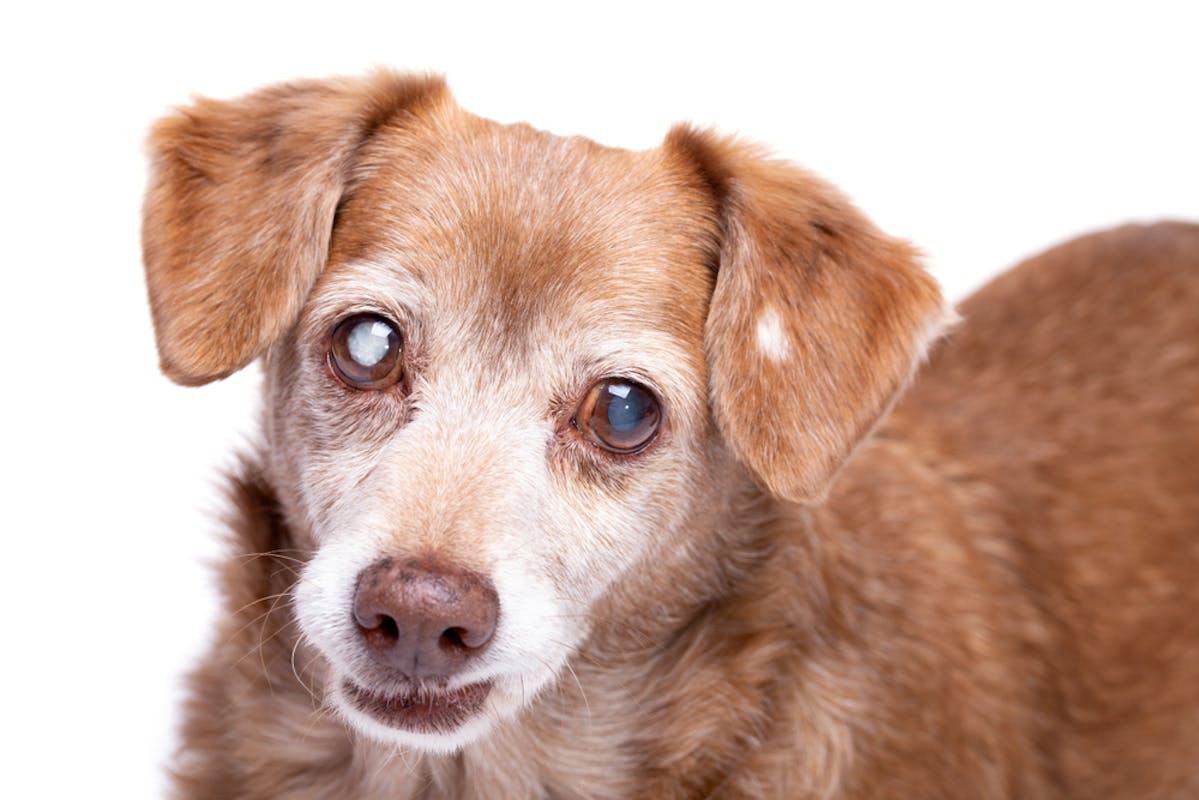
When a dog has PRA, these retinal cells deteriorate and die prematurely, eventually causing blindness.
There are two types of PRA - early onset (also known as retinal dysplasia) and late onset. Puppies with early onset PRA may have signs of vision loss by two to three months of age, and often the retinal cells did not ever fully develop. Dogs with late-onset PRA are typically diagnosed between 3 and 9 years of age, when cell function begins to deteriorate.
Signs of vision loss in dogs due to PRA
Rod cells often are affected first, and dogs may first have problems with night vision. Gradually, they also lose vision in bright light. Signs of vision loss in dogs include reluctance to use stairs or enter dark rooms. Because vision loss occurs slowly, many dogs adjust to the changes in their sight and some dog owners may not be aware of the problem until their dog is almost completely blind. Some dogs may have dilated pupils, or the “shine” of their eyes (the tapetum lucidum, which causes a glowing appearance when light hits the back of the eye) may be more visible. Dogs may also develop secondary cataracts. Although PRA does lead to blindness, it is not painful.
Diagnosis of PRA in dogs
PRA is usually diagnosed after dog owners notice signs of vision loss or cataracts in their dogs. A veterinarian can conduct an ophthalmic exam, looking for signs of retinal degeneration. They may refer a client to a veterinary ophthalmologist for further evaluation.
Treatment for dogs with PRA
There is no treatment for PRA. Fortunately, it does not cause any pain for the affected dog. Dog owners may have to make some modifications to their home (similar to baby proofing) and how they interact with their dog, to ensure that the dog still experiences a good quality of life even though they have vision loss. This would include making sure that the dog has spaces that they feel safe, not moving furniture or placing items in areas where they may run into them, using scent and sound for enrichment, allowing the dog to gradually acclimate to new environments, blocking access to stairs, focusing training on verbal cues, and announcing your presence when you approach a blind dog so they aren't startled.
Are all dogs at risk for PRA?
PRA has been identified in several dog breeds, but some may be at a greater risk than others, including American Eskimo Dog, Australian Cattle Dog, Australian Shepherd, Chesapeake Bay Retriever, Chihuahua, American Cocker Spaniel, Golden Retriever, Russell Terrier, Labrador Retriever, Pomeranian, Poodles and Yorkshire Terriers (note: this list is not exhaustive).
How is PRA inherited?
In most breeds, PRA is an autosomal recessive condition, meaning that a dog needs to inherit two copies of the mutation for the condition to be expressed. This would result when both parents are either carriers or affected. Unaffected dogs who are carriers can produce affected puppies.
In some dog breeds (Samoyeds, Siberian Huskies and Miniature Schnauzers), PRA is an x-linked recessive condition, meaning that it is associated with genes on the X sex chromosome. Because males have only one X chromosome (females have two), if they inherit a copy of the harmful variant, there’s no “healthy” allele to protect them. They will always inherit the condition. Females are only affected if they inherit two copies of the mutation.
English Mastiffs and Bullmastiffs are two known exceptions where PRA is inherited in a dominant fashion, meaning that inheriting just one copy of the mutated allele is sufficient to cause a dog to be affected. There are at least a dozen mutations related to PRA and genetic tests are available for several dog breeds.
Genetic Testing for PRA
There are likely multiple genes associated with PRA, and there are several known mutations. A dog testing clear for one mutation does not exclude the possibility of developing PRA. Multiple genetic companies have tests available for PRA, and many of these tests are breed-specific.
Breeding Decisions
Dogs who develop PRA should not be used for breeding. When available for a breed, dogs should be given a genetic test for PRA, and carriers should only be bred with clear dogs if clear-clear breedings are not available.
Resources
VCA: Progressive Retinal Atrophy in Dogs
Veterinary Vision: Retinal Degeneration
Bunel, M., Chaudieu, G., Hamel, C., Lagoutte, L., Manes, G., Botherel, N., ... & Quignon, P. (2019). Natural models for retinitis pigmentosa: progressive retinal atrophy in dog breeds. Human genetics, 138(5), 441-453.
Miyadera, K. (2018). Mapping of canine models of inherited retinal diseases. Retinal Degenerative Diseases, 257-264.

Join our Good Breeder community
Are you a responsible breeder? We'd love to recognize you. Connect directly with informed buyers, get access to free benefits, and more.