Collars, harnesses & leashes
What you need to take your dog on a successful walk!
Good Dog is on a mission to educate the public, support dog breeders, and promote canine health so we can give our dogs the world they deserve.
Good Dog is on a mission to educate the public, support dog breeders, and promote canine health so we can give our dogs the world they deserve.
Good Dog is on a mission to educate the public, support dog breeders, and promote canine health so we can give our dogs the world they deserve.
By Dr. Mikel Delgado, PhD
When choosing a collar or harness, you will find differences in the amount of control and comfort for you and your dog, especially during a walk. The breed and size of your dog also need to be considered. You may need to try out a few different options before settling on which one(s) are best to ensure a successful walk with your dog.
Collars are commonly used, generally safe to leave on all the time, and offer a convenient place to hold your dog’s tags. However, for safety reasons, they are not recommended for small/toy breeds and brachycephalic breeds for walking, as they can cause injuries if the dog pulls.
Harnesses are generally considered safer for all sizes and breeds of dogs. They are more secure and comfortable for walking a dog. They can be a bit more complicated to fasten on your dog, and they need to be fitted properly so they do not interfere with the dog’s natural gait.
Although dog owners often want equipment that offers control while walking, pulling on a lead is considered a training issue, not an equipment issue. If your dog pulls when you walk, a qualified behavior professional can help!
So which is best? It depends on you and your dog. Here are some things to consider regarding harnesses and the most commonly used types of collars.
Harnesses
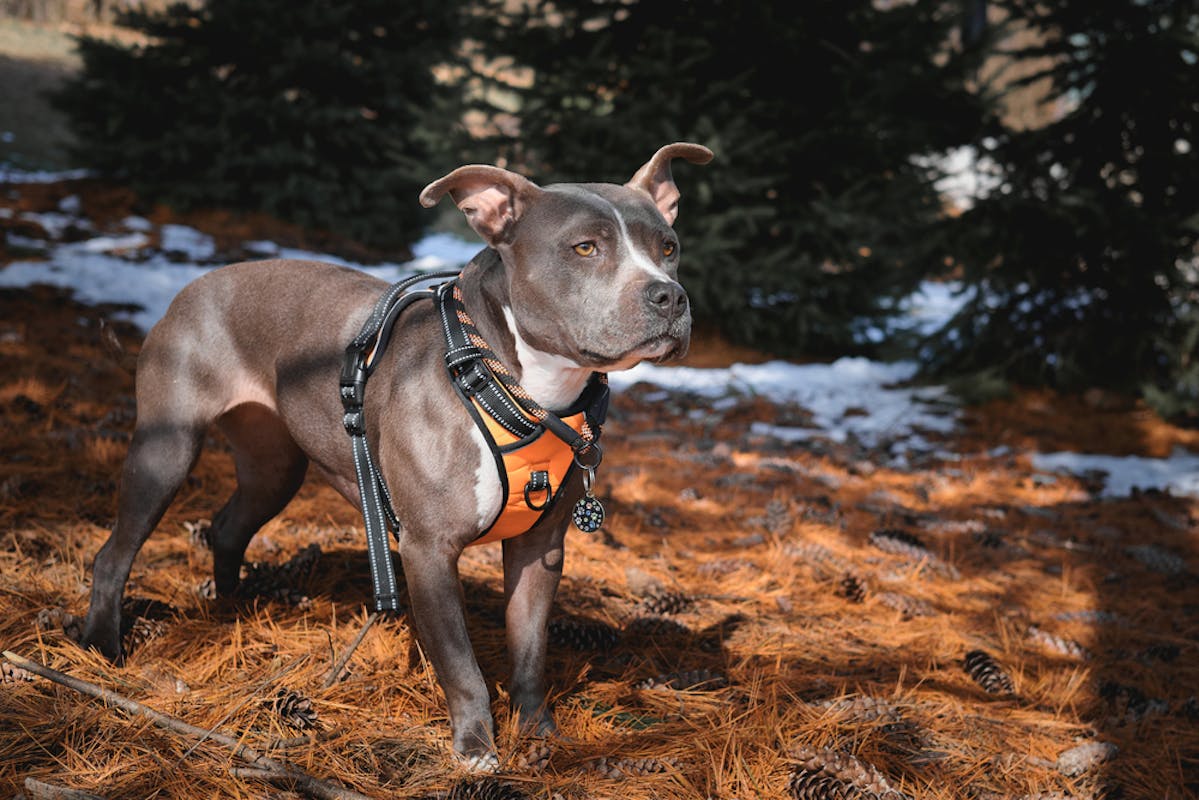
A dog harness consists of multiple straps that typically attach across your dog’s chest, shoulders, and/or upper back. The harness can be attached to a lead for walking. Harnesses should be removed when you are not walking your dog. For walking, there are two types of harnesses: front-clip (lead attaches at the front) or back-clip (lead attaches at the back).
Considerations:
- Harnesses are safer because they reduce pressure on the neck and throat (especially for small dogs, brachycephalic (flat-faced) dogs, and dogs with a history of tracheal collapse, and orthopedic or spinal problems)
- Harnesses generally reduce the dangerous effects of pulling, although they may not stop pulling altogether
- They may not have a place to secure tags, so your dog may still need to wear a flat collar for identification purposes
- A front-clip harness offers more control and limits how much your dog can pull
- A back-clip harness may be more comfortable for your dog, and is less likely to cause your dog’s legs to get tangled in the leash
Flat Collars
A flat collar is a standard dog collar that lies flat against your dog’s neck, usually with a buckle. It should be neither too loose nor too tight, but should fit your dog comfortably with room to place two fingers under it. Although a flat collar can be worn at all times for identification purposes, they may not be the best option for attaching a leash and walking your dog.
Considerations:
- Some dogs are able to slip out of a flat collar
- Standard collars are not recommended for small/toy breeds because of increased risk of neck injury (whiplash) if they pull
- The pressure on the windpipe from a collar can cause tracheal collapse
- Pulling on collars increases eye pressure, increasing risks for brachycephalic (flat-faced) dogs for eye proptosis, an emergency condition where the eye protrudes out of the socket.
- Collars offer very little control over pulling, which can be dangerous to both dog and human
- If the collar is left on the dog, watch for skin irritation or discomfort, and remove if it is wet
Martingale collars
This collar has two loops, one of which goes around your dog’s neck, and a second loop that attaches to a lead. When your dog pulls against the lead, the loops tighten uniformly around your dog’s neck. It must be fitted and sized to prevent choking.
Also known as a limited slip collar, the Martingale collar is most commonly used on sighthounds and dogs whose head is narrower than their neck. It may also be recommended for some fearful dogs, as this style of collar prevents dogs from backing up and slipping out of it.
Considerations:
- Martingale collars are considered aversive because they use physical pressure to stop your dog from pulling
- But, they are considered less aversive than choke or prong collars
- They should be used with close supervision as the outer loop could get caught on household objects and possibly choke your dog
- A Martingale collar needs to be fitted correctly to prevent choking when the loops tighten
Head collars
A head collar is similar to a halter used on horses, with one loop around the neck, and a second loop that goes around the dog’s muzzle. Head collars provide control over the dog’s head, rather than the neck, and generally provide more control than a flat collar.
Considerations
- It is possible that a dog could be injured if they yank or the handler pulls hard
- However, it is much harder for a dog to pull on a head collar than other collars
- Some dogs are uncomfortable with the strap on their muzzle
- Head collars should be fitted carefully
- You will need to take time to acclimate your dog to a head collar
- Many trainers recommend trying other styles of collars or harnesses first
Slip collars
A slip collar is both a lead and a collar, with a loop that can be slipped over your dog’s head. If the dog pulls, the loop tightens.
Considerations
- Slip collars are only recommended for short-term or emergency use, such as in shelters, clinics, or dog shows
- Slip collars can cause choking or trachea damage if used improperly
“Training” collars
Collars marketed for training include any collar that uses a painful, aversive, or annoying stimulus to stop a behavior, such as shock/electric collars, choke chain, prong, and vibration collars. For everyday walking, they are unlikely to be useful, and if it is difficult to walk your dog without a training collar, you may want to work with a veterinary behaviorist or other qualified professional.
Considerations
- These collars can cause injuries and stress
- Research has found that electronic collars are not more effective for training than positive reinforcement methods
- Most credentialed veterinary behavior professionals (e.g., AVSAB) do not support the use of training collars for behavior modification or routine use
What about the leash?
You will need a leash to attach to your collar or harness. Make sure you get a leash that is the right weight for the size of your dog: a small dog will need a lighter leash, while a large dog will need a heavier leash with a sturdier clip.
Retractable and bungee leashes are not recommended because they give you less control, and can encourage pulling. Your dog can also get tangled in a retractable leash which could result in injuries. A leash that is about 6 feet long gives you adequate control while giving your dog enough freedom to explore!
Resources
VCA: Head halter training for dogs
VCA: Controlling pulling on walks
RSPCA: What equipment should I use when teaching my dog or puppy to walk on a leash?
Positively: Head collars & no-pull harnesses
Carter, A., McNally, D., & Roshier, A. (2020). Canine collars: an investigation of collar type and the forces applied to a simulated neck model. Veterinary Record, 187(7), e52-e52.
China, L., Mills, D. S., & Cooper, J. J. (2020). Efficacy of dog training with and without remote electronic collars vs. a focus on positive reinforcement. Frontiers in Veterinary Science, 508.
Grainger, J., Wills, A. P., & Montrose, V. T. (2016). The behavioral effects of walking on a collar and harness in domestic dogs (Canis familiaris). Journal of Veterinary Behavior, 14, 60-64.
Pauli, A. M., Bentley, E., Diehl, K. A., & Miller, P. E. (2006). Effects of the application of neck pressure by a collar or harness on intraocular pressure in dogs. Journal of the American Animal Hospital Association, 42(3), 207-211.
Pálya, Z., Rácz, K., Nagymáté, G., & Kiss, R. M. (2022). Development of a detailed canine gait analysis method for evaluating harnesses: A pilot study. PloS one, 17(3), e0264299.
Schalke, E., Stichnoth, J., Ott, S., & Jones-Baade, R. (2007). Clinical signs caused by the use of electric training collars on dogs in everyday life situations. Applied Animal Behaviour Science, 105(4), 369-380.
Shih, H. Y., Phillips, C. J., Mills, D. S., Yang, Y., Georgiou, F., & Paterson, M. (2021). Dog pulling on the leash: effects of restraint by a neck collar vs. a chest harness. Frontiers in veterinary science, 1002.
Tappin, S. W. (2016). Canine tracheal collapse. Journal of Small Animal Practice, 57(1), 9-17.

Join our Good Breeder community
Are you a responsible breeder? We'd love to recognize you. Connect directly with informed buyers, get access to free benefits, and more.