Weekly Woofs Newsletter Archive
Check out all our past newsletters for information on health discounts, webinars, podcasts, and more!
Good Dog is on a mission to educate the public, support dog breeders, and promote canine health so we can give our dogs the world they deserve.
Good Dog is on a mission to educate the public, support dog breeders, and promote canine health so we can give our dogs the world they deserve.
Good Dog is on a mission to educate the public, support dog breeders, and promote canine health so we can give our dogs the world they deserve.
Catch up on all the latest news from Good Dog. We feature regular health updates, tech tips, product updates, and more!
Index
2022
2021
- December 17, 2021
- December 10, 2021
- December 3, 2021
- November 26, 2021
- November 19, 2021
- November 12, 2021
- November 5, 2021
- October 29, 2021
- October 22, 2021
- October 15, 2021
- October 8, 2021
- October 1, 2021
- September 24, 2021
- September 17, 2021
- September 10, 2021
- September 3, 2021
- August 27, 2021
- August 20, 2021
- August 13, 2021
- August 6, 2021
- July 30, 2021
- July 23, 2021
- July 16, 2021
- July 9, 2021
- July 2, 2021
- June 25, 2021
- June 18, 2021
- June 11, 2021
- June 4, 2021
- May 28, 2021
- May 21, 2021
- May 14, 2021
- May 7, 2021
- April 30, 2021
- April 23, 2021
- April 16, 2021
- April 9, 2021
- April 2, 2021
- March 26, 2021
- March 19, 2021
- March 12, 2021
- March 5, 2021
- February 26, 2021
- February 19, 2021
- February 12, 2021
- February 5, 2021
- January 29, 2021
- January 22, 2021
- January 15, 2021
- January 7, 2021
2020
January 7, 2022
Events 📅
- Register today for our live Q&A webinar with Dr. Robert Hutchison, DVM on Wednesday, January 19th at 5PM ET! Dr. Hutch will be sharing all of his expertise about canine reproduction and you can submit any questions in advance here. Even if you aren't able to join live, we encourage you to register because we will be providing full access to the recording and transcript after the event to all Good Breeders.
Curated Content 📫
- Good Dog's January Health Initiative is all about breeding soundness. For the month of January, we're offering $10 off a components of breeding soundness exam, or a progesterone test! To redeem this discount, sign up to join our breeder community and click on the Monthly Canine Health Initiative tile at the bottom of the Good Breeder Discounts page.
Payments through Good Dog
We'd like to give a huge thank you and shoutout to Jacque Reynolds of Gabby Jack Ranch for their post on Facebook about Good Dog's Puppy Training Program!
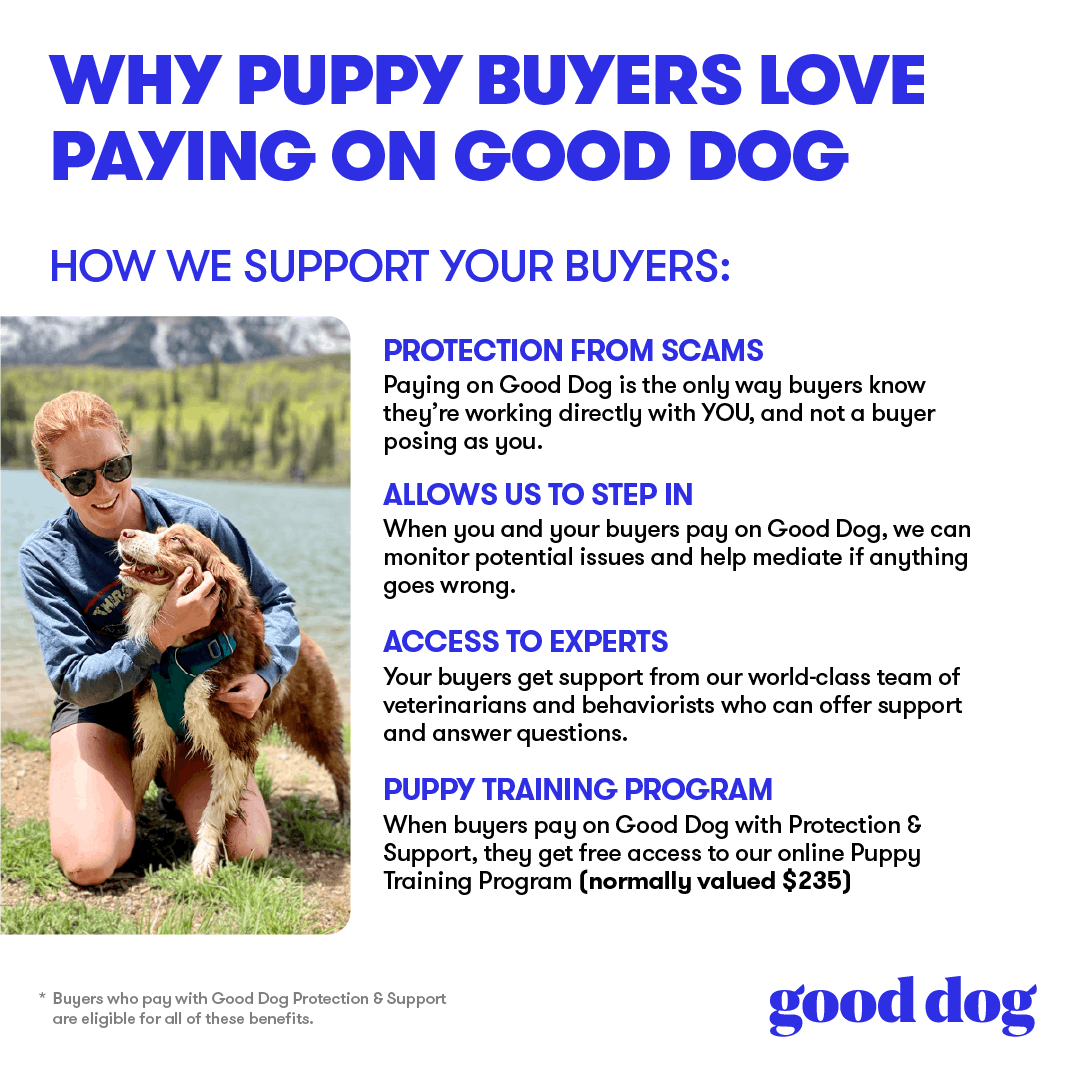
Good Dog's Puppy Training Program is free ($235 in value) for all owners who complete payment with breeders using Good Dog. Good Breeders also always have free access to the course.
The thoughtfully crafted courses within Good Dog's Puppy Training Program were designed to enable puppy owners to become great teachers, and help you navigate through the ups and downs of raising a puppy. Plus, our hands-on coaching is readily available to troubleshoot any issues that arise as your pup grows, and is always tailored to your specific challenge.
Good Dog’s Health & Research Corner 🔬
Does your stud dog need a semen evaluation? A 2018 study assessed the effect of age and dog size on semen quality, and looked at what percent of semen samples were “azoospermic” (contained no sperm). Researchers examined 251 semen samples from 140 dogs of different ages and breeds, measuring the volume of the sample, as well as the concentration, motility (movement), and morphology (physical quality) of the sperm. They also looked at how sample quality impacted the ability to impregnate a dog with artificial insemination (AI).
Over 90% of the samples contained sperm, and smaller dogs produced smaller samples with a lower total sperm count. Although age did not affect semen volume, sperm concentration or motility, younger dogs were more likely than older dogs to have normally-formed sperm. Successful AI was more likely when the sample contained normally-formed sperm. Although a semen evaluation cannot guarantee a breeding outcome, it can be an important tool in a breeding program. You can access “Variables Affecting Semen Quality and its Relation to Fertility in the Dog: A Retrospective Study” here.
December 17, 2021
Happy Holidays from all of us here at Good Dog! We hope you're able to enjoy some time spent with friends & family - your Weekly Woofs updates will resume January 7th 🙂
Events 📅
- Our 3rd Annual Breeder Appreciation Holiday Party was a blast! Thank you to everyone who joined us for the night of festivities and giveaways. In case you missed it (or if you just want to revisit the event), you can watch the recording here. I'd also highly recommend you check out this year's poem, Puppy Paws in the Snow 🐾❄️
- Save the Date! We'll be hosting a Breeder Appreciation Happy Hour on January 25th in New York City, for all of those attending Westminster! We'll have more details on the time and location soon, but in the meantime, RSVP here to let us know you're interested in celebrating with us
- Register early for our upcoming live Q&A with Dr. Hutchison, DVM! Dr. Hutch will be answering questions about canine reproduction on Wednesday, January 19th at 5PM Eastern.
How do payments on Good Dog stack up?
1. Built for breeders.
Good Dog built our payment platform specifically for breeders. From our terms and policies to our automatic invoicing and record-keeping features – this system was built for you. Our goal is to protect you and your puppy buyers and give you the security and support you deserve.
2. Always free for breeders.
You’re always in control of your money and there are never any fees for breeders. That’s not the case with other payment methods. Venmo may charge you a fee of 1.9% of the transaction amount, plus 10 cents, and has the power to remove money from your account to issue a refund to your buyer.
3. We always have your back.
We guarantee your payment, which means your money is always 100% protected in the event of a scam, fraud, or canceled payment. Other payment methods, like PayPal, put the burden on you. They require an "online verifiable tracking number,” and “valid proof of shipment or delivery” in order to have a chance at protection.
*Plus, set your pups and new owners up for success with Good Dog’s Puppy Training Program, which is part of the optional protection and support we offer puppy buyers making payments on Good Dog (or your buyers can choose our no fee option)!
Curated Content 📫
- This week on The Good Dog Pod Cat and Monica reminisce on the highlights of 2021 (and give some sneak peaks at what we have planned for 2022)!
Good Dog’s Health & Research Corner 🔬
We’ve focused a lot on canine obesity and weight loss this fall, but have you considered whether the holidays lead to weight gain for your dogs? Dr. Alex German, who gave a fantastic webinar for Good Dog in October, collaborated with other researchers to look at how the Christmas holiday impacted weight loss programs in a study of 38 overweight dogs. Dog owners in their study reported that their dogs ate more calories during the Christmas holiday period, and lost less weight during and after Christmas, compared to how they were doing before the holiday season!
The takeaway from this research: if your dog is on a weight loss program, try not to lose too much ground by giving them extra food and treats over the holiday!
Thank you for participating in last week’s survey about holidays and your dogs! 91% of you said you would be buying holiday gifts for your dog, and 68% will be including your dog on your holiday cards!
December 10, 2021
Events 📅
- Our 🎉 3rd Annual Breeder Appreciation Holiday Party 🎉 is next week! Join us on Wednesday, December 15th at 7:30pm ET for an evening of giveaways and holiday cheer 🙂 Make sure you register in advance here.
Curated Content 📫
- Have a topic or speaker you'd like to see featured in a future webinar or podcast episode? Let us know! Fill out this feedback form to let us know who you want to hear from next.
- Good Breeders now get FREE access to our new breeder program, Good Dog Breeding Foundations (a $245 value)! This program includes eight courses on pedigrees, genetics, timing your breedings, contracts and more. The program has key lessons for breeders who are just starting out, but also serves as a great refresher even if you’ve been breeding for a while.
- This week on The Good Dog Pod Nicole interviews Good Breeder Melissa Farmer about keeping your pups safe during the holidays and Good Dog's Health, Standards & Research Team discuss holiday hazards.
NEW: Good Dog’s Puppy Training Program included with payment
What To Expect From Good Dog’s Puppy Training Program?
- 🐶Self-Paced, Online Courses: Led by Sarah Hartwig, breeder and expert dog trainer with decades of experience, training courses cover critical topics like potty training, socialization, barking, and more, and are geared toward pups 8 weeks to 15 months of age
📞Coaching Calls & Email Office Hours: In-house experts help owners navigate puppy rearing with confidence in a hands-on setting. What are private coaching calls with Sarah like? Check out this video!
💻Puppy Program Facebook Group: Get real-time answers to your questions from Puppy Training coaches any time
📚Printable Plans & Guides for New Owners: Detailed guides are available to help new owners navigate their puppy’s first week, month, and year
How can I access the Puppy Training Program as a Good Breeder?
When you join Good Dog, you get FREE access to our Puppy Training Program!
How can my buyers access the Puppy Training Program?
You buyers receive FREE access to our Puppy Training Program ($235 value) when they make a full dog payment through Good Dog with Protection & Support!
Good Dog’s Health & Research Corner 🔬
Do you include your dog in your holiday celebrations? Studies have shown that anywhere from 30 to 70% of pet owners include their pet’s names alongside with other family members' names on their holiday cards. And when it comes to gift giving, we are even more likely to include pets: between 50 and 80% of pet owners report purchasing gifts for their pets. A 2008 study of the shopping habits of pet owners found that those who tended to indulge themselves (e.g., making impulsive purchases or enjoying shopping sprees) were more likely to also open their wallets for their pets to buy treats, toys, clothing or accessories!
Good Dog would love to know: are you buying presents for your dogs this year? And did you include your dogs in your holiday cards? Participate in our 2-question survey and we’ll report the results next week!
Take the 2-question survey
December 3, 2021
Events 📅
- In case you missed it, you can catch the recording of yesterday's Facebook Live here. Make sure you're following our Facebook page so you don't miss these prize-filled events!
- Don't forget to register for our 🎉 3rd Annual Breeder Appreciation Holiday Party 🎉 on Wednesday, December 15th at 7:30pm ET. We're giving away over $10,000 worth of prizes! Register here.
Curated Content 📫
- Good Breeders now get FREE access to our new breeder program, Good Dog Breeding Foundations (a $245 value)! This program includes eight courses on pedigrees, genetics, timing your breedings, contracts and more. The program has key lessons for breeders who are just starting out, but also serves as a great refresher even if you’ve been breeding for a while.
- The Good Dog Store is live! Get all your Good Dog gear at our official online store and take 20% off through Sunday (12/5)! Act fast - some items have sold out!
- This week's episode of The Good Dog Pod features America's Vet, Dr. Marty Becker! Dr. Becker joined us to talk about the Fear Free Movement: how it got started, what it is, and what it means for you.
Tech Updates 💻
🚧 FYI: We’re getting an end of year site upgrade 😎, we’ll be right back 🚧
We wanted to give you a heads up that we’ll be upgrading our website next week on Tuesday, December 7th. This means theGood Dog website will be temporarily offline and you will not be able to access it from approximately 3:00am to 6:00am EST on Tuesday, December 7th. We apologize in advance for any inconvenience this may cause, but are excited to continue making the website better for YOU 💙 If you have any questions regarding this planned outage, don’t hesitate to reach out to your Good Dog Specialist or email breederteam@gooddog.com anytime!
Our updated search results pages put breeders front and center! 🖼️
Our goal is to recognize breeders like you by giving you a place to showcase your individual programs that you put so much love and care into. That’s why we have redesigned the headings on our search result pages so that breeders’ profiles are displayed more prominently on the page! 🐶 ❤️ To spotlight your program even more, don’t forget to add cover photos to your profile page that show off your dogs! If you need any help adding photos, please feel free to reach out to our Good Dog Specialist team anytime at breederteam@gooddog.com.
Good Dog’s Health & Research Corner 🔬
We are excited to say we’ve had a tremendous response to our survey collaboration with Dr. Chris Zink about health and reproductive status in dogs. We’ve received over 6000 responses to date! We are still seeking participants with dogs who have had a vasectomy or ovary-sparing spay, so if you (or anyone you know) has a dog who has had one of these procedures, please feel free to take the survey or share information about the survey!
You can learn more about why we are doing this survey here. We hope to wrap up data collection by the end of the year and will keep you updated on what we learn.
And on the topic of research, have you ever thought about supporting a clinical trial? Good Dog has compiled a list of ongoing clinical trials related to canine health in our Health Hub. See whether your dog qualifies for any current studies here!
November 26, 2021
Good Dog’s 2021 Gratitude Giveaway
We hope you had a wonderful Thanksgiving and enjoyed some relaxing, quality time with your family, friends, and of course, your dogs! 🐶
As the holiday season begins, and 2021 comes to a close, we want to take a moment to share our gratitude for you--our incredible community of Good Breeders! You put so much time, dedication, and love into raising your pups, and we want to let you know how grateful we are for all of the joy you bring into the world.
🎊Good Breeder Gratitude Giveaway 🎊
We all have something to be thankful for. For us, that’s YOU and your fellow Good Breeders! As a small token of our gratitude, we’re giving away $50 each to five lucky members of our Good Breeder family 💙!
To Enter:
- Join our Good Dog Breeder Center Facebook group (if you haven’t already)
- Set up your secure payout method through Good Dog (if you haven’t already)
- Send a deposit or full payment request through Good Dog to one of your potential puppy buyers. (If you don’t have any payments to request right now, fill out this form instead!)
- We’ll be choosing 5 lucky winners who have completed steps 1-3 above to receive a 🎁$50 deposit to their Good Dog account 🎁
- Contest entries will close on Wednesday, December 1st at 12pm ET and FIVE winners will be contacted via email
We have so many more fun surprises (and giveaways!) coming up, so keep an eye on your email and in the Good Breeder Facebook group to make sure you don’t miss a thing 😉.
We can’t wait to celebrate YOU and your fellow dog breeders all December long! ❤️
Events 📅
- We hope you saw our invitation to our Third Annual Breeder Appreciation Holiday Party 🎉 🎉 Don’t forget to register to attend to join us on Wednesday, December 15th at 7:30 pm ET where you’ll have a chance to win over $10,000 in prizes! 🎁
- This week’s Facebook live was all about our Puppy Training Program! In case you missed it, you can catch the recording here.
November 19, 2021
Events 📅
- Yesterday's Facebook live was all about updates to our payment system! In case you missed it, you can catch the recording here. Make sure you keep an eye out for next week's Facebook Live, which will be dedicated to everything you need to know about Good Dog's Puppy Training Program, available to both breeders and their owners.
Curated Content 📫
- This week's episode of The Good Dog Pod is an adaptation of a webinar we had with Dr. Chris Zink. Dr. Zink introduces a new survey looking at how reproductive status affects health outcomes in dogs. We’re interested in learning more about alternatives to spay/neuter surgery, but we need ALL dog owners to participate. You can fill out the survey HERE!
Payment Update 💻
Have you used payments through Good Dog? Breeders are ALWAYS protected when they receive payments through Good Dog, and buyers have the option to pay with zero fees.
Good Dog’s Health & Research Corner 🔬
Many dogs compete in agility, and unfortunately some will be injured. A recent survey-based study looked at how factors such as age and reproductive status were related to injuries in agility dogs. 500 dog owners were surveyed at agility trials; the survey included questions about dogs’ age, sex, breed, age at spay/neuter, years of competition, and details about any injuries.
Almost one in three dogs had been injured; results indicated that the risk of injury increases with each year of age. Border Collies were at highest risk, and being spayed or neutered earlier was also associated with injuries. Finally, dogs at higher competition levels were more likely to have a history of injury.
Although survey-based research has limitations, this study adds to a body of evidence that early spay-neuter may present risks, especially for sporting dogs. Read the full study, “Internet Survey of Participant Demographics and Risk Factors for Injury in Competitive Agility Dogs” here.
November 12, 2021
Events 📅
- Watch the recording of our recent webinar with Dr. Chris Zink, DVM. Dr. Zink introduced a new survey looking at how reproductive status affects health outcomes in dogs, which you can read more about in the Health & Research Corner below 👇
- Watch Good Dog’s most recent Welcome Webinar! You’ll learn about the exclusive discounts, resources, and education you'll have access to as a Good Dog breeder. Plus, we show you how to navigate your Good Breeder Dashboard and use our exclusive breeder software.
- We've been hosting weekly Facebook Lives answering your questions and going over ways you can get the most out of your Good Dog memberships - be sure to like our Facebook page so you don't miss out on these events! We also give away prizes during these events 👀
Curated Content 📫
- Did you know your Good Dog Specialist can help you understand how to get more applicants on Good Dog? Our exclusive Good Dog Breeder benefits include personal support helping breeders securely place their puppies. Read more about the support we provide to help you place your pups securely, conveniently, and with peace of mind on Good Dog.
- You may have been hearing about The Puppy Protection Act. Read our article which summarizes the bill and who it could impact. We encourage you to share this article with your communities and speak to your lawmakers whenever there is new dog legislation to ensure they make informed decisions that reflect YOUR voices.
- This week on The Good Dog Pod, Sarah Hartwig discusses everything the Puppy Training Program has to offer for both breeders and buyers! The Puppy Training Program is a free benefit for buyers (and breeders) who use Good Dog's payment system.
Product Update 💻
🌟An Exciting Update to Help You Manage Puppy Buyer Applications 🌟
We want to make it easier for your potential puppy buyers to know when you’re accepting applications! Starting today, if your account is set to “sleep mode” meaning your applications are “snoozed” and you are not interested in receiving applications at this time, your profile will display an “Applications Closed” status. If your applications are not “snoozed,” and you’d like to receive applications, your profile will display an “Applications Open” status; you’ll have the option to add information about the number of puppies you currently have available or when your next litter is due directly on your profile! This means you will no longer have an “estimated wait time” field to update, and you’ll be able to manage your flow of applications using the new “Open” and “Closed” statuses. If you have any questions about “snoozing” your applications, you can read more about that feature here or reach out to your Good Dog Specialist Team anytime at breederteam@gooddog.com. We know your time is valuable, and we hope this change will help you manage and receive the applications from puppy buyers you want, when you want them! 🐶
Good Dog’s Health & Research Corner 🔬
We hope you enjoyed our webinar yesterday with Dr. Chris Zink, discussing alternatives to spay/neuter and our research collaboration! We’d love to have YOU participate in our survey, and we need feedback from ALL dog owners, whether your dogs are intact, spayed/neutered, or had an alternative procedure.
We are especially interested in hearing from dog owners whose dogs had vasectomies or ovary-sparing spay because there is no published research on the effects of these procedures. We hope to change that!
By completing this survey you will be doing a great service to the dog world by helping us understand the long-term effects of reproductive surgery so that we can make the best choices for our canine companions. You can fill out the survey HERE!
Did you know that the prevalence of spay/neuter surgery is highly dependent on location? In the United States, it is estimated that around 70% of dogs are spayed or neutered. In the UK, this number is closer to 54% and in Sweden, it is only 10%.
November 5, 2021
Events 📅
- Join us on Wednesday, November 10th at 1PM Eastern for a webinar with Dr. Chris Zink, DVM! Dr. Zink will be introducing a new survey looking at how reproductive status affects health outcomes in dogs. RSVP now on our Facebook page.
Curated Content 📫
- For the month of November, we're offering $10 off any reproductive health procedures: spay/neuter, progesterone tests, semen collection/analysis, or vasectomy/OSS surgery! Sign up to join our breeder community to get access to this discount.
- This week's episode of The Good Dog Pod is part two of our webinar with Dr. James Serpell, world-renowned leading canine behaviorist and co-creator of C-BARQ, and veterinary specialist, Vet of the Year, Dr. Chris Zink, DVM. Listen to the experts discuss recent research on the effects of early spay/neuter.
Payment Updates 💳
- This week we announced a big change to our secure payment system — the ability for both breeders and buyers to pay through the platform with ZERO fees. It’s an exciting step in our mission to bring trust and security to the dog world, by providing a FREE, protected payment option for dog breeders and their buyers. Read more about Good Dog's no-fee payment method here.
- We know how many people in the dog world have been victims of the spread of misinformation, and unfortunately, Good Dog is no exception. We've seen a lot of chatter on Facebook wondering how Good Dog makes money or accusing us of being a broker. In an effort to be as transparent as possible, we encourage you to read this article. Please feel free to share with your dog breeder friends or anyone who has questions about Good Dog 😀 Have any other questions about Good Dog or our model? Reach out anytime - I'm always happy to chat!
Upcoming improvements to our health testing levels (thanks, as always, to YOUR feedback!)
We are fast approaching our two-year anniversary of the launch of Good Dog’s health test levels. This was a milestone in our mission of improving dog health and supporting our Good Dog Breeder community on their journey from Good to Great to Excellent. Our community has grown so much during the years and now includes over 300 breeds! THANK YOU for giving us the opportunity to learn so much from all of you and the unique challenges and health concerns of all your amazing dogs. And thank you for the efforts you have put into maintaining your high standards, even in the face of shortages in veterinary care.
And as always, we are constantly working to improve (and make improvements based on your incredible feedback!), especially as our community continues to grow and evolve. You may have noticed some changes in the way health testing levels are communicated within search results, as we make these updates. But please know we are actively working on exciting plans to help you showcase everything that makes your programs unique and all that you put into your dogs directly on your Good Dog profile pages, and to provide transparency around health testing. We will focus additional efforts on educating the public about the importance of health testing.
Of course, we will continue to support our community by providing discounts and benefits for health testing, with our monthly health initiatives, the Good DogHealth Hub, through events like our Annual Health Symposium and through support of breed clubs with our Club Grant Program.
Stay tuned! As we move forward with these exciting improvements to help you showcase your unique programs, we will provide updates and will, as always, look forward to hearing feedback from YOU, our incredible community of Good Dog Breeders.
Good Dog’s Health & Research Corner 🔬
Dr. Chris Zink will be introducing a new survey looking at how reproductive status affects health outcomes in dogs in an upcoming webinar. We’re interested in learning more about alternatives to spay/neuter surgery, but we need ALL dog owners to participate! That means YOU can help Dr. Zink and Good Dog learn more about dog health! We’ll be launching our survey next week after our webinar onWednesday, November 10 at 1 PM ET. Be sure to join us on Facebook to watch the event live.
Dr. Zink wears many hats. She is a veterinarian who specializes in canine sports medicine. She is the owner of Canine Sports Productions and competes in several dog sports including Agility, Obedience, Conformation, and Rally. Dr. Zink is an accomplished researcher and author of dozens of scientific papers. She is the Director of Molecular and Comparative Pathobiology and a Professor at Johns Hopkins School of Medicine. And we are very grateful to say that she also takes time out of her very busy life to serve on Good Dog’s Advisory Board!
October 29, 2021
Events 📅
- Watch our recent webinar from one of the foremost experts on canine obesity, Dr. Alex German, DVM! Dr. German led a discussion on how to prevent obesity in your puppies. Make sure you're following our Facebook page so you don't miss upcoming virtual events!
Curated Content 📫
- In this week's special episode of The Good Dog Pod, we adapted our webinar with Dr. James Serpell, world-renowned leading canine behaviorist and co-creator of C-BARQ, and veterinary specialist, Vet of the Year, Dr. Chris Zink, DVM. Listen to the experts discuss how breeders can use C-BARQ to breed for behavior as well as recent research on the effects of early spay/neuter.
Halloween Tip 🎃
Halloween should be full of fun frights for humans, but it should never be a scary night for your dog. The chaos of visitors coming and going throughout the night can be overwhelming to some dogs, especially if strangers are wearing scary costumes. Your dog may be barking, hiding, shaking, or otherwise showing signs of fear and stress. Follow these tips to make sure your dog has a stress-free Halloween 👻🐶
- Keep your dog indoors
- Put them in a quiet, safe room away from the stress-provoking activity
- In case they escape, make sure your dog's microchip information is current, and that they are wearing a collar with an ID tag
Good Dog’s Health & Research Corner 🔬
We hope you’ve enjoyed our October Health Initiative on Canine Obesity!
Are dogs who participate in shows less likely to be overweight? And how are they judged? A recent study in Sweden assessed 120 dogs of six breeds (Chihuahuas, Dachshunds, French Bulldogs, Golden Retrievers, Labrador Retrievers, and Whippets) who were participating in a dog show. Results suggest that 32% of the show dogs were overweight, with Goldens, Labradors, and French Bulldogs more likely to be overweight and have a high body condition score. Very few Whippets or Dachshunds were overweight and no dogs were obese.
Weight had no effect on competition performance, meaning overweight dogs were just as likely to win awards as other dogs. The percent of overweight dogs was similar to that of the overall Swedish dog population, but show dogs were less likely to be obese. The researchers conclude that more awareness is needed among dog owners, breeders, and judges to reduce the number of overweight dogs! The paper, “Overweight in Swedish Show Dogs–Prevalence and Association with Performance in Competition” is freely available online.
October 22, 2021
Events 📅
- Join us on Thursday, October 28th at 1pm EDT to hear from one of the foremost experts on canine obesity, Dr. Alex German, DVM! Dr. German will discuss how to prevent obesity in your puppies. We'll be going LIVE on our Facebook page so make sure you click "Going" on the Facebook event and tune in at 1PM EDT.
- Yesterday Good Dog's Health, Standards & Research Team hosted a Facebook Live coffee chat all about hips! In case you weren't able to make it, you can watch the recording here.
Curated Content 📫
- This week's Good Dog Pod episode is a rerun of one of our all-time classics. Dr. Marty Greer DVM, JD discusses how to get your bitch pregnant. You'll learn about the common problems associated with breeding, and how you can avoid them!
Tech Tip 💻
- Did you know you can add custom questions to your Good Dog application? We've carefully selected some basic questions that are in every application by default, but we know each breeder's situation is unique. Add custom questions by going to the Application section of your profile and clicking "Add Question" at the bottom of the page.
Good Dog’s Health & Research Corner 🔬
We are very excited about next week’s webinar, featuring Dr. Alex German, DVM/PhD, one of the world’s foremost experts of companion animal obesity. He is currently a Professor of Small Animal Medicine at the University of Liverpool, England where he also runs the Royal Canin Weight Management Clinic. He is also an internal medicine specialist, and his research focuses on gastroenterology and the effects of early life nutrition and growth on later obesity in puppies and kittens.
In 2019, his study, “Association Between Life Span and Body Condition in Neutered Client-Owned Dogs” found that across a sample of over 50,000 dogs of 12 different breeds, there was a significant reduction in lifespan ranging from six months to over two years when dogs were overweight, with the impact being largest for small dogs (Yorkshire Terriers). His more recent research found that charting early growth in young dogs could be used to predict later obesity. He’ll tell us more about these growth charts during his webinar next week. We hope you’ll join us on Thursday, October 28th at 1 PM EST!
You can also follow Dr. German on Twitter.
October 15, 2021
Events 📅
- Join us on Thursday, October 21st at 5pm EDT when Good Dog’s Dr. Nate Ritter, DVM and Dr. Judi Stella, PhD, join Laura Reeves to teach us everything you need to know about your dog’s hips! We'll be going LIVE on our Facebook page so make sure you click "Going" on the Facebook event and tune in at 5PM EDT.
- Did you catch yesterday's Straight from the Center of the Ring Facebook Live? Laura Reeves hosted a great discussion on mastering the show ring. In case you weren't able to make it, you can watch the recording here.
Curated Content 📫
- Our October Health Initiative is all about combating and preventing canine obesity. This month, enjoy $10 off slow feeders, food puzzles, or scales for your dog! Sign up to join our breeder community to get access to this discount.
- This week's Good Dog Pod episode is a continuation of the Breeder to Breeder series where Laura Reeves, Susan Patterson, and Gayle Watkins do deep dives in different aspects of breeding. In this episode, they talk about what breeders can do to resuscitate puppies that seem to be fading.
Tech Tip 💻
- Did you know? We have dozens of educational webinars that are freely available to Good Dog breeders. Check out the webinars page of the Good Breeder Center and browse content from Dr. Robert Hutchison, Dr. Marty Greer, Paw Print Genetics, and more!
Good Dog’s Health & Research Corner 🔬
Are some breeds at higher risk for obesity?
Researchers in the UK used a massive dataset of electronic veterinary records for dogs to determine some risks factors related to being overweight or obese. The researchers randomly sampled records for 22,333 dogs who were seen at a vet clinic in 2016 (out of almost 1 million records that were available for 2016). Over 7% of dogs were labeled as overweight in the record, with Golden Retrievers (16.2%), Pugs (15.0%), and Beagles (14.2%) being among the breeds with a higher-than-average risk of overweight/obesity. Shih-Tzus and German Shepherds were less likely to be overweight. Being older and spayed/neutered also increased the risk of being overweight, confirming previous studies. The percentage of dogs who were overweight was lower than what is commonly cited, and the researchers believe that overweight status may be underreported in veterinary records. Further, it was revealed that dogs’ weights were not recorded in many of the electronic records.
Some dog breeds are at greater risk of becoming overweight, and further investigation is needed to determine whether overweight status is underreported in veterinary records. You can read the study, “Frequency, Breed Predisposition and Demographic Risk Factors for Overweight Status in Dogs in the UK” here!
October 8, 2021
Events 📅
- This month's Straight from the Center of the Ring Facebook Live is all about mastering the show ring. RSVP now and join us on Thursday, October 14th at 5PM Eastern for a conversation with the show ring expert herself, Laura Reeves!
- Dr. Carri Westgarth of the University of Liverpool spoke on Facebook about the effects of dog walking on dog and human health, and the dog-human relationship. Watch the recording to learn more about the benefits (both human and canine) of walking your dog regularly.
Curated Content 📫
- In this month's installment of Straight from the Center of the Ring, Laura Reeves shares tips on how to achieve the perfect "winning image" with your dog. Read the article to learn about how you can come to the show ring prepared, feeling confident and comfortable.
- As part of our October Health Initiative, Good Dog's Health Standards & Research team wrote an article about how you can prevent and combat canine obesity. Read the article to get some ideas on specific steps you can take to combat speedy eaters.
- This week's Good Dog Pod episode is the first in a series of Breeder to Breeder discussions where Laura Reeves, Susan Patterson, and Gayle Watkins do deep dives in different aspects of breeding. In this episode, they discuss one of the toughest topics in breeding: stillborn puppies.
Tech Tip 💻
- Did you know? We have a Health Hub dedicated to providing breeders the latest evidence-based information related to behavior, nutrition, preventative care, fitness, and reproduction.
Good Dog’s Health & Research Corner 🔬
All October we’re raising awareness about canine obesity! Hopefully you enjoyed yesterday’s talk about exercising with your dog by Dr. Carri Westgarth from the University of Liverpool and author ofThe Happy Dog Owner. You can catch the replay here!
Did you know that Good Dog has a Health Hub created by our Health, Standards & Research Team? We’ve got articles related to all aspects of dog wellness, including a new article on “Obesity and Your Dog’s Health” and our recommended reading list about dog nutrition!
We’d love to hear from you about what topics you’d like to see addressed in our educational content! Send your suggestions to: breederteam@gooddog.com.
October 1, 2021
Events 📅
- As part of National Pet Obesity Awareness Month, we invite you to join Good Dog and Dr. Carri Westgarth from the University of Liverpool and author of "The Happy Dog Owner" for a Facebook Live. She'll discuss her research about the effects of dog walking on dog and human health, and the dog-human relationship. RSVP now and join us on Thursday, October 7th at 1PM Eastern.
Curated Content 📫
- Our October Health Initiative is all about combating and preventing canine obesity. This month, enjoy $10 off slow feeders, food puzzles, or scales for your dog! Sign up to join our breeder community to get access to this discount.
- This week on The Good Dog Pod, Laura is joined by Kristin Sandstede and Dixie Rae Sick to discuss canine conditioning (both mental and physical) that you can engage in with your dog at home.
Tech Tip 💻
- Did you know? We have a Legal Hub dedicated to empowering breeders so you get the legal protection and support you deserve. Members of Good Dog get access to sample contracts, legal webinars, frequently asked legal questions, and more!
Good Dog’s Health & Research Corner 🔬
To kick off our month of dog obesity awareness, let’s start with a recent study, “Perceptions of Body Condition, Diet and Exercise by Sports Dog Owners and Pet Dog Owners.” Researchers recruited 171 dog owners; 101 of them had active sporting dogs. Each dog received a physical exam where their body condition score and percentage of body fat were assessed. Each owner filled out a survey about the dog’s feeding and exercise behaviors, and their opinion of their dog’s body condition.
Pet dogs were more likely to be overweight (78%, compared to just 45% of sporting dogs). All dogs exercised regularly, but pet dogs were more likely to be walked, whereas owners of sporting dogs were more likely to play fetch or other games with their dogs. Sporting dogs were less likely to be neutered than pet dogs, and on average they were also fed less food and smaller amounts of treats. The success rates for owners correctly identifying their dog’s body condition ranged from 52% (pet) to 57% (sporting).
Although pet dogs were at greater risk, many sporting dogs were still overweight. Being a sporting dog may reduce some risks, but there is room for improvement to help all dogs maintain a healthy weight!
September 24, 2021
Events 📅
- Thank you so much to everyone who joined our Health Symposium last Saturday! We hope you found it helpful and informative. If you previously registered for the event, you should have already received an email with access to the full recording. Otherwise, we’d invite you to sign up to join our community so you can watch the full recording, which includes presentations from speakers like Dr. Marty Greer, DVM, Dr. Gail K. Smith, VMD, PhD and Dr. Anita Oberbauer, PhD. Please feel free to share it with any fellow breeders or dog lovers who might find it useful! 🐶❤️
- We hosted a Welcome Webinar to highlight the top features and perks of being a member of Good Dog. Whether you're new or just want a refresher on our exclusive discounts, resources, and education, you can view the recording of the webinar here.
Curated Content 📫
- This week on The Good Dog Pod, Laura is joined by Dr. Marty Greer, DVM, JD to discuss the prevalence of obesity in dogs. Tune in to learn more about the effects of obesity, as well as what you can do to prevent it.
- Follow Good Dog on Instagram for some premium cute canine content! We're currently doing an Instagram takeover with Canine Companions, a service dog organization. So be sure to check out our Story while you're there.
Tech Tip 💻
- Add health testing for your adult dogs by going to the Sires & Dams section of your dashboard, click Update on the dog you'd like to add testing to, and navigate to the Health tab. From there, you can upload the results of individual tests to each dog.
Good Dog’s Health & Research Corner 🔬
We hope you loved the content at our Health Symposium as much as we did!
Dr. Gail Smith gave an amazing presentation on hip dysplasia, and we have a few articles in Good Dog’s Health Hub if you're interested in more info. Learn more about what hip dysplasia is and how to test and register your dog with OFA and PennHIP.
Our newly-launched Health Hub is a dedicated source where we bring you the latest in evidence-based information related to behavior, nutrition, preventative care, fitness, and reproduction (and everything else DOG). If you have suggestions for topics related to dog health and well-being that you’d like more information about, let us know atbreederteam@gooddog.com!
September 17, 2021
Events 📅
- Good Dog's First Annual Health Symposium is tomorrow! Join us for a free one-day virtual event that features experts in canine veterinary medicine and genetics, including Dr. Marty Greer, DVM, Dr. Anita Oberbauer, PhD, and others. This virtual symposium will begin on Saturday, September 18, 2021 at 11AM EDT. Learn more and register now here. If you aren't able to attend tomorrow, be sure to keep an eye out for how you can access the recordings of our speaker's messages.
- This week Laura Reeves hosted a Straight from the Center of the Ring Facebook Live, where she discussed everything you need to know about problem solving in the show ring. Check out the recording here!
Curated Content 📫
- This week on The Good Dog Pod, Laura is joined by two familiar guests: Susan Patterson and Dr. Gayle Watkins. The three of them discuss how to retrieve with your retrievers - from training, to participating in hunt tests and field trials.
Tech Tip 💻
- Looking for more high-quality puppy applicants? Add sires and dams, born, expected or future litters and show off your dogs. Adding a litter can help you connect with the right puppy applicants for your dogs.
Good Dog’s Health & Research Corner 🔬
Dr. Elizabeth Lutz received her Doctorate of Veterinary Medicine (DVM) from Cornell University in 2007. She completed her Residency in Comparative Ophthalmology at The Ohio State University in 2013, and holds a Master of Science in Comparative Veterinary Medicine from The Ohio State University. She is a board-certified Veterinary Ophthalmologist who practices in Havertown, Pennsylvania.
Dr. Lutz enjoys all aspects of clinical practice, as well as providing continuing education and providing state of the art medical and surgical care. Her clinical interests are diverse, and include the medical and surgical management of glaucoma, lens surgery, corneal surgery, retinal diseases and surgery, the novel treatment of tear film diseases, infectious disease ophthalmology, and exotic animal and equine ophthalmology.
Dr. Lutz will be joining our expert panel at the Health Symposium, along with Dr. Gayle Watkins, Dr. Kari Ekenstedt and Dr. Marty Greer.
September 10, 2021
Events 📅
- Wednesday, September 15th at 5PM EDT is this month's Straight from the Center of the Ring Facebook Live. Tune in to hear Laura Reeves discuss everything you need to know about problem solving in the show ring. RSVP now!
- Next Saturday is Good Dog's First Annual Health Symposium! Join us for a free one-day virtual event that features experts in canine veterinary medicine and genetics, including Dr. Marty Greer, DVM, Dr. Anita Oberbauer, PhD, and others. This virtual symposium will begin on Saturday, September 18, 2021 at 11AM EDT. Learn more and register now here.
- Dr. Casey Carl, DVM recently spoke on genetic neurologic disorders in dogs and answered your questions about the topic. You can watch the recording of the webinar here!
Curated Content 📫
- New York Breeders and Dog Owners - Legislative Alert!
Assembly Bill 4075 prohibits homeowners’ insurance providers from refusing coverage, or increasing premiums based on the breed of dog the homeowner owns. Good Dog advocates for legislation that prohibits breed discrimination and supports all responsible breeders and dog owners. New York residents can support the bill by contacting Governor Hochul by phone (1-518-474-8390) or online form and encouraging her to sign! - In this month's Straight from the Center of the Ring article, Laura Reeves gives her expert tips on solving some of the most common show ring problems. There's also a how-to video on showing your dog's bite!
- This week on The Good Dog Pod, Laura is joined by truffle hunting expert, Kristin Rosenbach, to discuss how to train your dog to hunt truffles. Listen to learn more about how you can participate in truffle hunting with your dog!
Tech Tip 💻
- Did you know you one of the most important components of your profile are the photos you display? Buyers looking for breeders are often heavily influenced by the cute photos they see on a profile. Make sure to update your profile with all the latest and greatest photos of your dogs by going to the Gallery section of your profile!
Good Dog’s Health & Research Corner 🔬
Dr. Marty Greer, DVM, JD wears many amazing hats. She is a practicing veterinarian who specializes in canine pediatrics and reproduction; she is a breeder of Pembroke Welsh Corgis and Danish-Swedish Farmdogs; and she is an attorney at Animal Legal Resources, LLC. She is also the Director of Vet Services at Revival Health. She is also an accomplished author, writing the seminal textbook, Canine Reproduction and Neonatology, and more recently, Your Pandemic Puppy: Finding and Raising a Well-Adjusted Dog During COVID-19.
Because of her expertise, she is in high demand to speak about all things related to breeding, reproduction, and raising puppies. Good Dog has been fortunate to have Dr. Greer as a guest on the Good Dog Pod and our webinar series, and we could not be more excited to have her as a speaker at our Health Symposium!
September 3, 2021
Events 📅
- Dr. Casey Carl, DVM is back for another webinar! Join us on September 9th at 1 PM Eastern for a discussion with Dr. Carl, the Associate Medical Director at Paw Print Genetics, on genetic neurologic disorders in dogs. RSVP now 🙂
- There's only 15 days left until Good Dog's First Annual Health Symposium! Join us for a free one-day virtual event that features experts in canine veterinary medicine and genetics, including Dr. Marty Greer, DVM, Dr. Anita Oberbauer, PhD, and others. This virtual symposium will begin on Saturday, September 18, 2021 at 11AM EDT. Learn more and register now here.
Curated Content 📫
- Our September Health Initiative is all about canine joint pain and how to help protect your dog's joints. We created a super handy infographic in this month's article that you can print and share to educate yourself and others on the basics of canine joint pain. And be sure to check out our Good Dog breeder benefits page to learn how you can get $10 off of slip-resistant surfaces, gripper socks or booties, or nail/hair trimmers!
- We’re so excited to announce that the National Beagle Club of America is one of our latest Good Dog Grant Recipients! We teamed up with our friends at Embark to provide the NBC with DNA Testing Kits, in support of the Club’s critical work to advance the health of the Beagle breed. Learn more about our Club Grant Program and how your Club can apply to receive a Good Dog Grant of up to $2,000! 🎉
Tech Tip 💻
- Did you know you can add custom questions to your Good Dog application? We've carefully selected some basic questions that are in every application by default, but we know each breeder's situation is unique. Take advantage of this (and many other features) by applying to join Good Dog!
Good Dog’s Health & Research Corner 🔬
Dr. Kari Ekenstedt, DVM, PhD, is an Assistant Professor of Anatomy and Genetics, and the head of the Canine Genetics Lab at Purdue University. Dr. Ekenstedt received her DVM and PhD from the University of Minnesota. She works on the cutting edge of the latest genetics methods to better understand canine health and disease. Part of her research focus is on the development of new genetic tests to help breeders make responsible decisions for their breeding programs.
Her research has addressed important canine health topics including peripheral neuropathy in Leonbergers, myelopathy in Pugs, and neuronal degeneration in Great Pyrenees. She has also published on the appearance of “hidden” genetic mutations in purebred dogs that lead to unexpected coat color variations. Dr. Ekenstedt’s work has been supported by the AKC Canine Health Foundation and the National Institute of Health. One memorable moment from her research career was when Dr. Ekenstedt obtained DNA cheek swab samples from 126 dogs in a single day at a field trial; this was not only a record, but also a reliable way to develop carpal tunnel!
We hope you will find Dr. Ekenstedt’s talk Exercise Induced Collapse as a Case Study for Dog Genetic Disease: Discovery, Testing, and Breeding to be a fascinating look into how genetic discoveries are made!
August 27, 2021
Events 📅
- Good Dog's First Annual Health Symposium is quickly approaching! Join us for a free one-day virtual event that features experts in canine veterinary medicine and genetics, including Dr. Marty Greer, DVM, Dr. Anita Oberbauer, PhD, and others. This virtual symposium will begin on Saturday, September 18, 2021 at 11AM EDT. Learn more and register now here.
- This past week, Dr. Anne Gemensky-Metzler, DVM, MS hosted a Facebook Live webinar on canine eye diseases. You can catch the recording here to learn about which breeds are at risk, what types of tests are needed, and how to incorporate the results into your breeding program.
Curated Content 📫
- Have you taken advantage of Good Dog's latest breeder benefit? Good Dog Breeders get free access to Avidog’s Your Litter A to Z (a $497 value)! Read more about the course and learn how to redeem this exclusive benefit here.
- It's your last chance to redeem Good Dog's August Health Initiative discount! For the month of August, take $10 off a cardiac consult, Holter monitor rental, or heartworm test. We have a new discount every month, so be sure to apply to join our community so you don't miss September's!
Tech Tips 💻
Do you know about the tech resources Good Dog provides to help you manage your breeding program?
- Customize your puppy buyer application. We know every breeding program is unique and that you need to ask the right questions to find the right homes for your pups 🐶 That’s why you have the option of adding custom questions to your puppy buyer application that are specifically tailored to your program’s needs.
- Add sires, dams, born, expected or future litters and show off your dogs. Adding a litter can help you connect with the right puppy applicants for your dogs.
- Connect with potential puppy buyers through Good Dog. We know how excited puppy buyers are to work with you, and we also know how busy you are. We tried to make it as easy as possible to message all your puppy applicants in one place from your Good Dog Breeder Dashboard.
- Want to take advantage of these resources? Sign up to join our breeder community to get access to these resources, plus exclusive educational material and special discounts!
Good Dog’s Health & Research Corner 🔬
Dr. Gail Smith, VMD, PhD is Professor Emeritus of Veterinary Orthopedic Surgery at the University of Pennsylvania and the Director of PennHIP. His research focused on the early diagnosis of hip dysplasia and resulted in the development of the PennHIP method for measuring the looseness of hip joints, which is a main cause of canine degenerative joint disease, also known as osteoarthritis.
Dr. Smith has no shortage of amazing accomplishments! He has contributed more than 100 publications on dog health, including research on the effects of diet restriction on aging and osteoarthritis, estimates of the prevalence of hip dysplasia, and risk factors for joint disease. He conducted a longitudinal study that followed a cohort of Labrador Retrievers for their entire lives to understand the trajectory of hip dysplasia. He has received research awards and accolades from the American College of Veterinary Surgeons (AVMA), the World Small Animal Veterinary Association, and Smith Kline Beacham among others, and he was a 2017 recipient of the Albert Nelson Marquis Lifetime Achievement Award.
Dr. Smith will be presenting on evidence-based breeding strategies to prevent the osteoarthritis of canine hip dysplasia at ourHealth Symposium.
August 20, 2021
Happenings 📅
- Exciting news! Good Dog Breeders now get free access to Avidog’s foundation course, Your Litter A to Z (it typically costs $497 to purchase on Avidog). This course features 18 modules, weekly reports, checklists, live Q&A calls, and more! Read more about the course here and get access to the course by becoming a Good Dog breeder!
- Join us on Tuesday, August 24th at 1PM Eastern for a Facebook Live on Canine Eye Disease with Dr. Anne Gemensky-Metzler, DVM, MS, a professor of clinical ophthalmology at The Ohio State University! In this webinar you'll learn what you need to know about canine eye testing - which breeds are at risk, what types of tests are needed, and how to incorporate the results into your breeding program! RSVP now!
- Join us on Thursday, August 26th at 5PM Eastern for our Facebook Live event with Laura Reeves and special guest Jennifer Amundsen, Esq! We will be discussing everything you need to know protecting your dog for life! RSVP now!
- Be sure to register for Good Dog's First Annual Health Symposium and join us for the free one-day virtual event! We'll be featuring experts in canine veterinary medicine and genetics, including Dr. Marty Greer, DVM, Dr. Anita Oberbauer, PhD, and others! This virtual symposium will begin on Saturday, September 18, 2021 at 11AM EDT. Learn more here.
In case you missed it 📫
- Dr. Judi Stella, PhD, Dr. Mikel Delgado, PhD and Dr. Nate Ritter, DVM spoke with Lisa Peterson from Embark about the importance of health testing and how you can establish a health testing practice that’s right for your breeding program. You can watch the recording of this webinar here!
- In this week's episode of The Good Dog Pod, Laura talks with Dr. Gayle Watkins about Avidog's course “Your Litter A to Z” (which is now free for Good Dog breeders)! Listen now.
What else is barking 🐶
- Three Rivers Kennel Club is hosting a health clinic at Purina Farms on Friday, September 17th, sponsored by Good Dog! If you're in the area and would like to do CAER testing, Auscultation or an Echocardiogram, fill out this form.
Good Dog’s Health & Research Corner 🔬
Because we couldn’t fit everything in one day, we added a satellite webinar to kick off our Health Symposium! We’ve invited Dr. Anne Gemensky-Metzler, DVM, MS, DACVO and Professor-Clinical of Ophthalmology at the Ohio State University School of Veterinary Medicine, to discuss everything eyeballs and your breeding program.
She is a board-certified Veterinary Ophthalmologist whose research is focused on canine cataracts and corneal disease. She worked with the AKC Canine Health Foundation to study the effects of tetracycline on canine corneal ulcers. She also knows the ins and outs of eye testing, as she has conducted eye exams at multiple numerous health clinics in the Ohio region over the last 21 years.
Dr. Gemensky-Metzler serves on the American College of Veterinary Ophthalmologists Board of Regents, and has received numerous teaching awards. She also enjoys public science education such as speaking at the local Science Café and Equine Affair.
Dr. Gemensky-Metzler will speak on Canine eye disease and your breeding program at our Health Symposium Satellite webinar on Tuesday, August 24th at 1 PM Eastern.
August 13, 2021
Happenings 📅
- Be sure to register for Good Dog's First Annual Health Symposium and join us for the free one-day virtual event! We'll be featuring experts in canine veterinary medicine and genetics, including Dr. Marty Greer, DVM, Dr. Anita Oberbauer, PhD, and others! This virtual symposium will begin on Saturday, September 18, 2021 at 11AM EDT. Learn more here.
In case you missed it 📫
- Watch the recording of Laura Reeves's most recent Straight from the Center of the Ring Facebook Live! In this episode, Laura discusses everything you need to know about how to move with your dog!
- In this week's episode of The Good Dog Pod, Laura is joined by renowned veterinarian Dr. Marty Greer to discuss some common orthopedic issues, as well as their symptoms, causes, and treatments. Listen now!
What else is barking 🐶
- We've revamped Susan Patterson's column, Straight from the Whelping Box! Now, you can check out all of Susan's answers in this organized hub.
- Good Dog's August Health Initiative is all about canine cardiac health. To celebrate, we created an article with several infographics that describe the basics of cardiac diseases, the OFA cardiac evaluation process, and more! Read the article now.
- Let the world know you're a proud Good Dog Breeder with our new Summer Facebook Profile frame! ☀️🏖 To add this frame to your profile picture, just follow these easy steps:
- Go to facebook.com/profilepicframes
* You can find our frame when you search “Proud Good Dog Breeder Frame”
- Once you select our Good Dog frame, you can click “Change Picture” and your new profile picture is all set!
- Don’t forget to share why you’re a proud Good Dog Breeder in the caption and tag us!
Good Dog’s Health & Research Corner 🔬
Dr. Kathryn Meurs, DVM, PhD is a Professor, and the Associate Dean for Research and Graduate Studies at the North Carolina State School of Veterinary Medicine. She is a board-certified veterinary cardiologist who completed her residency and PhD at Texas A&M University. She is a true pioneer in the quest to identify dogs who are affected by or carriers of heart disease before they reach breeding age.
Her research has spanned multiple heart conditions and dog breeds, including cardiomyopathy, long QT syndrome, and Myxomatous mitral valve disease (MMVD). Her research has addressed the genetic causes of heart disease in Great Danes, Dobermans, Boykins, English Springer Spaniels, Rhodesian Ridgebacks, and Cavalier King Charles Spaniel, among others. Dr. Meurs was the first recipient of the Mark L. Morris Jr. Investigator Award from the Morris Animal Foundation in 2016.
Dr. Meurs will be speaking on:Screening for healthier hearts -- genetic testing versus a cardiology exam - breeds and diseases to consider at the Good Dog Health Symposium.
August 6, 2021
Happenings 📅
- Join Laura Reeves for our next Straight from the Center of the Ring Facebook Live on Thursday, August 12th at 5PM EDT! Laura will discuss everything you need to know about how to move with your dog in the show ring. RSVP now so you don't miss out!
- Be sure to register for Good Dog's First Annual Health Symposium and join us for the free one-day virtual event! We'll be featuring experts in canine veterinary medicine and genetics, including Dr. Marty Greer, DVM, Dr. Anita Oberbauer, PhD, and others! This virtual symposium will begin on Saturday, September 18, 2021 at 11AM EDT. Learn more here.
In case you missed it 📫
- In this week's episode of The Good Dog Pod, Laura Reeves talks with Debra Hamilton, Esq. about the power of mediation in resolving issues surrounding dogs. Listen now!
What else is barking 🐶
- In this week's installment of Straight from the Center of the Ring, Laura Reeves shares expert tips for getting your dog moving in the show ring. Read more about how to move your dog now!
- Good Dog's August Health Initiative is all about canine cardiac health! For the month of August, take $10 off a cardiac consult, Holter monitor rental, or heartworm test! Join Good Dog to get access to this exclusive benefit.
- Good Dog's Legal Hub has a new look! The Legal Hub has been freshly reorganized so that you can easily find sample contracts, popular legal webinars, FAQs, and more! This includes new content, such as our recently-released Sample Satisfaction and Release Letter. Join Good Dog to access this hub!
- Speaking of new designs, we overhauled our Good Dog Breeder Discounts page to highlight all the active discounts and benefits from Good Dog and our partners! Join Good Dog to access all of Good Dog's exclusive benefits!
Good Dog’s Health & Research Corner 🔬
We are so excited to introduce you to our Health Symposium keynote speaker: Dr. Anita Oberbauer! Dr. Oberbauer is a Professor at UC Davis, where she is trailblazer in the field of canine genetics. Her work focuses on identifying whether canine health conditions are heritable, their modes of inheritance, and ultimately searching for the genetic cause.
She has published a huge body of work, including on canine epilepsy, cataracts in Jack Russell Terriers, deafness in Dalmatians, Addison’s disease, and the effects of neuter status on health in dogs. She helped discover a genetic mutation associated with biting and seizures in the Belgian Malinois, and her lab has several current research projects looking for paw-ticipants: https://cgap.ucdavis.edu/. On top of her many research accomplishments, Dr. Oberbauer is also a breeder of Belgian Tervuren!
We think that Dr. Oberbauer’s keynote:Preserving dog health through testing: How to reduce test anxietyis going to be an amazing start to our Health Symposium and we hope to see you all there!!
July 30, 2021
Happenings 📅
- Be sure to register for Good Dog's First Annual Health Symposium and join us for the free one-day virtual event! We'll be featuring experts in canine veterinary medicine and genetics, including Dr. Marty Greer, DVM, Dr. Anita Oberbauer, PhD, and others! This virtual symposium will begin on Saturday, September 18, 2021 at 11AM EDT. Learn more here.
In case you missed it 📫
- Watch our recent webinar about Giardia and Coccidia Infections with Dr. Trisha Rettig! Dr. Rettig covers signs, diagnostic testing, and common treatment options, and Good Dog's own Dr. Nate responds to audience Q&A. Watch now!
- In this episode of The Good Dog Pod, Laura Reeves is joined by Jen Amundsen and Kayley Paylor to talk about common contract concerns between breeders and puppy buyers. Listen now!
What else is barking 🐶
- Sign up to join our breeder community to get free access to our webinar on getting your bitch pregnant, with Dr. Marty Greer, DVM, JD!
July 23, 2021
Happenings
- Join us for a discussion of Giardia and Coccidia Infections in Dogs with Dr. Trisha Rettig. The webinar will cover signs, diagnostic testing, and common treatment options followed by a Q&A with Drs. Rettig and Ritter. Register now!
- Be sure to register for Good Dog's First Annual Health Symposium and join us for the free one-day virtual event! We'll be featuring experts in canine veterinary medicine and genetics, including Dr. Marty Greer, DVM, Dr. Anita Oberbauer, PhD, and others! This virtual symposium will begin on Saturday, September 18, 2021 at 11AM EDT.
In case you missed it
- Watch our recent Facebook Live about Anxiety & Dogs featuring Meghan Herron, DVM! Dr. Herron is the Senior Director of Behavioral Medicine, Education, and Outreach at Gigi's Shelter for Dogs. Watch now!
- In case you missed our recent Straight from the Center of the Ring Facebook Live, you can check out the recording here where Laura dives into your questions about puppy stacking!
- New to Good Dog? Or need a refresher on our exclusive discounts, resources, and education? Check out the recording of our most recent Good Dog Welcome Webinar and get to know the team!
- In this episode of The Good Dog Pod, Laura Reeves is joined by Jaci Bowman to talk about the Poodle as a hunting dog. Jaci has been an owner, trainer, and handler of hunting Poodles for over two decades. Listen now!
What else is barking
- We're excited to be included in the Dandie Dinmont Terrier Club of America's latest issue of Mustard & Pepper, highlighting our Club Grant Program and the incredible work the DDTCA is doing as a Good Dog Grant Recipient!
Good Dog’s Health & Research Corner
Do dogs “doggy paddle”?
Humans, cats, armadillos, and crocodiles do it, and scientists think even dinosaurs did it: “doggy paddling.” Despite the term doggy paddle being a common descriptor of a specific swimming style, it turns out that no one has ever actually analyzed how dogs swim. UNTIL NOW!
Eight pet dogs from six different breeds were recorded while swimming in a pool. The researchers analyzed the dogs’ behavior and movements while swimming. All dogs, regardless of breed, swam at the surface, keeping their heads above water. Dogs alternated all four limbs while swimming, using a gait that is very similar to how dogs run on land, starting each stroke with the left hindleg, then the right foreleg, then the right hindleg, and finally the left foreleg. Smaller dogs paddled at a higher frequency than larger dogs in the study. Dogs’ tails did not seem to be involved in their swimming motions.
Doggy paddling is an efficient way to move in the water, minimizing resistance; however, the researchers concluded that the term “doggy paddle” is not the best description to describe how other species swim, now that we know how dogs actually paddle in the water. You can read the study here: “The “dog paddle”: Stereotypic swimming gait pattern in different dog breeds.”
July 16, 2021
Happenings 📅
- Join us on Facebook Live on Wednesday, July 21st at 1pm EDT as Meghan Herron, DVM talks about anxiety in dogs. Dr. Herron is the Senior Director of Behavioral Medicine, Education, and Outreach at Gigi's Shelter for Dogs.
- We rescheduled our Straight from the Center of the Ring Facebook Live to Tuesday, July 20th at 5pm EDT. RSVP now and join the discussion on everything you need to know about properly stacking your dog!
- We're so excited to invite you to our Good Breeder Welcome Webinar! Join us on Thursday, July 22nd at 4:30pm EDT for a chance to meet the Good Dog Team and your fellow breeders! You'll get a refresher on all things Good Dog, hear about new updates, and have a chance to ask questions and give feedback. Register today!
- Be sure to register for Good Dog's First Annual Health Symposium and join us for the free one-day virtual event! We'll be featuring experts in canine veterinary medicine and genetics, including Dr. Marty Greer, DVM, Dr. Anita Oberbauer, PhD, and others! This virtual symposium will begin on Saturday, September 18, 2021 at 11AM EDT.
In case you missed it 📫
- In this episode of The Good Dog Pod, Laura Reeves shines the spotlight on the companionable Cavalier King Charles Spaniel breed along with two other breed experts. Listen now!
What else is barking 🐶
- Check out the most recent installment of Laura Reeves's Straight from the Center of the Ring and learn all about why stacking is important, how to properly stack your dog, and everything in between!
Good Dog’s Health & Research Corner 🔬
You may have heard reports of dogs who know dozens of toy names. Recent research looked at whether this behavior is trainable, or is more innate.
Scientists first recruited six dogs who, according to their owners, knew the names of several toys. This was confirmed by asking the dogs to fetch a number of toys from another room. All dogs performed well above chance. These dogs along with 47 naive dogs and puppies were trained by their owner repeating the name of novel toys while playing tug or fetch with them. Dogs were rewarded when they fetched the toy.
Dogs were tested monthly to see if they could fetch the requested toys from another room. After three months, only seven dogs had learned at least ten new toy names - the six dogs who had previously demonstrated word-learning skills, and one dog from the naive group. Interestingly, ALL of these dogs are Border Collies! (However, there were plenty of Border Collies in the group who did not demonstrate word-learning).
The researchers concluded that these seven dogs appeared to be gifted, with a predisposition for learning new words. There is likely a genetic component to this capacity, and for the remaining 46 dogs, training was not sufficient to help them learn new words. Read the study, “Word learning dogs (Canis familiaris) provide an animal model for studying exceptional performance.”
July 9, 2021
Happenings 📅
- Join us on Facebook Live on Thursday, July 15th at 5pm EDT to hear Laura Reeves discuss everything you need to know about properly stacking your dog!
In case you missed it 📫
- Watch the recording of our recent Facebook Live to see Laura Reeves and Allison Foley, grooming expert and founder of Leading Edge Dog Show Academy, share tips on introducing your puppies to grooming!
- Renowned author and speaker, Myra Savant-Harris, recently spoke in a Good Breeder Webinar about neonate puppy care. In case you missed it, you can watch the recording here! Please note only logged-in Good Dog Breeders can access this recording.
- In this episode of The Good Dog Pod, Laura Reeves takes a deep dive into the Clumber Spaniel breed along with three other breed experts. Listen now!
What else is barking 🐶
- Microchipping can be an important part of pet ownership, but it can get confusing with different scanning frequencies, microchip brands, and how they actually work! Check out Good Dog's article on microchipping 101 for all the info you need.
- Unfortunately, there has been some false information on Facebook about us and our commitment to safeguarding breeders’ personal information. We commit to you that Good Dog does NOT sell your personal data and never has! We are committed to creating a community that supports and protects you and your personal information. For more information on the ways Good Dog keeps your personal data secure, we encourage you to read our Privacy Bill of Rights and Privacy Policy! Good Dog was specifically built to support, empower, promote, and protect dog breeders and it’s critical to us that our policies, including our Privacy Policy and our Privacy Bill of Rights, reflect our commitment to you!
Good Dog’s Health & Research Corner 🔬
Folic acid fails to prevent birth defects in Labrador and Golden Retrievers
Nutritional defects in the dam during pregnancy have been associated with birth defects and stillbirths in puppies. In humans, deficiency of folic acid, a B vitamin, has been linked to cleft palate, heart defects and other congenital abnormalities. Studies of breeds with a high rate of oral clefts (Boston Terriers, Pugs, French Bulldogs and Chihuahuas) found that supplementation of folic acid reduced the risk of cleft palate and cesareans. A new study looked at whether these findings could be used to benefit Labrador and Golden Retrievers and their crosses.
Data from over 270 dams and 1900 puppies cared for by Guide Dogs for the Blind were assessed. Unfortunately, folic acid supplementation had no positive or negative impact on four measures: cleft palate, umbilical hernia, stillbirth or caesarean sections. This lack of an effect may be because Golden and Labrador Retrievers have such a low prevalence of these issues compared to other breeds. The benefits of folic acid supplementation may be limited to high risk breeds.
Read the study, “Folic acid supplementation does not decrease stillbirths and congenital malformations in a guide dog colony.”
July 2, 2021
Happenings 📅
- Join us on Facebook Live on Thursday, July 8th at 1pm EDT as Laura Reeves and Allison Foley, grooming expert and founder of Leading Edge Dog Show Academy, share tips on introducing your puppies to grooming! We will also be hosting a special giveaway from Chris Christensen during the event, so we hope you can attend live!
In case you missed it 📫
- In this episode of The Good Dog Pod, Laura Reeves is joined by Malena DeMartini to talk about separation anxiety in dogs! Malena is a certified dog trainer and behavior consultant who specializes in this topic, with over two decades of experience. Listen now!
What else is barking 🐶
- With the Fourth of July this weekend, we wanted to highlight noise phobias and how to help dogs cope for our July Health Initiative. You can read more about noise phobias, and how to introduce your puppies to sounds, in this article!
- Updates to Venmo: More Fees for Breeders
We want to make sure you’re empowered with all the facts when you choose a payment method. If you use your Venmo account for the sale of “goods and services” (read: your puppies!) it may now cost you more. Starting July 20th, Venmo will deduct 1.9% of the transaction plus 10 cents from the money sent to you. This means Venmo will take a significant portion of your sale. Additionally, in the event of a payment dispute (including claims from the buyer that what they received was not as described), Venmo now has the right to step in and issue a refund at their discretion (deducted from breeders’ accounts).
Here at Good Dog, we know how much you invest in your breeding programs. That’s why we’ve made payments through Good Dog completely free for breeders. Please don’t hesitate to reach out if you have any questions - we’re here to support you!
Good Dog’s Health & Research Corner 🔬
Aging is both a physical and mental process, but physical and behavioral/mental changes do not always happen at the same rate. A recent publication reviewed how research related to dogs tends to categorize dog ages. In general, dogs are considered “old” when they are in the last 25% of their breed’s expected lifespan, which for some large breeds such as Great Danes and Dogue de Bordeaux, means they would be considered as needing geriatric care at as young as 5 years old.
Based on behavioral and cognitive tests, dogs with shorter lifespans do not experience an accelerated decline in cognitive abilities. Although their bodies age faster due to health problems, their minds do not. The author of this thought-provoking article proposes consistent categories for dog aging: puppy (< 6 mos), adolescent (6 mos -2 years), adults (2-6 years), senior (7-11), geriatric (12+) and very-aged (15+), recognizing that some dog breeds have a life expectancy that is typical for their breed, but atypical for dogs as a species.
Read the article:“How Old Is My Dog? Identification of Rational Age Groupings in Pet Dogs Based Upon Normative Age-Linked Processes”
June 25, 2021
Happenings 📅
- Susan Patterson's educational column, Straight from the Whelping Box, will be going on a short holiday break the week of July 8th. We'll be back on the 15th, so in the meantime be sure to submit your whelping questions to Susan!
In case you missed it 📫
- Laura Reeves hosted a fantastic Facebook Live about Rare Breeds, featuring four special guests: Sandra Pretari Hickson, Eve Tetzlaff, Agi Hejja, and D'Arcy Downs-Vollbracht, Esq.! Check out the recording on our Facebook page.
- This month, The Good Dog Pod is exploring the effects of transitioning to post-pandemic life on our dogs. In this episode, Laura Reeves and certified professional dog trainer Kristin Sandstede talk about latchkey puppies. Kristin has been teaching dog obedience for over two decades and is the founder of Big Moose Dog Training. Listen now!
What else is barking 🐶
- We recently published an article about the early spay/neuter of dogs, which includes a downloadable infographic about what you need to know! Read about the latest research regarding this common practice that you and your puppy buyers need to know.
- Deciding on the most important questions to ask buyers can be a daunting task! Here is what our highly experienced breeders, Dr. Gayle Watkins and Laura Reeves, have to say about what you should include in your puppy buyer questionnaire.
- In this article, Dr. Gayle Watkins shares how to spot signs of canine heat stress in neonate puppies and protect them from overheating. Overheating can stop digestion in puppies and cause several other serious problems, so it's important to know how to recognize when your puppies are at risk.
Good Dog’s Health & Research Corner 🔬
Keratoconjunctivitis sicca, or dry eye, can lead dogs to have irritated eyes with corneal ulcers or yellow discharge. A recent study looked at veterinary records of over 350,000 dogs in the United Kingdom to assess the prevalence and risks related to this potentially painful condition.
From these records, the researchers were able to determine that about 0.4% of dogs were affected (that translates to 4 affected dogs out of every 1000 dogs). Brachycephalic breeds were most likely to be diagnosed with KCS, with American cocker spaniels, West Highland white terriers, cavalier king Charles spaniels, Lhasa apsos, English bulldogs, English bull terriers and English cocker spaniels most at risk. Increased age and being above the average weight for a breed increased the risks of KCS. This research can help us better prevent, recognize and treat eye disease in purebred dogs.
The study, Keratoconjunctivitis sicca in dogs under primary veterinary care in the UK: an epidemiological study, is open access!
June 18, 2021
Happenings 📅
- Good Dog’s Health, Standards, and Research Team is so excited to announce the launch of Good Dog's Health Resources, created specifically for dog breeders and your puppy buyers and dog owners! This is a one- stop source for every aspect of a dog's well -being! It includes the latest developments in health testing, health and behavior articles and webinars, downloadable worksheets and infographics, and more. Our team will regularly update the resources with new content so you and your puppy buyers will always have access to the latest information to help keep your dogs as happy and healthy as possible! Check out Good Dog's Health Resources now.
- Our webinar with Myra Savant-Harris, renowned author and speaker on canine reproduction, is next week! Join us for a conversation on Neonate Puppy Care on Wednesday, June 23rd at 5PM EDT. Register now!
- Join us on Thursday, June 24th at 5pm EDT as Laura Reeves and 3 special guests teach us all about rare breeds! This event will be a Facebook Live, so make sure to join our page and RSVP to this chat!
In case you missed it 📫
- This week's episode of The Good Dog Pod features Good Dog’s Head of Education, Dr. Gayle Watkins, who leads a discussion on retraining your dog (or training your puppy) as we head back to our offices. Listen now!
What else is barking 🐶
- We've been able to support over 50 Clubs with Good Dog Grants since the launch of our Club Grant Program! We received an overwhelming amount of interest in the program after Westminster Weekend, and are encouraging any Clubs interested in securing a grant of up to $2,000 to apply today!
- Dr. Gayle Watkins, Good Dog's Head of Education and founder of Avidog, recently published an article in this month's issue of Showsight magazine! Read the article to learn about the impact Covid had on our show puppies.
- Have a question about breeding or whelping? Ask our expert advisor, Susan Patterson, and she'll answer it on her weekly column, Straight from the Whelping Box! This week, Susan answered questions about Canine Herpes Virus, Coccidia, and more!
Good Dog’s Health & Research Corner 🔬
Puppies are naturally sensitive to human communication
Dogs are incredibly sensitive to human gestures, such as pointing. If you point at something, your dog quickly picks up on your intention. These gestures are often called cooperative, as we are typically communicating something to our dog - often something that benefits them as well (like finding a treat!).
New research shows that puppies are “primed” to be responsive to humans. Almost 400 8-week old Labrador, Golden Retriever and Lab/Golden cross puppies being raised by Canine Companions for Independence (CCI) participated in the study. Puppies were given a series of cognitive tests assessing puppies ability to follow human gestures, as well as their attentiveness to humans.
Puppies followed human gestures above what would be expected by chance, and approached and gazed at humans when spoken to. These traits also had a genetic component, meaning that to an extent, they are inherited. Interestingly, when given a difficult task to solve, puppies were less likely to seek out help from a human compared to previous studies of adult dogs. This suggests that some aspects of human-dog communication develop a bit later in life. You can read the study and watch cute videos of the cognitive tests here: Early-emerging and highly heritable sensitivity to human communication in dogs.
June 11, 2021
Happenings 📅
- Tune into our upcoming webinar with Myra Savant-Harris, renowned author and speaker on canine reproduction, for a conversation on Neonate Puppy Care! This webinar will take place on Wednesday, June 23rd at 5PM EDT. Register now!
- Our Breeder Appreciation Party is tonight! The event will be at Hudson Anchor Rooftop in Tarrytown, NY, less than 10 minutes from Westminster. We hope to see you there - make sure to pre-register and follow our Facebook Event for the latest updates!
In case you missed it 📫
- Dr. Casey Carl, DVM, the Associate Medical Director at Paw Print Genetics, recently discussed IVDD & CDDY and answered your questions about disc disease in dogs! Watch the recording of the webinar now.
- This week's episode of The Good Dog Pod is all about the 2021 Westminster Kennel Club Dog Show! Our host Laura Reeves is joined by Allison Alexander, who has been an All-Breed Professional Handler for over 30 years. Listen now!
What else is barking 🐶
- Our June Health Initiative is all about keeping our dogs safe and cool throughout the summer! For the month of June, we're offering $10 off anything to keep your dog cool and safe, such as cooling mats, dog life vests, and water toys! This discount can only be applied once per breeder. We also created some handy downloadable pamphlets to help you and your dogs have a fun-filled, safe summer!
- Have you watched our FREE Good Breeder Webinar on the effects of early spay/neuter? Experts Dr. Chris Zink, DVM and Dr. James Serpell, PhD discuss this topic in a Good Breeder Webinar, which you can watch for free here!
- Speaking of free webinars, make sure to check out the recording of Protecting Dogs from Tick-Borne Diseases with Dr. Trisha Rettig, PhD to get the information you need to keep your dogs safe from ticks this year!
Good Dog’s Health & Research Corner 🔬
Research participation alert! Do you live in the Raleigh, North Carolina area? NC State College of Veterinary Medicine is looking for Maltese and Siberian Husky dogs for a study looking at breed differences in pain sensitivity. Learn more here.
Multiple studies suggest: dogs can sniff out COVID cases
Although in the United States, COVID cases are decreasing, the SARS-CoV-2 virus is still a threat in many parts of the world, and access to rapid testing is critical. We already know that dogs can use their amazing sense of smell to detect everything from cancers to hypoglycemia, and now multiple research teams are testing dogs’ ability to detect COVID positive individuals. Among recent findings:
- Trained dogs could correctly identify 17 out of 26 positive samples from swabs, and 43 out of 50 positive samples from masks and clothing of COVID-positive humans.
- In an Australian study, both experienced and inexperienced detection dogs could be trained to detect COVID cases, with an accuracy averaging over 95%. Out of 15 dogs, one correctly identified ALL positive and negative samples.
Dogs are trained and tested on samples from a limited number of patients, so it is still unknown how well dogs perform when exposed to new samples. Current research is on it - and perhaps instead of a nasal swab, we can all look forward to a dog nose letting us know if we’re in the clear.
June 4, 2021
Happenings 📅
- Join us on Thursday, June 10th at 1pm EDT for a conversation on IVDD & CDDY: Disc Disease in dogs, with Dr. Casey Carl, DVM, the Associate Medical Director at Paw Print Genetics! Register now to attend this Good Breeder Webinar.
- Join us for our Breeder Appreciation Party on Friday, June 11th. The event will be at Hudson Anchor Rooftop in Tarrytown, NY, less than 10 minutes from Westminster. We’ll have free food, drinks, live music and giveaways from Embark Vet, Revival Animal Health, Chris Christiansen and others! And better yet: dogs are welcome! Make sure to pre-register and follow our Facebook Event for the latest updates!
In case you missed it 📫
- We had a great webinar with America's Vet, Dr. Marty Becker, DVM about the Fear Free Movement! In case you weren't able to join us live, you can watch the recording here.
- Good Dog Pod Host Laura Reeves hosted a Facebook Live where she walked through the important steps in raising your new show dog! Watch the recording on our Facebook page.
- For the 50th (🎉!) episode of The Good Dog Pod, Laura is joined by a familiar guest, Susan Patterson, Good Dog Advisor and author of Straight from the Whelping Box! Susan talks about dog-proofing our homes. Listen now.
What else is barking 🐶
- Laura Reeves published an article on the Good Breeder Center about the top 5 reasons why owning a rare breed dog is life changing. Read the article now!
Good Dog’s Health & Research Corner 🔬
Gene discovered related to hereditary deafness in puppies
Like in humans, non-syndromic hearing loss (NSHL) is observed in dogs -- meaning the dog is deaf without other signs (such as the white fur and blue eyes associated with deafness in some breeds). By utilizing data from thousands of dogs from both a commercial genetic testing company, and by completing whole genome sequencing on additional dogs, researchers were able to identify a gene, LOXHD1, that is associated with deafness in dogs. This gene is also related to human loss in humans and mice.
Out of a population of almost 800,000 dogs, six had two copies of the LOXHD1 mutation. Researchers contacted four out of six of the owners of the dogs, confirming that those dogs were in fact completely deaf. Of all of the dogs in the study carrying at least one LOXHD1 mutation, 63% had recent Rottweiler ancestry. This study provides us with new understanding of one of the genetic causes of deafness, and the increased risk for Rottweilers. Once a LOXHD1 test is available, breeders will be able to screen their dogs and breed appropriately to reduce the risk of producing puppies with hearing loss. Read the study: “Missense variant in LOXHD1 is associated with canine nonsyndromic hearing loss.”
May 28, 2021
Happenings 📅
- Remember to join us on Thursday, June 3rd at 1PM EDT, to hear from America’s Vet, Dr. Marty Becker, DVM! Dr. Becker will be joining us to talk about the Fear Free Movement. Developed by hundreds of experts in behavior, medicine, and handling, Fear Free has become one of the most transformative initiatives in the history of companion animal practice. Register now!
- Join us on June 3rd at 5pm EDT as Laura Reeves teaches us about everything that happens in between getting your new puppy and its first dog show! This Facebook Live is part of our Straight from the Center of the Ring series with Laura Reeves. RSVP now on our Facebook page!
- Join us on Thursday, June 10th at 1pm EDT for a conversation on IVDD & CDDY Disc Disease in dogs, with Dr. Casey Carl, DVM, the Associate Medical Director at Paw Print Genetics! Register now to attend this Good Breeder Webinar.
- Join us for our Outdoor Breeder Appreciation Party on Friday, June 11th. The event will be at Hudson Anchor Rooftop in Tarrytown, NY, less than 10 minutes from Westminster. We’ll have free food, drinks, live music and giveaways from Embark Vet, Revival Animal Health, Chris Christiansen and others! And better yet: dogs are welcome! Make sure to pre-register and follow our Facebook Event for the latest updates!
In case you missed it 📫
- This week on The Good Dog Pod, Laura is joined by Sally Hoyle, President of Dog Scouts of America! Sally introduces us to what Dog Scouts is as well as the ways Dog Scouts can enrich your dog’s life (hint: summer camp for dogs!). Listen now.
What else is barking 🐶
- Have a question about breeding or whelping? Ask our expert advisor, Susan Patterson, and she'll answer it on her weekly column, Straight from the Whelping Box! This week, Susan answered questions about meconium aspiration syndrome (MAS), calcium, and more!
Good Dog’s Health & Research Corner 🔬
Periodontal disease and cognitive dysfunction
In humans, there is a link between Alzheimer’s disease and periodontal disease. New research suggests that the same may be true of our dogs. Researchers studied 11 aged dogs (9+) with canine cognitive dysfunction (CCD) and 10 control dogs who had other health problems but not CCD (such as joint problems). All dogs received a neurological exam and had detailed dental photographs taken. Owners also completed a survey about the dog’s signs of CCD. The dental photographs were scored by a veterinarian blinded to whether they were looking at photos of a dog with or without CCD.
Results suggested that dogs with CCD had worse periodontal disease than similarly aged dogs without CCD. Although this study could not determine a cause-and-effect relationship, it is possible that similar to in humans, periodontal disease could be a risk factor for dementia. It is thought that the chronic inflammation of the oral tissues may increase neurotoxins. More research is needed to better understand this link, but it sounds like a great reason to stay up on your dog’s oral health. You can read the entire study here: “Periodontal disease is associated with cognitive dysfunction in aging dogs.”
May 21, 2021
Happenings 📅
- On Thursday, June 3rd at 1PM EDT, America’s Vet, Dr. Marty Becker, DVM, will be joining us on a Good Breeder Webinar to talk about the Fear Free Movement. Developed by hundreds of experts in behavior, medicine, and handling, Fear Free has become one of the most transformative initiatives in the history of companion animal practice. Register now and join this event with Dr. Becker himself!
- Join us for our Outdoor Breeder Appreciation Party on Friday, June 11th. The event will be at Hudson Anchor Rooftop in Tarrytown, NY, less than 10 minutes from Westminster. We’ll have free food, drinks, live music and giveaways from Embark Vet, Revival Animal Health, Chris Christiansen and others! And better yet: dogs are welcome! Make sure to pre-register and follow our Facebook Event for the latest updates!
- Join us in attending the 2021 Combined Independent Specialties hosted by the Greenwich Kennel Club and sponsored by Good Dog! The event will take place June 12th-13th, 2021 at the Taylor Farm Dog Park, which is only 30 interstate miles from the Westminster Kennel Club Dog Show! Visit the GKC website for the full premium lists, and make sure to register!
In case you missed it 📫
- Watch the recording of our recent webinar with Harin Greer to learn all about puppy insurance from Trupanion! You can check out the recording of this event here.
- This week on The Good Dog Pod, Laura is joined by Dr. Chris Zink, DVM! Dr. Zink talks about her specialty: canine sports medicine and rehabilitation. Listen now.
What else is barking 🐶
- May's edition of Straight from the Center of the Ring is out! This issue, Laura Reeves talks about growing up a show dog: from the first day you get your new puppy to its very first dog show. Show dogs can be born, but they are also made. Read more from the expert now.
- Have a question about breeding business insurance? Let us know! We are planning our future webinar series, and we would love to hear from you!
Good Dog’s Health & Research Corner 🔬
Why are some dogs more likely to look you in the eye?
A recent study of 130 dogs in Hungary looked at what factors might make a dog more likely to make eye contact with a stranger. All dogs were pets who were brought into the lab for a series of cognitive tests, including assessing their greeting behavior, playfulness and eye contact.
Results suggested that cooperative breeds (such as sheepdogs) and mixed breed dogs were quicker to make eye contact than non-cooperative breeds (hounds, sled dogs). Older dogs were less interested in attending to humans than younger dogs.Playful dogs and dogs with a shorter muzzle also made eye contact with a stranger faster compared to other dogs.
The authors of the study propose that the popularity of short-muzzled (brachycephalic) dogs might be related to their propensity to be more attentive to us, increasing the perception that these dogs are more social. This research raises interesting questions about how breeding for certain traits (such as working with humans, and a shorter muzzle) might impact how they interact with humans! You can read the study here: “Shorter headed dogs, visually cooperative breeds, younger and playful dogs form eye contact faster with an unfamiliar human.”
May 14, 2021
Happenings 📅
- On Thursday, May 20th at 1PM EDT, Harin Greer, Senior Account Manager at Trupanion, will be hosting a Good Breeder Webinar about Puppy Health Insurance! Register now so you don't miss this Good Breeder Webinar.
- Join us for our Outdoor Breeder Appreciation Party on Friday, June 11th. The event will be at Hudson Anchor Rooftop in Tarrytown, NY, less than 10 minutes from Westminster. We’ll have free food, drinks, live music and giveaways from Embark Vet, Revival Animal Health, Chris Christiansen and others! And better yet: dogs are welcome! Make sure to pre-register and follow our Facebook Event for the latest updates!
- Join us in attending the 2021 Combined Independent Specialties hosted by the Greenwich Kennel Club and sponsored by Good Dog! The event will take place June 12th-13th, 2021 at the Taylor Farm Dog Park, which is only 30 interstate miles from the Westminster Kennel Club Dog Show! Visit the GKC website for the full premium lists, and make sure to register!
In case you missed it 📫
- We had a great webinar with Dr. Takeshi (Taki) Kawakami from Embark Vet all about Genetic Health Testing 101! You can check out the recording of this event here.
- In our most recent Facebook Live, Laura Reeves and Gayle Watkins discuss everything you need to know about puppy play area setup and stimulation! Watch the recording of the Facebook live here.
- This week on The Good Dog Pod, Laura is joined by the founder and CEO of Companion, John Honchariw! Companion is an automated dog training device that uses artificial intelligence as well as real human trainers to give your dog a consistent training experience. Listen now to learn about the origins of Companion and how it works!
What else is barking 🐶
- Have any videos of your dogs that you'd like to share with the world? We're creating a TikTok channel and need your submissions! We're looking for videos of your dogs that are shot vertically, less than 1 minute long, and, most importantly, are very cute. Respond to this video with your videos, as well as your Instagram handle so we can credit you!
Good Dog’s Health & Research Corner 🔬
Research Study Seeks to Predict Hip Dysplasia Early
Dr. James Cook, director at University of Missouri Thompson Laboratory for Regenerative Orthopedics and OFA chief operating officer Eddie Dziuk, join host Laura Reeves to talk about a study into biomarkers for hip dysplasia that can be identified in puppies at five months old.
Dr. Cook and his team released the results of a pilot study in 2019.
“(The) pilot study showed that specifically in male dogs … with over 90% accuracy, at five months of age, with a urine sample, we were able to predict hip dysplasia status at two years of age. So, it really is a crystal ball,” Cook said.
“This is the Holy Grail for us,” Cook noted. “We're super excited about it. The pilot study involved 14 dogs. The coolest part is that it can help both (dogs and people) at the same time. Which makes the research progress more quickly because dogs are such a good representation of people and vice versa. People get hip dysplasia as well. In fact, we're understanding that that is a primary cause of what we thought was just aging arthritis in the past. So, the cool thing is, so far, the biomarkers that work for dogs, work for people. That's really both given us more validity and sped up the process a bit as well.”
Cook is working with OFA (Orthopedic Foundation for Animals) to gather volunteer dogs for the study.
“We're targeting approximately 500 dogs,” Dziuk said. “This is to carry out and basically extend the information that they got from that pilot study. This is a very long-term study. It's going to take two years until we get the final output of this, but that'll give us some great information going forward after that.”
ENROLL HERE!
“A dog can be younger than six months of age at the time of enrollment,” Dziuk said, “but that first set of samples that we're looking to collect has to be done in that four to six month window.
“We are looking for serum, urine and then whole blood. The serum and the urine samples go to Doctor Cook’s lab. Separately, that whole blood sample will become part of the CHIC DNA repository. So basically, when dogs enroll in the program, they’re participating in the ongoing study that Doctor Cook is doing and they're also making DNA available for other future studies.”
“A biomarker is anything we can measure in the body,” Cook said, “that tells us something that can be either diagnostic, prognostic, treatment decision-making or screening…. The proteins that (we are) measuring are from inflammation and deterioration of the cartilage.
Listen to hear more about this absolutely fascinating study and how you can enroll your puppies.
May 7, 2021
Happenings 📅
- Join us on Facebook on Wednesday, May 12th at 5PM EDT as Laura Reeves and Gayle Watkins discuss everything you need to know about puppy play area setup and stimulation! We’ll be giving away a FREE Avidog Adventure Box to ONE lucky attendee during the event, so make sure you’re there! 🎉RSVP here.
- On Thursday, May 13th at 1PM EDT, Meghan Jensen from Embark Vet will be hosting a Good Breeder Webinar about Genetic Health Testing 101! Register now so you don't miss this educational event.
- Join us in attending the 2021 Combined Independent Specialties hosted by the Greenwich Kennel Club and sponsored by Good Dog! The event will take place June 12th-13th, 2021 at the Taylor Farm Dog Park, which is only 30 interstate miles from the Westminster Kennel Club Dog Show! Visit the GKC website for the full premium lists, and make sure to register!
In case you missed it 📫
- This week on The Good Dog Pod, Laura is joined by Dr. Chris Zink, DVM to discuss how to exercise your dogs! Dr. Zink is a sports medicine specialist and many times author. Dr. Zink talks about the considerations that should go into exercising a young dog. Listen now!
What else is barking 🐶
- We are thrilled to offer SEO 101 for dog breeders! Learn more about what SEO is, why it's important, and how you can improve your ranking on Google. Read about all the latest tips and tricks!
- Have a question about breeding or whelping? Ask our expert advisor, Susan Patterson, and she'll answer it on her weekly column, Straight from the Whelping Box! This week, Susan answered questions about progesterone, dehydration, and uninterested males.
Good Dog’s Health & Research Corner 🔬
Playing dogs seem to love an audience
Dogs love to play - and if they are lucky, they live with another dog they enjoy playing with! Dogs have signals, such as play bows and “play face” that they use to communicate with each other about their interest in play. But do dogs change their play behavior when they have a human audience?
To find out, researchers tested 10 pairs of dogs who lived and regularly played together. Each pair was tested multiple times in their home environment. During each session, there were three different conditions: no audience (owner in the other room), an inattentive audience (owner in the room, but using a laptop or reading a book), and an attentive audience (owner praises and talks to or pets the dogs). The dogs’ play behaviors together in each condition were assessed (all sessions were videotaped).
Dogs played for longer when owners were present and paying attention to them! This finding suggests that there is something about human attention that facilitates play between dogs. The attention may have been exciting or rewarding to the dogs, made them feel safe, or could have even provoked a little jealousy. The takeaway: your dogs might play a little more when you’re paying attention!
The study can be found here: “Owner attention facilitates social play in dog–dog dyads (Canis lupus familiaris): evidence for an interspecific audience effect.”
April 30, 2021
Happenings 📅
- On Thursday, May 13th at 1PM EDT, Meghan Jensen from Embark Vet will be hosting a Good Breeder Webinar about Genetic Health Testing 101! Register now so you don't miss this educational event.
In case you missed it 📫
- Watch our latest Facebook Live where Laura Reeves brings us inside the world of dog shows and events with Straight from the Center of the Ring!
- This week's episode of The Good Dog Pod is breed showcase all about the Shetland Sheepdog! Laura Reeves is at the Shetland Sheepdog Club of America National Specialty, talking all about this amazing breed! Listen now.
What else is barking 🐶
- A big thank you to dog owners and dog breeders everywhere, especially in California! Proposed California Assembly Bill 702, legislation that aimed to regulate all dog breeders in California, is no longer being considered this year! To all of you who wrote and called your assembly members...THANK YOU! This incredible effort shows just how much stronger we are TOGETHER!
- Today is the last day to sign the Healthy Puppy Pledge! For every signature received, Good Dog and Revival will donate $2 to the Morris Animal Foundation to fund a research study focused on vaccines and treatments for parvovirus.
- Make sure to enter our "Who's a Good Dog?" photo contest for a chance to win a Chris Christensen Mighty Mouse Dryer and Thick N Thicker grooming products for National Purebred Dog Day. 🥳 Read more here.
- Are you planning on attending shows, sporting events, club events, conferences, virtual events, and/or any other dog-related events this year? Want to support Good Dog's mission in supporting Good Breeders? Fill out this form and we'll reach out with more information in the coming weeks 🙂
Good Dog’s Health & Research Corner 🔬
Embark genetic data contributes to discovery of new coat pattern gene
By surveying customers of their DNA tests for dogs, Embark researchers were able to locate a gene responsible for the trait known as “roaning” - a pattern of mottled white fur mixed with colored fur. Over 1500 dog owners provided saliva swabs for DNA samples and photos of their dogs to confirm roan patterning. Researchers used a technique called GWAS (genome-wide association study) to look for areas of the genome that might be different in dogs with the roan pattern from those without. And in fact, they did find a marker on the CFA38 gene that successfully predicted roaning. Interestingly, Dalmatian dogs, whose patterns are not considered roan, showed a similar pattern as roaned dogs! There is a likely modifier gene in the Dalmation that has not yet been discovered. Moving forward, Embark panels will include the roaning test results. This study also highlights how commercial genetic testing can advance new scientific discoveries. The publication, “R-locus for roaned coat is associated with a tandem duplication in an intronic region of USH2A in dogs and also contributes to Dalmatian spotting,” is open access and available at:
https://journals.plos.org/plosone/article?id=10.1371/journal.pone.0248233
April 23, 2021
Happenings 📅
- As part of Healthy Puppy Month, please join us for a Good Breeder Webinar on Tuesday, April 27th at 1pm EDT where we'll discuss parvovirus with Dr. Gerryl Hall, DVM. Dr. Hall has over 30 years of experience working in the animal care field and has specifically participated in providing resources and advice on infectious disease, vaccination, and sanitation at local and national levels. Register now!
- Join us on Facebook on April 29th at 5pm ET as Laura Reeves brings us inside the world of dog shows and events with Straight From the Center of the Ring!
- Save the date! We're hosting a Breeder Appreciation Party on Friday, June 11th from 6-9pm in Tarrytown, NY! This event will be co-hosted by our friends at Embark Vet and Trupanion to celebrate the start of Westminster Weekend 🥳
In case you missed it 📫
- Share our most recent Ask Dr. Nate Facebook Live with your puppy buyers to educate them about protecting their puppies from parvo!
- As the weather is getting warmer, ticks are starting to make their appearance across the country. Watch our most recent Good Breeder Webinar with Dr. Trisha Rettig, PhD to learn about protecting your dogs from tick-borne diseases!
- This week's episode of The Good Dog Pod is all about May 1st: National Purebred Dog Day! Laura is joined by Susi Szeremy who is the founder of National Purebred Dog Day, as they discuss the history of the holiday as well as their love for purebred dogs. Listen now!
What else is barking 🐶
- Calling all Good Lawyers! We're looking to expand our list of Good Breeder-recommended lawyers so that we have at least one Good Lawyer for every state. Have a Good Lawyer you’d like to recommend? Click here to add them to our list of recommendations for our Good Breeder community!
Your security matters to us 🔒
Next week, we’ll be introducing device verification to help better protect your account on our platform!
This means that on the off-chance there ever was an act of fraud, account hackers wouldn’t have access to your personal information and program details.
How it works:
- If you log in from an unrecognized browser or device, you will be prompted to verify the device via email.
- Until the email verification link is successfully authenticated, the dashboard section of your account will not be accessible.
- Once authenticated, you can continue to your Good Dog dashboard.
As always, please feel free to pass along feedback so we can continue to improve the platform.
Good Dog’s Health & Research Corner 🔬
You can contribute to research related to canine aging
The Dog Aging Project, run by the Texas A&M College of Veterinary Medicine is looking for more dogs to contribute to their genetic study of aging. Researchers are specifically looking for:
- Large breed dogs weighing between 70-100 lbs., especially breeds other than Labradors, retrievers, and German shepherds
- Giant breed dogs weighing more than 100 lbs., such as Great Danes, Wolfhounds and Mastiffs
- Hound dogs, spaniels, pointers, terriers, bulldogs and pit bulls, including mixes
- Working dogs, such as herding, K-9, service, agility and mushing dogs
Because this is ongoing research, they are looking to sign up puppies that continue to be a part of this 10-year project. If you’d like more information on how to sign up, you can check out:
DogAgingProject.org
And be sure to let your puppy buyers know about this important project!!
April 16, 2021
Happenings 📅
- Join us on Thursday, April 22nd at 1pm EDT for a webinar hosted by Dr. Trisha Rettig, PhD, to learn about common tick-borne diseases in the US and tick preventative options. Register now!
- As part of Healthy Puppy Month, please join us for a Good Breeder Webinar on Tuesday, April 27th at 1pm EDT where we'll discuss parvovirus with Dr. Gerryl Hall, DVM. Dr. Hall has over 30 years of experience working in the animal care field and has specifically participated in providing resources and advice on infectious disease, vaccination, and sanitation at local and national levels. Register now!
In case you missed it 📫
- Laura Reeves and Susan Patterson hosted a Mentoring Coffee Chat on our Facebook page where they discussed everything you need to know about connecting with owners virtually! You can watch the recording of this chat on the Good Breeder Center.
- This week on The Good Dog Pod, our host Laura Reeves is in Boise, Idaho at the German Shorthaired Pointer Club of American National Specialty. To celebrate, this episode is all about the German Shorthaired Pointer! Listen now 🎧
What else is barking 🐶
- We’re thrilled to announce the launch of our Club Grant Program, which will support Clubs in their incredible efforts to build a better world for our dogs by providing them with a Good Dog Grant of up to $2,000!🎉If your Club is interested in applying to receive a Good Dog Grant, please fill out this Club Grant Interest Form 😊
- This month on Straight From the Center of the Ring, Laura Reeves gives her take on how to find the perfect show puppy! Read this month's article to learn about selecting a show prospect puppy - nothing is guaranteed, but Laura is here to help you make an educated guess!
- We've partnered with Trupanion! Trupanion has been offering simple, fair and affordable pet insurance for over a decade. As part of our special partnership, Good Breeders get automatic pre-approval to join the Trupanion Breeder Support Program. Apply using this special link to claim this exclusive Good Breeder benefit!
Good Dog’s Health & Research Corner 🔬
Is your dog right or left-pawed? Or ambi-dog-trous?
Like humans, many other animals can be either right or left “handed.” A new citizen science project, “The effect of sex and age on paw use within a large sample of dogs (Canis familiaris)” in the UK tested almost 18,000 dogs to see if they had a paw preference. Dog owners were asked to place a tasty treat inside a tube, just out of their dog’s reach. Dogs were given three chances to reach for the treat, and owners were asked to classify their dog as a lefty, a righty, or “hard to tell.” In all, around 44% of dogs were right pawed, 30% were left-pawed, and the remaining 26% had no preference. Dogs are more likely to be lefties than humans (about 10% of us are left-handed), and more male dogs were left-pawed than females. One limitation of the study is that they only used one task to test paw-preference, and it is possible that dogs might perform differently on other tasks (such as “shake” or observing which foot dogs use first when starting to walk). Do you know which paw your dog prefers to use for tasks? You can read the study here!
April 9, 2021
Happenings 📅
- Join us on April 14th at 5pm EDT as Laura Reeves and Susan Patterson discuss everything you need to know about connecting with owners virtually! This will be a Facebook Live event, so make sure to RSVP on our Facebook page!
In case you missed it 📫
- Gayle Watkins, PhD is Good Dog’s new Head of Education! We're joining forces with the founder of Avidog University to provide YOU with the highest quality education and support that we can.
- This week on The Good Dog Pod, we are joined by our very own Cat Matloub, Esq. for a discussion about California Bill 702 and the implications it has for breeders across the country. Listen now 🎧
What else is barking 🐶
- April is Healthy Puppy Month! We’re partnering with Revival Animal Health to support the 🌟 Morris Animal Foundation 🌟 with their parvovirus research efforts! Visit HealthyPuppyMonth.com to sign the Healthy Puppy Pledge, learn more about parvovirus, and hear stories about parvo survivors. For every signature ✍️, Good Dog and Revival will each donate $1 to the Morris Animal Foundation.
- During the month of April, we’re offering $10 off flea or tick treatment for your dog! Visit the Good Breeder Benefits page for more info!
Good Dog’s Health & Research Corner 🔬
Parasites increase dogs’ attractiveness to sand flies
Sand flies: small, silent, and often unnoticed spreaders of disease. One such disease is leishmaniasis, spread by the bites of female sand flies, who feed on blood when they bite. Dogs are susceptible to leishmaniasis (which can be fatal for them), and they are the most common reservoir for its spread to humans. Some cases of leishmaniasis in the US have been reported, typically in people who have recently travelled in more commonly affected areas, such as Costa Rica, Mexico, Africa, and Southern Europe.
A recent study collected the hair of both infected and non-infected dogs in Brazil. The odors of hair samples were extracted, and then sand flies were placed at the end of a Y-shaped maze. At either end of the “Y” was either the scent of an infected dog, or an uninfected dog, and the flies were allowed to choose to visit either end of the maze. Female sand flies were overwhelmingly attracted to the smell of infected dogs over the uninfected dogs.
These results suggest that the parasite infection changes dogs’ smell in a way that increases the chance that flies will bite them and further spread leishmaniasis. “Parasite manipulation” is a fascinating example of how evolution increases the reproductive success of parasites...and it keeps scientists on their toes! You can read more about the study here and the open-access publication is here.
April 2, 2021
Happenings 📅
- A new month means a new Ask our Advisors event! Join Good Dog Advisors Laura Reeves, Susan Patterson, and Gayle Watkins as they answer YOUR questions about the fourth week of neonatal care. Register now and be sure to bring a tasty drink and a couple of questions on Tuesday, April 6 at 6:30 PM EDT!
In case you missed it 📫
- Good Dog advisors Laura Reeves and Susan Patterson hosted a Facebook Live event all about co-ownership! In case you missed this event (or if you just want to rewatch), you can check out the recording here!
- This week on the Good Dog Pod, we celebrated Healthy Puppy Month by inviting Dr. Kelly Diehl, the Senior Director of Science and Communications at the Morris Animal Foundation to talk about Parvovirus! In this episode, we learn about Good Dog's partnership with Revival Animal Health to support the Morris Animal Foundation with their Parvovirus Research Efforts. Listen now 🎧
What else is barking 🐶
- April is Health Puppy Month! We’re partnering with Revival Animal Health to support the 🌟 Morris Animal Foundation 🌟 with their parvovirus research efforts! Visit HealthyPuppyMonth.com to sign the Healthy Puppy Pledge, learn more about parvovirus, and hear stories about parvo survivors. For every signature ✍️, Good Dog and Revival will each donate $1 to the Morris Animal Foundation.
- We have just published our Co-Ownership template to the Legal Resource Center! This template is to be used as a guide to create your own co-ownership agreement, since each co-ownership relationship is incredibly unique.
- During the month of April, we’re offering $10 off flea or tick treatment for your dog! Visit the Good Breeder Benefits page for more info!
Dr. Judi's Health Corner 🔬
Do dogs recognize videos of other dogs as dogs?
Do your dogs seem interested in what’s happening on your television? Scientists still aren’t 100% certain of how dogs perceive moving images, and whether they can recognize what they are seeing. A recent study from Italy looked at how dogs respond to videos and sounds of dogs, and whether they would expect to hear barking when they see a video of a dog. To test this, 32 owned dogs (17 purebred and 15 mixed-breed dogs) were presented with either:
- Dog video (dog walking) + dog sound (barking)
- Dog video + frog sound (with similar sound dynamics as the barking)
- Non-dog video (cow or horse, walking at same pace as in the dog video) + dog sound
- Non-dog video + frog sound
In similar tests in human infants and other animals, we can’t ask the animal to tell us if they are surprised by what they see. Scientists instead use the amount of time that an animal or infant stares at the presented images. The longer an individual looks (“looking time”), the more it is assumed that they are surprised.
Dogs spent the least time looking at the center of the presentation screen when the dog video was paired with barking, than when the dog video and sound, or dog sound and video were mismatched. Researchers concluded that dogs were surprised when they saw a video of a dog, but heard the sound of a frog, or when they heard barking but saw a video of a horse or cow. This is the first demonstration that dogs recognize other dogs on video. You can read the study here: https://pubmed.ncbi.nlm.nih.gov/33740148/
March 26, 2021
Happenings 📅
- Join Good Dog advisors Laura Reeves and Susan Patterson for a Facebook Live event all about co-ownership! This event will stream live on Thursday, April 1 at 1 PM EDT. RSVP now! And keep an eye out for a co-ownership sample contract coming to Good Dog's Legal Resource Center soon...😉
In case you missed it 📫
- Our latest Good Breeder Webinar featured Dr. James Serpell, BSc, PhD, who spoke about the human-dog bond. In case you weren't able to watch it live, you can view the recording here!
- This week on the Good Dog Pod, Laura Reeves is joined by a very special guest, Zach Silver, who is a doctoral student at Yale University. Zach conducts research on how non-human animals learn from and about humans. In this episode, we learn about how dogs learn. Listen now 🎧
What else is barking 🐶
- 📣 Expiring soon! During the month of March, Good Breeders get 50% off any order of diseases, coat colors and traits, and all breed-specific panels from Paw Print Genetics!
- Have a question about breeding or whelping? Ask our expert advisor, Susan Patterson, and she'll answer it on her weekly column, Straight from the Whelping Box! This week, Susan answered questions about supplements, pyometra, and sunflower lecithin.
- Read the March installment of Laura Reeves's monthly column, Straight from the Center of the Ring! This month, Laura talks about the concept of "points" - what they are, how they are earned, how many a dog needs, and more!
- We wrote an article on how to use Zoom in 4 easy steps! Our Good Breeder Webinars use Zoom, so in case you're new to Zoom (or if you need to send some simple instructions to a fellow breeder), you can refer to this article!
Dr. Judi's Health Corner 🔬
What’s going down at the dog park? Possibly parasites!
Although puppies are most at risk for gastrointestinal parasites, any dog can be susceptible and suffer clinical signs due to parasites. Recent research looked at whether off-leash dog parks were a risky environment for dogs due to the potential spread of parasites. In order to assess this, researchers collected fecal samples from dog parks in 30 urban areas of the United States. The goal was to collect 100 samples from up to 10 different dog parks in each area. Over 3000 samples were collected, and all dogs contributing data were owned and from unique households. The age and breed of each dog was also recorded.
Almost 69% of owners had their dog on heartworm/intestinal parasite control medication, but the percent varied by geographic location. Intestinal parasites were found in over 20% of the tested feces, with 85% of sampled dog parks having at least one positive sample. The most common parasite was Giardia, and the most common nematode was hookworms. The take home message is that the majority of dog parks will have some parasite presence. Maintaining dogs on broad-spectrum parasite control and regular fecal testing are two ways to help ensure that your dog stays healthy while enjoying some social time at the dog park!
The full study can be read here.
March 19, 2021
Happenings 📅
- Mark your calendars for Thursday, March 25th at 1 PM EST for a webinar with with Dr. James Serpell, BSc, PhD! Dr. Serpell is renowned for his research on canine behavior, health, and welfare. This webinar will focus on the human-dog bond. Register now!
In case you missed it 📫
- Dr. Casey Carl, DVM (the Associate Medical Director at Paw Print Genetics) gave a great webinar on ocular diseases. In case you weren't able to catch it live, you can watch the recording here!
- This week on the Good Dog Pod, our host Laura Reeves is joined by two very special guests: Brian and Jenna O'Connor, who talk about one of the least common breeds in the US, the Drent! Tune in to hear the fascinating history of this rare breed. Listen now 🎧
What else is barking 🐶
- During the month of March, Good Breeders get 50% off any order of diseases, coat colors and traits, and all breed-specific panels from Paw Print Genetics!
- The fundamental right to breed is under attack and unless we unite to protect it, we could lose it forever. The future of our dogs starts with supporting dog breeders, today. And the future only looks brighter when dog breeders support one another. Read about why Good Dog believes in the fundamental right to breed here.
- A bill was recently introduced in the California Assembly to regulate everyone who breeds a dog in California, which will unfortunately have a negative impact on dog breeders, dog owners, and dogs, everywhere. Here’s what you need to know about what the proposed bill states, how it could impact dog breeders and what you can do to help.
- We're excited to announce our updated policy on OFA preliminary hip and elbow screening as part of our continuing efforts to improve canine health and well-being and to provide full transparency to potential puppy buyers. Our policies are guided by the best available scientific data and as new data are published, our community standards, including policies with respect to preliminary screenings, will be subject to further revisions. If you have any questions, feel free to reach out to screening@gooddog.com!
Dr. Judi's Health Corner 🔬
Osteosarcoma is a painful tumor of the bone which appears to be common in some dog breeds. It is often first detected when a dog experiences limping or lameness. Because of the observed breed association, it is assumed that there is a genetic component to the condition. Previous studies have had small sample sizes or did not explore possible protective factors. A recent retrospective, case-control study in the UK looked at data from over 1700 osteosarcoma cases and compared them with a control population of almost a million dogs without osteosarcoma. From this data, researchers were able to assess which breeds appeared to be at highest and lowest risk for developing osteosarcoma. Over 70% of the dogs represented in the entire dataset were purebred.
Certain breeds had an increased risk of osteosarcoma compared to crossbred dogs: Rottweilers, Rhodesian Ridgebacks, Great Danes and Mastiffs. Breeds with the lowest risk of osteosarcomas included Jack Russell Terriers, Bichon Frises, French Bulldogs, and Cavalier King Charles Spaniels. The findings support an association between breed, body size and risk of developing osteosarcoma. You can read the study here: Dog breeds and body conformations with predisposition to osteosarcoma in the UK: a case-control study.
March 12, 2021
Happenings
- We're excited to host another Good Breeder Webinar with Dr. Casey Carl, DVM, Associate Medical Director at Paw Print Genetics! Dr. Carl will be covering and answering your questions about PRA, PLL, and Juvenile Cataracts on Thursday, March 18th at 1 PM EST. Register now!
In case you missed it
- We had a great time getting to know the newest members of Good Dog's Health, Standards & Research team: Dr. Nate Ritter, DVM and Dr. Mikel Delgado! Laura Reeves chatted with the team about Veterinarians 101. You can watch the recording of the coffee chat at the bottom of this page.
- This week on the Good Dog Pod, we welcomed Erin Runcan, an Associate Professor of Clinical Theriogenology and Reproductive Medicine from The Ohio State University! Erin talks about high risk pregnancies among dogs, and provides her insights on how to achieve a healthy birth. Listen now
- As part of our March Health Initiative, we released an article all about ocular diseases and injuries! Join us this month as we highlight the signs, symptoms, and risk factors for common canine ocular diseases and injuries.
What else is barking
- During the month of March, Good Breeders get 50% off any order of diseases, coat colors and traits, and all breed-specific panels from Paw Print Genetics!
- Be sure to check out this week's post on Straight from the Whelping Box! Susan Patterson discusses colostrum, weight control, and more! And, as always, send any questions you have for Susan to the Good Breeder Mailbag!
Dr. Judi's Health Corner
This week, I'm excited to have my colleague Dr. Mikel Delgado share some of her knowledge about the dog world!
Some endangered species are hard to study — they can be rare or otherwise difficult for scientists to observe. Tracking populations is important for making conservation decisions. Wildlife detection dogs (WDDs) to the rescue!! Due to their exquisite sense of smell (thanks to the thousands of olfactory receptors they possess) dogs can be trained to signal when they detect plants, scat, hair or animal nests. A recent overview of all studies related to WDDs found that the United States reported the highest use of WDDs, but the United Kingdom, Germany and Sweden also had high reports of use. Labrador Retrievers, pointing dogs (of unspecified breed), Border Collies, and German Shepherds were the most commonly used dogs for this work. Sheepdogs and cattle dogs were often used for plants, scats and pest detection. In over 88% of reports, dogs outperformed other methods of detection! Although there was some variability in performance, based on breed and what dogs were searching for, this study highlights just one of the many ways that humans and dogs work together, and the potential for dogs to help in unexpected ways with conservation efforts. The study was published open access and you can read the full article, Detection dogs help generate important data for research and conservation.
March 5, 2021
Happenings
- All About Veterinarians — Facebook Live on Thursday, March 11 at 5 PM EST. Join us for a coffee chat with Laura Reeves (host of the Good Dog Pod), Dr. Judi Stella and the newest members of Good Dog's Health, Standards & Research team: Dr. Nate Ritter, DVM and Dr. Mikel Delgado! Register now so you don't miss it
- We're excited to host another Good Breeder Webinar with Dr. Casey Carl, DVM, Associate Medical Director at Paw Print Genetics! Dr. Carl will be covering and answering your questions about PRA, PLL, and Juvenile Cataracts on Thursday, March 18th at 1 PM EST. Register now!
In case you missed it
- We had a great discussion about the third week of neonatal care with our advisors this week! Laura Reeves, Susan Patterson, and Gayle Watkins talked about Early Neurological Stimulation, diet, cleaning tips and tricks, and more! You can watch the recording of the Ask Our Advisors session here.
- This week on the Good Dog Pod, Laura Reeves spoke with Meredith Mapes, a well-experienced musher! Tune in to hear Meredith's experience raising and running sled dogs as well as what it's like to compete in the Iditarod. Listen now
What else is barking
- During the month of March, Good Breeders get 50% off any order of diseases, coat colors and traits, and all breed-specific panels from Paw Print Genetics!
- Tech Tip: Did you know we have a dedicated section on the Good Breeder Center that has all your exclusive Good Breeder benefits? Click on Exclusive for Good Breeders at the top of the Good Breeder Center, or visit this link to check out exclusive legal resources, health discounts, and more!
- During the month of March, we're offering $10 off an eye exam or genetic test for your dog! Our March Health Initiative is all about the signs, symptoms, and risk factors of common ocular diseases. Visit the Good Breeder Benefits page for more info!
Dr. Judi's Health Corner
Our brains send us signals about the movement and position of our bodies, giving us self-awareness of our place in space, allowing us to understand how our bodies relate to other objects. A common test of this in human infants is whether they understand that it is difficult to move a blanket and give it to someone else if they are sitting on it. Do dogs have a similar awareness? Researchers tested this by asking dogs to bring them a ball made of rope, while the dog was sitting on a mat. The rope could either be attached to the mat the dog was sitting on, attached to the ground, or not attached to anything. If dogs understand that being on the mat limited their ability to move the ball when it was attached to the mat, they should be more likely to get off the mat before fetching it, showing body awareness. Dogs quickly learned that the mat was jerking under their paws when they pulled on the attached ball, and stepped off the mat more frequently than when the ball was attached to the ground or unattached! This demonstrates that they understood the consequences of their body being on the mat and could respond accordingly. Read the full article here: Dogs (Canis familiaris) recognize their own body as a physical obstacle.
February 26, 2021
Happenings 📅
- Make sure you don't miss our third Ask our Advisors session! Join us on Tuesday, March 2nd at 6:30PM Eastern for a discussion on the third week of neonatal care! Register now and come with your own questions, or sit back and listen to the experts answer your fellow breeders' questions about the third week of a puppy's life.
In case you missed it 📫
- We were so happy to have Dr. Robert Hutchison, DVM join us for another Good Breeder webinar. In case you weren't able to join us, you can watch the recording here to learn all about the stages of labor!
- This week on the Good Dog Pod, Laura Reeves is accompanied by Dr. Steven Jones, the Assistant Professor of Small Animal Orthopedic Surgery at The Ohio State University for a conversation on CCL (ACL) tears. Listen now 🎧
What else is barking 🐶
- Introducing a custom Good Breeder Facebook frame! To add this frame to your profile picture, just follow these easy steps:
Go to www.facebook.com/profilepicframes
* You can find our frame when you search “Good Dog Supports Good Breeders”
Once you select our Good Dog frame, you can click “Change Picture” and your new profile picture should be all set! - California is proposing a bill that will require breeding permits. We encourage you to read more about the proposed bill here. If you live in California, contact your state representative and discuss Assembly Bill No. 702. You can find your representative’s information by searching with your address here. Keep a lookout for additional talking points from us soon!
- You now have the ability to reorder your buyer application questions! If you have any custom questions in your buyer application, you can now reorder them by clicking the up or down arrows that appear to the right of each question. Add & reorder application questions here!
Dr. Judi's Health Corner 🔬
As a community of dog lovers we are always looking to better understand the process of domestication and evolution of our dogs from the wild type to the many breeds we have today. We came across an interesting study published this month from a group of researchers led by the University of Buffalo that reported that the oldest known bone fragment of a dog was found in Southeast Alaska dating to 10,150 years ago. They originally thought the bone was from a bear but DNA analysis indicated it was from a dog femur. Prior to this finding the oldest known fragments found in the Americas were found in the Midwest. The new finding adds more information to the history and ways that dog populations have come to the continent. Read the full article:An early dog from southeast Alaska supports a coastal route for the first dog migration into the Americas.
February 19, 2021
Happenings 📅
- Don't miss our webinar with Dr. Hutchison, DVM! Join us on Thursday, February 25th at 1PM Eastern for a discussion on the stages of labor! Register now!
In case you missed it 📫
- We had a great webinar with Dr. Trisha Rettig, PhD about vaccine-preventable infections & building your vaccine plan. In case you weren't able to join us (or if you'd like to rewatch the webinar), we'll be posting the recording of the webinar to the Good Breeder Center on Monday! In the meantime, you can watch Dr. Rettig's first webinar on Immunology Basics here!
- This week on The Good Dog Pod, Dr. Leanne Lilly discusses the idea of Fear Free Vet visits and how to prepare your dog for their next vet visit. Listen now 🎧
What else is barking 🐶
- Introducing...From the Center of the Ring with Laura Reeves! From the Center of the Ring is your monthly look inside the world of dog shows and events. Check out this month's post on the basics of dog shows, including how you can get involved!
- Click here to learn about the exclusive benefits and protection offered to you and your puppy buyers (including FREE puppy training classes) when you use payments through Good Dog! Payments through Good Dog is the first ever secure online payment system built specifically for dog breeders and the only payment method that saves breeders thousands of dollars by standing behind breeders in the event of fraud and fraudulent chargebacks.
- Saw something in an old newsletter but can't find it? Or just want to catch up on previous newsletters? Check out the Good Breeder Newsletter Archive, where we'll be adding all our newsletters for you to reference!
- Take advantage of our partnership with Paw Print Genetics! Good Breeders can save 40% off any order of diseases, coat colors or traits or 50% off any breed-specific panel all year long. Please note DNA profiling, Parentage, Clear by Parentage Certificates and Collie Dermatomyositis are excluded from this discount, and the discount cannot be applied to previous orders. You can always contact Paw Print Genetics at AskUs@pawprintgenetics.com.
Dr. Judi's Health Corner 🔬
- Recent advances in genetic sequencing and discovery of causal mutations for hundreds of diseases has made it relatively inexpensive to screen our dogs for genetic disease or risk factors to produce healthier puppies. A group of scientists in Sweden may have just made it easier. They have developed new methods for DNA sequencing and used them to build a better reference library. This will advance our understanding of both canine and human genetics leading to a better understanding of health and disease. Read more about this exciting breakthrough here.
February 12, 2021
Happenings 📅
- Our second webinar with Dr. Trisha Rettig, PhD is happening next Thursday at noon Eastern. Register now so you don't miss the conversation about Vaccine-Preventable Infections and building a vaccine plan for your dogs!
- Dr. Hutchison, DVM is back for another webinar! Join us on Thursday, February 25th at 1PM Eastern for a discussion on the stages of labor! Register now - you won't want to miss this!
In case you missed it 📫
- You can now ‘snooze’ applications by breed. This means if your program includes more than one breed, you can now choose a breed to snooze, rather than pausing applications for your entire program. You can make changes in your Account Settings.
- In case you missed our coffee chat on Facebook with Laura Reeves, you can watch the recording here! Laura demonstrates essential grooming techniques as well as what products she uses at home.
- This week's episode of The Good Dog Pod is all about at-home grooming hacks that every breeder should know, featuring renowned groomer Allison Alexander! Listen now
What else is barking 🐶
- In recognition of February being National Pet Dental Health Month, we shared everything you need to know about Periodontal Disease, and how to best protect your dog’s oral health! Read more here.
Dr. Judi's Health Corner 🩺
We are about halfway through National Pet Dental Health Month so we thought we would provide some more information about periodontal disease and the significant impact it has on our dogs’ health and well-being. The article we are highlighting this week is A review of the frequency and impact of periodontal disease in dogs that provides a comprehensive overview of the scientific literature. An interesting feature of the paper is Figure 1 that illustrates the prevalence of periodontal disease for 60 different breeds. The percentage of dogs with PD ranged from 5% of pitbulls up to 39% of greyhounds. We encourage you to discuss preventative care options for your dogs with your veterinarian.
February 5, 2021
Happenings 📅
- Join us for our upcoming coffee chat: Everything You Need to Know About Grooming, on Thursday, February 11, 5 PM Eastern. RSVP now so you don't miss the conversation with Good Dog advisor (and host of The Good Dog Pod), Laura Reeves!
In case you missed it 📫
- We had our second Ask Our Advisors session this week, where breeders asked Laura Reeves, Gayle Watkins, and Susan Patterson all about the second week of neonatal care! You can catch the recording of the session here.
- Make sure you don't miss this week's episode of The Good Dog Pod, which is all about veterinarians and how they can best work with breeders, featuring the Dean of the College of Veterinary Medicine at The Ohio State University, Dr. Rustin Moore! Listen now
What else is barking 🐶
- Did you know we've partnered with Paw Print Genetics? Good Breeders can save 40% off any order of diseases, coat colors or traits or 50% off any breed-specific panel all year long. Visit the Good Breeder Benefits page for more info! Please note DNA profiling, Parentage, Clear by Parentage Certificates and Collie Dermatomyositis are excluded from this discount, and the discount cannot be applied to previous orders. You can always contact Paw Print Genetics at AskUs@pawprintgenetics.com.
- Be sure to check out this week's post on Straight from the Whelping Box! Susan Patterson discusses supplements, deworming, and more! And, as always, send any questions you have for Susan to the Good Breeder Mailbag!
Dr. Judi's Health Corner 🩺
Owner Personality, Owner-Dog Attachment, and Canine Demographics Influence Treatment Outcomes in Canine Behavioral Medicine Cases
Behavior problems in dogs are common, negatively impact the human-dog bond and are often a factor in relinquishment to shelters. The development of behavior problems including aggression to strangers and dogs, excessive barking, and anxiety behavior is dependent on both human and dog factors. A recent study conducted by a group at the University of Pennsylvania School of Veterinary Medicine reports that the success of behavioral interventions is also affected by both dog and human factors. They followed human-dog dyads for 6 months collecting dog behavior data using C-BARQ at baseline, 3 and 6 months, and a human Personality Inventory that included traits such as introversion, extroversion, conscientiousness and neuroticism and a pet attachment scale at baseline. Dog factors associated with treatment outcomes included age and weight with the most consistent predictor of behavior change at 6 months being less desirable behavior at baseline. Human factors included owner conscientiousness, extraversion and openness. And owner-dog attachment also played a role in outcomes for some behaviors. The authors concluded that this information could be used to inform treatment protocols and prognosis for clinical behavioral treatment and intervention.
January 29, 2021
- Join us for our upcoming webinar: Ask Our Advisors: 2nd Week of Neonatal Care, on Tuesday, February 2, 7:30 PM Eastern. Register now so you can jask questions directly to our Good Dog Advisors, Dr. Gayle Watkins, Laura Reeves, and Susan Patterson!
- Have a question about breeding or whelping for our world-renowned breeder advisor, Susan Patterson? Fill out our Good Breeder Mailbag to send Susan a question to be answered on Straight from the Whelping Box!
- Thank you for joining us for our latest Good Breeder Webinar with Dr. Trisha Rettig! In case you missed the conversation we had with Dr. Rettig about immunology basics, you can catch the recording here.
- Upcoming News: We will be introducing changes to the way you communicate your program availability with buyers. We heard your community feedback and soon you will be able to snooze by breed instead of snoozing your entire program. We've made updates to ensure buyers are aware of your litter and puppy availability prior to applying. We hope this introduces more flexibility and clarity when managing your program and inbound applications. Keep an eye out for more detailed communication coming to your inbox next week!
- Make sure you don't miss this week's episode of The Good Dog Pod, which is all about learning the language of reactive dogs, featuring renowned trainer Kristin Sandstede! Listen now
Dr. Judi's Health Corner
This week we are going to focus on how to find a veterinarian that can do screening tests for your breeding dogs. Accessibility to specialists will vary depending on the region of the country where you are located. Some breeders may need to drive considerable distances to access veterinarians to conduct screening tests. The pandemic and associated restrictions, including cancellation of shows and health clinics, has made it difficult to obtain even routine veterinary care in some cases. Veterinarians have had to put measures in place to protect themselves, their staff, and their clients from infection which has increased the time it takes to deliver care therefore decreasing the number of appointments available each day. This often results in the decision to prioritize care for sick or injured patients over screening tests for breeding dogs. Additionally, in many states veterinary care staff are now being employed to administer COVID vaccines to people so that we can all get back to normal sooner. We hope that you will be patient and understanding of the veterinary professionals that are working so hard to care for our companions, and us, during these trying times. To support our breeding community in our shared mission to produce healthy puppies we have updated our Resources for Health Screening and Veterinary Specialists document which can be found in the Good Breeder Center. Let us know if you work with an amazing veterinarian that you want to recommend to other Good Breeders and we will add them to our Good Vets! And of course we are always here to help so if you have any questions reach out to your Relationship Manager or email help@gooddog.com.
January 22, 2021
- Join us for our upcoming webinar: Immunology Basics with Dr. Trisha Rettig, PhD, on Thursday, January 28, 12:00 PM Eastern. Register now so you can join the discussion about vaccine titers, nomographs, and different types of vaccines.
- We're so excited to partner with Wisdom Panel to offer Good Breeders 15% off Optimal Selection Canine! Find the discount code (in addition to details about all our other partnerships) on our Good Breeder Benefits page!
- Vaccines are an incredible tool to help prevent infection from serious diseases like parvovirus, canine distemper virus, and rabies–but how do they actually work? As part of our January Health Initiative, we teamed up with immunology expert Dr. Trisha Rettig to help explain the basics of vaccines!
- Did you know we have an exclusive Facebook group specifically for our Good Breeders? Join the group today to keep in touch with your fellow Good Breeders, ask questions, and give advice! We can't wait to see you there 🙂
- This week on The Good Dog Pod is part two of our conversation with the Associate Medical Director of Paw Print Genetics, Dr. Casey Carl DVM! Tune in to hear more about the genetics of coat colors and traits!
Dr. Judi's Health Corner
Training using positive reinforcement has been gaining popularity for many years. However, there are still trainers and schools that use punishment (aversive) or combine both reward and aversive methods. A study published in December aimed to answer the question Does training method matter? The researchers looked at the responses of 92 dogs at 7 different training schools that employed reward (positive), aversive (negative), or a combination of the two methods. The researchers observed behavior from video recordings and measured cortisol levels from saliva samples. They found that the dogs trained with aversive or mixed methods displayed more anxiety-related behaviors such as crouching and yelping and had greater increases in cortisol levels compared to the dogs that were trained with reward only. They also conducted a cognitive bias test with 79 of the dogs and found that the dogs that were trained with aversive methods responded more pessimistically. They concluded that use of aversive methods should be avoided when training companion dogs due to the negative effects on their welfare. Learn more about how to choose a trainer here.
January 15, 2021
- We changed the date of our upcoming webinar, Immunology Basics with Dr. Trisha Rettig, PhD, to January 28, 12:00 PM Eastern. We apologize for any confusion! You can register for this webinar all about vaccine titers, nomographs, and different types of vaccines here.
- Tech Tip! Did you know that when a puppy buyer goes to apply for a puppy, they are shown your price and waitlist information? Make sure your price and wait time are accurate by updating your profile!
- This week on The Good Dog Pod, Laura and Judi have a conversation with Dr. Trisha Rettig - a researcher on immune responses. Tune in to hear more about how vaccinations work, titers, and why Dr. Rettig sent mice to space!
- We posted an article to the Good Breeder Center about what you should consider before entering into a co-ownership agreement. There are many considerations (legal and otherwise) you should take into account before entering into a co-ownership arrangement. Read the article to learn what you need to know!
- Thank you to everyone who joined us on Facebook for our coffee chat on how to think about accepting deposits and handling deposit disputes with puppy buyers! You can take a look at our upcoming schedule here.
Dr. Judi's Health Corner
Sleep, or lack of it, is known to affect cognitive ability and mood in both people and animals. Changes in sleep patterns is often a symptom of chronic pain and the onset of cognitive dysfunction in older dogs. A recent study from Margaret Gruen and colleagues at NC State studied the sleep patterns of 42 healthy adult dogs to establish baseline information so we can better use changes in sleep to monitor the health of our dogs. Results indicate activity is affected by both weight and sex and dogs are most active when we are home- in the morning and evening and on weekends (this study was conducted pre-COVID). The full paper can be found here.
January 7, 2021
- Our January Health Initiative is all about how vaccines work to keep your pups safe and healthy. For the month of January, take $10 off of a vaccine or titer test for your dog! This discount can only be applied once per breeder. Find the discount code (in addition to details about all our other partnerships) on our Good Breeder Benefits page!
- Join us on our Facebook page on Tuesday, January 12 at 6 PM Eastern for a live mentoring coffee chat all about accepting deposits and handling disputes with puppy buyers! This event will be hosted by Laura Reeves and the Good Dog Legal Team - RSVP now so you don't miss it!
- This week's episode of The Good Dog Pod is the second in our series about dog grooming! Laura covers the importance of proper bathing and drying in making sure your dog is healthy and looking great! While your Italian Greyhound isn’t going to take as long as your Newfoundland, they all need the same level of care. Listen today to get tips on everything from nail trimming and bathing to shampoos and conditioners!
- Remember to check out our weekly Q&A advice column by Susan Patterson, Straight from the Whelping Box! This week, Susan discusses how to clean washable hospital pads for your whelping box.
- The Paw Print Genetics discount code to get 40% off any order of diseases, coat colors and traits and 50% off all breed-specific panels has been updated for 2021! Find the discount code (in addition to details about all our other partnerships) on our Good Breeder Benefits page!
December 28, 2020
- Thank you to everyone who joined us for our 2nd Annual Breeder Appreciation Holiday Party! We had a great time wrapping up the year with you all. Remember, we're sending everyone who registered for the party a small prize, so keep an eye out for an email from us so we can get you your prize in the new year!
- Make sure to take advantage of all our December discounts! We’re offering our Good Breeders $10 off of a holiday present, $20 off each Embark for Breeders DNA Test, and 50% off any order of diseases, coat colors and traits from Paw Print Genetics. Find the discount codes (in addition to details about all our other partnerships) on our Good Breeder Benefits page!
- This week's episode of The Good Dog Pod is part two of our Q&A series on stud dog management, timing your bitches, and common whelping problems with Dr Hutchison, DVM! Listen now and be sure to keep an eye out for future Q&A sessions where YOU can get your questions answered by the experts!
- Remember to check out Susan Patterson's weekly column, Straight from the Whelping Box! This week, Susan discusses using frozen semen for a maiden bitch, what lights to use for breeding bitches, and much more! Straight from the Whelping Box is taking a short holiday break but will be back on January 7th.
Dr. Judi's Health Corner
Good Breeders are aware of the implications of genetic diversity within their breed and the health of their dogs. I came across this blog post by Jaakko Pohjoismaki, a researcher from Finland discussing his recent publication, Variation in breeding practices and geographic isolation drive subpopulation differentiation, contributing to the loss of genetic diversity within dog breed lineages. They studied subpopulations of several breeds to look for differences in their genetic makeup. They reported strong differentiation within breeds based on geographic location and specialization of lineages. He suggests some practices breeders could incorporate into their programs to increase genetic diversity. We hope this will stimulate some discussion amongst you
December 18, 2020
- Thank you to everyone who joined us for our 2nd Annual Breeder Appreciation Holiday Party! We had a great time wrapping up the year with you all Remember, we're sending everyone who registered for the party a small prize, so keep an eye out for an email from us so we can get you your prize in the new year!
- Make sure to take advantage of all our December discounts! We’re offering our Good Breeders $10 off of a holiday present, $20 off each Embark for Breeders DNA Test and 50% off any order of diseases, coat colors and traits from Paw Print Genetics. Find the discount codes (in addition to details about all our other partnerships) on our Good Breeder Benefits page!
- This week's episode of The Good Dog Pod is part two of our Q&A series on stud dog management, timing your bitches, and common whelping problems with Dr Hutchison, DVM! Listen now and be sure to keep an eye out for future Q&A sessions where YOU can get your questions answered by the experts!
- Remember to check out Susan Patterson's weekly column, Straight from the Whelping Box! This week, Susan discusses using frozen semen for a maiden bitch, what lights to use for breeding bitches, and much more! If you'd like to get your question answered, then fill out the Good Breeder Mailbag! Straight from the Whelping Box is taking a short holiday break but will be back on January 7th
Dr. Judi's Health Corner
Good Breeders are aware of the implications of genetic diversity within their breed and the health of their dogs. I came across this blog post by Jaakko Pohjoismaki, a researcher from Finland discussing his recent publication, Variation in breeding practices and geographic isolation drive subpopulation differentiation, contributing to the loss of genetic diversity within dog breed lineages. They studied subpopulations of several breeds to look for differences in their genetic makeup. They reported strong differentiation within breeds based on geographic location and specialization of lineages. He suggests some practices breeders could incorporate into their programs to increase genetic diversity. We hope this will stimulate some discussion amongst you
December 4, 2020
- The December Canine Health Initiative is here! Throughout the month of December, we’ll be offering our Good Breeders $10 off of a holiday present, including treats or toys, to celebrate the dogs they love. Learn more about our December Health Initiative (and keep updated on future initiatives) by visiting out our Good Breeder Benefits page. Visit the Good Breeder Center to learn about the 13 hazards that can be hiding in plain sight this holiday season. Some of them may surprise you!
- Tune into our Facebook page on December 8th at 4pm EST for a Facebook live event about Canine Nomographs, hosted by Dr. Gayle Watkins!
- This week's episode of The Good Dog Pod is part one of our Ask our Advisors series! Good Dog Advisors Dr. Gayle Watkins, Laura Reeves, and Susan Patterson host a Q&A session where they answer questions about the first week of neonatal care. Listen now and be sure to keep an eye out for future Ask our Advisors sessions where YOU can get your questions answered by the experts!
- Check out the Genetics of Coat Color and Traits webinar we did with Dr. Casey Carl, DVM and learn about color modifying loci (D, E, S) and traits (curly, long, hairless) from the expert! You can watch the webinar (and read the transcript) here.
- Join us for Good Dog's 2nd Annual Breeder Appreciation Holiday Party, on Thursday, December 17th at 7:30PM EST! It will be a festive night where you can gather (virtually) with the Good Dog Team, some of our expert advisors, and your fellow dog breeders! Plus, when you register to join our Holiday Party, you’ll be automatically entered to win over $10,000 worth of prizes. Register now!
Dr. Judi's Health Corner
To kick off the last month of an eventful 2020 we thought we would highlight an article we are sure our fellow dog lovers will appreciate. A group of scientists recently met virtually, as the International K9 Team, to discuss preliminary findings from studies being conducted around the world to see if dogs have the ability to sniff out COVID. Sniffer-dog scientists (how’s that for a great job) around the world have turned their attention and research efforts toward training dogs to sniff out COVID as has been done with cancer and malaria. Preliminary findings from several groups look promising. One research group had dogs screen 1,680 airline passengers and they found 158 cases which were later confirmed with a PCR test. Negative results were correctly identified 100% of the time and positives 92% of the time! Read the whole article, Can dogs smell COVID? Here’s what the science says, to learn more about our amazing canine companions.
November 20, 2020
- Our webinar with the Associate Medical Director of Paw Print Genetics, Dr. Casey Carl, DVM is on Tuesday, November 24th at 1PM EST. Register now and join us on Tuesday for a discussion on the genetics of coat color!
- We've extended the priority deadline for Good Dog's Partnership Program to December 31. Fill out the interest form to start a conversation with us on how we can work together to support your club! You can read more about Good Dog's Club Partnership Program here.
- Tech Tip! Did you know your puppy buyers can now indicate on their applications when they want to pay securely through Good Dog? Paying through Good Dog gives your puppy buyers the peace of mind they deserve and protects you from scams, fraudulent chargebacks, and canceled payments.
- This week's episode of The Good Dog Pod is all about dog grooming at home. Laura takes us back to the basics for getting a better coat (all before even leaving for the show ring)! Laura gives some great tips and tricks you need to be aware of when grooming your dog at home - listen now!
- Tune in to our Instagram page every Friday (starting today!) to follow our amazing Good Breeder Eve of Dyberry Creek Farm as she raises her new Entlebucher puppy! Make sure you're following gooddog & goodbreedercenter so you don't miss this exclusive content!
- Facebook profile picture borders are now available! Visit the Good Breeder Center Facebook page to get yours
- Stay tuned for an exciting announcement, coming very soon... ☃️
Dr. Judi's Health Corner
Parasites are a continuous concern for our companion animals. Some parasites are zoonotic meaning they can infect both humans and animals so are of special importance. Monitoring and reporting of prevalence and areas with the greatest increase in parasitic infections is an important aspect of epidemiology and the resulting veterinary recommendations for dog owners. The Companion Animal Parasite Council (CAPC) is an important and leading source for such information in the United States and Canada. This week they announced the top 10 cities for roundworm infections for the month of October. Don’t forget to take advantage of November’s health initiative -$10 off preventative medications or a fecal test!
November 13, 2020
- Thank you to everyone who joined us last week for our Good Breeder mentor coffee chat! We had a great discussion on what to think about when requiring spay/neuter in your puppy buyer contracts. If you'd like to watch the recording (or register for upcoming chats), you can do so here!
- We're so excited to announce that we've teamed up with Trupanion to launch a special Breeder Appreciation Giveaway to recognize all of the time, energy, and investment you put into your breeding program! Sign-up here to enter to win prizes like a Jonart whelping box, playpen, and swag bags The deadline to enter is December 20th, so act now!
- This week's episode of The Good Dog Pod is the first part of our Q&A we recently did with Dr. Hutchison, DVM. Check out The Good Dog Pod to hear Dr. Hutchison talk about stud dog management, timing your bitches and common whelping problems!
- Remember to check out Susan Patterson's weekly column, Straight from the Whelping Box! This week, Susan describes the what's in her whelping toolbox. If you'd like to get your question answered, then fill out the Good Breeder Mailbag!
- Be sure to join us for our next Good Breeder Webinar on the Genetics of Coat Color & Traits with Dr. Casey Carl, DVM, Associate Medical Director at Paw Print Genetics! It will be held on Tuesday, November 24th at 1PM EST. Register now!
Dr. Judi's Health Corner
We are excited to highlight a new paper entitled Canine nomograph evaluation improves puppy immunization published in the Clinical Theriogenology journal by the research group at the University of Wisconsin Companion Animal Vaccine and Immuno Diagnostic Service Laboratory (CAVIDS). The researchers report improved immune response and protection for puppies who were vaccinated following a protocol that utilized nomographs compared to those that did not. This information is critically important for breeders and puppy buyers to decrease the risk of parvo and distemper, two viruses with high mortality and morbidity, in their puppies. And a big thank you to Good Dog Advisor Gayle Watkins and the Avidog community for participating in this important research. More information about nomographs can be found here.
November 6, 2020
- Be sure to check out the recording of the webinar Q&A we did with Dr. Hutchison, DVM!
- The priority deadline for completing Good Dog's Club Partnership Form is November 30! If you haven't already, fill out out the form to get in touch with us and to learn more about joining Good Dog's Club Partnership Program.
- This week's episode of The Good Dog Pod is a breed showcase all about the Briard! Check out The Good Dog Pod to hear Laura speak with renowned Briard breeder, Terry Miller of Deja Vu Briards, about the history of the breed and what it's like owning and breeding them!
- Thank you to all those who joined us yesterday for our Good Breeder Mentor coffee chat on what to think about when requiring spay/neuter in your puppy buyer contracts! In case you missed it, you can watch the recording (and register for upcoming chats) here! As always, all Good Breeders are invited
- As part of our November Health Initiative, we released six pamphlets giving important information about six common intestinal parasites. Read and download them here!
Dr. Judi's Health Corner
In our continuing efforts to provide the most up to date information to our community of Good Breeders, we are excited to announce a new feature in our weekly email newsletter highlighting recent science news that will benefit dogs and the people who care for them
To kick us off, this week is an update on non-hereditary DCM! Kansas State University’s College of Veterinary Medicine and Veterinary Diagnostic Laboratory recently hosted a virtual meeting that brought together leading scientists in academia, industry and government to present the latest research findings on non-hereditary cases of DCM in dogs. The meeting highlighted the interdisciplinary approach that includes nutritionists, cardiologists, and epidemiologists working to understand the recent increase in cases reported to the FDA.
October 30, 2020
- Thank you to everyone who joined us for our Q&A Webinar with Dr. Robert Hutchison, DVM! Stay tuned for an upcoming email on how you can watch the recording
- We've released two policies to help explain some common questions we get from Good Breeders. Read "What do I need to know about Good Dog’s health testing levels?" to learn more about Good Dog's minimum health testing requirements, and check out "What is Good Dog’s policy on snoozing applications from puppy buyers?" to learn how you can manage the flow of your applications!
- Make sure to check out Susan’s post this week in Straight from the Whelping Box and continue to send in your questions through the Good Breeder Mailbag!
- This week's episode of The Good Dog Pod is all about Good Dog’s 2020 Campaign to End Online Puppy Scams! Check out The Good Dog Pod to hear Laura speak with Good Dog's leadership team about what Good Dog is doing to end online puppy scams (and what YOU can do to help). Read more about Good Dog's 2020 Campaign to End Online Puppy Scams here. And if you're interested in joining us in our mission to stop online puppy scams, then sign our pledge now!
- Our November Canine Health Initiative is here! For the month of November, take $10 off products to prevent or treat intestinal parasites OR a fecal exam. This discount can only be applied once per breeder.
- Join us on Thursday, November 5 at 5PM Eastern for a Good Breeder Mentor coffee chat on what to think about when requiring spay/neuter in your puppy buyer contracts. Register for the chat here - all Good Breeders are invited!
October 23, 2020
- If you haven't already, make sure to register for our live Q&A webinar with Dr. Robert Hutchison, DVM on Thursday, October 29th at 1PM EST! You can also submit questions for Dr. Hutchison in advance of the webinar!
- Watch our most recent video on the Legal Resource Center! Learn about how lemon laws can vary from state to state, how they interact with your contracts and the importance of reading the "definitions" section of legislation from Good Breeder and attorney, Annabel Maley, Esq.
- Join Good Dog's Halloween Costume Contest! Snap a pic of your pooch in costume and post it in the comments of this Facebook post for a chance to win some Good Dog swag!
- This week's episode of The Good Dog Pod is all about coat color genetics! Check out The Good Dog Pod to hear Laura speak with the Associate Medical Director at Paw Print Genetics, Dr. Casey Carl, DVM.
- Check out our Help Center and get to know our payment policies and how they protect you and your puppy buyers, including our Breeder Payment Protection Policy, Refund Policy, and International Buyer Policy, among others!
October 16, 2020
- If you haven't already, make sure to register for our live Q&A webinar with Dr. Robert Hutchison, DVM on Thursday, October 29th at 1PM EST! You can also submit questions for Dr. Hutchison in advance of the webinar!
- This week we launched Straight from the Whelping Box with Susan Patterson, a new Good Dog Q&A advice column created exclusively for Good Breeders. Every Thursday, renowned champion breeder Susan Patterson will be sharing her expert breeding advice directly with our Good Breeder community. Also, don’t forget to submit your questions for Susan using your Good Breeder Mailbag and she might just answer it in next week’s column!
- Join Good Dog's Co-Founder and Chief Experience Officer, Lauren McDevitt, and Good Dog's Product Manager, Laura Pellegrino, for an exclusive webinar ("What Should Good Dog Build Next") on Wednesday, October 21st at 5PM EST! Lauren and Laura will show off the features available on Good Dog now, and then we will take YOUR feedback about what to build next to help inform our work over the next few months and make sure we are always building features that our breeders love!
- This week's episode of The Good Dog Pod is all about Good Dog's Club Partnership Program, which provides clubs with financial support (including an annual grant of up to $2,000 and contributions to breed-specific research), recognition, education and free legal and tech support, among other things! Check out The Good Dog Pod to hear Laura speak with special guests, Wendy Ball of the Bichon Frise Club of America (BFCA) and D'Arcy Downs-Vollbracht and Sandra Hickson of the Dandie Dinmont Terrier Club of America (DDTCA).
- Check out the recording of the sixth and final webinar in our webinar series with Leader Dogs for the Blind, which is all about C-Sections and Neonatal care!
October 9, 2020
- Check out the recording of this week's Good Breeder webinar, all about how you can protect yourself and your buyers with payments through Good Dog!
- Our October Canine Health Initiative is live! We are offering our Good Breeder community $10 off a heartworm prevention product or heartworm test. For details on how to redeem this discount, visit our Good Breeder Benefit page. And for more information regarding heartworm disease, you can read our article about it on the Good Breeder Center.
- We are hosting a Mentoring Program Coffee Chat on Tuesday, October 13, at 5pm ET. The topic of the chat will be What to Know about Artificial Insemination and Laura Reeves of Pure Dog Talk and The Good Dog Pod will be the special guest! Register now - all Good Breeders are welcome to attend
- If you'd like to see our previous Mentoring Program Coffee Chat, you can watch the recording here! We discussed what to look for in a breeder-friendly veterinarian with our Good Breeder Mentors as well as Lynn Calkins and Gayle Watkins!
- Are you a member of a dog club? Fill out this form to help us make stronger connections with your clubs, so we can continue to support the good forces in the dog world!
- This week's epsiode of The Good Dog Pod is part 2 in a breed showcase all about America's most popular breed, the Labrador Retriever! Check out The Good Dog Pod to hear Laura speak with three renowned, champion Labrador experts about everything from the history of the Labrador Retriever's standard to the relationships breeders have with their puppy buyers today.
October 2, 2020
- Tech Tip! You don't have to have a fancy camera to take great photos of your dogs. Listen to episode 11 of The Good Dog Pod (How to take great photos of your dogs) to get advice from an expert! Having high quality photos on your profile goes a long way in drawing interest and highlighting your program!
- Stay tuned for the full announcement of our October Canine Health Initiative! We will be offering an exclusive discount on heartworm prevention 🤫
- Use our Good Breeder Mailbag to send any questions you have to Good Dog Advisor and Westminster Best of Breeder winner, Susan Patterson in preparation for the launch of the exclusive Good Breeder advice column, From the Whelping Box!
- This week's episode of The Good Dog Pod is all about America's most popular breed, the Labrador Retriever! Check out The Good Dog Pod to hear Laura speak with three renowned, champion Labrador experts who collectively have over 120 years of breeding experience: Susan Patterson, Barbara Gilchrist and Sue Willumsen.
- We had our fifth webinar with Leader Dogs for the Blind as part of our partnership with the organization that provides guide dogs for people who are blind or visually impaired! Check out the recording (and register for the final webinar) here!
September 25, 2020
- Tech Tip of the week! Update your deposit policy in the payment section of the Policies in your Good Breeder Profile. Not only does this provide potential puppy buyers with valuable information, but it saves you time in having to explain your policy when someone applies for a puppy!
- Know of any nursing homes that are looking for therapy dogs? Or want to help connect nursing homes with Good Breeders who have therapy dogs? Please respond to this email and let us know! We'd love the opportunity to work with nursing homes (or similar places) and help connect them to responsibly-bred therapy dogs! A special thank you to Good Breeder, Bailey Barrett, for the thoughtful partnership suggestion ️
- At Good Dog, we're continuously working to learn and improve. We would love to speak with you about your experience as a breeder over a 1-hour phone or video chat. We're offering a $35 Amazon gift card as a small thank you for a time. To participate, please complete this form!
- Exciting news! We're hosting another Q&A with the legendary canine reproduction specialist, Dr. Hutchison, DVM! Stay tuned for details on how you can submit your questions. And if you missed our first Q&A, you can check out the recording here!
- This week on The Good Dog Pod, Laura Reeves talks about the disbanding of her local kennel club and the general state of clubs across the country. Tune in to learn Laura's 5 tips for joining and succeeding in an all-breed club, plus 5 more tips for club leadership!
September 18, 2020
- Tech Tip! Add health testing for your adult dogs by going to the Sires & Dams section of your dashboard, click Update on the dog you'd like to add testing to, and navigate to the Health tab. From there, you can upload the results of individual tests to each dog.
- Today is the last day you can take advantage of your exclusive Revival Animal Health Good Breeder discount of $10 off any order of $99 or more. Read more about the discount and our partnership with Revival Animal Health here.
- We're excited to announce our new partnership with Orivet Genetic Pet Care! Good Breeders will now be able to access an exclusive discount of 15% off orders with Orivet. Visit your Good Breeder Benefits page to access your code!
- We developed a coat color policy for French Bulldogs that aligns with the French Bulldog Club of America's position. Read the policy here.
- This week on The Good Dog Pod, Laura chats with Dr. Jessica Hekman, DVM, PhD on The Functional Dog Collaborative and breeding healthy & behaviorally sound dogs.
Join our Good Breeder community
Are you a responsible breeder? We'd love to recognize you. Connect directly with informed buyers, get access to free benefits, and more.